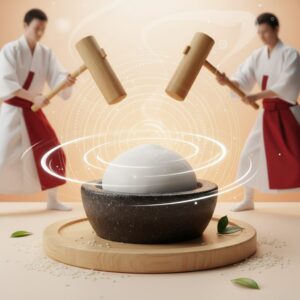
Imagine the crisp, cold air of late December in Japan. The feeling is festive but also purposeful, a collective hum of preparation for the New Year, the most important holiday on the calendar. In a neighborhood square, a community center courtyard, or a traditional family home’s garden, a distinct sound cuts through the winter quiet: a heavy, rhythmic thump-thump-thump. It’s followed by a soft, wet slap, and then the percussive beat resumes. Steam rises from a large wooden or stone mortar, carrying the sweet, clean scent of cooking rice. This is the sound of mochi-tsuki, the traditional act of pounding steamed glutinous rice into mochi rice cakes. On the surface, it’s a culinary task. But if you watch, you’ll quickly realize you’re witnessing something far more profound. This isn’t just about making food. Mochi-tsuki is a physical ritual, a demanding and collaborative performance that binds families and communities together, forging social bonds through shared sweat and synchronized effort. It’s a powerful, tangible expression of shared purpose, turning simple grains of rice into a symbolic food that carries the hopes for the year to come.
Embracing a similar spirit of community and cultural craftsmanship, the itadakimasu mealtime ritual further exemplifies how traditional practices continue to bind modern Japanese society.
The Mechanics of the Ritual: A Symphony of Steam, Wood, and Muscle
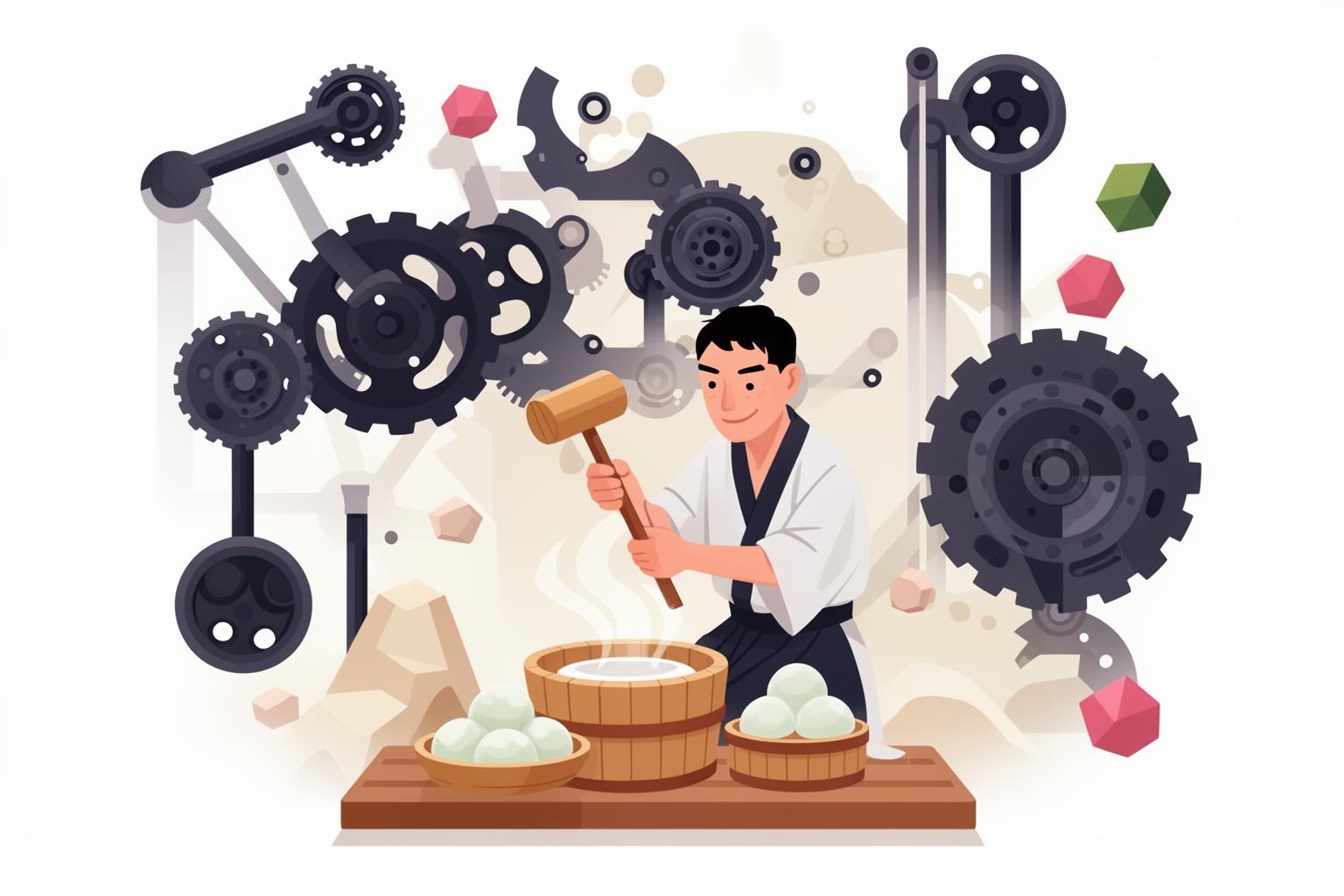
To grasp the social significance of mochi-tsuki, you first need to recognize the intense physicality involved. This is far from a delicate or quiet activity. It is loud, demanding, and requires a nearly dance-like coordination among participants. It is a primal, elemental act that bonds people to their food and to one another in a way that buying a plastic-wrapped block of mochi from a store never could. The entire event embodies the idea that the value of something lies not just in the final product but in the shared effort invested in making it.
The Ingredients and Tools of Tradition
At the heart of it all is the rice—but not just any rice. Mochi is made from a specific variety called mochigome (もち米), a glutinous short-grain rice with a higher amylopectin content than the everyday uruchimai (うるち米). This chemical distinction is crucial; when steamed and pounded, mochigome develops an incredibly sticky, elastic, and chewy texture that defines mochi. The process begins by washing the mochigome and soaking it overnight, allowing the grains to absorb water and soften. The next morning, the rice is steamed in wooden boxes called seiro (蒸籠) until cooked through but still firm.
Next come the main instruments of this culinary percussion. The centerpiece is the usu (臼), a large mortar traditionally carved from a single tree trunk or a solid block of stone. An usu is a cherished household item, often handed down through generations, its surface worn smooth by decades of pounding. It symbolizes stability and continuity. Accompanying the usu is the kine (杵), a long, heavy wooden mallet resembling something out of a cartoon. Lifting and swinging the kine demands considerable strength and stamina; this duty usually falls to the stronger members of the group, often men taking turns to avoid fatigue.
The Dance of the Pounders
Once the steaming rice is transferred into the usu, the true performance begins. First, one person uses the kine to knead and crush the rice, breaking down the grains into a unified mass. After this initial mashing, the steady pounding commences. Here, the essential partnership reveals itself. There are two primary roles: the tsuki-te (突き手), or pounder, and the kaeshi-te (返し手), the turner.
The tsuki-te raises the heavy kine high and brings it down forcefully into the center of the usu, letting out spirited shouts, or kakegoe (掛け声), with each strike. These calls—often simple, rhythmic exclamations like “Yoisho!” or “Sore!”—are more than just noise; they keep the rhythm and signal timing to the partner. In the brief moment after the mallet is lifted, the kaeshi-te plunges their hands into the hot, sticky mass. They fold the mochi and slap it with a little cold water (te-mizu) to prevent sticking, then pull their hands out just before the kine smashes down again.
This is a dance of immense trust and perfect timing. Any hesitation or misstep in the rhythm from either person could result in a serious injury to the kaeshi-te’s hand. The turner doesn’t look up; they sense the rhythm, instinctively knowing when the mallet rises and when it falls. The air rings with the percussive clash of wood on rice, the wet slap of the turner’s hands, and the coordinated shouts of the pounders. This shared rhythm is the heartbeat of the event, a pulse felt by all present. Children watch in amazement, elders offer encouragement, and everyone becomes part of the focused, collective energy of the moment.
From Grains of Rice to Vessels of the Divine
The effort and coordination involved are impressive, but what truly transforms mochi-tsuki from a simple food preparation technique into an essential cultural ritual is its profound spiritual significance. In Japan’s indigenous Shinto faith, rice is more than just a staple food; it is a sacred gift, believed to possess its own life force and a connection to the divine. Thus, pounding the rice is more than a physical process; it serves as a purification, concentrating that spiritual energy into a powerful, edible form.
Mochi as a Sacred Food
Mochi made for the New Year is regarded as a sacred offering, worthy of the gods. Specifically, it is prepared to welcome the Toshigami (年神), the deity of the new year, who is believed to visit homes on New Year’s Day, bringing health, happiness, and good fortune for the coming months. The pure white, smooth mochi is viewed as a suitable temporary abode, or yorishiro, for this deity. By making and consuming this mochi, people are thought to partake in the Toshigami’s power, literally ingesting the strength and luck necessary to face the year ahead. This belief lends the entire mochi-tsuki process a deep sense of reverence. The participants are not merely preparing a snack; they are working together to create a vessel for good fortune and divine presence.
Kagami Mochi: The New Year’s Altar
The most iconic form of New Year’s mochi is the kagami mochi (鏡餅), or “mirror rice cake.” This decorative offering consists of two round, flattened mochi cakes stacked one atop the other—the smaller placed on the larger—and topped with a daidai (橙), a type of Japanese bitter orange. The name is thought to come from its resemblance to ancient bronze mirrors, which were themselves sacred objects in Japan, believed to carry divine power. The two discs are rich in symbolism, said to represent the passing year and the incoming year, the sun and the moon, or the principles of yin and yang.
The kagami mochi is placed in a prominent location in the home, often on the family’s Shinto altar (kamidana) or in the tokonoma alcove, as an offering to the Toshigami. It remains there for the first week or so of the New Year. Then, on a day usually in early to mid-January known as Kagami Biraki (鏡開き), or “mirror opening,” the now-hardened mochi is broken apart—never cut with a knife, as that would symbolize severing ties—and eaten, typically in a soup or grilled. This act marks the conclusion of the New Year’s celebration and the absorption of the divine power contained within the mochi.
A Taste of Togetherness: The Communal Feast

After all the pounding is finished and the kagami mochi has been carefully shaped, the true reward begins: eating the freshly made mochi. This is the moment when the community can literally savor the results of their joint effort. The mochi is at its peak at this stage—extraordinarily soft, warm, and stretchy, with a subtle, sweet rice flavor. It is divided while still pliable and enjoyed in various simple, delicious ways, fostering a festive atmosphere of shared enjoyment.
More Than One Way to Eat Mochi
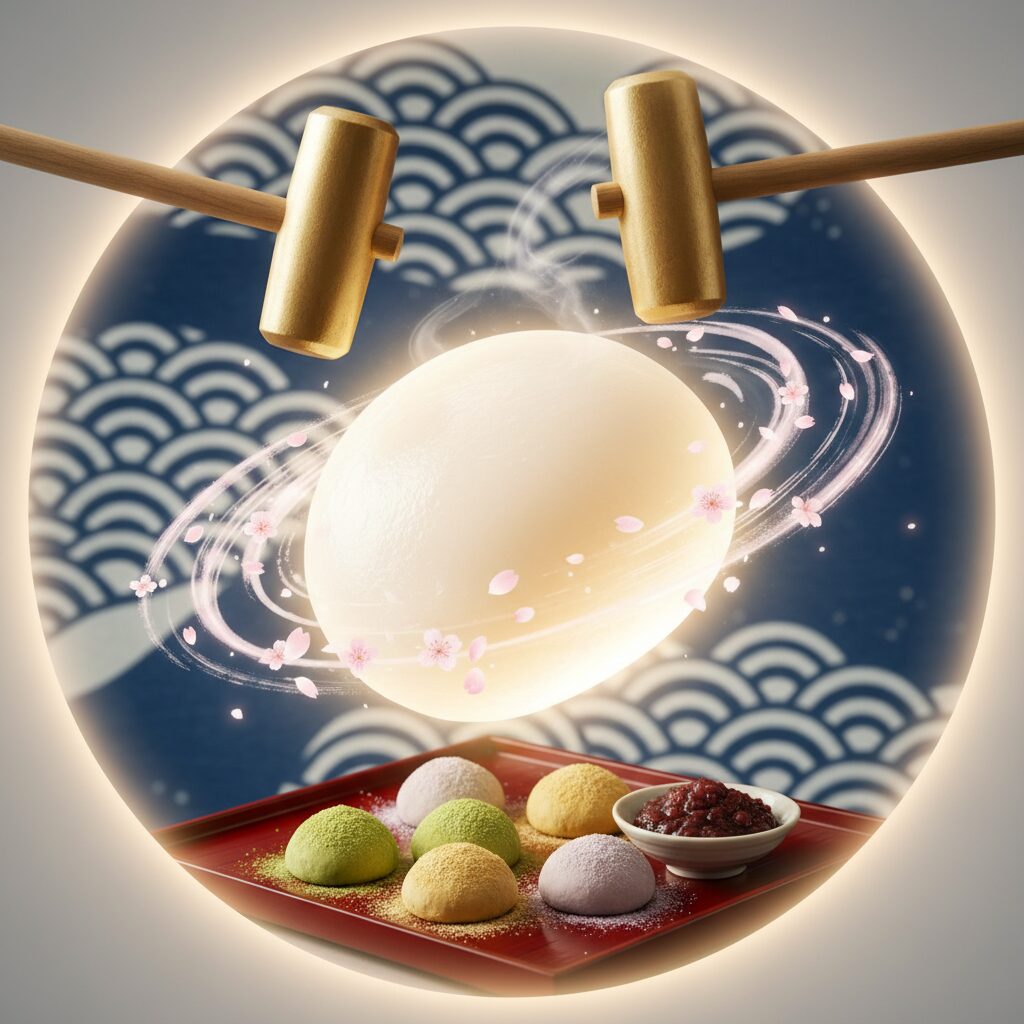
Everyone gathers to shape small balls or squares of the fresh mochi and adorn them with their favorite toppings. The traditional preparations exemplify rustic simplicity.
One of the most beloved is anko (あんこ), a sweet paste made from boiled azuki red beans. The earthy sweetness of the anko complements the plain, chewy mochi perfectly. Another popular choice, especially among children, is kinako (きな粉), a flour made from finely ground roasted soybeans. The nutty, aromatic kinako is usually mixed with sugar and generously sprinkled over the mochi, creating a delightful textural contrast.
A straightforward yet meaningful combination is satō-jōyu (砂糖醤油), a sweet and savory glaze made from soy sauce and sugar, sometimes accompanied by a sheet of nori (seaweed) wrapped around the mochi. For those who prefer a savory edge, grated daikon radish mixed with soy sauce, known as karami mochi (からみ餅), provides a sharp, refreshing contrast to the mochi’s richness.
However, the quintessential New Year’s dish is ozōni (お雑煮), a hearty soup featuring mochi as its centerpiece. The style of ozōni varies widely across Japan, beautifully reflecting regional culinary traditions. In the Kanto region near Tokyo, it is typically a clear dashi broth with chicken and vegetables. In the Kansai region around Kyoto and Osaka, a common variant is a cloudy, rich soup made with white miso. Each family has its own recipe, passed down through generations, and sharing a bowl of ozōni is a core part of the Japanese New Year celebration.
The Social Glue
This communal meal is where the social role of mochi-tsuki truly comes into focus. Everyone present has a part to play. The strong young men and women take turns using the kine, demonstrating their strength. Experienced mothers and grandmothers skillfully oversee the process, their hands moving quickly as they turn the rice and shape the cakes. Children, too young to pound, assist with smaller tasks, such as rolling finished mochi in kinako or anko, their faces dusted with flour. Elders watch over, offering advice and sharing mochi-tsuki stories from their youth. It is a living tradition, a vibrant transfer of cultural heritage across generations.
The shared physical effort fosters a deep sense of camaraderie. The feast that follows is more than just a meal; it is a celebration of collective labor. The mochi tastes better knowing the sweat and teamwork that went into making it. This reinforces the notion that the community is a unified whole, capable of working together to provide sustenance and good fortune for everyone. It is a ritual that strengthens bonds in a way that simply sitting down to eat never could.
Mochi-tsuki in the Modern Age: A Tradition Under Pressure
Despite its cultural significance, the tradition of mochi-tsuki has encountered difficulties in modern Japan. Like many physically demanding customs, it has declined in an era defined by convenience and demographic shifts. The practical challenges of contemporary life have turned the annual ritual into a logistical obstacle for many.
The Decline of a Communal Ritual
Urbanization has been a major factor. Modern Japanese residences, particularly apartments in densely populated cities, simply lack the space for a large usu and kine. Families tend to be smaller and more geographically scattered, making it hard to assemble enough people to carry out the labor-intensive process. Additionally, the prevalence of supermarkets has made perfectly formed, shelf-stable mochi available year-round for just a few hundred yen. The convenience is undeniable.
Safety is another concern. Mochi’s extremely sticky and dense texture makes it a known choking hazard, especially for the elderly. Every new year holiday sees tragic news reports of mochi-related fatalities. This has caused some communities to hesitate in organizing large-scale events.
The Modern Revival
Nevertheless, claims of mochi-tsuki’s disappearance are greatly overstated. While it may be less frequent in private homes, the practice is being preserved and even revitalized as a community-focused event. Instead of a private family tradition, mochi-tsuki is often hosted by neighborhood groups, local temples and shrines, schools, or companies. These gatherings attract large crowds, bringing together people who might not otherwise connect.
For many contemporary Japanese, especially urban residents, these public mochi-tsuki events provide a valuable chance to engage with their culture and neighbors. It offers children firsthand experience of their heritage beyond just reading about it. It enables communities to unite and reaffirm their local identity. Although these events often feature food stalls and games, at their heart lies the rhythmic pounding of mochi—a sound that calls the community together.
At home, technology has offered a middle ground. Many families now have electric mochi-making machines that automate steaming and pounding. While these devices lack the romance and communal spirit of the traditional method, they let families enjoy fresh mochi without the strenuous labor, sustaining the culinary tradition even as the social ritual evolves.
Ultimately, mochi-tsuki endures because it fulfills a basic human need for connection. It is more than a way to make rice cakes; it is a social technology perfected over generations. It symbolizes community itself: diverse individuals, each with different roles and strengths, coming together in coordinated rhythm to create something nourishing and sacred to share. In a world that increasingly feels fragmented and convenient, the raw, sweaty, synchronized effort of mochi-tsuki remains a powerful and meaningful reminder of what it truly means to build something together. It is the sound of a community’s heart beating as one.