Imagine sitting down to a meal in a quiet restaurant deep in the Japanese countryside. Spring has just begun to assert itself, and the last patches of snow are retreating from the shaded slopes of the mountains. A small, elegant dish is placed before you: a few lightly battered and fried green morsels. You take a bite. Instead of the expected mild vegetal sweetness, your palate is hit with a wave of complex, assertive bitterness. It’s aromatic, a little earthy, and completely unfamiliar. In many food cultures, this pronounced bitterness might be considered a flaw, an element to be masked or bred out of existence. But here, your Japanese host smiles. “The taste of spring,” they say.
This is the world of sansai, or wild mountain vegetables. Foraged from the hills and forests during the brief window between the snowmelt and the full blush of summer, these plants are not just ingredients; they are an edible announcement. They are the definitive flavor of Japan’s seasonal transition, a culinary ritual that connects people to the land and the cyclical nature of time. But to truly understand their place in the Japanese heart, you have to get past a simple question of taste and ask something deeper: Why is this bitterness—this challenging, untamed flavor—not just accepted, but revered? The answer reveals a philosophy that sees food as medicine, ritual, and a direct line to the wild, resilient heart of nature itself.
In this culinary journey where each ingredient echoes nature’s fleeting masterpiece, exploring the spirit of shun further unveils Japan’s cherished connection to seasonal perfection.
The Mountain’s Bounty: More Than Just Vegetables

First, let’s clarify what sansai are not. They are not the perfectly uniform, hydroponically grown greens wrapped in plastic that you find in a city supermarket. The term means “mountain bounty” or “mountain vegetables,” with the key word being “mountain.” These are wild plants, gathered by hand in a practice called sansai-tori. This act of foraging is as integral to the tradition as eating them. It demands deep local knowledge—the skill to identify edible plants, know the exact time to harvest, and navigate the terrain.
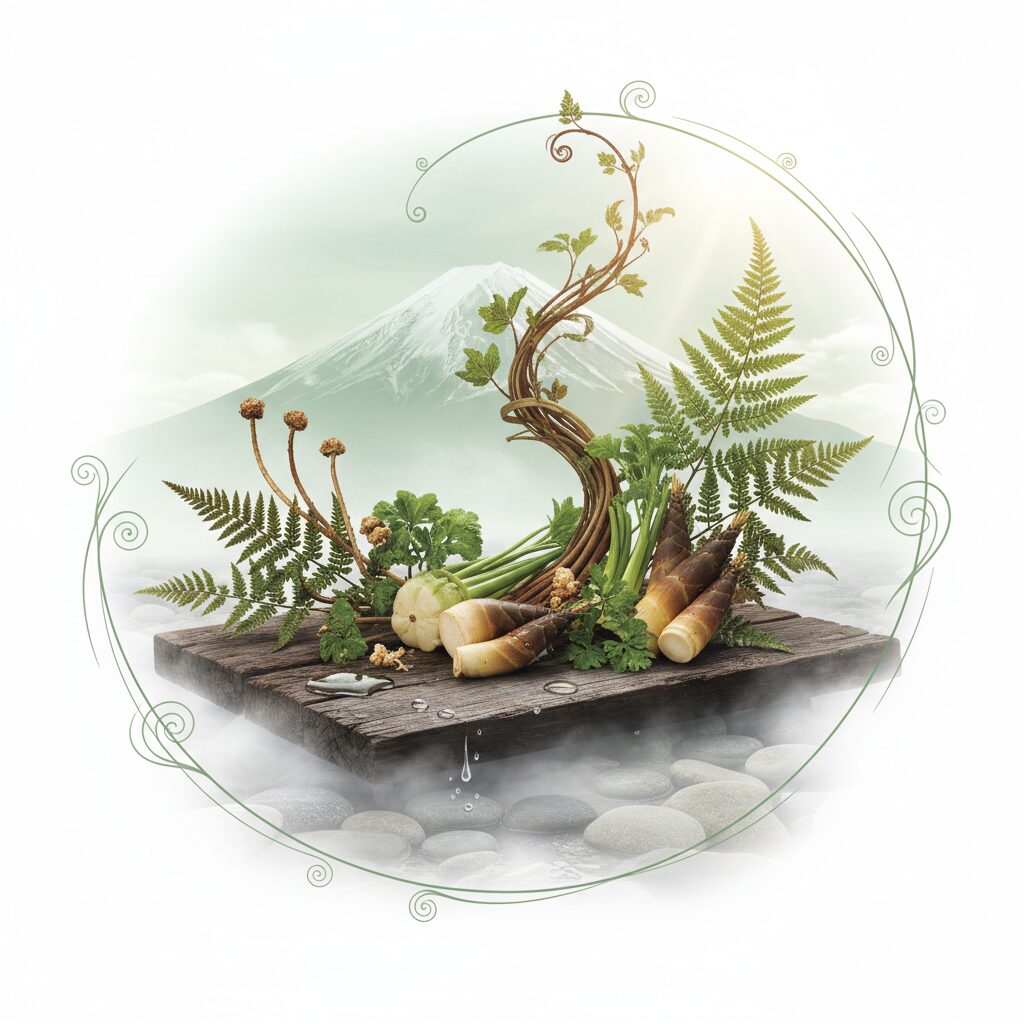
Although hundreds of varieties grow throughout Japan, a few favorites grace menus each spring. The very first to appear, often pushing straight through the snow, is fukinoto, the flower bud of the butterbur plant. It’s a tightly curled, vibrant green ball bursting with aromatic bitterness. Eating fukinoto is like a shock to the system, a sharp awakening after the quiet of winter. Soon after comes kogomi, the tightly coiled heads of the ostrich fern. These fiddleheads offer a milder flavor and a pleasantly crisp texture, making them a popular introduction to sansai. Then there’s tara no me, known as the “king of sansai.” These are the young shoots of the Japanese angelica tree, harvested from thorny branches. They have a rich, almost buttery taste balanced by distinct bitterness and are absolutely sublime when prepared as tempura. Others like warabi (bracken), zenmai (royal fern), and udo (mountain asparagus) each contribute their own unique notes of astringency, earthiness, and crisp freshness to the seasonal spread.
Their value lies in their fleeting nature. The harvesting window for any single type of sansai often lasts only a week or two. This rarity, this brief availability, elevates them from simple food to a cherished, once-a-year experience. They cannot be bought on demand. You must wait for the mountain to reveal them.
The Philosophy of Bitterness: Aku as Medicine and Metaphor
The key to understanding the Japanese appreciation for sansai lies in a single concept: aku (灰汁). Technically, aku refers to the harsh, bitter, or astringent compounds present in many wild plants and some cultivated ones. It’s the scum that forms on the surface of a simmering soup, the astringency of an unripe persimmon, or the bitterness in a raw bamboo shoot. In most Japanese cooking, the goal is aku-nuki, the process of removing this harshness to reveal a cleaner, more refined flavor.
However, with sansai, the approach differs. The aku is not completely removed; instead, it is carefully controlled and reduced to a palatable level while intentionally preserving a subtle trace of that original wild bitterness. This is the essence of the practice. That bitterness is not a defect; it is the plant’s life force.
Traditional wisdom, based in folk medicine, viewed this bitterness as a natural purifier. After a long winter of preserved, heavy, and often salty foods, the body was thought to become sluggish. The potent aku of the first spring greens was regarded as a tonic—a way to stimulate the digestive system, cleanse the blood, and gently rouse the body from its dormancy. It served as a physiological reset, a spring cleaning for the inside. These plants contain polyphenols and other compounds that, in moderation, are believed to have beneficial effects. Eating sansai was, and continues to be, a way to consume the mountain’s potent medicine.
Beyond the physical, the bitterness carries a powerful metaphor. It is the taste of struggle. It symbolizes the immense energy a plant expends to break through cold, hard soil and lingering snow. It embodies resilience, of life reasserting itself against the odds. Eating sansai means partaking in that wild, untamed energy. In a world of cultivated vegetables bred for sweetness and uniformity, the challenging flavor of sansai serves as a reminder of something more primal and authentic. It’s the taste of the earth itself awakening from a long sleep.
Taming the Wild: The Ritual of Preparation

Because sansai are wild, they must be handled with care and respect. The aku-nuki process is a culinary ritual that connects the raw mountain with the refined table. It represents a conversation between the cook and the ingredient. The aim is not to erase the plant’s essence, but to harmonize it, making its wildness accessible without diminishing its spirit.
Techniques change depending on the plant. Many are briefly blanched in boiling water, then plunged into ice water to preserve their color and mellow their bitterness. Some, like warabi, are traditionally soaked overnight in water mixed with wood ash, a natural alkaline solution that breaks down the toughest compounds. This ancient method reflects a time when people relied solely on what nature provided.
After taming the aku, sansai are prepared to highlight their distinct character. Tempura is the most common and beloved preparation. The intense heat of the oil creates a crisp exterior with a soft interior. The heat also softens the bitterness, making it rounder and more fragrant. A simple dusting of high-quality sea salt perfectly complements the vegetable’s natural flavor.
Other preparations offer a more straightforward taste. In an ohitashi, the blanched greens are soaked in a delicate, chilled broth of dashi, soy sauce, and mirin, allowing their pure, clean flavor to shine. For a richer dish, there’s goma-ae, where the vegetables are tossed in a nutty, slightly sweet dressing made of ground sesame seeds, sugar, and soy sauce. The dressing’s sweetness and umami balance the bitterness of the greens, creating a lively and satisfying harmony. You’ll also find sansai scattered over soba or udon noodles, or cooked with rice in the seasonal takikomi gohan, where their earthy aroma permeates every grain.
A Marker of Time: Eating the Season
In Japan, the concept of shun (旬) is central to the culture of eating. Shun signifies the peak season of an ingredient, the precise moment when it is at its most flavorful, nutritious, and abundant. It embodies a philosophy that encourages aligning one’s diet with the rhythms of nature. For example, while it’s possible to eat a strawberry in winter, it lacks the essence of a true shun strawberry enjoyed in early summer.
Sansai represent perhaps the ultimate expression of shun. Their season is remarkably brief and absolutely fixed. It begins with the melting snow and vanishes as summer’s heat arrives. Eating fukinoto tempura in April is to engage in a timely, deeply meaningful ritual. It serves as a sensory confirmation that winter has truly ended and that the world is bursting with new life. This connects you to the calendar in a way far more profound than simply noting a date—you are literally tasting the season.
This contrasts sharply with the modern global food supply chain, which creates the illusion of year-round availability. The discipline of waiting an entire year for the return of tara no me makes the experience of finally eating it infinitely more special. It cultivates a sense of anticipation and gratitude. It powerfully reminds us that we are part of a natural cycle and that some of the best things in life are fleeting and cannot be summoned at will.
The Taste of a Place
This connection is not only to time but also to place. The culture of foraging and eating sansai is strongest in Japan’s mountainous regions, such as Tohoku in the north and the central prefectures of Nagano and Gifu. The specific varieties available, their local names, and traditional preparations are all deeply linked to the local landscape, or terroir. Foraging for sansai is an intimate act of connection with a particular forest or mountainside. The knowledge of where to find the best kogomi or which slope the fukinoto first appear on is passed down through generations. When you eat sansai at a rural inn, you are tasting not just spring but the spring of that specific mountain.
So the next time you encounter that sharply bitter flavor in a Japanese dish, pause for a moment. Don’t dismiss it as an acquired taste or a culinary flaw. Recognize it for what it truly is: a message from the wild. It is the taste of resilience, the medicine of the mountains, and a ritual that marks the turning of the earth. It tells a complex story of a culture’s profound respect for nature, conveyed in a single, unforgettable bite. It is the taste of the thaw.