
If you’ve spent any real time in Japan, you’ve seen it. You’ve probably even had to do a quick sidestep to avoid it. A mother with two kids strapped into her bicycle, one front and one back, gliding past you on a narrow sidewalk. An elderly woman, back ramrod straight, pedaling her sturdy mamachari home from the grocery store, its front basket laden with daikon radish and milk cartons. A high school student in a crisp uniform, headphones in, weaving expertly through the afternoon pedestrian traffic. They all share one thing in common: they are riding their bicycles on the sidewalk. And for the first-time visitor, it’s confusing. For the repeat visitor, it becomes a nagging question. In a country legendary for its adherence to rules, its immaculate queues, and its profound sense of public order, why does this one, seemingly major, traffic violation get a universal pass?
You might have assumed it’s simply illegal but ignored, another one of those quirky exceptions that make Japan so endlessly fascinating. The truth is far more complex, a blurry intersection of law, infrastructure, and a deeply ingrained cultural mindset. This isn’t just about breaking a rule. It’s about a different kind of rule, one written not in legal code but in the shared, unspoken agreements of daily life. Understanding the sidewalk cyclist means understanding a specific, lingering piece of Showa-era pragmatism that continues to define the rhythm of Japanese neighborhoods, long after the era itself has passed. It’s a story about how people adapt a built environment to their needs, and how a society creates its own logic when the official one doesn’t quite fit.
This blend of unspoken social rules and everyday ingenuity extends beyond traffic habits, as seen in the rise of oshi-katsu culture that underscores Japan’s unique approach to balancing tradition with change.
The Law on Paper vs. The Law on the Pavement
Let’s address the technical details first. According to Japan’s Road Traffic Act, a bicycle—or jitensha—is classified as a ‘light vehicle’ (keisharyō), placing it in the same category as carts and other human-powered transportation. As a vehicle, it should be ridden on the road, specifically on the far left side, moving with traffic just like a car. Riding on the sidewalk is generally considered a violation.
However, this is Japan, where exceptions often outweigh the rules. The same law allows several important exceptions. Cyclists are allowed on sidewalks if they are:
- Children under 13 years old.
- Seniors aged 70 or above.
- Individuals with certain physical disabilities.
So far, so straightforward. This explains many of the sidewalk cyclists you see, but it doesn’t cover the many students, shoppers, and commuters in between. This is where the law becomes delightfully interpretive and distinctively Japanese. A cyclist is also permitted on the sidewalk in two additional cases: when a specific traffic sign indicates the sidewalk is shared by pedestrians and bicycles, or—and this is the loophole an entire country exploits—when it is considered “unavoidable due to road or traffic conditions.”
What qualifies as “unavoidable”? The law doesn’t specify. It provides no exact criteria. Is a narrow road with fast-moving cars unavoidable? Is a street cluttered with parked vehicles forcing you into the center of the lane unavoidable? Is the general, unsettling feeling of being a vulnerable human on a two-wheeled machine alongside a one-ton metal box unavoidable? For most Japanese people, the answer to all these questions is an emphatic yes. This deliberate vagueness turns a strict rule into a gentle suggestion, shifting the responsibility from the state to the individual and relying on personal judgment and social pressure to maintain order. The police aren’t ignoring it; the law itself is looking the other way with a squint.
A Landscape Not Built for Two Wheels
To understand why a cyclist might opt for the crowded, obstacle-filled sidewalk instead of the road, you only need to examine the roads themselves. Japan’s urban landscape is a densely woven tapestry shaped by centuries of development. Many streets, particularly in residential areas, are extremely narrow. They were not designed to accommodate the wide sedans and delivery trucks that now traverse them. For a car, navigating these streets is a tight squeeze. For a cyclist sharing that narrow strip of asphalt, it can feel downright dangerous.
Dedicated, protected bike lanes are rare in most Japanese cities. While they are becoming more common in the centers of major metropolises like Tokyo, they disappear entirely once you move into the residential labyrinths where most residents live. What remains is often just a simple painted line along the edge of the road, if you’re lucky. More frequently, this narrow designated space is obstructed by parked cars, delivery vans, and utility poles positioned right at the street’s edge.
Although Japanese drivers are generally polite, they are not used to sharing the road with cyclists in the same way drivers in Amsterdam or Copenhagen might be. The road is seen primarily as car territory. Cyclists clinging to the edge are often regarded as unpredictable obstacles. Drivers worry about hitting them; cyclists worry about being hit. Despite its own hazards—pedestrians, shop signs, uneven paving—the sidewalk feels like a safer refuge. It represents a slower, more human-scaled environment. Riding on the sidewalk is less an act of rebellion and more a practical risk assessment.
This infrastructure issue is a direct consequence of Japan’s post-war development. During the economic boom of the 1950s and 60s, the priority was motorization. The car symbolized progress and prosperity. Urban planning centered on accommodating more cars within the ancient street grids. The humble bicycle, the mode of transport for the common person, was left to fend for itself. It naturally took to the wide sidewalks constructed in front of new apartment buildings and shopping arcades—a space it has occupied ever since.
The Soul of the Machine: The Mighty Mamachari
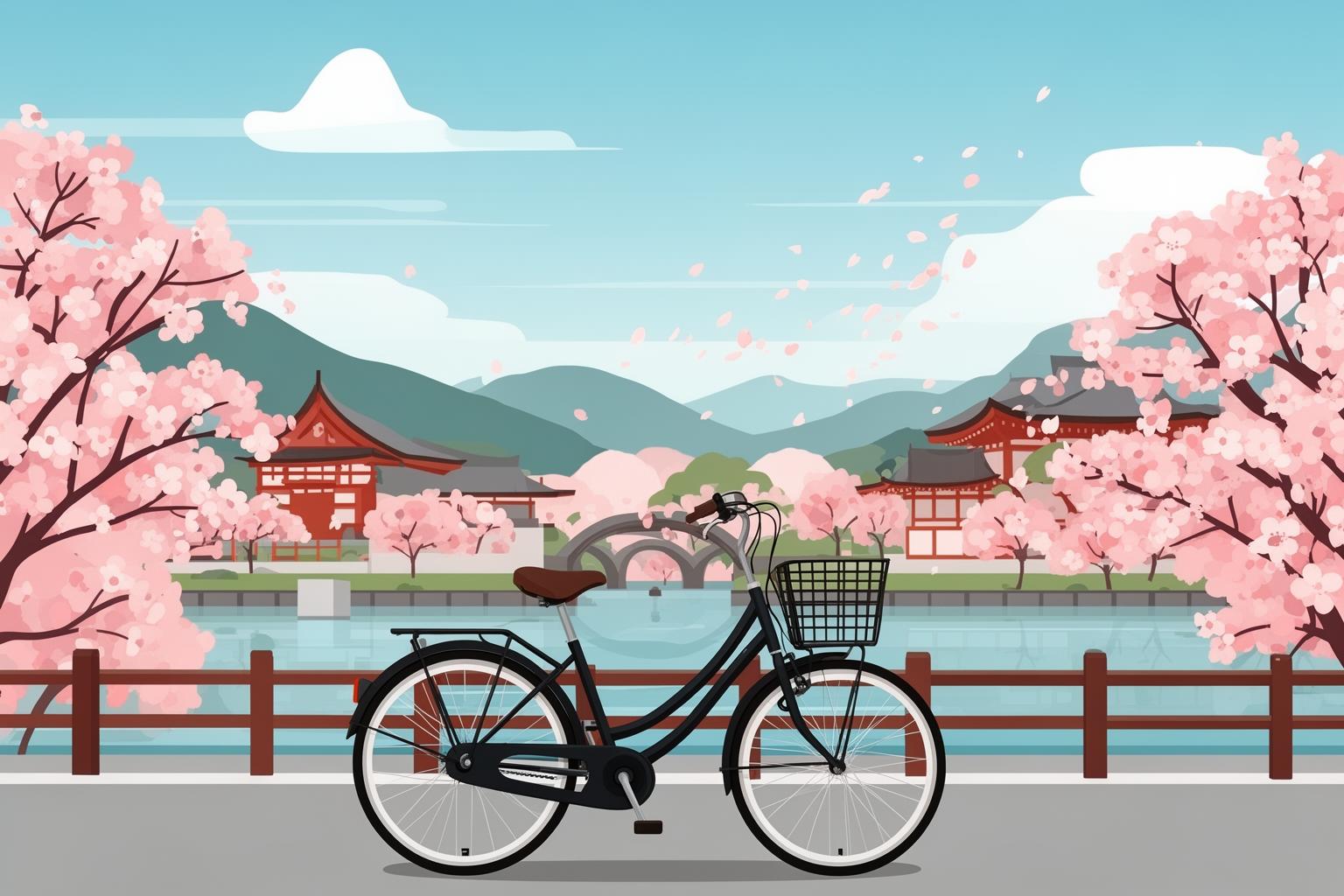
You cannot truly understand the sidewalk cycling phenomenon without acknowledging its primary vehicle: the mamachari (ママチャリ), or “mom’s chariot.” This is neither a sleek, lightweight racing bike nor an aggressive mountain bike. The mamachari reigns as the undisputed queen of Japanese streets, a practical workhorse built for utility rather than speed.
Every aspect of the mamachari is crafted for a life of slow, steady, local errands. It features a low, step-through frame, making it easy to mount and dismount, even when wearing a skirt. The handlebars are high and swept back, encouraging an upright, un-aerodynamic posture ideal for watching out for pedestrians. It typically comes with a sturdy front basket, a built-in wheel lock, a kickstand, a chain guard to protect your trousers, and often a dynamo-powered headlight. It is heavy, slow, and nearly indestructible.
The mamachari is an appliance—a shopping cart, a school bus, and a means to get to the train station all rolled into one. Its design language shouts ‘neighborhood.’ It feels completely out of place in a traffic lane. Its natural speed matches a fast walking pace, not that of a car. Riding a mamachari on a busy road is like taking a golf cart onto the highway. The design of the country’s most popular bicycle reinforces the idea that its proper place is among people, not cars. The machine itself is a vote for the sidewalk.
The Unspoken Rules: A Showa-Era Social Contract
This brings us to the cultural core of the issue. The widespread acceptance of sidewalk cycling is a living remnant of the Showa era (1926-1989), a period when community norms and situational ethics often held greater influence than strict, top-down regulations. The neighborhood spirit was one of mutual accommodation—you made allowances for your neighbors because you expected to see them again the next day.
This mindset established an unwritten code of conduct for sidewalk cyclists. It’s not a free-for-all, but rather a delicate dance governed by a shared understanding of hierarchy and respect. The rules are straightforward and universally recognized:
- Pedestrians reign supreme. Cyclists are guests in their space and must yield at all times. This means slowing to a crawl when passing, giving ample distance, and never, under any circumstance, causing a pedestrian to jump aside.
- Use your bell sparingly. A sharp bell ring isn’t a command to “move aside,” but a polite, apologetic “excuse me, just letting you know I’m behind you.” Often, a soft throat clearing or the gentle whirring of pedals suffices.
- Be predictable. Weave slowly and smoothly, avoiding sudden movements. The aim is to blend into the pedestrian flow, not disrupt it.
This system functions because it hinges on the uniquely Japanese concept of omoiyari, an intuitive empathy and consideration for others. You anticipate the needs and movements of those around you and adjust your behavior accordingly. A cyclist sees an elderly person ahead and instinctively slows down. Spotting a mother with a toddler, they give extra space, aware that the child might move unpredictably. It’s a constant, subtle social negotiation.
To an outsider, it might appear chaotic. Yet for those involved, it’s a clear, highly effective dance of micro-adjustments and mutual respect. A police officer is unlikely to ticket the grandmother on her mamachari because she isn’t a threat; she’s abiding by this unspoken social contract. She embodies the spirit of the law, even if she technically breaks its letter. Meanwhile, the aggressive, high-speed food delivery cyclist in a bright uniform is increasingly viewed as problematic precisely because they violate this contract—moving at vehicle speeds within pedestrian space, triggering growing social backlash.
The Future of the Sidewalk
Is this system permanent? Probably not. Times are gradually changing. The rise of the gig economy has introduced a new class of professionals, often more reckless, cycling on the sidewalks. Cities are becoming more aware of the need for proper cycling infrastructure, and new bike lanes are slowly being added to the asphalt. Public discussion about bicycle safety and liability is increasing, accompanied by stricter penalties for accidents.
Yet, the fundamental conditions that gave rise to the sidewalk cyclist remain. The roads are still narrow. The mamachari continues to be the dominant vehicle for everyday life. And the Showa-era mindset of pragmatic accommodation remains deeply ingrained in the nation’s psyche.
So, the next time you’re in Japan and find yourself sharing the sidewalk with a bicycle, don’t view it as an act of lawlessness. Instead, see it for what it truly is: a glimpse into the country’s underlying system. It’s a solution born of necessity, one that trusts individual judgment over rigid rules, and a quiet testament to the idea that sometimes, the most practical path forward is the one everyone has tacitly accepted, even if it’s not marked on the map.