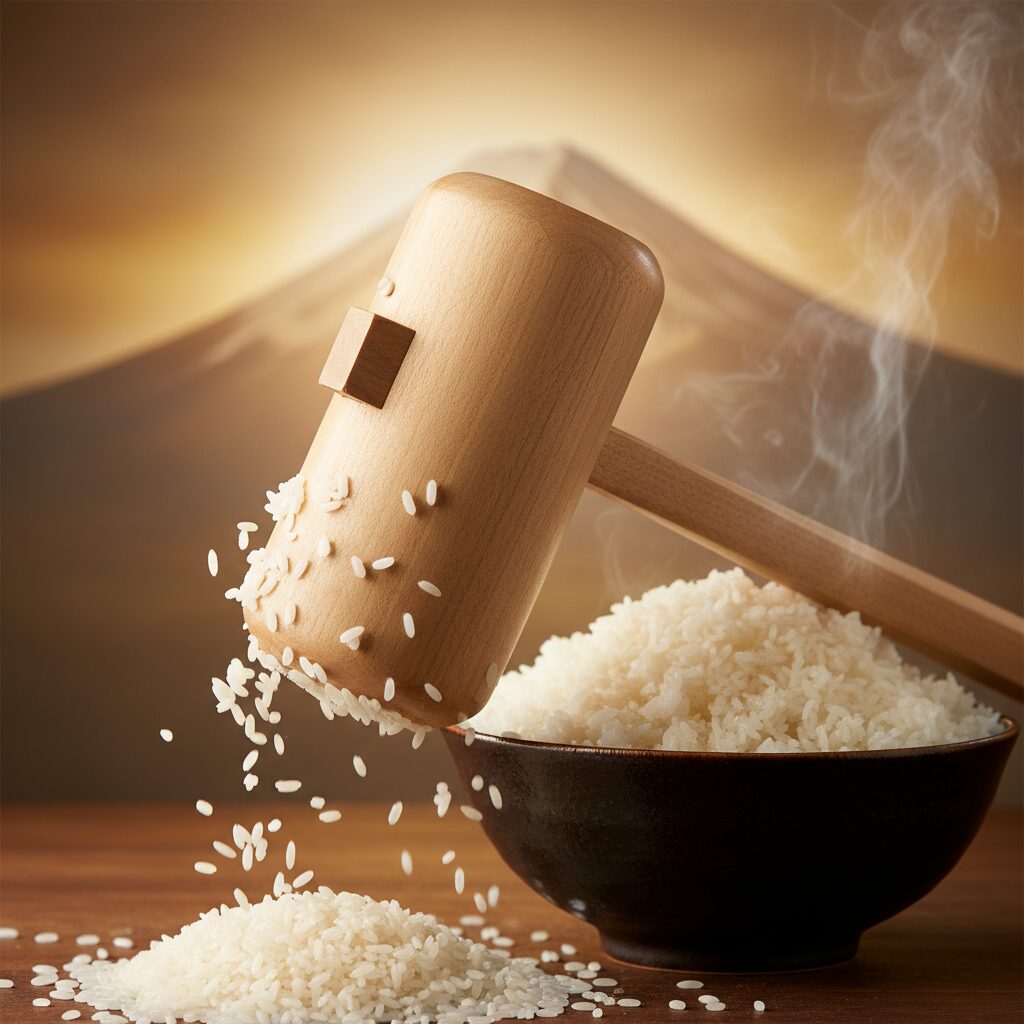
Imagine the scene. It’s a crisp, cold day in late December, the kind where your breath plumes in the air. A palpable sense of festive anticipation hangs over the neighborhood, a quiet hum before the grand crescendo of New Year’s Day. In the courtyard of a small local shrine, or perhaps a community center parking lot, a crowd has gathered. Children, bundled in thick coats, chase each other with squeals of delight. Grandmothers, their faces etched with the wisdom of decades, stand chatting, offering quiet directions. In the center of it all is the source of the commotion: a plume of steam rising from a wooden box, carrying the sweet, earthy scent of cooked rice. Next to it sit the instruments of the day’s ritual: a massive, hollowed-out log or stone that serves as a mortar—the usu—and a comically oversized wooden mallet that looks like something out of a cartoon—the kine.
Suddenly, the rhythm begins. A man, sleeves rolled up despite the chill, lifts the heavy kine high above his head. With a sharp, guttural cry of “Yoisho!”, he brings it down with a thunderous thump into the steaming mass of rice in the mortar. Almost before the mallet rebounds, another person—often a woman, quick and precise—darts in, wets her hands in a nearby bowl of water, and expertly folds the sticky, hot rice over on itself. Then, just as quickly, she pulls her hands away. Thump. The mallet comes down again. “Yoisho!” Fold. Thump. Fold. A primal, powerful beat is established, a cadence of effort and trust that draws everyone in. This is mochitsuki, the traditional Japanese ceremony of pounding glutinous rice to make mochi, the chewy, stretchy rice cakes that are the quintessential food of the New Year.
In a country renowned for its efficiency and technological prowess, a place where you can buy perfectly formed, vacuum-sealed mochi in any convenience store, this scene might seem like a bizarrely inefficient anachronism. It’s laborious, physically demanding, and even a little dangerous—a mistimed swing of the mallet could have painful consequences. So why does this tradition persist? Why do communities across Japan still go through the immense effort of hauling out the heavy usu and kine year after year to perform this strenuous task? The answer has very little to do with making rice cakes. It has everything to do with making a community. Mochitsuki isn’t just about producing food; it’s a deeply ingrained social ritual, a physical act of communion that reinforces the bonds of family, neighborhood, and generation. It’s a workout for the social muscle, and its true product isn’t the mochi itself, but the connection forged in the rhythm of the pounding.
As communities unite through the time-honored ritual of mochitsuki, Japan’s culinary landscape also dazzles with modern creativity in the form of innovative fake food concepts that challenge our perceptions of authenticity.
The Anatomy of a Ritual: Understanding the Tools and the Team
Before you can truly grasp the social significance of mochitsuki, it’s important to first understand its basic mechanics. This isn’t a delicate culinary task; it’s a full-body effort centered around simple, powerful tools that have remained largely unchanged for centuries. The entire event depends on the interaction between two essential pieces of equipment and the people who operate them.
The Usu and Kine: A Sacred Stage
The centerpiece is the usu, the mortar. It commands a strong presence. Traditionally, it’s carved from a solid section of a tree trunk, such as the sturdy keyaki (Japanese zelkova), or occasionally sculpted from stone. An usu is extremely heavy and stable. It’s not something casually taken out of a cupboard; its appearance marks a special occasion. The wood is often worn smooth from generations of use, its surface holding the subtle, sweet memory of countless batches of New Year’s mochi. Its deep bowl serves as the stage for the entire transformation.
The kine, or mallet, is its energetic counterpart. It’s a long, heavy wooden pestle, often weighing more than ten kilograms. Repeatedly lifting it demands significant strength and stamina. It’s not a tool for precision, but for powerful, rhythmic blows. The solid, percussive sound it creates striking the rice is the heartbeat of the event, resonating through neighborhoods and signaling that New Year preparations are fully underway.
The Dance of Two Roles: Tsuki-te and Kaeshi-te
Mochitsuki is essentially a two-person dance, a high-stakes partnership based on rhythm and absolute trust. The two main roles are the tsuki-te (the pounder) and the kaeshi-te (the turner).
The process starts with specially grown glutinous rice called mochigome. This rice is soaked overnight, then steamed in a wooden container called a seiro until it’s fully cooked and fragrant. The hot, steaming rice is then unceremoniously dumped into the usu. At first, one person might use the kine to knead and mash the rice, breaking down the grains into a cohesive, sticky paste. But soon, the real work begins.
The tsuki-te is the powerhouse. Usually a man, or a rotation of men, this person lifts and swings the heavy kine. Their job is to deliver consistent, forceful strikes to the center of the rice mass. It’s a test of endurance. Each swing is accompanied by a spirited shout, usually “Yoisho!”—a traditional Japanese kakegoe, a vocalization used to mark effort and coordinate timing, similar to “heave-ho!” in English.
While the tsuki-te provides the power, the kaeshi-te adds the finesse. This role, often held by an experienced woman, is arguably the more challenging and dangerous one. In the split second after the kine is raised, the kaeshi-te must reach into the usu with wet hands—to prevent sticking—and quickly flip, fold, and moisten the rice dough. This ensures the entire mass is evenly pounded, developing the characteristic smooth, elastic texture of perfect mochi. Their hands are mere inches from where the heavy mallet will land. A single fraction of a second’s hesitation or mistiming from either participant could cause serious injury. There is no room for uncertainty.
This is where the magic unfolds. The pounder and the turner fall into a synchronized rhythm, guided by chants and the steady, percussive beat. Thump. Flip. Thump. Flip. It’s a wordless conversation, a physical expression of mutual trust. The tsuki-te relies on the kaeshi-te to be fast and sure. The kaeshi-te relies on the tsuki-te to be steady and predictable. This intense, focused partnership lies at the heart of the community-building power of the ritual. Everyone watching is drawn into this rhythm, clapping and shouting their own encouragements, becoming part of the shared energy of the moment.
A Bite of Divinity: The Deep Symbolism of Mochi
To truly understand why people go to such lengths, it is helpful to recognize that mochi in Japan is far more than just food. It carries centuries of cultural and spiritual significance. Its importance is closely linked to the revered status of rice itself.
In Shinto, Japan’s native religion, rice is viewed as more than mere nourishment. It is a sacred offering from the gods, symbolizing purity, life force, and national identity. The entire cycle of planting, growing, and harvesting rice was historically embedded in religious rituals designed to secure a good harvest and show gratitude to the deities, or kami. Consequently, rice-based foods, especially for significant occasions, hold special meaning.
Mochitsuki is the process of transforming this already sacred grain into an even more powerful symbolic form. The act of pounding is regarded as purifying the rice and infusing it with spiritual energy. The mochi produced is considered a hare-no-ke food—reserved for special, celebratory, and sacred events, in contrast to everyday (ke) consumption. It is believed to contain the spirit of the rice and, by extension, a divine essence that can be passed on to those who consume it.
Longevity and Family Harmony
Mochi’s physical characteristics are central to its symbolism. Its most distinctive trait is its remarkable stretchiness and elasticity. This quality is interpreted as a metaphor for longevity and resilience. Eating mochi during the New Year expresses a prayer for a long, healthy life that can stretch and endure without breaking. The process itself, in which individual grains of rice are pounded until they lose their separateness and merge into a unified mass, symbolizes family and community cohesion. Just as the rice grains unite, so too should the family and community come together in harmony for the year ahead.
This symbolism is epitomized in the kagami mochi. This New Year decoration features two round mochi cakes—a smaller one atop a larger one—usually topped with a daidai, a type of Japanese bitter orange. The two discs are said to represent the passing and coming years, the human heart, or the sun and moon. The name kagami means “mirror,” alluding to the round bronze mirrors used in ancient Japan, which were themselves sacred objects, most notably one of the Emperor’s Three Sacred Treasures. The kagami mochi is placed on the family’s Shinto altar (kamidana) or another significant place in the home as an offering to the toshigami, the New Year deity believed to visit and grant blessings of good fortune and prosperity for the coming year.
Eating mochi, therefore, is not merely a culinary custom. It is a profoundly symbolic act of partaking in something sacred, a way to internalize prayers for health, unity, and divine blessing as the New Year begins.
The Social Glue: How Pounding Forges Community Bonds
The heart of the mochitsuki tradition lies in its role as a social catalyst. It is an inherently participatory event. Mochitsuki cannot be done alone, and its success relies on the coordinated efforts of many. In a modern society where interactions often feel brief and digital, mochitsuki offers a refreshingly tangible and collaborative experience.
A Role for Everyone
Unlike many rituals with designated priests or leaders, a community mochitsuki is wonderfully egalitarian. It creates a space where everyone, regardless of age or status, has a role to play. Young, strong men and fathers may take turns as the tsuki-te, demonstrating their stamina. Experienced mothers and grandmothers often serve as the essential kaeshi-te, their expertise ensuring the quality of the final product. But participation does not end there.
Once the rice has been pounded into a smooth, gleaming white dough, it is placed on a table dusted with flour (katakuriko or cornstarch) to prevent sticking. At this stage, another group of community members becomes involved. Women, and often enthusiastic children, gather around to pinch off pieces of the hot, pliable mochi and shape them into small, round cakes. Their hands move quickly, faces flushed from the steam and the joyful energy of the group. This tends to be the most talkative and laughter-filled part of the process. It is a less intense, more social phase, a time to catch up on neighborhood gossip and share stories. The children, with their hands and faces inevitably dusted with white flour, learn the tradition not through formal teaching but through joyful, sensory participation. They experience the unique warmth and texture of freshly made mochi, a memory that will linger far longer than any explanation.
Even those who do not pound or shape have a role. Some might tend the fire for the steamer, others prepare the various toppings and fillings for the fresh mochi, while others simply provide vital support as an encouraging audience, offering shouts and applause. The event creates a temporary, self-contained world where every contribution counts, reinforcing a sense of shared purpose and collective achievement.
Transmitting Culture Across Generations
Mochitsuki serves as an essential bridge between generations. In a world where families are often geographically scattered and traditional knowledge risks being lost, this event offers a physical setting for cultural transmission. A grandfather might show his grandson how to properly hold the kine, adjusting his grip and stance. A grandmother guides her granddaughter’s hands as she learns to shape the hot mochi without burning herself. These lessons are taught not through books, but through shared physical experience.
The rhythm of pounding becomes a shared memory, a tangible connection to the past. For older participants, the sounds and smells evoke New Year’s celebrations from their childhoods. For younger participants, it creates new memories that shape their understanding of the holiday. This act of creating something together—something to be shared as the first and most important food of the New Year—physically connects them to their heritage and to one another.
In many urban neighborhoods in Japan, where residents may live close by but rarely interact daily, a mochitsuki event organized by the local community association (chonaikai) can be one of the most significant social occasions of the year. It encourages people to leave their apartments, greet neighbors, and work together toward a common goal. It transforms a collection of households into a functioning community, even if only for a day. The shared effort and subsequent feast break down social barriers and help build a foundation of familiarity and goodwill.
The Immediate Reward: Tasting the Fruits of Labor
One of the most enchanting aspects of mochitsuki is the immediate and delightful satisfaction it provides. The very first batch of mochi made, called tsukitate, is regarded as the best. It’s exceptionally soft, warm, and aromatic, with a texture and taste that cannot be matched by mass-produced, packaged mochi. Eating it fresh on the spot is an essential part of the tradition.
A small food stall is almost always set up nearby, offering a variety of classic preparations for the fresh mochi. The selection showcases the simple, comforting flavors of Japanese home cooking:
- Anko Mochi: Perhaps the most traditional pairing, the warm mochi is filled with or topped by sweet red bean paste (anko). The earthy sweetness of the beans perfectly complements the mild, chewy rice cake.
- Kinako Mochi: The mochi is coated with kinako, a fine, nutty powder made from roasted soybeans, typically mixed with a little sugar and a pinch of salt. It’s a wonderfully fragrant and soothing choice.
- Karami Mochi: For a savory option, the mochi is served with freshly grated daikon radish, often seasoned with a splash of soy sauce. The sharp, pungent radish cuts through the richness of the mochi, creating a refreshing and piquant flavor.
- Isobe Maki: A simple yet deeply satisfying choice where the mochi is grilled or toasted, dipped in soy sauce, and then wrapped in a crisp sheet of nori (seaweed). The combination of salty, smoky, and chewy textures is irresistible.
Sharing this first meal together marks the culmination of everyone’s hard work. It completes the cycle: from the raw, sacred grain to the communal effort of transformation, to the shared act of consumption. This immediate feast strengthens the bonds forged during the pounding. The taste of that fresh mochi becomes forever linked with memories of laughter, rhythmic calls, and the collective spirit of the day.
Beyond this immediate feast, the mochi made during mochitsuki becomes a key part of New Year’s cuisine, most notably in ozoni, a traditional soup eaten on the morning of January 1st. Ozoni is highly regional, with variations in broth, ingredients, and even the shape of the mochi (round in western Japan, square in eastern Japan) differing widely across prefectures. For many families, the mochi made during their community mochitsuki will be the very mochi that goes into their family’s unique version of this symbolic first meal of the year, carrying the spirit of the community into the home.
Tradition in a Modern World: The Future of Mochitsuki
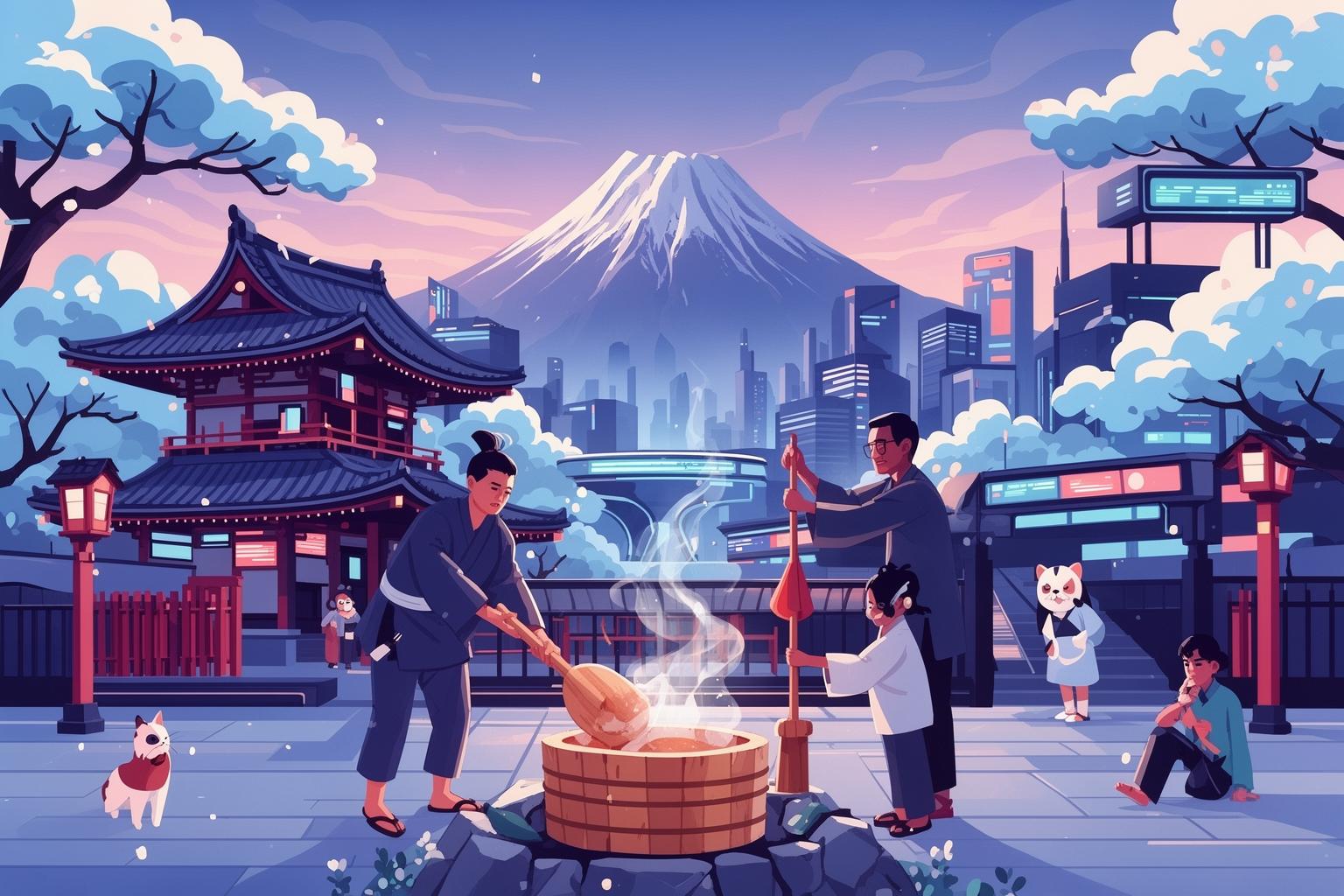
It would be misleading to depict mochitsuki as a widespread, flourishing tradition without recognizing the challenges it faces. Like many customs rooted in an agrarian past, it has experienced a gradual decline amid modernization. The reasons are practical and varied. Modern Japanese homes, particularly in urban areas, often lack the space for such a large-scale activity. The usu and kine are costly and cumbersome to store. Urban lifestyles are busy, and the convenience of high-quality, store-bought mochi is undeniable.
Moreover, the expertise needed to conduct a mochitsuki, especially the vital skill of the kaeshi-te, is mainly held by the older generation. As this generation grows older, there is a real risk that the tradition will vanish due to a shortage of experienced practitioners. For a time, it seemed that mochitsuki might become a relic, a quaint piece of folklore seen only in historical dramas or rural villages.
However, in recent years, a noticeable and encouraging revival has taken place. As Japanese society becomes more urbanized and digitally immersed, there is a growing counter-movement—a desire for authentic, hands-on experiences and genuine human connection. Mochitsuki meets this need perfectly. It is everything that a screen-based life is not: it is physical, sensory, communal, and deeply tied to place and season.
This revival is manifesting in many ways. Kindergartens and elementary schools increasingly hold mochitsuki events to introduce children to their culture in an engaging and interactive manner. Companies organize them as team-building exercises, acknowledging the tradition’s power to foster cooperation and camaraderie among colleagues. Community centers and non-profit organizations are acquiring equipment and hosting workshops to pass on the skills to a new generation. There is even a rise in “experience-based” tourism, where both Japanese urbanites and foreign visitors can pay to take part in a traditional mochitsuki in rural settings.
What this shows is that the value of mochitsuki has been rediscovered. People are realizing that its purpose was never really about efficiency. It continues because it is inefficient. Its worth lies in the effort. The physical exertion, the slight element of risk, the need for synchronization—these are not drawbacks; they are the essence. They compel people to be present, to communicate, and to depend on one another in a direct and uncomplicated way.
Ultimately, the rhythmic thud of the mallet striking rice is more than just the sound of food being prepared. It is the sound of a community reaffirming its existence. It is the beat that aligns the hearts and efforts of young and old, neighbors and families. It is a ritual that transforms a simple grain into a sacred symbol and, in doing so, turns a group of individuals into a unified whole, ready to enter the New Year with a renewed sense of connection and shared strength. The mochi itself may last only a few days, but the bonds it helps build are meant to endure throughout the year.