Someone asks you about Japan, and your mind likely conjures a highlight reel of hyper-efficiency. You see the Shinkansen, a white bullet slicing through the countryside at impossible speeds. You picture the Shibuya Scramble Crossing, a mesmerizing, orderly chaos of thousands of people moving at once. You think of automated everything, from ramen ticket machines to talking toilets. It’s a nation that seems to have perfected the art of moving forward, quickly and without friction. And you wouldn’t be wrong. But that’s only half the story. The more fascinating half, I’d argue, is Japan’s equally refined mastery of standing still.
To find it, you have to look for the faded awnings, the dark wood doors, and the swirling, calligraphic signs that read 喫茶店 — kissaten. These are not coffee shops in the modern sense. They are not co-working spaces with communal tables and charging ports. They are not grab-and-go depots for a paper cup of caffeine. A kissaten is a time capsule. It’s a dimly lit sanctuary dedicated to the deliberate, almost sacred, act of slowing down. Stepping into one is like stepping through a portal into the Showa Era, a post-war period of analog dreams and jazzy optimism that officially ended in 1989 but lives on in these quiet corners.
Here, the goal isn’t to get your coffee and leave. The coffee is merely the price of admission. What you’re really buying is time. You are renting a small pocket of stillness in a relentlessly moving world. You are paying for the permission to sit, to think, to read, or, most radically of all, to do absolutely nothing. This is the art we’ve forgotten, and the kissaten is its quiet cathedral. Forget the tourist traps and the sleek, minimalist cafes for a moment. Let’s talk about how to truly find a piece of Japan’s soul by learning how to do nothing at all.
As you linger in this deliberate pause, you might also discover the quiet roar of Japan’s resilient soul that echoes through its forgotten economic narratives.
The Anatomy of a Time Capsule: Deconstructing the Kissaten Space
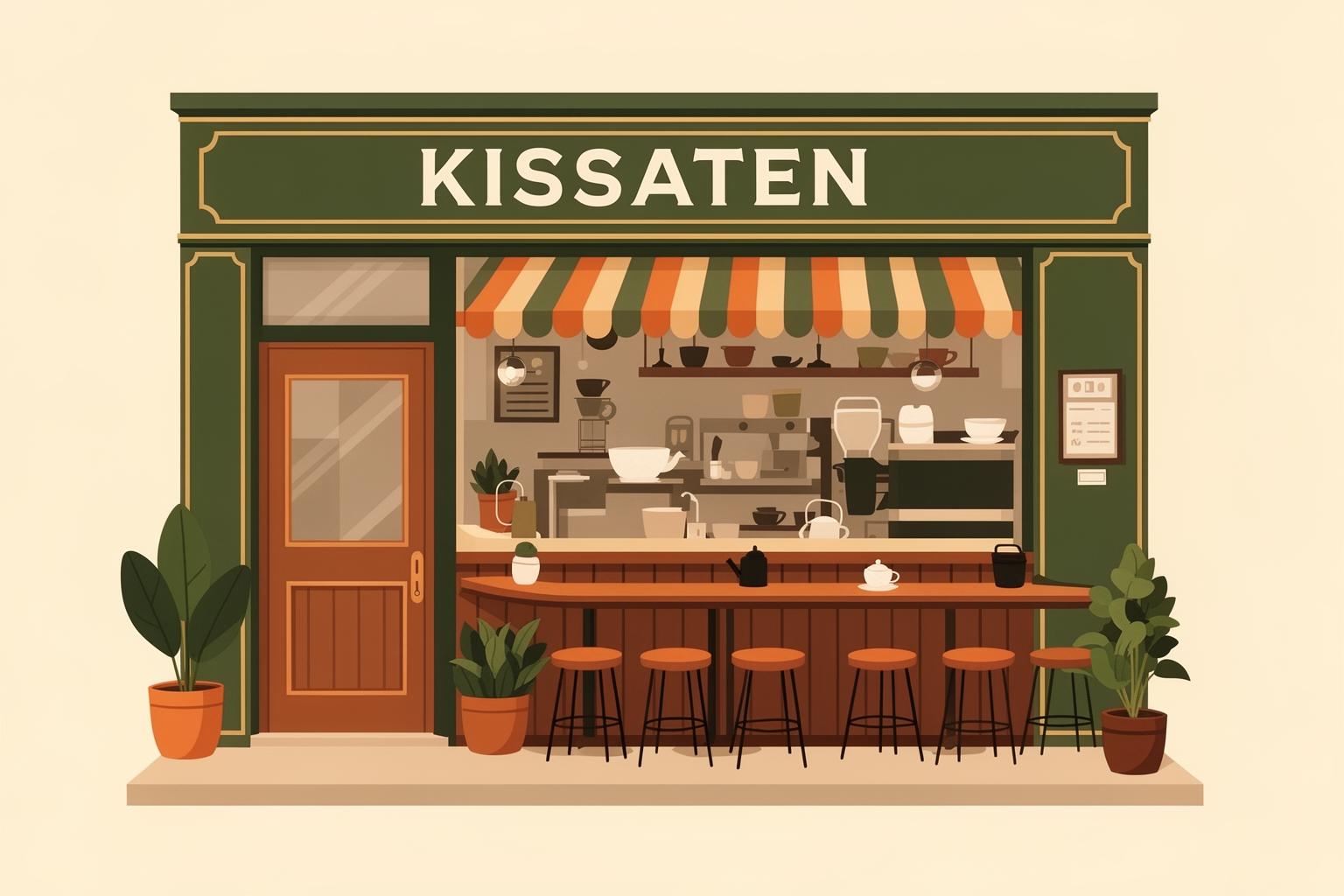
Before you even place your order, the kissaten has already begun to work its subtle magic on you. The atmosphere itself takes center stage, a meticulously crafted environment designed to reset your internal rhythm. It offers a sensory journey that gradually dissolves the stress of the outside world, using sight, sound, and scent to gently guide you into a calm state. This is no accident; it is the culmination of decades of cultural evolution, where the space itself acts as a silent instructor in the art of stillness.
A Symphony in Sepia: The Visual Language
The first thing you notice is the light—or rather, the subdued absence of it. Kissaten are typically dim, bathed in the warm, soft glow of stained-glass pendant lamps, ornate brass sconces, or perhaps a solitary bare bulb hanging above the counter. The lighting is never harsh or sterile; it is intended to blur the boundaries of the outside world and ease your anxieties. Sunlight, if it filters in at all, passes through lace curtains or dusty panes, arriving diffused and hazy as though it has traveled a great distance to reach you.
This softened light bathes a setting of deep, rich textures. Nearly all walls are clad in dark wood, polished to a lustrous shine over decades by many hands and the slow march of time. The booths and chairs are covered in thick, resilient fabrics like burgundy velvet, forest green corduroy, or weathered dark leather. These materials absorb sound and light, enhancing the enclosed, womb-like atmosphere. You are not in a bright, airy space designed for lively chatter; you are in a secluded retreat crafted for quiet reflection.
By contrast, modern cafes feature white walls, pale wood, and vast glass windows. Those spaces prioritize openness, visibility, and social display. The kissaten is quite the opposite: built for invisibility, inviting you to withdraw into your own thoughts. Every detail supports this intent. Tables are small, forming intimate islands; booths have high backs, providing privacy. The air often carries a faint, ghostly hint of stale cigarette smoke—a vestige of the pre-smoking ban era—adding to the layered character of the place, a perfume woven from countless conversations, solitary musings, and hours idled away.
The Sound of Silence (and Siphons)
Next, you become aware of the soundscape. A well-run kissaten masters the art of controlled acoustics. The loudest noises are typically the tools of the craft: the gentle clink of a ceramic cup set onto its saucer, the soft hiss of a milk steamer, or the hypnotic gurgle of a glass coffee siphon. These comforting, analog sounds speak of human skill and deliberate care.
If music is present, it is selected with meticulous care. It is almost always instrumental—classical compositions or cool, mellow jazz from the ’50s and ’60s. You might hear a Bach cello suite, a Miles Davis trumpet solo, or the tender melancholy of a Bill Evans piano trio. The volume remains low enough to serve as a pleasant background texture, a subtle score for your thoughts rather than an intrusive distraction. It fills the silence without demanding attention, standing in stark contrast to the loud, chart-topping pop blaring in chain cafes to speed customer turnover.
Above all, the prevailing sound is respectful quiet. People don’t come here for loud debates or raucous gatherings. Conversations unfold in hushed tones, a soft murmur that rarely rises above the music’s level. The space itself enforces this social contract. Speaking loudly amid the solemn, wood-paneled calm would feel as inappropriate as shouting in a library. This mutual understanding is what makes the kissaten a sanctuary—a collective, unspoken vow to preserve the peace.
The Figure in the Chair: The Master
Presiding over this entire sensory arrangement is its most essential element: the masutā, or Master. He (and it is often a he) is not a “barista” or “manager.” He is the quiet, dignified proprietor, the guardian of the kissaten’s soul. Often dressed in a crisp white shirt, possibly with a waistcoat or apron, he moves with an economy of motion born from decades of experience. A man of few words, his presence is the cornerstone of the establishment.
Watching the Master at work is a meditation in itself. He prepares coffee not with the frantic pace of a modern barista, but with the serene focus of a craftsman. He measures beans, adjusts the grinder, and tends to the siphon or nel drip with patient, ritualistic grace. His movements are unhurried, perfected over years of practice. He is not there to provide customer service in the bubbly, Americanized sense—there is no forced small talk. The interaction is one of quiet, mutual respect: a slight nod, a soft “irasshaimase” (welcome), and the delivery of your order often concludes the exchange. The Master’s role is not to be your friend but to be a steady, reassuring presence—a human constant that upholds the timeless quality of the space he so carefully preserves.
The Menu as a Manifesto: Ordering More Than Just Coffee
The menu in a kissaten is not a collection of trendy options designed to chase the latest culinary crazes. Rather, it is a carefully curated record of a particular moment in Japanese cultural history. Each item—whether coffee, toast, or spaghetti—tells its own story. Ordering from it is not merely about nourishment; it is about engaging in a ritual and consuming a piece of history preserved with deliberate care and intention.
The Ritual of the “Morning Set”
One of the most cherished kissaten traditions is the mōningu sābisu, or “morning set.” Available from opening until around 11 a.m., it is an affordably priced set that typically includes a cup of coffee, a thick, fluffy slice of toast (shokupan), a hard-boiled egg, and sometimes a small side salad. Its cost is often only slightly more than a single cup of coffee later in the day.
Yet the morning set is far beyond just a budget breakfast. It serves as a social anchor. It is the ritual that draws local regulars—retirees reading newspapers, business owners plotting their day, solitary individuals seeking a peaceful start. For them, the kissaten acts as a “third place,” an extension of their living room. The morning set is a gesture of hospitality from the Master, a way of saying, “You are welcome here. Begin your day with us. Take your time.” The toast itself commands reverence: thick-cut, toasted to a flawless golden brown, served with butter and jam. It is simple, comforting, and profoundly satisfying—an everyday luxury accessible to all.
Coffee as a Craft, Not a Commodity
Naturally, the heart of the kissaten is its coffee. Yet, here coffee is not treated as a mere caffeine fix but as an object of artisanal devotion. You won’t encounter a confusing array of flavored lattes or frappuccinos. Instead, the focus lies on brewing methods that emphasize process and flavor rather than speed.
The two most common techniques are the siphon and the nel drip. The siphon—a visually striking apparatus made of glass globes, tubes, and an open flame—brews a clean, aromatic cup through vapor pressure and vacuum. Watching the Master prepare siphon coffee is akin to witnessing both a scientific experiment and a magic show. The process demands patience, and its deliberate slowness itself expresses intention.
The nel drip (from “flannel drip”) is a simpler yet equally exacting method. Employing a cloth filter seasoned over time, the Master slowly pours hot water over the grounds in a fine, steady stream. This painstaking process takes several minutes per cup, yielding coffee with a rich body and unmatched smoothness. In both methods, the visible craft is what matters. You are not just receiving a finished beverage—you are witnessing its creation. This purposeful inefficiency stands as a quiet defiance against the automated, one-button world outside.
Beyond the Bean: Napolitan, Cream Soda, and Other Comforts
The food menu at a kissaten is a culinary time capsule of yōshoku—Western-style dishes adapted to the Japanese taste, most of which gained popularity during the Showa Era. These are not gourmet innovations but dishes designed for maximum comfort and nostalgia.
The undisputed star of the kissaten food offerings is Napolitan spaghetti. Made with a ketchup-based sauce, sausage, green peppers, and onions, it is a sweet, savory, utterly satisfying dish vastly different from anything found in Italy. It is a wholly Japanese invention, evoking the hopeful post-war era.
Other staples include kare raisu (curry rice), a thick, mild, and comforting curry stew served over white rice, and assorted sandwiches (sando), especially the tamago sando (egg salad sandwich) made with soft white bread with the crusts carefully removed. For a sweet finish, nothing is more iconic than melon cream soda: a bright green, fizzy melon soda crowned with a perfect scoop of vanilla ice cream and a bright red maraschino cherry. These dishes do not seek to challenge your palate; they aim to soothe your soul, invoking a sense of natsukashii—a gentle, wistful nostalgia for a simpler, bygone time.
The Unspoken Rules: A Guide to Kissaten Etiquette
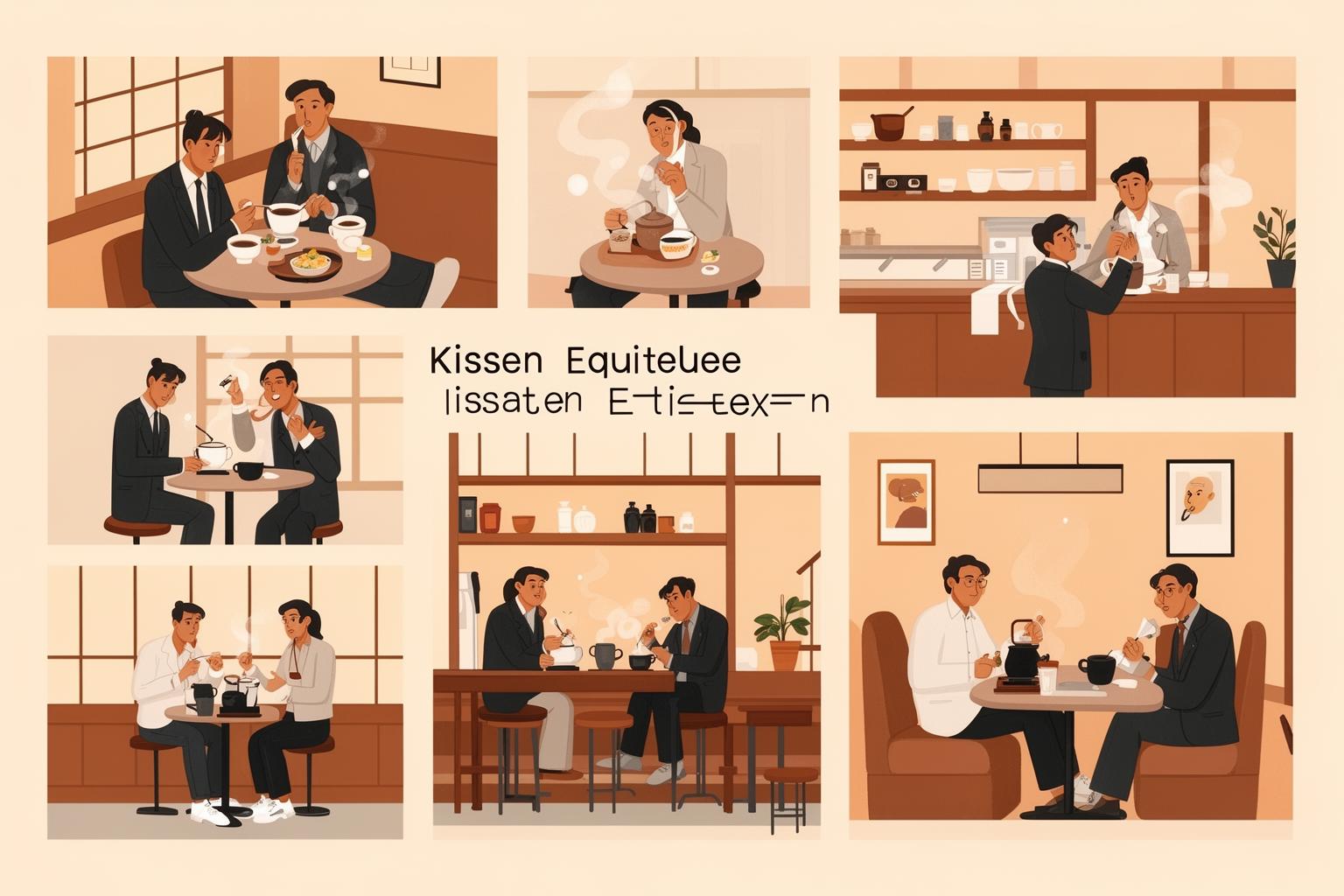
To truly appreciate a kissaten, one must recognize that it follows a distinct set of social rules different from those of a typical café. These rules are seldom stated outright but are implicitly understood by everyone present. They form the invisible framework that maintains the unique atmosphere of the space. Learning this etiquette is essential to fully experiencing what a kissaten has to offer.
Entering the Stillness
Your behavior starts the moment you reach the door. A kissaten is not a place for loud or grand entrances. Open the door gently and step inside quietly. The soft chime of a small bell will likely announce your arrival. Offer a subdued, low “Konnichiwa” or “Ojama shimasu” (a polite phrase meaning “excuse me for intruding”) to the Master behind the counter, who will probably respond with a quiet “Irasshaimase” and a subtle nod.
After that, select your seat calmly. Survey the room and pick a spot that feels appropriate. Avoid wandering around indecisively or calling out to friends across the room. Settle into your chair, remove your coat, and place your bag beside you. The intention is to blend into the existing quiet of the room rather than disturb it. This quiet initial entrance sets the mood for your entire visit. You are a guest in a serene space, and your first task is to honor that calm.
The Permission to Linger
This may be the most important—and for many outsiders, the most unfamiliar—aspect of kissaten culture. After ordering your single cup of coffee (or melon soda, or slice of toast), you have effectively paid for your stay. That one item grants you the right to occupy your seat for a considerable amount of time. An hour, two hours—as long as there isn’t a queue waiting outside (which is rare), you are welcome to remain.
No one will rush you. The Master will not conspicuously wipe down the surrounding empty tables. The bill will not be brought to you unless you quietly ask for it with “Okaikei onegaishimasu.” This can feel odd if you’re used to the Western service style focused on maximizing table turnover. But in a kissaten, the business model differs. The transaction is not just for the consumable product; it’s for the time and space it provides. The understanding is that customers need a place to rest, reflect, and escape. The kissaten offers this service, and the price is a cup of coffee. Hastening the customer would go against the very purpose of the establishment.
The Art of Solitude in Public
A kissaten is one of the few public places in modern society where solitude is not only accepted but expected. It is a space designed for the individual. You will observe people quietly engaged in solitary activities: reading a paperback, writing in a journal, sketching in a notebook, or simply staring out the window, lost in thought.
Perhaps the most profound activity of all is to sit and do nothing. This is where true mastery lies—resisting the urge to pull out your phone, check emails, or seem “busy.” The kissaten grants you permission to just be. To let your mind drift. It is a space that normalizes public introspection, a practice increasingly rare in our hyper-connected world.
While quiet conversation between two people is acceptable, it should remain low in volume. This is not a place for business meetings, loud phone calls, or group discussions. Using a laptop is often considered a breach of etiquette. The bright screen disrupts the analog sanctuary with a jarring modern intrusion, and the sound of typing disturbs the carefully curated ambiance. The kissaten is a refuge from that world, and the unspoken rule is to leave its tools and stresses at the door.
Why Now? The Kissaten’s Role in a Burnout Culture
It might be easy to write off the kissaten as a quaint but irrelevant relic, a dusty leftover from a bygone era destined to disappear. However, these establishments are not merely surviving; in many respects, they are more culturally significant now than ever before. In a world shaped by digital acceleration, relentless productivity targets, and widespread burnout, the kissaten offers something urgently needed: a tangible, accessible remedy.
An Antidote to Efficiency
Modern life is ruled by the logic of efficiency. We optimize our schedules, workflows, and even leisure time. Cities are designed to move people and goods as quickly as possible. Cafes are built for rapid customer turnover. Within this context, the kissaten’s intentional inefficiency is not a flaw but its greatest strength. It represents a conscious and profound rejection of the cult of productivity.
Here, time is not a resource to be maximized but something to be savored. The slow drip of coffee, the unhurried motions of the Master, and the permission to linger for hours over a single order—all create a pocket of resistance against the pressures of the modern economy. A kissaten offers a sanctuary for “unproductive” time, the kind essential for creativity, reflection, and mental renewal. It reminds us that there is worth in stillness, daydreaming, and simply being present without an agenda.
Tangible Nostalgia and the Search for Authenticity
In an age dominated by digital mediation, where much of life is lived through screens, there is a growing desire for authentic, tangible experiences. This partly explains the quiet resurgence in popularity of kissaten, especially among younger Japanese who never experienced the Showa Era firsthand. They are drawn to the palpable reality of these spaces.
Everything in a kissaten is real. The wood carries a grain you can feel. Velvet seats have texture. The coffee fills the air with a rich aroma. Music plays from a physical record or CD player, not a streaming algorithm. The menu is a weathered piece of paper, not a QR code. This sensory, analog reality anchors us in a world often feeling abstract and fleeting. It is a form of tangible nostalgia, not only for a specific historical era but for a time when things felt more solid, permanent, and human-scale.
Finding Your Sanctuary
Discovering a great kissaten requires slowing down and paying close attention, using the very skills you’ll need inside. Wander through older, quieter neighborhoods. Look beyond the bright, modern storefronts. Seek signs of age: a faded plastic awning, a window display of dusty, sun-bleached plastic food models (shokuhin sanpuru), or a hand-painted wooden sign bearing the shop’s name. These are symbols of authenticity.
When you find one, step inside. Embrace the initial quiet and the feeling that you might be intruding. You are not. Find a seat, order something simple, and put your phone away. Pick up the book you brought or simply observe your surroundings. Notice the details. Listen to the sounds. Allow yourself to be bored for a moment. That boredom is the gateway. It is when your mind finally slows and settles into the gentle rhythm of the place. This radical act of doing nothing may feel awkward at first. But with practice, you’ll realize it’s not the absence of activity but an activity itself: the essential human practice of being still.
Ultimately, the kissaten is far more than just a place to get coffee. It is a cultural technology, brilliantly designed to stop time. It is a physical argument for the value of slowness, a refuge created to preserve the quiet spaces in our minds. In a world demanding ever greater speed, the greatest rebellion may be to find an old wooden booth, order a cup of siphon coffee, and give yourself, without guilt or apology, an hour to do absolutely nothing.