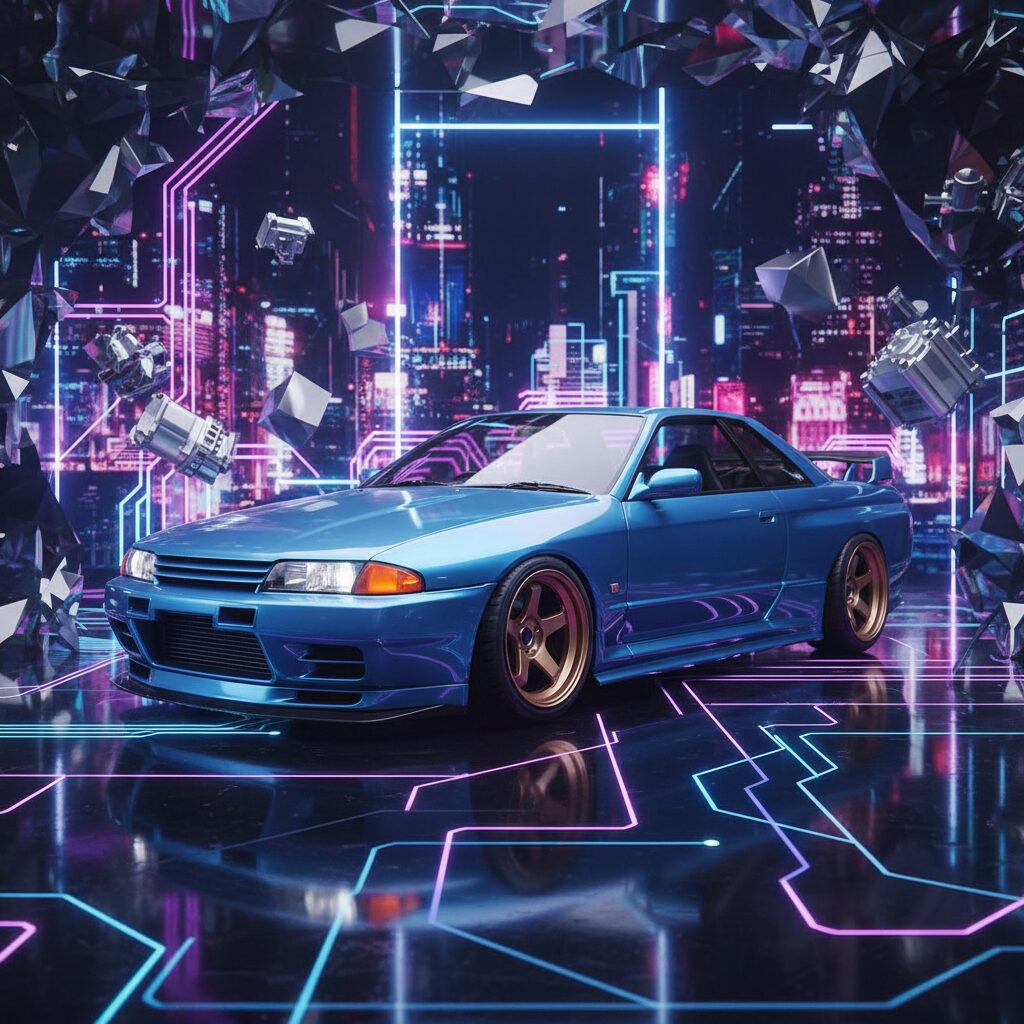
Someone asks you about 90s Japanese cars, and an image immediately flashes into your mind. Maybe it’s a searingly orange Toyota Supra, its distinctive taillights disappearing into the night. Perhaps it’s the guttural growl of a Nissan Skyline GT-R, a car nicknamed ‘Godzilla’ for its monstrous ability to devour racetracks. Or it could be the nimble form of a Mazda RX-7, carving a perfect line through a mountain pass. For decades, these cars have been more than just transportation; they’ve become icons, totems for a global community of enthusiasts. It’s a devotion that transcends borders, languages, and generations. But why? Why these specific machines from this particular island nation during this one sliver of time? The answer isn’t just in the horsepower figures or the lap times. To understand the cult of Japanese Domestic Market (JDM) tuning, you have to look deeper, into the economic furnaces of the 1980s, the unique philosophies of Japanese craftsmanship, and the digital winds that carried these legends across the ocean. It’s a story about a nation at the peak of its economic power, whose engineers were given a blank check to build their wildest dreams, inadvertently creating the perfect canvases for a new form of automotive art.
The relentless fusion of raw engineering and artistic passion that defined 90s JDM legendry is similarly celebrated in the world of Japanese model hobby culture.
Forged in the Fires of an Economic Miracle
To understand why these cars are so special, you first need to appreciate the era that produced them. The late 1980s and early 1990s in Japan marked the peak of the “Bubble Economy,” a time of extraordinary economic prosperity. Stock prices and land values were skyrocketing. Confidence was unwavering. Flush with cash and ambition, Japanese corporations weren’t merely competing—they were striving for global dominance. This economic euphoria directly sparked an automotive arms race.
The Bubble Economy’s Blank Check
For Japanese automakers, this era was a golden age of research and development. Budgets appeared limitless. The objective was no longer just to manufacture reliable, economical cars for the masses—they had already achieved that. The new mission was to create technological flagships, rolling showcases of engineering excellence that would prove Japan could outmatch the legendary performance brands of Europe. Cars like the Nissan Skyline GT-R, Honda NSX, and Mitsubishi 3000GT were not merely vehicles; they were symbols of national pride.
This ambition gave rise to an intriguing paradox. While engineers were encouraged to innovate with complex all-wheel-drive systems, twin-turbochargers, and active aerodynamics, there was a domestic restriction known as the “Gentleman’s Agreement.” Major Japanese manufacturers informally agreed to cap the advertised horsepower of their performance cars at 280 PS (276 horsepower). This limitation, motivated by safety concerns, had an unintended and wonderful consequence. Rather than chasing peak power numbers, engineers concentrated on developing exceptionally durable, well-balanced platforms. More importantly, they built engines that were massively over-engineered. A 2JZ engine in a Toyota Supra or an RB26DETT in a Skyline GT-R left the factory rated at 276 horsepower, but everyone knew their true potential was far, far greater. They were intentionally detuned, holding a vast reserve of power. This wasn’t just a car; it was a promise. It was an invitation for the owner to unlock the power that engineers had so meticulously concealed within.
The Pantheon of Performance
The outcome of this environment was a legendary lineup of performance cars. Each embodied a different engineering philosophy, a unique approach to the pursuit of speed. The Nissan Skyline GT-R (notably the R32, R33, and R34 models) was a digital warrior, employing its advanced ATTESA E-TS all-wheel-drive system and twin-turbo RB26 engine to defy expectations. It was a technical marvel that earned the “Godzilla” nickname by dominating its motorsport rivals. The Toyota Supra (A80) was an entirely different creature. It was a grand tourer focused on raw power. Its 2JZ-GTE inline-six engine became legendary, a cast-iron block so robust that tuners could reliably extract three to four times its stock horsepower.
Then there was the Mazda RX-7 (FD3S), perhaps the purest sports car of the collection. It rejected pistons in favor of a high-revving, lightweight twin-rotor Wankel engine. This gave it an almost perfect 50/50 weight distribution and exceptional agility, making it king of winding roads. And one cannot overlook the Honda NSX, developed with input from Formula 1 champion Ayrton Senna. It was Japan’s answer to Ferrari, an all-aluminum, mid-engine supercar that valued balance, driver feedback, and everyday usability above all else. These cars, along with others like the Mitsubishi Lancer Evolution and Subaru Impreza WRX, weren’t just fast; they were distinctive. They possessed character, shaped by the confidence and ambition of an entire nation.
The Soul of the Machine: A Japanese Approach to Technology
Simply being well-engineered doesn’t create a religion. The lasting appeal of these cars is also deeply tied to a uniquely Japanese cultural approach to objects and continuous improvement. Modifying one of these vehicles isn’t considered defacing a classic; rather, it’s viewed as advancing its intended path toward perfection.
Kaizen and the Pursuit of Perfection
The philosophy of kaizen, or continuous improvement, is fundamental to Japanese industry. It emphasizes the importance of always finding small, incremental ways to enhance something. This mindset is at the core of the tuning culture. Owners don’t simply purchase a Supra and leave it stock. They engage in its ongoing evolution. They might upgrade the turbochargers for increased power, install a new suspension for improved handling, or fit lighter wheels to boost responsiveness. Each modification is a purposeful step, a personal expression of kaizen. The car is never truly “finished.” It remains a living project, a constant pursuit of an ideal form.
This idea is linked to the concept of the takumi, or master craftsman. While the original engineers at Toyota or Nissan were the first takumi, the tuners—whether legendary shops like Top Secret and Mine’s or dedicated amateurs working in their garages—become the successors. There is profound respect for balance and harmony in the Japanese tuning world. It’s not just about installing the biggest turbo possible. It’s about ensuring the brakes can handle the added power, the suspension is fine-tuned to complement the new tires, and the entire setup works cohesively. This holistic approach treats the car as a complete system, not just a collection of parts.
The Analog Heart in a Digital Age
Another key to their charm is where these cars stand on the technological timeline. They strike a perfect balance, bridging the purely mechanical vehicles of the past with today’s computer-driven cars. They boasted advanced technology for their era—electronic fuel injection, engine control units (ECUs), and sophisticated drivetrains. Yet, they lack the intrusive electronic safety nets that define modern performance cars. Traction control is rudimentary or absent. There’s no lane-keep assist, no rev-matching software you can’t disable, no synthesized engine noise pumped through speakers.
This results in an unfiltered, visceral driving experience. You feel the road through the steering wheel. You sense the turbochargers spooling up. You feel the rear end of the car squirm under power. It demands skill from the driver and, in return, offers a deep sense of connection and control. In an era when cars increasingly drive themselves, the 90s JDM hero car provides an analog counterpoint. It reminds the driver they are an essential part of the equation, the human element in a beautiful mechanical dance. That raw, honest feedback is something many enthusiasts believe is missing from modern cars, no matter how fast they are.
The Culture of the Tune: Where the Religion Took Form
The cars themselves were the scripture, but the religion required temples and prophets. The tuning culture that emerged around these vehicles in Japan was born in the shadows, along winding mountain roads and sprawling urban expressways. This illicit, underground origin was essential to its mystique.
From Touge Racers to Wangan Runners
Two main arenas shaped the Japanese tuning scene. The first was the touge, the tight, technical mountain passes that weave through Japan’s landscape. Here, raw horsepower took a backseat to agility, balance, and driver skill. This was the birthplace of drifting, where drivers of cars like the Nissan Silvia and Toyota AE86 mastered the art of controlled chaos. Touge culture celebrated the lightweight, nimble machine and the hero driver capable of unlocking its full potential.
The second arena was the Wangan, the long, straight stretches of the Bayshore Route on the Shuto Expressway around Tokyo. This was the realm of pure speed. Legendary tuning shops and secretive groups like the notorious Mid Night Club built monstrously powerful machines designed for stability and acceleration well beyond 300 km/h (186 mph). Here, the Skyline GT-R and Toyota Supra dominated. These two distinct subcultures—the technical artistry of the touge and the high-speed fixation of the Wangan—formed a rich and diverse ecosystem of tuning styles that enthusiasts around the world would later embrace and adapt.
The Media Megaphone
This vibrant but localized scene might have remained a niche interest if not for a few cultural exports that acted as a powerful global megaphone. The first, and arguably most influential, was the video game Gran Turismo. Released in 1997 for the Sony PlayStation, it was subtitled “The Real Driving Simulator.” For millions of young people outside Japan, it was their first exposure to the extensive catalog of JDM cars. Not only could you drive the GT-R, Supra, and RX-7, but you could also purchase, modify, and tune them. It served as an interactive encyclopedia that educated a generation on the names, specs, and potential of these machines, planting a seed of passion that would blossom years later.
At the same time, the manga and anime series Initial D romanticized the world of touge racing. It was more than a car story; it was an in-depth exploration of driving technique, tuning philosophy, and the discipline needed to become a master of the mountain pass. It transformed the humble Toyota Sprinter Trueno (AE86) into a global icon and provided the subculture with a narrative and a soul. Lastly, the American film franchise The Fast and the Furious projected the visual aesthetic of the Japanese tuning scene—the neon lights, the extravagant body kits, the focus on iconic Japanese cars—onto cinema screens worldwide. While a stylized Hollywood fantasy, it undeniably established the 1990s Japanese sports car as the definitive hero car for a new generation.
The Modern Disciple: Why Now?
The seeds sown by video games and media two decades ago are now coming to fruition. The kids who spent countless hours racing around Laguna Seca in a virtual Supra and imagining touge battles have grown into adults with careers and disposable income. This has created the perfect storm of nostalgia, accessibility, and a craving for a more genuine automotive experience.
The Nostalgia Engine and the 25-Year Rule
Nostalgia wields immense power. For many, owning and modifying a Skyline or an RX-7 means recapturing a piece of their youth—it’s about finally possessing the poster car that once decorated their bedroom wall. This demand has been accelerated by legal frameworks, especially the 25-year import rule in the United States. This regulation permits cars aged 25 years or more to be imported without conforming to modern safety and emissions standards. As each iconic 90s model—the R32 Skyline GT-R in 2014, the FD RX-7 in 2018, and soon the R34 GT-R—reaches this milestone, it unleashes a wave of demand. This triggers a recurring cycle of hype, media coverage, and soaring prices, further solidifying their legendary status.
A Canvas for Identity
Perhaps the deepest reason for the lasting allure of these cars lies in what they offer in an era of automotive uniformity. Modern vehicles are safer, faster, and more efficient than ever, yet they often feel sterile and indistinct. By contrast, a 90s Japanese sports car serves as a blank canvas—an invitation to create and express individuality. The choice of wheels, the exhaust tone, suspension tuning, and engine components—all reflect the owner’s personality, priorities, and aesthetic sense. Owning one is not just joining a global community; how you build it makes it distinctly your own. It’s less a product purchase and more an artistic endeavor. It’s kinetic sculpture, a cultural artifact from a uniquely hopeful moment in time, one that you don’t merely own but continually help to shape.
These cars are not simply relics; they are vessels of stories—of economic ambition, engineering purity, underground culture, and personal expression. They represent an era when vehicles had distinct, sometimes imperfect but always palpable souls. For the devoted global community of tuners and dreamers, preserving, modifying, and driving them is a way to keep that spirit alive.