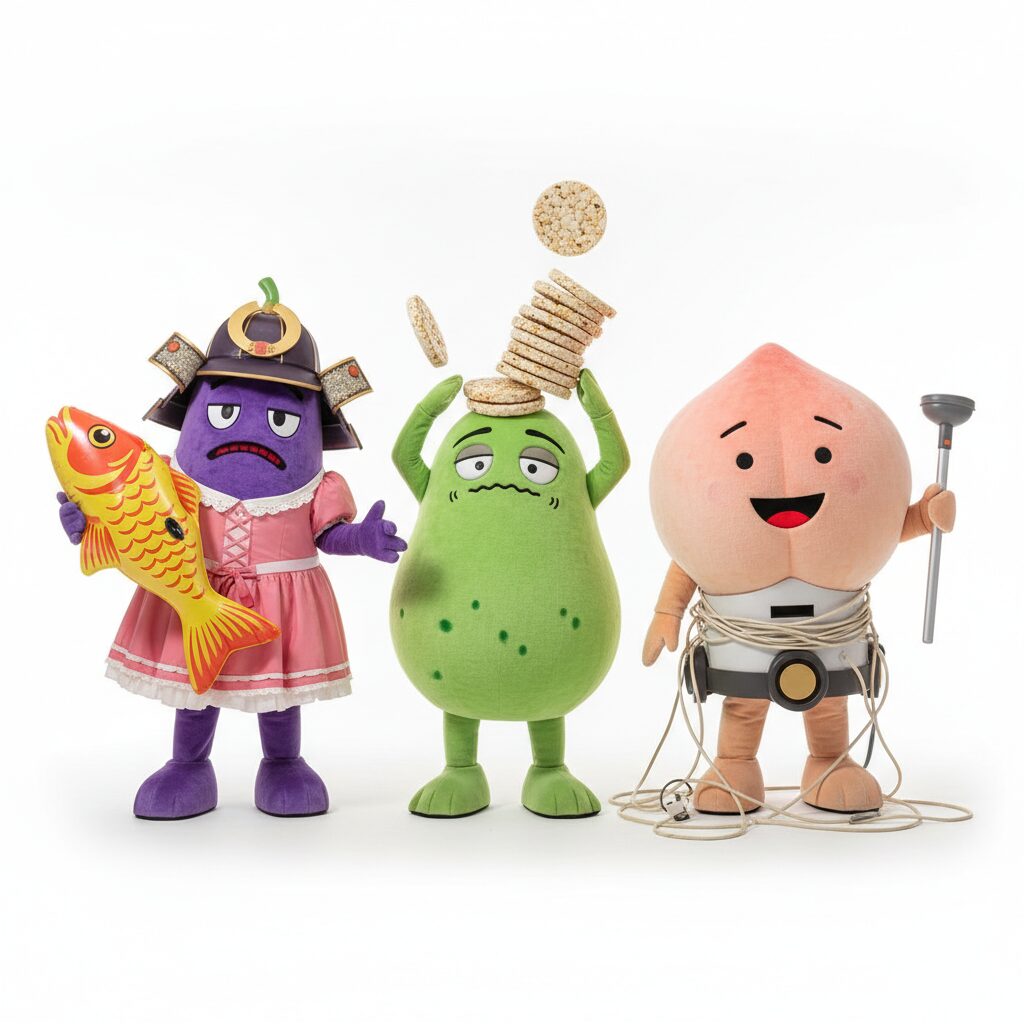
Walk through any reasonably sized town in Japan, and you will eventually encounter something deeply strange. It might be a seven-foot-tall, vaguely cat-like samurai waving clumsily at children. It could be a smiling, anthropomorphic block of tofu handing out pamphlets about fire safety. Or maybe it’s a hyperactive, screeching pear-fairy who moves with the frantic energy of a speed-metal drummer. You are not hallucinating. You have just come face-to-face with a yuru-chara.
These are the mascots of Japan, and they are everywhere. They are the faces of prefectures, cities, and tiny neighborhood associations. They represent airports, tax offices, museums, and even prisons. Forget sleek corporate logos; Japan prefers to communicate through large, felt-covered beings with fixed smiles and slightly wobbly gaits. The term itself, coined by cultural critic Miura Jun, is a contraction of yurui kyarakutā. Kyarakutā is easy—it’s just the Japanese rendering of “character.” The magic is in yurui. It’s a beautifully flexible word that can mean loose, gentle, laid-back, or even amateurish. A perfect yuru-chara isn’t supposed to be polished like a Disney creation. It’s supposed to be a little bit… off. Its charm lies in its imperfection.
But this isn’t just a quirky novelty for tourists to photograph. The world of yuru-chara is a massive subculture, a multi-billion yen industry, and a fascinating window into the Japanese psyche. It’s a phenomenon that answers a distinctly modern need through a lens of ancient cultural sensibilities. So why does a country known for its precision, formality, and refined aesthetics have such a profound love for these goofy, often bizarre, local heroes? Who are they for, and what purpose do they truly serve beyond being cute? The answer reveals a complex interplay of economics, regional pride, and a deep-seated need for a softer, more approachable way of navigating the world.
The quirky allure of yuru-chara is just one facet of Japan’s inventive charm, as seen in the way Japanese convenience store culture transforms everyday spaces into vibrant community hubs.
The Anatomy of an Obsession
The mascot boom didn’t just emerge overnight. It developed from a distinct set of social and economic factors that made Japan an ideal environment for a new form of localism. While characters have long been embedded in Japanese commercial culture—Hello Kitty has been a global icon since the 1970s—the yuru-chara movement stands apart. It is grassroots, regional, and deeply connected to identity.
A Tale of Two Cats: The Spark and the Blueprint
The defining moment for the yuru-chara movement dates back to 2007 in Hikone, a quiet castle town in Shiga Prefecture. To commemorate the 400th anniversary of Hikone Castle, the local government created a mascot named Hikonyan. He was a simple white cat wearing a red samurai helmet, inspired by a local legend. He wasn’t flashy, but he had a gentle, modest charm. And he became a phenomenon.
Tourism in Hikone surged. Merchandise sold rapidly. Hikonyan’s success revealed a powerful new formula: a well-crafted, historically meaningful mascot could become a significant economic boost for a struggling region. At a time when many rural towns faced decline due to aging populations and urban migration, yuru-chara offered a relatively low-cost, high-impact method for machi-okoshi, or regional revitalization. Suddenly, every town, village, and tourism board longed for its own Hikonyan.
The Gospel of Yurui: Embracing Imperfection
As the number of mascots soared, Miura Jun, the man who coined the term, set forth a loose set of guidelines that defined a genuine yuru-chara. These principles are essential to understanding their charm.
First, the character must express a strong affection for its hometown or region. Its design should feature local specialties, history, or landmarks. Gunma-chan, from Gunma Prefecture, is a pony because the area was historically known for horse breeding. Sanomaru, a samurai mascot from Sano City, sports a bowl of Sano ramen on his head and carries swords made from fried potatoes, both local treats. This direct, visual connection to place is indispensable.
Second, the character’s movements should be endearingly awkward and unsteady. This is the physical representation of yurui. Professional mascot performers are trained to be energetic and precise. Yuru-chara performers, often local civil servants or volunteers, are encouraged to be somewhat clumsy. Their wobbling, shuffling steps and slow, exaggerated motions make them appear vulnerable and approachable. It’s humor born from effort.
Third, and most importantly, the character must be unsophisticated. It should resemble something designed by a local committee, not a polished Tokyo ad agency. This intentional lack of refinement rejects corporate perfection. It builds a sense of intimacy and authenticity, making the character feel truly part of the community. It’s our quirky onion-headed mascot, not a soulless marketing gimmick.
The Titans of the Trade
Within this expansive ecosystem, a select few characters have risen beyond their local roots to achieve national and even international fame. Their stories highlight diverse routes to mascot stardom, spanning carefully orchestrated government campaigns to chaotic, independent uprisings.
Kumamon: The Bear Who Conquered the World
No conversation about yuru-chara is complete without honoring the king: Kumamon. Created in 2010 to boost tourism for the new Kyushu Shinkansen line, this rosy-cheeked black bear representing Kumamoto Prefecture is a prime example of branding excellence. His design is deceptively simple and modern, yet his public persona embodies pure yuru-chara mischief. He is renowned for unpredictable antics, from getting stuck in doorways to playfully wrestling with other mascots.
However, Kumamon’s true brilliance lies in his economic model. In a brilliant marketing move, the Kumamoto prefectural government made his image rights completely free to use, provided the product somehow promoted the prefecture. This sparked an unprecedented surge in Kumamon-branded items, ranging from soy sauce bottles and tractors to high-end Leica cameras. He became an open-source icon, a living advertisement for his home. The economic impact is immense, valued in the billions of dollars. Kumamon demonstrated that a yuru-chara can be more than a cute face; it can serve as a legitimate economic strategy.
Funassyi: The Anarchist Pear-Fairy
While Kumamon represents the establishment, Funassyi embodies the wild, screeching voice of rebellion. An unofficial mascot for the city of Funabashi in Chiba Prefecture, Funassyi is a genderless pear-fairy with an incredibly high-pitched voice, a penchant for shrieking “Nassha!” (a blend of “Funabashi” and “pear”), and a habit of jumping around with wild, unrestrained energy.
Created by a local citizen and repeatedly rejected by the city government, Funassyi persisted and built a massive following through independent appearances, social media, and sheer, manic determination. Unlike most yuru-chara, Funassyi talks. And shrieks. A lot. Inside the costume is the creator himself, defying the unspoken rule of mascot silence. This rebellious, DIY spirit deeply resonated with the public. Funassyi’s success is a testament to the grassroots power of the subculture; a true folk hero who rose to stardom on their own terms, proving you don’t need official approval to win the nation’s heart.
The Cultural Logic Behind the Cuteness
So why does this all work so well in Japan? The explanation goes much deeper than a mere fondness for cute things. Yuru-chara resonate with several fundamental aspects of Japanese culture, offering a gentle cushion in a society that can often be rigid and formal.
Communication Through a Softer Lens
Japan is a society that often emphasizes indirect communication and social harmony (wa). Direct, overt requests can be perceived as aggressive or disruptive. Mascots offer an ideal solution. A charming, smiling character urging you to sort your trash properly, pay your taxes on time, or stay alert to public safety concerns feels less like an order from a faceless bureaucracy and more like a kind, friendly reminder.
The Tokyo Metropolitan Police Department has Pipo-kun, a wide-eyed creature with large ears to hear citizens’ pleas and an antenna to detect danger. The Japan Self-Defense Forces feature Prince Pickles and Princess Parsley. These characters act as cultural buffers, creating an emotional shield between the public and potentially intimidating government institutions. They make authority feel more approachable.
Modern Animism: Giving Form to Place
This habit of anthropomorphizing everything has deep historical roots in Japan’s native Shinto beliefs. Shintoism is fundamentally animistic, centered on the belief that kami (gods or spirits) inhabit all things—not only people, but rocks, trees, rivers, mountains, and even abstract ideas. The world is alive with beings and personalities.
From this viewpoint, giving a town or region a living avatar isn’t such a surprising leap. A yuru-chara serves as a modern yorishiro, a physical object that can attract and house a spirit. They become a vessel for a place’s identity, a tangible expression of local pride and character. They turn the abstract concept of “hometown spirit” into something you can see, hug, and cheer for. This link to a spiritual past, even if subconsciously felt, lends the yuru-chara phenomenon a resonance it might lack elsewhere.
The Healing Power of Kawaii
Finally, there is the undeniable power of kawaii, or cuteness. In Japan, kawaii is not merely a childlike aesthetic; it is a pervasive and influential cultural force embraced across all ages and genders. Cuteness is considered disarming, comforting, and emotionally restorative. In a society known for long work hours and intense social pressures, kawaii offers moments of iyashi—healing and emotional relief.
Yuru-chara are the perfect conduits for iyashi. Their simple designs, awkward movements, and earnest, silent attempts to fulfill their roles are inherently calming and entertaining. Watching a giant melon-bear struggle to pass through a small doorway creates a moment of pure, uncomplicated joy. It offers a brief escape into a softer, sillier, and far less demanding world than reality. They function as a collective societal stress ball.
The Sun Sets on the Golden Age
By the mid-2010s, the phenomenon had reached a fever pitch, with nearly every organization in the country having a mascot, resulting in an overabundance of forgettable characters. The term chara-kyara sensō (character wars) became part of the popular vocabulary. The market was oversaturated, leading local governments to engage in unusual mascot “restructuring,” publicly “firing” underperforming characters to reduce costs.
The annual Yuru-chara Grand Prix, a huge online popularity contest that was the movement’s centerpiece, held its final event in 2020, officially signaling the end of the boom. The national craze has certainly quieted down. However, this doesn’t mean the yuru-chara have disappeared. Far from it.
Instead, they have completed their shift from a passing trend to a permanent fixture. No longer a novelty, they are now a fully embraced and integrated part of the Japanese cultural landscape. They continue to act as tireless, smiling ambassadors for their hometowns, welcoming visitors at train stations and promoting local products at festivals. While the fierce competition has diminished, the core mission endures. They are the quirky, charming, and deeply human face of local Japan—a reminder that sometimes the most effective way to convey a serious message of identity and community is through the wobbly dance of a giant, felt-covered turnip.