Walk into any major department store in Japan, like Isetan in Shinjuku, and just stand near the entrance for a minute. When the doors officially open for the day, you’ll witness something remarkable. A line of staff, perfectly poised, will perform a deep, synchronized bow to the first customers of the day. It’s not a quick nod. It’s a slow, deliberate, and almost reverent gesture. Later, you might see two businessmen on a train platform exchanging business cards, their bodies angled towards each other in a crisp, respectful bend from the waist. Later still, you might catch a TV news segment where a disgraced executive is bowing for what feels like an eternity, his head nearly touching the podium, a silent plea for forgiveness in physical form.
To a first-time visitor, it can all look like a simple, uniform act of politeness. A bow is a bow, right? In reality, that’s like saying a word is just a word. In Japan, the bow—known as ojigi (お辞儀)—is a complex and nuanced language all its own. It’s a physical grammar that communicates respect, gratitude, apology, and social standing with more precision than spoken words ever could. The angle of the back, the duration of the hold, the position of the hands, and the direction of the gaze are all morphemes in a sentence that every native speaker can read instantly.
This isn’t just about manners; it’s a window into the Japanese mindset. It’s a constant, visible reinforcement of social structure, relationships, and the deep-seated value placed on harmony. Understanding the bow isn’t about memorizing rules to avoid offending someone. It’s about grasping a fundamental pillar of Japanese social interaction. It’s the key to unlocking the unspoken dialogue that happens in every meeting, every transaction, and every greeting. So, let’s break down that grammar. Let’s learn to read the room by reading the bow.
This meticulous display of non-verbal communication mirrors the ethos of Japan’s synchronized morning calisthenics, where each coordinated movement reinforces a shared commitment to order and precision.
More Than a Greeting: The Basic Elements of Ojigi
Before diving into the details, it’s important to recognize that a bow is more than just a physical action; it’s a way of expressing a relationship. Every time one person bows to another in Japan, they are physically acknowledging their relative social positions. This isn’t about one person being “better” than the other but about acknowledging established roles such as customer and clerk, senior and junior, host and guest, or teacher and student. The bow is the ritual that keeps these social dynamics functioning smoothly.
Though the act appears simple, it consists of several key elements. The first and most evident is the angle. Bending from the waist while keeping the back and neck straight is fundamental. A common mistake made by foreigners is the “head bob,” where only the chin dips. This is considered too casual and somewhat sloppy. A proper ojigi is a full-body gesture initiated from the hips.
Next is duration. How long you hold the bow at its lowest point is as important as the depth of the bow. A quick, sharp bow sends a different message than a slow, deliberate one. The pause at the bottom is where sincerity is conveyed. Rushing a bow is like mumbling a thank you—the form is present, but the feeling is missing.
Finally, there is breath and gaze. A proper bow is often coordinated with breathing: you inhale as you straighten up and exhale as you bend. This creates a natural, unhurried rhythm. Your gaze should follow the movement, lowering to the floor in front of you while bowing and rising again as you straighten. Maintaining direct eye contact during a bow is considered a major faux pas; it can be seen as mistrustful or even confrontational.
Together, these elements create a complete statement. A deep, slow bow with a lowered gaze communicates something very different from a quick, shallow one. Mastering the art of ojigi means learning how to compose these non-verbal sentences appropriately for every social context.
The Geometry of Respect: Decoding the Angles
The most noticeable variable in a bow is its depth. The angle of your back serves as a direct and immediate indicator of the respect level or emotional intensity you are expressing. While there is an endless range of subtle variations, bows are commonly divided into three main categories.
Eshaku (会釈): The 15-Degree Nod
Eshaku is the most casual bow in the set. It involves a slight forward tilt of about 15 degrees from the waist. This is the everyday bow, similar to a friendly nod or a quick “hello.” It’s used when passing a colleague in the hallway, when a receptionist acknowledges you, or when thanking someone for holding a door. It’s a gesture of recognition and light courtesy.
Despite being casual, it’s still performed with intention. The back stays straight, and the movement is controlled but not careless. Office workers might exchange eshaku bows dozens of times daily. It serves as the background hum of politeness, smoothing daily interactions by acknowledging others without interrupting the day’s flow. It’s informal but meaningful; the foundation of mutual respect.
Keirei (敬礼): The 30-Degree Standard
This is the staple bow in Japanese culture. The keirei, typically ranging from 30 to 45 degrees, is the standard for formal respect. It’s the bow you use when greeting a client, thanking a superior, welcoming a customer, or meeting someone for the first time. It clearly signals respect and sincerity.
When a store clerk bows to you, it’s almost always a keirei. Presenting your business card—your meishi—is also done with a keirei. Its angle is deep enough to be formal and respectful but not so deep as to imply apology or excessive submission. It conveys, “I acknowledge you, respect your status, and appreciate this interaction.” In business, the keirei is the standard, setting a professional and respectful tone for every encounter.
Saikeirei (最敬礼): The 45- to 70-Degree Statement
Known as the “most respectful bow,” the saikeirei is reserved for moments of deep gratitude, profound respect, or sincere apology. It involves a bow of 45 degrees or more, a deep and sustained gesture that expresses strong emotion. A saikeirei is never used for a minor favor.
This bow is appropriate when meeting someone with very high social status, like a company CEO or a respected public figure. It is also the bow of apology. When a company makes a major mistake, its executives will appear at a press conference and perform a deep, prolonged saikeirei to the cameras. This is not just ceremonial; it’s a culturally required act of public contrition. The depth and length of the bow correspond to the seriousness of the offense. A saikeirei can also express overwhelming gratitude, the kind of thanks that cannot be fully conveyed by words. It is a gesture of humility and great respect, and its use is always deliberate and sincere.
The Weight of a Moment: Why Duration Matters
If the angle of the bow is the noun, then its duration is the adjective—it shapes the meaning and adds emotional nuance. A 30-degree keirei held for three full seconds expresses a much deeper sense of gratitude than one that is over in an instant. The pause at the bottom of the bow is essential. It’s a moment of stillness that allows the sentiment to resonate.
Consider an apology. A quick, jerky bow feels dismissive and insincere. In contrast, a deep bow held with the person remaining lowered for several seconds before rising slowly conveys a strong sense of remorse. The recipient is given time to observe and feel the sincerity of the gesture. The slowness of the movement itself is a form of respect, signaling that you are giving the other person your full, unhurried attention.
This idea is often captured in the phrase ichi-go ichi-e (一期一会), a concept from the tea ceremony meaning “one time, one meeting.” It suggests that every encounter is unique and should be cherished. A proper bow embodies this philosophy. You stop what you’re doing, plant your feet, and perform the gesture with your full presence. You don’t bow while walking or talking. You give the moment, and the person, the gravity they deserve.
The rhythm of the bow is also part of this non-verbal language. A proper bow follows a three-beat count: down (exhale), pause, up (inhale). Rushing any of these steps undermines the gesture’s meaning. Japanese people are highly sensitive to this rhythm, and a poorly timed bow can unintentionally convey haste, disrespect, or insincerity. The time you dedicate to the gesture directly reflects the value you place on the relationship.
Context is King: Reading the Room
A bow never occurs in isolation. Its significance is entirely shaped by the context, the setting, and the individuals involved. The same 45-degree bow can express “thank you for your patronage” in a store or “I am deeply sorry for causing you trouble” during a business meeting.
In the Workplace
In a Japanese office, hierarchy is visibly expressed through a continuous flow of bows. When a junior employee enters a senior manager’s office, they will likely perform a crisp keirei at the door, repeating it upon leaving. Throughout the day, colleagues of similar rank exchange casual eshaku nods. When a team meets with a client, the entire group bows, often coordinated by the most senior member who sets the timing and depth. Junior members tend to bow slightly lower and hold it a fraction of a second longer than their boss, subtly reinforcing the team’s internal hierarchy. It is a silent, ongoing dance of status and respect.
Commerce and Hospitality
Visitors to Japan most commonly encounter bowing here. From gas station attendants to convenience store cashiers, bowing is an essential part of customer service, or omotenashi. This bow signifies professional respect for the customer. It is not personal subservience but a standard gesture conveying that the customer is valued. The synchronized bows at the opening of a department store epitomize this: a collective expression of welcome and gratitude toward the patrons who sustain the business.
The Apology Bow
A bow is most powerful when used to apologize. For minor mistakes, a deep keirei may be enough. For more serious errors, the saikeirei is employed. In extreme cases, there is the dogeza (土下座)—the act of getting on hands and knees, bowing until the forehead touches the floor. The dogeza is the ultimate gesture of apology and submission. It is rarely seen in everyday life, mostly appearing in historical dramas or during major public scandals. Performing a dogeza means relinquishing all dignity to earn forgiveness. It is a social nuclear option with immense impact.
Sacred Spaces
When visiting a Shinto shrine or Buddhist temple, you will observe a different style of bowing. At a shrine’s torii gate, it is customary to pause and perform a single, respectful bow toward the main hall. Inside, when praying before the altar, the typical protocol is two bows, two claps, and one final bow. These bows are not directed at other people but at the resident deities or Buddhas. They signify reverence and humility before the divine, linking bowing to its profound spiritual and historical origins.
From the Floor Up: The Seated Bow (Zarei)
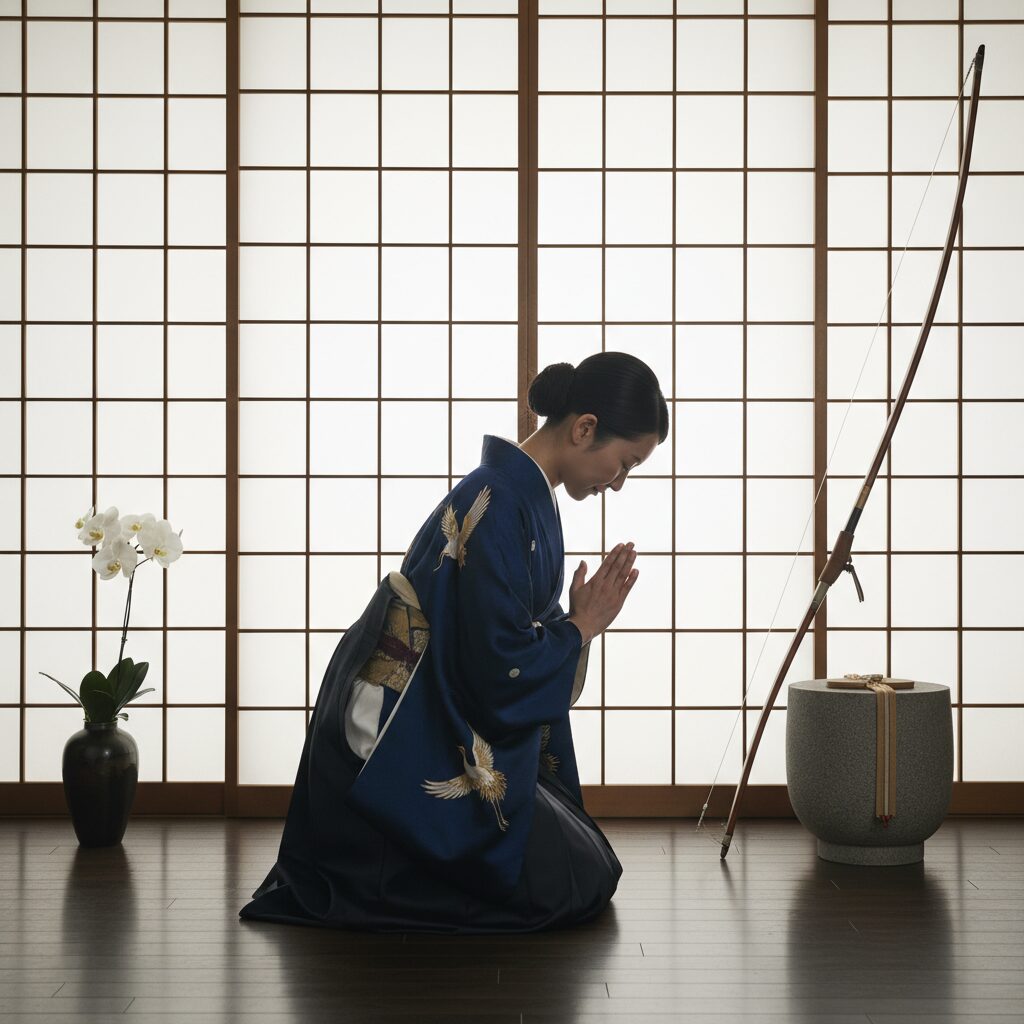
While the standing bow, or ritsurei (立礼), is the most commonly seen form today, the seated bow, or zarei (座礼), holds equal importance, particularly in traditional settings. Throughout much of Japanese history, daily life took place on tatami mat floors, making the seated bow the standard for formal occasions.
Zarei is performed from the formal seiza sitting position (kneeling with the tops of the feet flat on the floor and sitting on one’s heels). Like its standing counterpart, the seated bow has varying degrees of formality. A casual seated bow may simply involve placing your hands on your thighs and bowing slightly. A more formal version requires sliding your hands down to the floor in front of your knees, creating a triangle shape with your thumbs and index fingers, and then bowing deeply over them.
The most formal seated bow is a slow, deep prostration, akin to the standing saikeirei. This bow is commonly seen in high-level martial arts demonstrations, the tea ceremony, and highly traditional formal gatherings. It demands discipline and practice to perform with grace. Sitting in seiza is already a gesture of respect, and executing a poised zarei from this position adds an additional layer of formality and reverence to the interaction.
Although most modern Japanese people do not regularly use zarei in everyday life, its presence serves as a reminder of how deeply these protocols are ingrained in the culture, originating from a time when etiquette was expressed through the entire body, whether standing or seated.
The Foreigner’s Dilemma: Common Pitfalls
For non-Japanese individuals, navigating the world of ojigi can be challenging. The desire to show respect exists, but the execution can sometimes go wrong, resulting in awkward or unintentionally humorous moments.
One common mistake is the aforementioned head bob. Bowing only with your neck and head while keeping your back stiff appears insincere and lazy. The movement should originate from the waist.
Another typical error is the awkward handshake-bow combination. When a Westerner offers a handshake and a Japanese person initiates a bow, the outcome can be an uncomfortable dance where one person bows into an extended hand. The general rule is to either shake hands or bow. If a Japanese person offers a handshake, it usually reflects an adaptation to Western customs; a simple nod while shaking hands is perfectly acceptable. Attempting a full bow while reaching for a handshake is both difficult and unnecessary.
Perhaps the greatest cultural misunderstanding concerns eye contact. In Western cultures, maintaining eye contact when thanking or apologizing signifies sincerity. However, doing so during a bow in Japan is inappropriate. Your gaze should naturally lower as you bow. Sustaining eye contact can be interpreted as challenging or even aggressive, as though you are scrutinizing the other person’s response rather than focusing on the gesture itself. Genuine respect calls for lowering your eyes.
The final pitfall is a lack of intentionality. Bowing while moving or distracted lessens the meaning of the gesture. The Japanese bow is a moment of focused respect. Stop, stand with your feet together, keep your hands at your sides (for men) or clasped in front (for women), and perform the bow as one deliberate action. This level of concentration is what gives the gesture its significance.
The Final Bow: Internalizing the Logic
After considering all these aspects—the angles, the durations, the contexts—it’s easy to feel overwhelmed, as though you’ve been given a dense textbook on social physics. But the “aha moment” in grasping the Japanese bow is understanding that it’s not about memorizing a rigid set of rules. It’s about internalizing the social logic behind it.
The bow is the physical expression of one’s awareness of social context and relationships. It represents a constant, subconscious calculation: Who is this person? What is my relationship to them? What does this situation require? An employee doesn’t think, “Okay, this is my boss, so I must perform a 30-degree bow for 1.5 seconds.” They simply feel the appropriate level of respect, and their body expresses it through a bow naturally suited to the moment.
It is the visible manifestation of the fundamental Japanese cultural concepts of hierarchy and uchi-soto (内外), the distinction between one’s “inside” group and “outside” groups. How you bow to a family member (uchi) is vastly different from how you bow to a new client (soto). The bow acts as the gatekeeper, the ritual that negotiates the space between people.
Ultimately, the bow stands as a testament to a culture that places immense value on social harmony and the power of the unspoken. In a society that tends to be less direct in verbal communication, gestures like the bow carry significant weight. It is a language of respect that, once learned, reveals everything you need to know about the relationships in the room. It’s not just bending at the waist; it’s making the social order visible, one graceful, intentional gesture at a time.