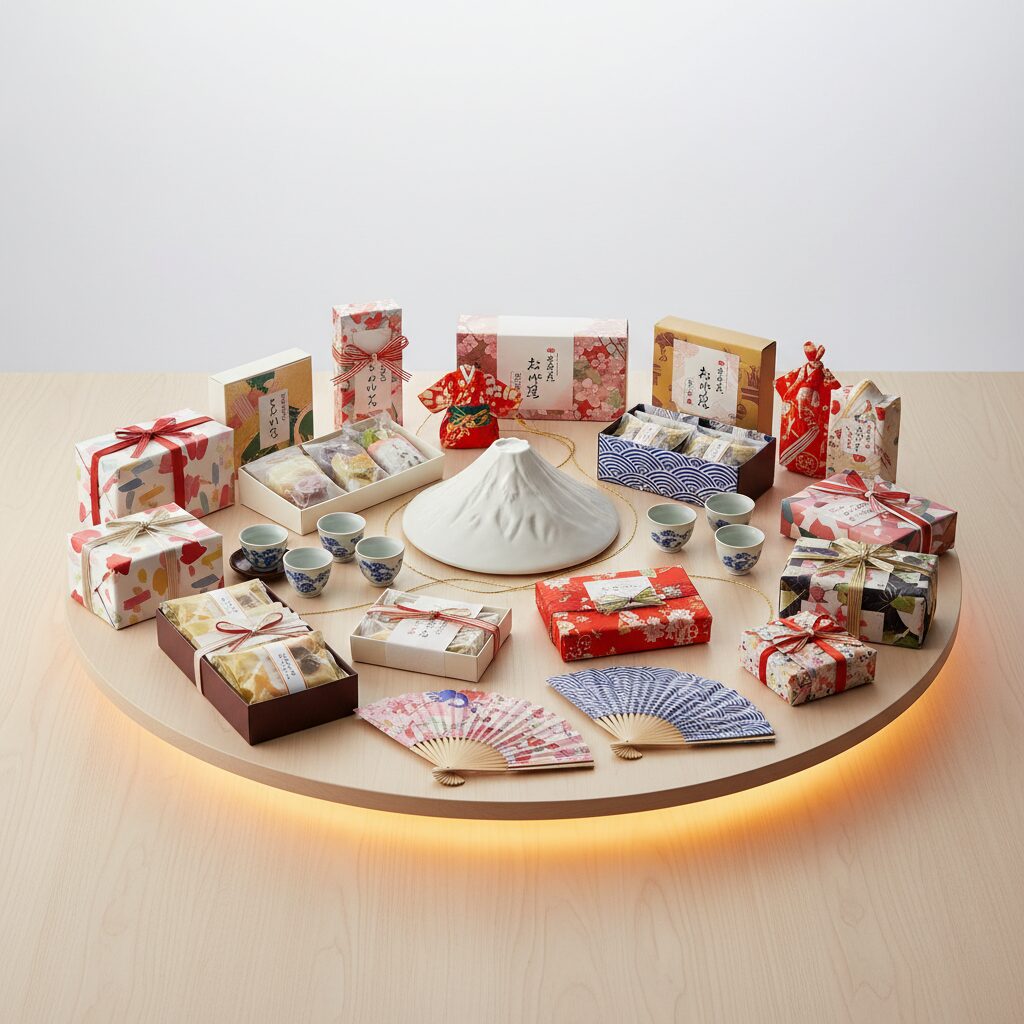
Walk into any major train station or airport in Japan, and you’ll be hit by a dazzling, almost overwhelming, display of meticulously packaged goods. Towers of brightly colored boxes, each containing individually wrapped cakes, cookies, or crackers, are arranged with architectural precision. You’ll see travelers—businessmen in suits, young families, elderly couples—carefully deliberating before purchasing several boxes at once. This isn’t just last-minute souvenir shopping. This is a deeply ingrained social ritual in action. This is the world of omiyage.
If you’ve spent any time in Japan, you’ve likely been a recipient. A colleague returns from a weekend trip to Kyoto and a box of green tea cookies magically appears on the shared desk in the office. You visit a friend’s parents, and as you leave, they press a small, beautifully wrapped package into your hands. On the surface, it’s simple: a gift from a trip. But translating omiyage as just a “souvenir” is like calling a classically trained orchestra a garage band. It misses the point entirely. A souvenir is for you, a personal memento of your travels. An omiyage is for them—your colleagues, your family, your neighbors. It is a tangible piece of social glue, a complex gesture that speaks volumes about gratitude, obligation, and your place within a group. It’s a silent language that, once you learn to understand it, reveals the intricate inner workings of Japanese society.
The intricate interplay of personal sincerity and social expectation that underpins omiyage is further illuminated by exploring the role of honne and tatemae in everyday Japanese interactions.
The Souvenir Is for You; The Omiyage Is for Us
The fundamental distinction lies in perspective. A souvenir represents a personal act of memory preservation. You purchase a miniature Eiffel Tower in Paris to remind yourself of your trip there. The transaction centers on you and your experience. Omiyage, conversely, is socially oriented. It serves as evidence that you were mindful of your social circle even while away. It acknowledges the community you belong to and are now returning to.
Consider the kanji characters for the word: お土産. The main component, 土産, consists of 土 (tsuchi), meaning “earth” or “land,” and 産 (san), meaning “product.” An omiyage is literally a “product of the land.” It isn’t just a random keepsake; it is a taste of the place you visited, brought back to share. By giving omiyage, you share a part of your journey, letting those who stayed behind partake in it vicariously. It communicates, “I went to Hokkaido, and I brought back a piece of Hokkaido for you.”
This act of sharing is essential. When a coworker returns from vacation and leaves a box of treats in the breakroom, it fulfills several purposes. It expresses goodwill, thanks the team for managing in their absence, and subtly apologizes for any inconvenience their leave may have caused. It’s a peace offering that eases their reintegration into the group. Returning empty-handed from a trip, especially within the country, would be viewed as inconsiderate, even somewhat odd. It would imply a disconnect from the group and a failure to recognize your role within the collective.
Navigating the Web of Social Obligation
To truly appreciate the importance of omiyage, it is essential to understand the concept of giri (義理). Although there is no exact English equivalent, giri can be described as a sense of social duty, moral obligation, or the unwritten rules of reciprocity that shape relationships. Japan operates on a complex system of giving and receiving, with omiyage serving as one of its most common forms of currency.
This system establishes a delicate equilibrium. When you receive a gift, you are implicitly expected to reciprocate in the future. This is not a cold, transactional exchange but rather a continuous, flowing cycle that strengthens connections. Omiyage is a low-stakes, high-frequency means of keeping this cycle alive.
The Office: The Primary Setting
The workplace is where the omiyage tradition is most apparent and widely practiced. After any trip—whether for business or leisure—bringing back a gift for the department or team is mandatory. The preferred choice is almost always a large box of individually wrapped snacks. This is purely practical: it’s easy for everyone to take one, there’s no mess, and it doesn’t disrupt the workday. The box can be placed on a communal table with a silent nod, allowing people to help themselves throughout the day. It’s an efficient, unobtrusive gesture that perfectly fulfills the social obligation. The significance lies more in the act than the gift itself; it is the recognition of the group that matters.
Friends and Family: A More Intimate Gesture
Outside of work, the rules are somewhat more relaxed, but the core principle holds. When visiting friends or family—especially if you haven’t seen them in a while or are staying in their home—bringing omiyage is customary. Here, the gift can be more personalized. Rather than a generic box of cookies, you might bring a small bottle of local sake for a friend who enjoys it, or a well-known local dessert for the family to share. The gift acknowledges their hospitality and strengthens your personal bond. Likewise, after a significant trip, it’s expected to bring small tokens back for your immediate family and closest friends.
Neighbors and Acquaintances: Fostering Harmony
Omiyage also extends to more casual relationships, such as neighbors. This practice helps sustain good kinjo-zukiai (近所づきあい), or neighborhood relations. If you take a short day trip to a nearby town known for, say, rice crackers, you might buy an extra bag to give to the family next door. It’s a small, simple way to uphold wa (和), or social harmony, which is a foundational concept in Japanese society. These small, consistent gestures help ensure that relationships remain smooth and friendly.
The Unwritten Rules of the Perfect Pick
Selecting the right omiyage is a subtle art governed by a set of unspoken guidelines. It’s not about choosing the priciest or most exotic item but about showing thoughtfulness and an awareness of the social context.
Rule 1: It Must Be Local
The key requirement is that the omiyage is a meibutsu (名物), a well-known specialty from the area you visited. Every prefecture, city, and even small town in Japan boasts its own meibutsu. Consider Tokyo Banana, the popular banana-shaped sponge cakes filled with custard cream, or Shiroi Koibito, the delicate white chocolate cookies from Hokkaido. From Kyoto’s yatsuhashi cinnamon rice cakes to Okinawa’s beni-imo purple sweet potato tarts, these products are strongly linked to their place of origin. Presenting a meibutsu shows you truly visited the area and carefully chose something representative of the local culture. This is why train stations and airports serve as extensive marketplaces for regional specialties, conveniently catering to travelers heading home.
Rule 2: Presentation Is Everything
In Japan, packaging is often as significant as the gift itself, and omiyage perfectly exemplifies this. The boxes are artfully designed, the wrapping paper is neat and refined, and the contents are often arranged with great care. This meticulous attention reflects the giver’s sincerity. A thoughtfully wrapped gift conveys respect for the recipient. Even if the gift is just simple cookies, the elegant presentation enhances the gesture. This care extends to individually wrapping each item inside the box, which serves not only for hygiene but also for easy sharing—a vital consideration in workplace settings.
Rule 3: The Price Point Dilemma
The price of an omiyage requires careful balance. It should be nice enough to show you care, but not so costly that it burdens the recipient. An excessively lavish gift can make the receiver uneasy, feeling pressured to reciprocate with something of equal or greater value—a phenomenon known as okaeshi-gaeshi (an endless cycle of return-gifting). For coworkers, a package priced between 1,000 and 3,000 yen is typical. For close friends or family, spending more is acceptable. The aim is a gesture of gratitude, not a display of wealth that disrupts social balance.
The Performance of Giving and Receiving

The exchange of omiyage is a small, ritualized performance that follows its own script. Recognizing these cues is essential for smoothly navigating the social interaction.
When giving the gift, the giver will almost always say a specific, self-effacing phrase: “Tsumaranai mono desu ga…” (つまらないものですが…). This literally means “This is a boring/insignificant thing, but…” It’s a classic example of Japanese謙遜 (kenson), or humility. The phrase is not intended to be taken literally; rather, it is a polite formula used to downplay the gift, ensuring the recipient does not feel overly indebted. It presents the act as a humble gesture instead of a grand one.
The recipient, in response, is expected to initially protest politely— “Oh, you shouldn’t have!”—before accepting with gratitude. They should then praise the gift, often commenting on the beautiful packaging or the thoughtfulness of the choice. Usually, the gift itself is set aside to be opened later, unless it’s food meant to be shared immediately.
This polite exchange of humility and gracious acceptance is central to Japanese communication. It softens the interaction, transforming a simple exchange of goods into a moment of mutual respect and social connection.
Ultimately, omiyage serves as a microcosm of Japanese culture. It reflects the importance of the group over the individual, the emphasis on social harmony, and the complex web of obligations that tie people together. To an outsider, it may seem rigid or unnecessarily complicated. But for those within the culture, it is a natural, unspoken rhythm of life. It is a language of gratitude and belonging, expressed not with words, but through a box of beautifully packaged local treats. So next time you’re at a Japanese train station, take a closer look at the bustling shops. You’re not just seeing snacks being sold; you’re witnessing the essential work of social maintenance wrapped in delicious, cellophane-covered form.