You’ve probably seen the term floating around online, likely on a wellness blog or an Instagram post with artfully filtered photos of a sun-dappled forest floor. Shinrin-yoku, or “forest bathing.” It sounds pleasant, doesn’t it? Gentle, a bit whimsical, and perfectly suited for a world obsessed with self-care hashtags. It’s easy to dismiss it as another fleeting trend, a Japanese import repackaged for a Western audience, like matcha lattes or minimalist organizing. But to see it that way is to miss the point entirely. In Japan, shinrin-yoku isn’t a trend; it’s a diagnosis and a prescription. It’s a formal, medically-researched antidote developed specifically to combat the crushing pressures of the country’s notoriously intense urban work culture. This isn’t just about taking a nice walk in the woods. It’s a deliberate, sensory immersion into nature, born from a national health crisis and backed by a growing body of scientific evidence. It’s what happens when a society pushes itself to the brink and then looks to its oldest source of wisdom—the forest—for a way back.
Embracing the scientifically supported benefits of forest immersion, many also turn to a doctor’s prescription for a restorative walk in the woods as a practical extension of this nature-led healing tradition.
The Birth of a Prescription: From Burnout to Bathing
To truly understand shinrin-yoku, you need to grasp the environment that made it essential. Picture Japan in the 1980s: the country was caught in an economic bubble of extraordinary magnitude. It was an era marked by relentless productivity and boundless ambition. Tokyo’s skyscraper lights seemed to burn endlessly. Life revolved around nonstop work, grueling commutes on overcrowded trains, and an absolute corporate loyalty that demanded total commitment. Yet, this economic triumph had a darker side. A new term surfaced in everyday language: karoshi, or “death from overwork.” Heart attacks, strokes, and suicides directly tied to job-related stress emerged as a recognized societal crisis. The human toll of the nation’s success was becoming painfully clear.
Against this context, the Japanese government stepped in. In 1982, the Ministry of Agriculture, Forestry, and Fisheries introduced the term shinrin-yoku. This was not an organic wellness trend arising from yoga studios, but a top-down public health initiative, a deliberate response to a national crisis. Aware that the country was richly forested—covering nearly seventy percent of the land—and that its people faced a significant nature deficit, the government proposed a straightforward yet profound idea: what if forests themselves could serve as medicine?
This official origin is crucial, distinguishing shinrin-yoku from the more casual, individualistic nature and wellness practices common in the West. It was designed as a national health strategy, a preventative approach to be supported and researched. The government began investing in studies, aiming to scientifically validate what many sensed intuitively: that spending time beneath the forest canopy produces measurable, positive effects on the human body. They weren’t merely encouraging people to take a hike; they were seeking to establish the forest as a recognized therapeutic setting.
The Science Behind the Scenery
What started as a government initiative quickly developed into a serious area of medical research. Scientists in Japan aimed to quantify the healing effects of the forest, transforming the concept from poetic imagery into the realm of peer-reviewed scientific literature. Their discoveries underpin the growing recognition of shinrin-yoku as a legitimate form of preventative healthcare.
One of the key findings relates to phytoncides—aromatic, antimicrobial volatile organic compounds that trees emit to protect themselves from insects and decay. When we walk through a forest, we inhale these compounds. Dr. Qing Li, a prominent researcher in this field, conducted groundbreaking studies demonstrating that inhaling phytoncides significantly increases both the number and activity of Natural Killer (NK) cells—a crucial type of white blood cell that combats tumors and virus-infected cells. A weekend spent in a forest was shown to enhance NK cell activity for up to thirty days. This demonstrated not just a sense of well-being, but a tangible strengthening of the immune system.
Beyond immune enhancement, research has uncovered a profound effect on the nervous system. Numerous studies indicate that spending time in a forest environment significantly lowers cortisol levels, the body’s primary stress hormone. Elevated cortisol is associated with many modern health issues, including anxiety, weight gain, and heart disease. Simultaneously, forest bathing reduces blood pressure and heart rate. It soothes the sympathetic nervous system—our “fight or flight” response, which urban living often over-activates—and stimulates the parasympathetic nervous system, responsible for “rest and digest” functions. This promotes the body’s natural repair and recovery processes. In essence, the forest offers a direct biological antidote to the physiological stresses of city life. Scientific evidence shows that the calmness felt among trees is not merely psychological; it reflects a measurable change occurring deep within the body.
To formalize this understanding, Japan has established numerous certified “Forest Therapy Bases” and “Forest Therapy Roads.” These are not simply beautiful woodlands, but carefully selected and scientifically evaluated sites designed to maximize therapeutic benefits. This system treats nature with the rigor and seriousness of a clinical resource.
What Forest Bathing Actually Looks Like
So, if it’s not hiking, what do you actually do during shinrin-yoku? The simplest answer is: as little as possible. The practice is a radical invitation to slow down, shedding the purpose-driven mindset that dominates much of our daily lives. There’s no destination, no mileage target, no calorie count. The entire aim is to be present, not to accomplish.
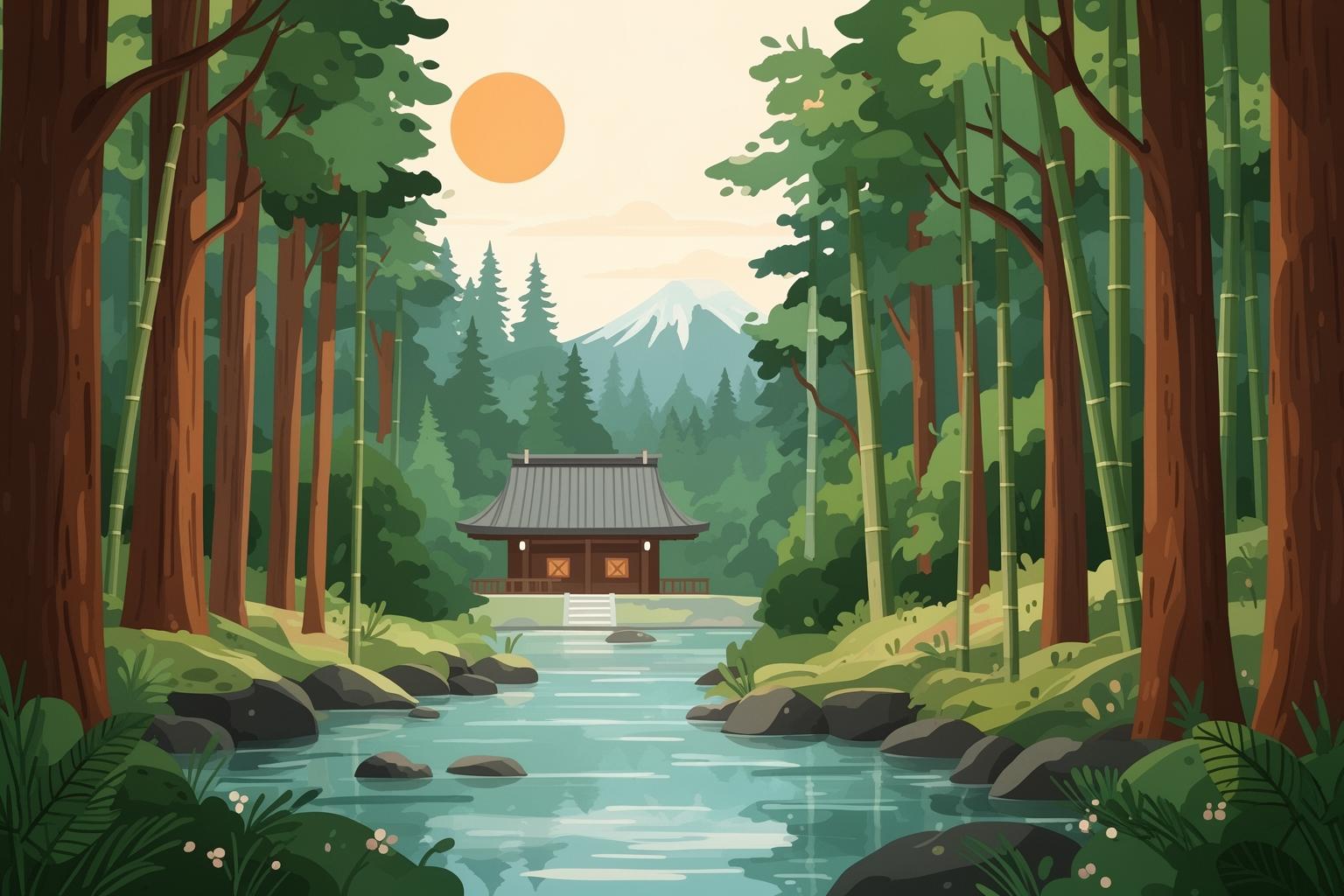
A guided shinrin-yoku session is a gentle, meandering experience. The guide’s role isn’t to lead you along a trail but to offer “invitations”—suggestions for engaging your senses. You may be asked to spend ten minutes simply observing the way sunlight filters through the leaves, a concept Japan beautifully names komorebi. Or you might be encouraged to close your eyes and listen closely, discerning the separate sounds of a distant woodpecker, the rustle of bamboo, or the murmur of a hidden stream. You could also be invited to touch the rough bark of a cedar or the cool, moist moss on a stone.
The focus lies in full sensory immersion. It’s about noticing the faint fragrance of pine needles beneath your feet after a light rain. It’s about sensing the air against your skin. It’s about unplugging from the digital world and reconnecting directly with the analog environment of the forest. This intentional slowness and sensory awareness distinguish it from exercise. A hike often centers on conquering the trail and pushing physical limits, whereas forest bathing invites the forest to enter you, allowing your body and mind to harmonize with the natural rhythms around you. You might cover only a single kilometer over two or three hours. The distance doesn’t matter. The depth of the experience does.
An Urban Culture’s Deep-Rooted Need
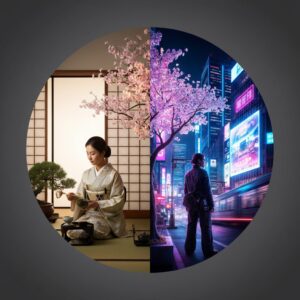
This prescribed return to nature fits perfectly within the broader context of Japanese culture. At the core of modern Japan lies a profound duality: on one side, it is a nation characterized by some of the world’s most futuristic, sprawling, and densely populated megacities; on the other, it is a culture with an ancient and deeply rooted reverence for nature, grounded in its native religion, Shintoism.
Shintoism is animistic; it does not place humanity at the center of the universe. Instead, it perceives kami—gods, spirits, or divine essences—in all things, especially in remarkable natural objects. A majestic, ancient tree, a powerful waterfall, or a uniquely shaped rock can all be homes to kami. Shrines are often constructed to honor these sacred sites, and ancient trees frequently bear a shimenawa, a sacred rope, marking their spiritual significance. This belief system cultivates a deep respect for the natural world, viewing it not as a resource to be exploited but as a living, sacred entity.
For centuries, this was the unquestioned foundation of the Japanese worldview. However, rapid post-war industrialization and urbanization created a divide. Millions now live lives almost entirely surrounded by concrete and steel, with days dictated by train schedules and office hours. The connection to nature, so fundamental to the culture’s spiritual identity, has become weakened. Shinrin-yoku, therefore, is more than just a stress-reduction technique; it is a modern, secular ritual for reconnecting with an essential part of the Japanese psyche. It is a way to remember a relationship that the relentless pace of modern life has caused many to forget.
It is a quiet rebellion. It resists the cult of efficiency and productivity by embracing aimlessness. It offers a remedy to the city’s overstimulation through the gentle, restorative stimulation of the forest. In a society that values the group, it creates space for solitary, internal reflection. Shinrin-yoku is not an escape from Japaneseness; rather, it is a profound and necessary engagement with it. It acknowledges that no matter how many skyscrapers rise or how fast bullet trains travel, the human spirit and the national soul will always need the deep, quiet wisdom of the woods.