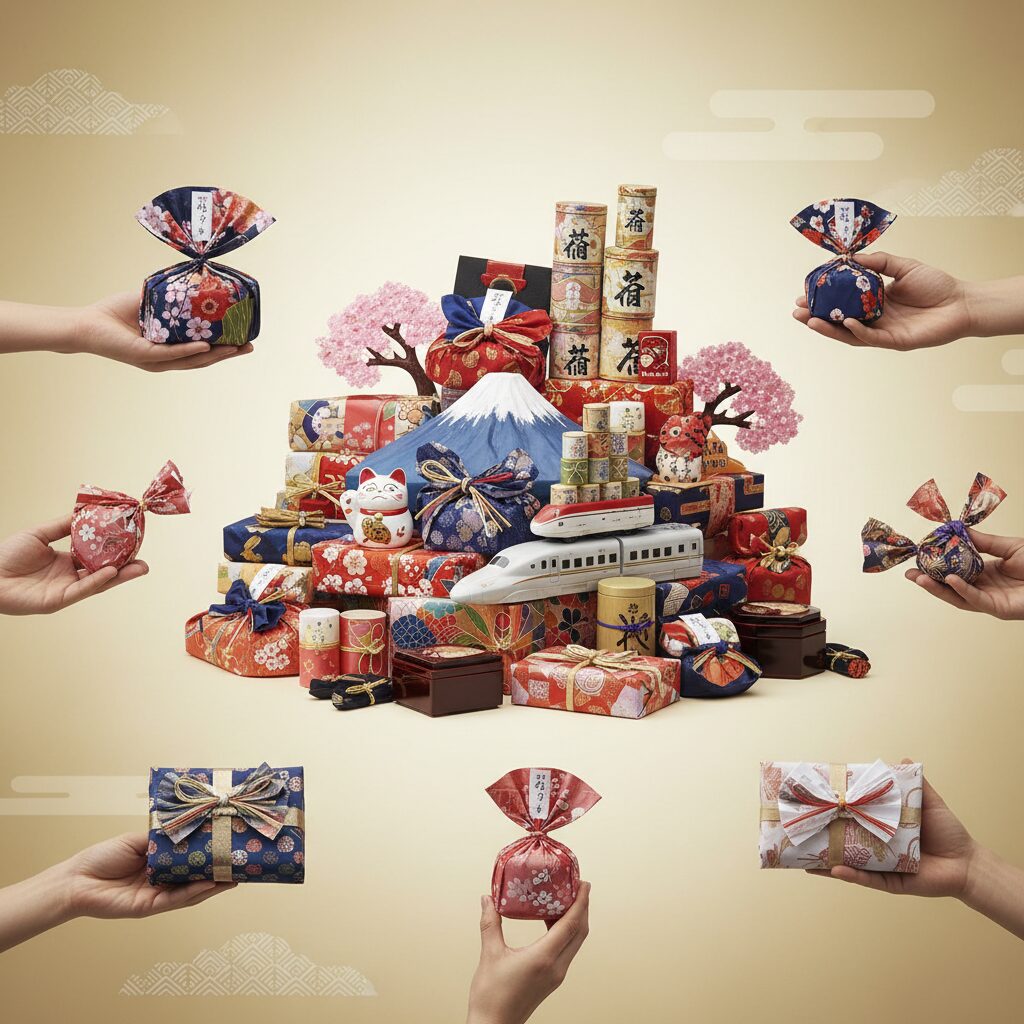
Walk into any Japanese office on a Monday morning, and you’ll likely see it. Sitting quietly on a central table or near the tea station is a brightly colored, impeccably designed box. Within a few hours, it will be opened, and its contents—a neat grid of individually wrapped cookies, crackers, or cakes—will be passed around or left for people to take. Someone has returned from a trip, and this is the evidence. This isn’t just a friendly gesture; it’s the fulfillment of a deeply ingrained social contract. This is omiyage.
If you translate omiyage (お土産) as a simple “souvenir,” you’ve already missed the point. A souvenir is something you buy for yourself to remember a trip—a keychain, a t-shirt, a magnet for your fridge. It’s a personal memento. Omiyage, on the other hand, is never for you. It is a gift purchased specifically for the people back home: your colleagues, your family, your neighbors. It’s a tangible piece of your journey, brought back to share with the group you temporarily left behind. It’s a way of saying, “I was thinking of you while I was away,” and more importantly, “Thank you for holding down the fort.”
Understanding omiyage is essential to understanding the rhythm of social and professional life in Japan. It’s far more than a box of sweets; it’s a tool for maintaining harmony, expressing gratitude, and acknowledging your place within a collective. For foreigners, it can seem like a quaint custom, but to disregard it is to fundamentally misunderstand the unspoken rules of Japanese society. This isn’t just about being polite. It’s about participating in a ritual that binds people together, one beautifully wrapped gift at a time.
This tradition echoes in other aspects of Japanese culture, as seen in the bustling atmosphere of depachika basements, where culinary artistry and communal spirit unite.
The Gift That Says, “I Belong”
At its core, the culture of omiyage is deeply tied to the group-oriented nature of Japanese society. In contrast, the Western focus on individualism often frames a vacation as a personal retreat, a story to be recounted later through photos and anecdotes. In Japan, your absence from the group—whether it’s your office team or family—is a significant event. You have temporarily stepped away from your role, and your responsibilities may have been managed by others. Omiyage is the crucial gesture that helps ensure your smooth reintegration into that group.
Consider it this way: the gift symbolizes your return, but it also acts as an apology for your absence and a token of gratitude toward those who took over in your stead. It repairs the slight disruption in the social fabric caused by your departure. By bringing something back for everyone, you reaffirm your bond with the collective. You acknowledge that even while physically elsewhere, your thoughts remained with the group. This is a powerful, non-verbal message in a culture that often values indirect communication.
The Meaning in the Name
The word itself hints at its purpose. The kanji for omiyage, 土産, literally mean “product of the land.” This is crucial. An omiyage is not just any gift; it must be a specialty, or meibutsu (名物), of the region you visited. If you take a business trip to Hokkaido, you bring back Shiroi Koibito cookies. A family visit to Kyoto calls for yatsuhashi, a cinnamon-flavored sweet. A weekend in Fukuoka means you’ll be searching for some mentaiko (spicy cod roe) flavored crackers. Each region, and often every major train station and airport, has its own famous omiyage, carefully packaged in beautifully designed boxes ready to be gifted.
This geographic specificity is essential. Buying a generic box of chocolates from the airport convenience store technically satisfies the obligation, but it sends a message of little effort. Worse still, bringing a well-known Tokyo snack back to your Tokyo office following a trip to Osaka would be perplexing—it demonstrates a fundamental misunderstanding of the custom. The gift must represent the place you visited, allowing recipients to share your travel experience through the taste of that particular location.
Omiyage as a Professional Necessity
Nowhere is the omiyage ritual more pronounced or significant than in the workplace. In a Japanese office, maintaining group harmony, or wa (和), is of utmost importance. The team operates as a cohesive unit, and any disruption to this balance must be handled with care. A vacation is a prime example of such a disruption. While your colleagues may be happy for you, your absence could result in extra work or delayed projects for them. Omiyage acts as the unspoken lubricant that eases this tension.
When you set that box on the table, you are fulfilling an essential professional obligation. It is a gesture of goodwill that carries considerable significance. It conveys, “Thank you for your hard work while I was away. Please accept this small token of my gratitude.” The gesture is not about the gift’s monetary value but the acknowledgment and respect it represents. Neglecting to bring omiyage after a trip, especially a personal holiday, would be considered thoughtless and even selfish. It implies that you do not value your colleagues or your role within the team. Although no one is likely to confront you directly, your social standing in the office would quietly but surely suffer.
The Unwritten Rules of Office Gifting
Navigating professional omiyage involves a set of unstated rules that everyone seems to instinctively understand.
Presentation is Everything
In Japan, gift packaging is often as important as the gift itself. Omiyage is no exception. The boxes are artistic, featuring beautiful designs, elegant calligraphy, and thoughtful arrangements. If the shop provides wrapping paper, it should be flawless. This attention to presentation reflects the giver’s sincerity. A crushed box or torn paper would signal disrespect. When presenting omiyage, you do so with humility, often saying something like “Tsumaranai mono desu ga…” which means “This is an insignificant thing, but…” This phrase is a customary expression of modesty, not a judgment on the gift’s quality, and helps prevent the gesture from seeming boastful.
The Importance of Individual Wrapping
Have you ever wondered why nearly all omiyage snacks are individually wrapped? This is no packaging accident but a design feature driven by social necessity. Individual wrapping ensures the gift can be distributed easily, hygienically, and fairly among many people. There’s no need for a knife, plates, or mess. A colleague can simply take one and enjoy it later at their desk. This design facilitates effortless, unobtrusive sharing, preserving the office’s workflow and harmony. It’s a small detail that reveals the practical considerations embedded in Japanese social customs.
Choosing the Right Tier
While all omiyage fulfills the same basic purpose, the choice of gift can subtly communicate status and awareness. There is a generally understood hierarchy. For a short domestic trip, a standard box of regional cookies from the train station is perfectly acceptable. However, for an overseas trip, expectations may be somewhat higher—perhaps some premium chocolates from Belgium or specialty tea from England. Additionally, you might purchase the main box for the entire team but choose a smaller, slightly more refined gift for your direct boss or colleagues who covered significant extra work during your absence. This requires social sensitivity and an understanding of office dynamics. It is a delicate balance of obligation and appreciation.
The Psychology Behind the Box
To truly understand omiyage, one must look beyond the surface etiquette and explore the cultural psychology behind it. This practice is deeply tied to the concepts of giri (義理) and on (恩). Giri can be translated as “duty” or “social obligation,” a powerful force guiding how one should behave to sustain reciprocal relationships. Bringing omiyage is an expression of giri; it is an expected part of being a member of a social group. On denotes a debt of gratitude one owes. When colleagues cover for you, they extend a form of on, and giving omiyage is a small way to repay that debt.
This exchange is far from a cold, transactional act. Instead, it serves as the mechanism through which social bonds are continually strengthened. In a culture where overt emotional displays or direct verbal praise may be rare, these ritualized gestures carry significant communicative weight. They form a reliable, universally understood language of gratitude, respect, and belonging. The omiyage ritual offers a structured and predictable way to convey complex social sentiments without the potential discomfort of direct confrontation.
A Custom in a Changing World
Certainly, not everyone in Japan wholeheartedly embraces the omiyage tradition. For some, especially younger people, it can feel like a hassle—mendōkusai. The pressure to pick the perfect gift, the expense, and the time spent shopping at the end of a trip can seem like an outdated chore. In today’s more globalized and individualistic society, some are beginning to question the necessity of such a strict social expectation.
However, the custom persists with impressive resilience. Train stations and airports continue to be filled with large omiyage shops doing steady business around the clock. Why? Because despite the small inconveniences, omiyage fulfills an important role that hasn’t been replaced. It is a simple, effective, and graceful solution to the complex challenge of maintaining social harmony.
It ensures no one feels overlooked. It offers a moment of shared connection. It eases the minor tensions that can arise in any group setting. It is a small cost to pay for a functional, thoughtful, and cohesive community.
So next time you see that colorful box appear in a Japanese office, you’ll know exactly what it is. It’s more than just a souvenir. It’s a carefully chosen symbol, a social lubricant, a peace offering, and a message of belonging all combined. It quietly affirms the idea that even when we travel far, we remain connected to those waiting for us at home.