So you’re looking for pottery in Japan. Not the immaculate, glossy porcelain you see in department store gift sections, nor the mass-produced trinkets lining the main streets of tourist towns. You’re looking for something else. Something with texture, with a story baked into its very form. You’re searching for the studios where the air is thick with the scent of damp earth and woodsmoke, where the shelves hold pieces that feel ancient and alive at the same time. You’re looking for the heart of wabi-sabi, and you have a feeling it lives in the clay.
This is a journey many discerning travelers try to make, but it’s one that guidebooks often get wrong. They might point you to a perfectly curated gallery that sells wabi-sabi-style ceramics, but that’s not the same thing. What you’re after is the source: the maker’s space, the kiln, the quiet philosophy that gives these objects their profound character. This isn’t about finding a souvenir. It’s about finding a connection to an aesthetic that runs counter to our modern obsession with perfection, polish, and disposability. It’s about understanding a deeply ingrained part of the Japanese psyche that cherishes the imperfect, the impermanent, and the humble. Finding these places requires looking past the obvious and learning to see with different eyes. It’s less of a shopping trip and more of a pilgrimage.
Exploring the rich tapestry of Japan’s cultural heritage can lead you to unexpected treasures, such as the understated charm of traditional Japanese konbini that echo the very spirit of wabi-sabi.
Deconstructing Wabi-Sabi: More Than Just ‘Imperfect’
Before you can discover a wabi-sabi studio, you need to grasp the spirit that animates it. The term is so often misused, casually applied to anything that appears rustic or aged, that it has lost much of its original meaning. It’s not a design trend; it’s a way of seeing the world.
Let’s explore it further. Wabi refers to a quiet, rustic simplicity. It’s the contentment found in a modest life, free from the pursuit of luxury. Picture a solitary cabin in the woods, a well-worn wooden tool, or the quiet satisfaction of a humble meal. It’s an internal sense of peace and serenity that comes from recognizing richness in simplicity. Sabi, in contrast, is about the beauty that emerges with age, wear, and the passage of time. It’s the visible traces of life on an object—the patina on bronze, the moss on a stone lantern, the softened edges of a wooden step. It’s an appreciation for the story that imperfection reveals.
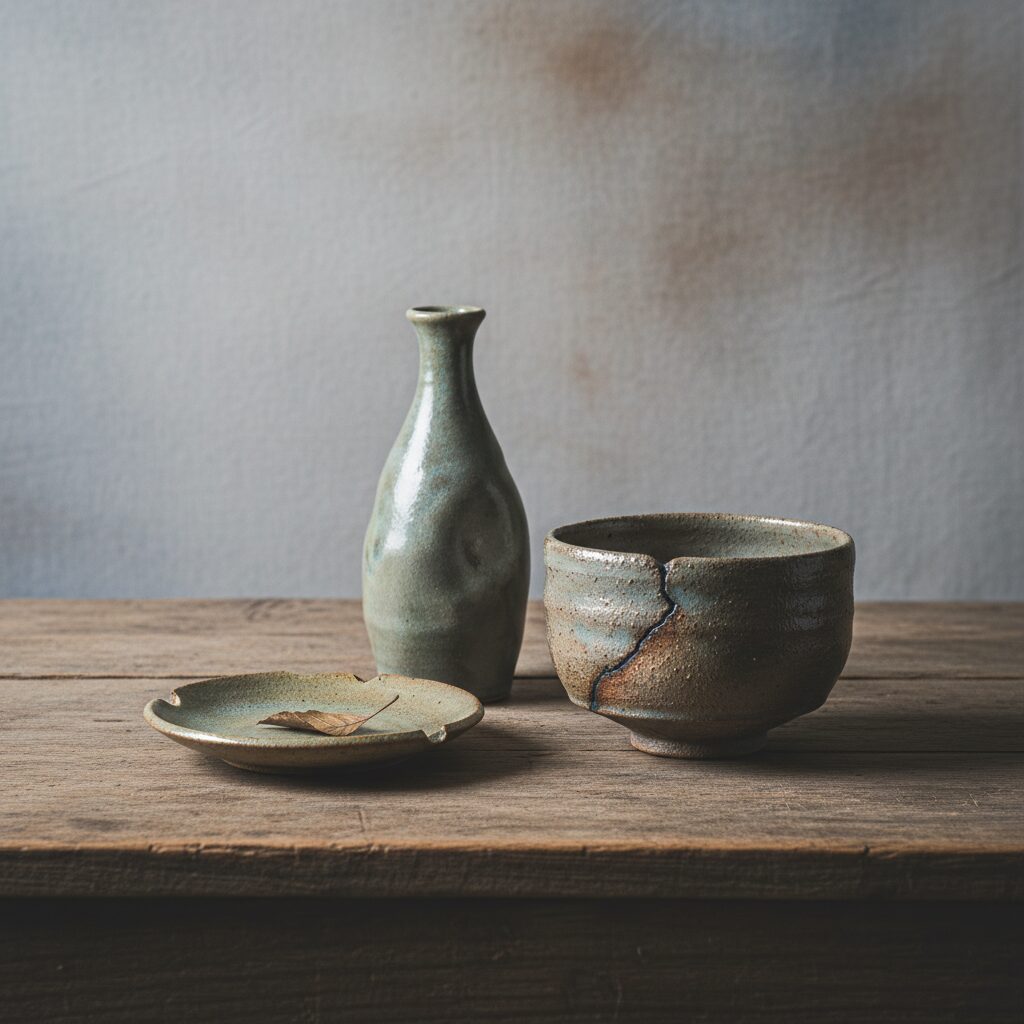
When wabi-sabi is expressed in ceramics, it is not a style to be deliberately manufactured. You can’t just craft a lopsided cup and call it wabi-sabi. Instead, it’s a quality that emerges naturally. It comes from a process where the artist collaborates with nature and chance. The potter shapes the clay, but the fire in the kiln holds the final authority. An unexpected drip of glaze, a subtle crackle appearing during cooling, a scorch mark where a flame kissed the surface—these are not seen as flaws. They are accepted, even celebrated, as unique moments in the life of the piece. They serve as evidence of its creation, a tribute to the forces that shaped it. An artist who truly understands this isn’t trying to create imperfection; they aim to create honesty, and in that honesty lies its imperfect beauty.
The Anatomy of a Wabi-Sabi Studio
Once you grasp the philosophy, you begin to notice the places where it flourishes. These studios rarely advertise with flashy signs or large windows. Instead, they reveal themselves through more subtle hints. Learning to identify them is the first step in your search.
Location is the First Clue
Authentic pottery studios are almost never found on a city’s main commercial street. The high rent and heavy foot traffic suit retail shops, not the slow, dusty process of creation. Instead, look toward the outskirts. You’ll find them tucked away on quiet residential side streets, sometimes operating out of the ground floor of an old house with no sign, just a few pots discreetly placed by the door. More often, they cluster in traditional pottery towns—places like Mashiko, Bizen, Shigaraki, or Tamba. These are entire communities centered around clay, where hillsides are marked by quarries and the air carries a faint scent of burning wood. Reaching these towns usually means a journey by local train or bus—a deliberate act of seeking that filters out casual tourists. The journey itself becomes part of the experience, slowing you down and preparing you for a different pace of life.
The Maker’s Mark: Look for the Hand, Not the Machine
The studio’s physical environment reveals everything. Forget the bright, sterile white walls of a modern art gallery. A true maker’s space is, above all, a workshop—a place of labor. Evidence of that labor should be visible everywhere. A fine layer of clay dust might cover every surface. The floor may be stained and uneven. Buckets of glaze, tools worn smooth from years of use, and shelves sagging under the weight of pieces in various stages—some drying, some waiting for their first firing, others finished—will be around.
One of the most telling signs is the kiln. A massive, wood-fired climbing kiln (noborigama) or tunnel kiln (anagama) built into a hillside is a clear sign of a potter deeply committed to traditional methods. These kilns are impressive, almost dragon-like earthen structures resting on the property. Firing them can take days of continuous, exhausting work, feeding wood into the firebox around the clock. The results are unpredictable, which is exactly the point. This acceptance of chance is central to the wabi-sabi ethos. If you see a stack of firewood as tall as the building itself, you’ve found the right place.
The Artisan’s Presence
In these studios, the boundaries between workshop, gallery, and home often blur. More often than not, the artisan will be present, working—perhaps hunched over a potter’s wheel, trimming the foot of a bowl, or quietly examining a freshly fired piece. Don’t expect a polished salesperson to welcome you at the door. The maker may simply offer a quiet nod before returning to their work. This isn’t rudeness; it’s focus. Their life is one of deep concentration, and you are entering their creative space.
Those who choose this path are a distinct breed. They have deliberately opted out of a world that values speed and scale. They dedicate themselves to a craft that is physically demanding, financially uncertain, and requires a lifetime to master. They are philosophers as much as artisans, expressing their worldview through clay. Their presence fills the studio with a quiet dedication. It’s a space governed by the rhythm of the seasons, the drying of clay, and the firing of the kiln, not by market demands.
Reading the Clay: What to Look For in the Pottery Itself
Training your eye to truly appreciate ceramics is the next step. As you handle the pieces, you’re searching for signs of the artist’s touch and the kiln’s fire, rather than machine-made perfection.
Asymmetry and ‘Naturalness’
Pick up a teacup (yunomi) or a rice bowl (chawan). Does it feel perfectly round? Or does it have a slight oval shape, a gentle waviness in the rim that seems to fit the curve of your hand? Wabi-sabi forms are often subtly asymmetrical. They aren’t careless or poorly crafted; instead, their shape feels organic, as if it naturally evolved rather than being forced into existence. The potter lets the clay express itself, guiding it instead of controlling it completely. Notice the faint fingerprints, the marks from trimming tools, the slight tilt of a vase. These are signs of a dialogue between the maker and their material.
The Language of Glaze
Glaze is another important clue. Instead of uniform, bright colors, seek out glazes that are complex and varied. A hallmark of wood-fired pottery is a natural ash glaze (shizen-yu). This glaze isn’t applied by the potter but forms during firing when wood ash circulates inside the kiln, melts at high temperatures, and settles on the pots’ surfaces, flowing down their sides in rivers of green, brown, and gold. This effect is entirely shaped by the fire. You may also find pieces featuring a deliberate crackle in the glaze (kannyu), or a rough, gritty texture known as “shark skin” (samehada). Some of the most admired pieces, especially from traditions like Bizen or Shigaraki, are left unglazed (yakishime). Their beauty arises from the raw, scorched clay texture, colored by flames and ash. These are not flaws; they embody the spirit of the piece.
The Weight of Intention
Don’t just look—touch. While a gallerist might hesitate, in most studios you’re encouraged to carefully pick up the work. Notice how it feels in your hands. Does it have a satisfying weight? Is it balanced? Run your fingers across the surface. Is it rough or smooth? Cold or warm? A well-crafted piece of pottery has a presence, a quiet strength. It feels grounded and substantial. You can sense the maker’s intention through its balance and form. It is an object made not merely for display but for use—to hold warm tea, to serve a simple meal. Its beauty is meant to be fulfilled through interaction.
The Art of the Visit: Etiquette and Approach

How you behave in these spaces is important. This isn’t a typical retail environment, and treating it like one can lead to a feeling of disconnection. Being a respectful guest will greatly enhance your experience.
It’s a Workshop, Not a Supermarket
Keep in mind that you are in a working artist’s studio, often also their home. Move thoughtfully. Walk slowly and speak softly. The silence is not empty; it’s filled with focus. Always ask permission before taking photographs; a simple “Shashin o totte mo ii desu ka?” will be appreciated. Pay attention to your surroundings—there are delicate items everywhere, and some parts of the workshop may be off-limits for safety reasons. Treat the space with the same respect you would give to a library or a temple.
Engage with Respect, Not Expectation
Don’t assume the artisan will launch into a sales pitch or explain every piece in detail. The work is meant to communicate on its own. If the artist is not deeply focused on their craft, a simple expression of appreciation is the best way to begin a conversation. A comment like “Kirei desu ne” (It’s beautiful) or a question about a particular detail you admire is much more effective than opening with “How much is this?” Bargaining or requesting a discount is culturally inappropriate and shows disrespect toward the artist’s labor and skill. The price reflects not just the materials but also the years of experience and the days spent firing that went into creating the piece.
The Purchase as a Connection
If you choose to buy something, see it as an act of patronage and connection, not merely a transaction. You are not just acquiring a product. You are becoming the caretaker of an object that embodies the artist’s time, philosophy, and a fragment of the kiln’s fire. When the potter carefully wraps your selected piece in cloth and places it in a wooden box (kiribako), they are entrusting its story to you. This ritual elevates the exchange from commerce to a meaningful transfer of culture. You take home a tangible piece of the wabi-sabi spirit, a gentle reminder to find beauty in the imperfect moments of your own life.
Where to Begin the Search
Instead of providing a map to a specific location—which can cause over-tourism and diminish the magic of discovery—it’s better to direct you toward the right forests. Japan boasts several historic pottery regions, each with its own unique character. Researching and exploring these places independently is part of the reward.
Mashiko: Situated in Tochigi Prefecture, north of Tokyo, it has a strong connection to the mingei (folk art) movement and is renowned for its earthy, sturdy, and functional pottery with warm, thick glazes. It’s a relatively accessible and welcoming town for visitors.
Bizen: Located in Okayama Prefecture, this is one of Japan’s six ancient kiln sites. Bizen-ware is famously unglazed, its character coming entirely from the unique iron-rich clay and the exceptionally long, week-long firings in wood-burning kilns. The results are subtle, powerful, and deeply respected.
Shigaraki: Also one of the six ancient sites, found in Shiga Prefecture. Shigaraki clay is sandy and coarse, with pieces often displaying a distinctive scorched, rugged texture accented by flecks of feldspar that burst on the surface during firing. It showcases a raw, elemental style of pottery.
Tamba (Tachikui): Located in Hyogo Prefecture, this is another ancient kiln town. Tamba pottery is known for its natural ash glazes and simple, honest forms. It’s a quiet rural area where you can sense centuries of tradition.
To discover the wabi-sabi maker within these towns, you still need to put in the effort. Wander off the main street. Follow the smoke from a kiln. Peek down alleyways. The best discoveries are rarely the most obvious.
Ultimately, the quest for these studios is an exercise in mindfulness. It encourages you to slow down, observe closely, and appreciate the subtle beauty that our fast-paced world often misses. The bowl or cup you bring home will be more than an object; it will be a vessel of memory, a tangible link to a quiet workshop where an artist and fire combined to create something honest and beautiful. It serves as a reminder that true perfection lies not in a flawless surface, but in a well-lived story.