So you’ve heard about shinrinyoku, or ‘forest bathing’. The term has drifted overseas, usually packaged in lifestyle blogs as a kind of quaint, Japanese-style wellness trend—a mindful walk in the woods, maybe with some green tea involved. It sounds pleasant enough, a simple prescription to unplug and relax. And while it is that, this gentle translation misses the point entirely. It smooths over the cultural texture and scientific rigor, reducing a profound practice to a simple weekend activity. In Japan, shinrinyoku isn’t just a nice idea; it’s a recognized, government-promoted form of preventative medicine. It’s a deliberate response to the pressures of a hyper-modern society, built on a foundation of ancient spiritual beliefs and validated by contemporary medical research.
To truly understand it, you have to see it not as a trend, but as a deep-seated cultural instinct. It’s the convergence of Shinto reverence for nature, the psychological escape valve for intense urban life, and a data-driven public health initiative. This isn’t just about ‘getting back to nature’. It’s about letting nature get back into you, in a way that can be measured in your bloodstream and observed in your brain activity. It’s a prescription without a pill, a therapy session where the therapist is a forest. And understanding why this became a cornerstone of Japanese well-being reveals a great deal about the country’s relationship with its environment, its people, and the enduring search for balance in a world that constantly threatens to throw us off-kilter.
Exploring further beyond the calming effects of shinrinyoku, traditional public baths offer another window into Japan’s multifaceted approach to well-being.
The Roots of Reverence: Why a Forest is Never Just Trees
Before diving into the science, we first need to explore the spiritual foundation from which shinrinyoku emerged. In the West, nature is often regarded as a resource to manage or a wilderness to conquer. Mountains are challenges to be summited; forests serve as sources of timber or settings for recreation. By contrast, the Japanese worldview, deeply influenced by Shinto, approaches this differently. Shinto, Japan’s indigenous religion, is a form of animism that does not position humanity at the top of a hierarchy. Instead, it perceives divinity, or kami, in all things—the rivers, mountains, wind, and especially the trees.
The Presence of the Gods
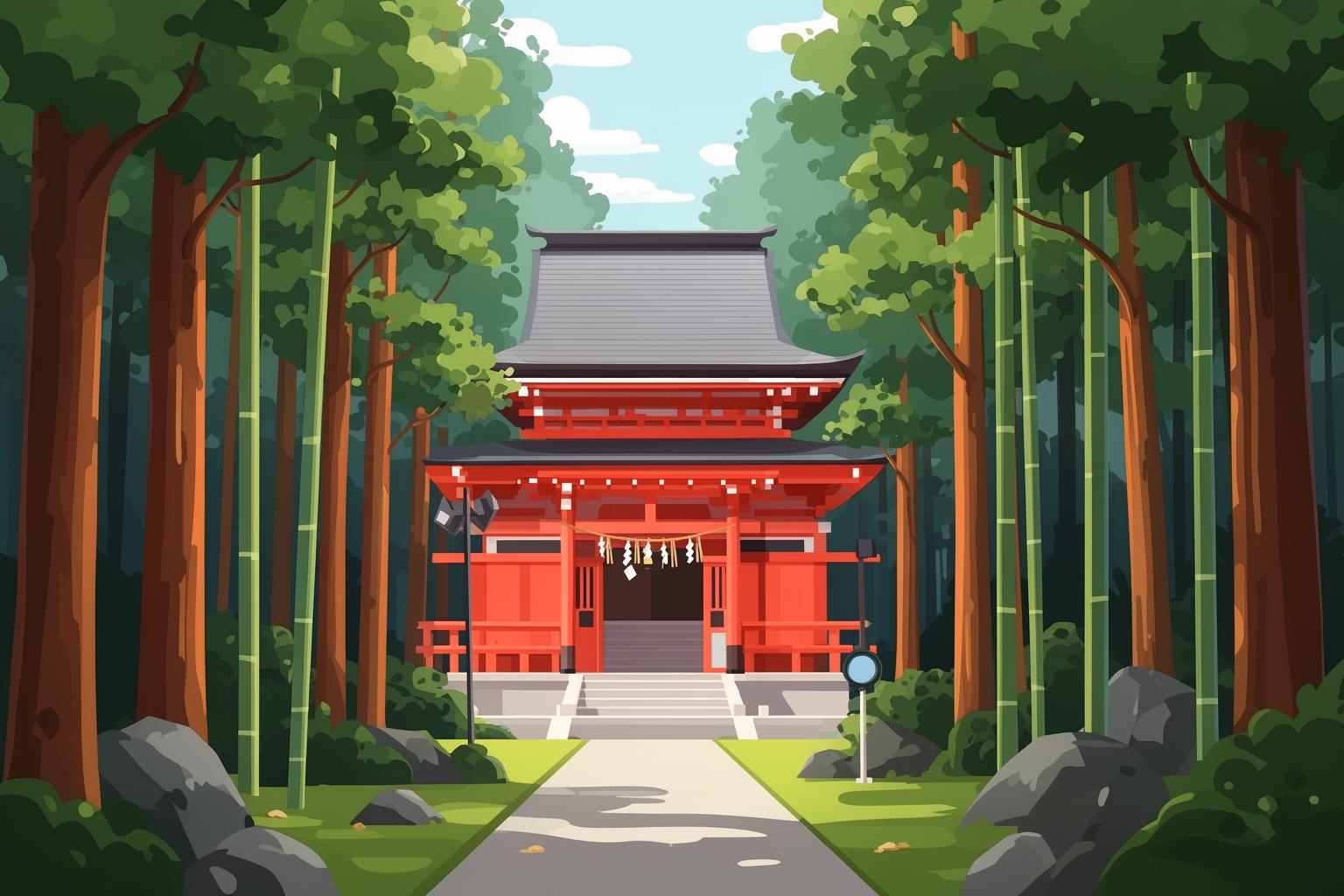
Walking through an ancient Japanese forest is like entering a sacred realm. You often encounter venerable camphor or cedar trees adorned with a thick rice-straw rope called a shimenawa, tied around their trunks. These are shinboku, sacred trees believed to house kami. They are not meant to be cut down but revered. This simple visual sign transforms one’s interaction with the environment. You are not merely a visitor in a neutral space; you are a guest within a living sanctuary, a cathedral of towering cedar and whispering bamboo. This cultural mindset runs deep—the forest is not just an “it,” but a presence. It fosters an innate respect and a sensation of being embraced by something greater than oneself. When you enter a forest, you are, quite literally, stepping into a place of worship. The silence is not empty; it vibrates with a quiet, powerful energy.
The Urban Compact and the Craving for Green
This ancient respect for nature exists in a complex, dynamic tension with Japan’s ultra-modern urban environment. Millions live in some of the most densely packed cities on earth—immersed in a world of concrete, steel, and relentless sensory overload. The daily commute, intense work culture, and sheer population density create immense psychological strain. Life in a city like Tokyo is efficient and vibrant but deeply disconnected from the natural world. This challenge is certainly not unique to Japan, yet the severity of the urban experience here makes the need for a natural reprieve especially urgent.
Shinrinyoku, therefore, is more than just a pleasant activity; it is a vital act of rebalancing. It is a conscious, intentional pilgrimage away from the artificial and back to the authentic. The forest provides a sensory reset. The chaotic noise of the city yields to the rustling of leaves and birdsong. The harsh lines of buildings soften into the organic shapes of trees and rocks. The recycled office air gives way to the fresh, earthy scent of damp soil and wood. This stark contrast is essential. The relief is deeply felt precisely because the daily pressures are so overwhelming. It represents a profound yearning for a space that demands nothing from you—a place where you can simply exist.
From Folk Wisdom to Public Health Policy
While the cultural and spiritual reverence for forests is ancient, the term shinrinyoku itself is surprisingly contemporary. It was introduced in 1982 by the Japanese Ministry of Agriculture, Forestry, and Fisheries. This was no marketing ploy; it was a deliberate public health strategy. During the 1980s, Japan was experiencing an economic boom, but a troubling downside was surfacing. Stress levels were soaring. The phenomenon known as karoshi, or death from overwork, was becoming a serious social issue. There was increasing awareness that the nation’s economic prosperity was coming at the expense of its citizens’ physical and mental well-being.
The government sought accessible, low-cost ways to enhance public health. They turned to their most abundant natural resource: forests, which cover nearly 70% of the country. They named an age-old intuition and began to study it scientifically. The aim was to shift the idea of ‘nature is good for you’ from poetic sentiment to evidence-based medicine.
The Science of Healing Air
Japanese researchers, especially Dr. Qing Li of the Nippon Medical School in Tokyo, began experiments to measure the physiological effects of spending time in forests. Their findings provided scientific support for what people had intuitively known for centuries. Their discoveries focused on several key areas.
The first were phytoncides—antimicrobial volatile organic compounds released by trees and plants to protect against insects, bacteria, and fungi. When humans inhale these airborne chemicals, they have significant effects on the body. Dr. Li’s research showed that breathing phytoncides markedly increases the number and activity of Natural Killer (NK) cells, a type of white blood cell crucial to the immune system for targeting and eliminating infected or cancerous cells. Studies found that a two-day forest visit could enhance NK cell activity for up to thirty days.
Next, they examined the impact on the nervous system. Daily stress triggers the sympathetic nervous system, our ‘fight or flight’ response, flooding the body with hormones like cortisol and adrenaline, which raise heart rate and blood pressure. The studies demonstrated that spending time in a forest activates the parasympathetic nervous system, the ‘rest and digest’ response. Saliva and urine tests showed significantly reduced cortisol levels after a forest walk compared to a city walk. Blood pressure, pulse rate, and heart rate variability all improved, indicating a shift from stress to relaxation.
The Institutionalization of Nature Therapy
Building on this growing evidence, Japan has taken shinrinyoku further by professionalizing it. Nationwide, dozens of certified ‘Forest Therapy Bases’ and ‘Forest Therapy Roads’ have been established. These are not just any wooded areas but specific forests scientifically evaluated and designated for their therapeutic benefits. Researchers assess air quality, trail accessibility, and overall environment to ensure maximum healing potential.
Additionally, certified Forest Therapy Guides are available. These are not merely nature guides who identify trees; they are trained professionals versed in the science of shinrinyoku who facilitate immersive experiences. They lead participants at a deliberately slow pace, provide ‘invitations’ to engage the senses, and help people disconnect from a goal-driven mindset. This infrastructure reflects how seriously the practice is regarded. It is not left to chance but is a structured, supported, and medically respected form of care.
The Practice: The Art of Sensory Immersion
So, what does a proper shinrinyoku session actually entail? The first and most important point to grasp is that it is not exercise. It is unrelated to hiking, trekking, or trail running. The aim is not to reach a destination or burn calories. In fact, you might only cover a kilometer or two over the course of several hours. The real journey is internal.
Slowing Down to Notice
The pace is intentionally slow, almost meditative. A guide might describe it as a ‘toddler’s pace’—pausing often to observe a mushroom, touch moss on a rock, or watch an insect. This enforced slowness pushes back against the hectic speed of modern life. It compels the mind to stop planning, worrying, and rushing ahead, and instead simply land in the present moment.
The entire experience centers on engaging the five senses, something we rarely do intentionally in everyday life.
Sight: You’re encouraged to observe details you’d typically overlook. The intricate pattern of a leaf’s veins. The way sunlight filters through the canopy, a phenomenon for which Japan has a beautiful, specific term: komorebi. The endless shades of green, from deep, dark cedar to bright, fresh moss.
Sound: You pause and simply listen. At first, it may seem silent, but gradually you begin to discern layers of sound—the wind stirring pine needles, the calls of various birds, the gurgle of a distant stream, the rustle of a small animal in the undergrowth. You listen to the silence between the sounds.
Smell: This is where phytoncides come into play. You take slow, mindful breaths, inhaling the rich, earthy aroma of the forest floor, the sharp scent of pine needles, the fresh smell of air after rain. Smell is strongly connected to memory and emotion, and the forest’s fragrance has a direct, soothing effect on the brain.
Touch: You are invited to physically engage with the forest. Feel the rough, textured bark of an ancient tree. Run your fingers through cool stream water. Pick up a smooth stone. Remove your shoes and sense the soft moss or cool earth beneath your feet.
Taste: This often surprises people most. A guide might brew a simple tea from foraged leaves or needles or simply encourage you to notice the taste of the fresh, clean air itself.
Underlying all of this is an essential, unspoken rule: disconnect. Phones are switched off and put away. The urge to take photos, post updates, or filter the experience through a screen is resisted. Shinrinyoku is about direct, unfiltered contact with nature. It is an act of being present, not documenting presence. This digital detox is a key part of its healing power.
A Prescription for Modernity
Shinrinyoku is much more than just a wellness trend. It is a beautiful, intricate practice that intertwines the spiritual, cultural, and scientific aspects. Rooted in an ancient Shinto reverence for nature as sacred, it is driven by the modern desire to escape the stresses of urban life and validated by thorough medical research.
It provides a profound understanding of the Japanese approach to health: emphasizing prevention over cure, valuing balance, and embodying a deep wisdom that acknowledges the complex relationship between environmental health and human well-being. It serves as a reminder that our bodies and minds are not separate from nature but are fundamentally connected to it. In an era dominated by digital distractions and chronic stress, this practice of doing nothing—merely walking, breathing, and observing in a forest—feels less like a charming tradition and more like a vital, urgent remedy for the human soul.