Sit down for a meal anywhere in Japan—a bustling ramen shop, a quiet temple dining hall, or a family dinner table—and you’ll notice a pause. Before anyone lifts their chopsticks, before a single grain of rice is touched, a small ritual unfolds. Hands come together, heads dip in a slight bow, and in a soft chorus or a quiet murmur, you’ll hear the word: “Itadakimasu.”
To a visitor, the common translation of “Let’s eat,” or perhaps something akin to the French “Bon appétit,” seems to fit. After all, it’s said right before eating. But that translation is woefully incomplete. It captures the timing but completely misses the soul of the expression. It’s like describing a symphony as just “a collection of sounds.” The truth is, there is no direct equivalent in English, because itadakimasu isn’t a call to action. It is a state of mind.
At its core, itadakimasu is a moment of profound gratitude. It’s a quiet, secular prayer that acknowledges the vast, interconnected web of life and labor that brought the meal to your bowl. It’s a recognition of sacrifice—of plants, of animals, of people. This single word transforms the simple act of eating from a biological necessity into a moment of mindful connection with the world. It’s not about a specific deity; it’s about a deep-seated cultural respect for the food itself, a philosophy you can feel in the air just before the first bite.
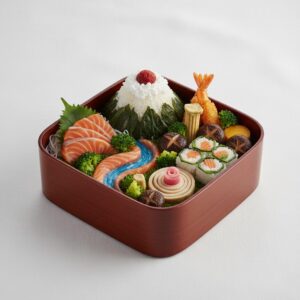
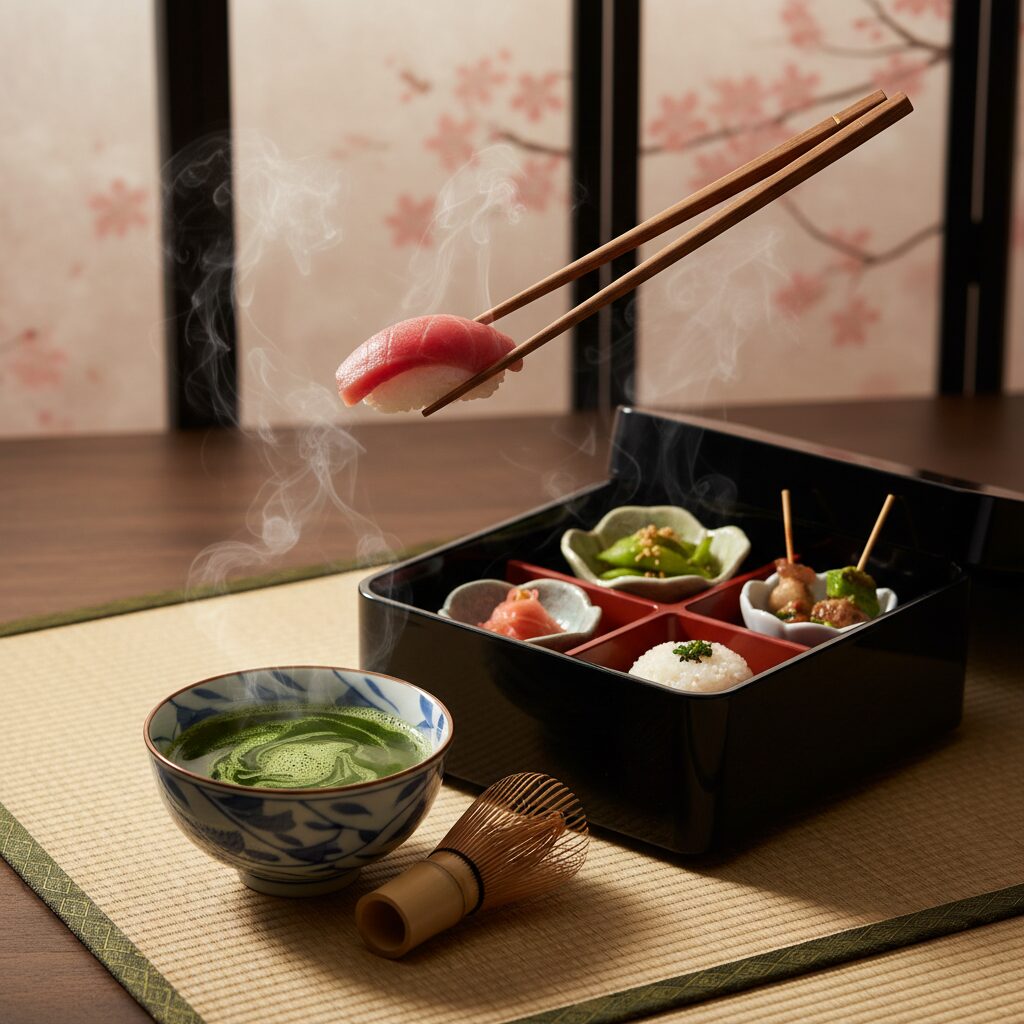
The deep sense of thankfulness encapsulated in itadakimasu is mirrored in various aspects of Japanese culinary culture, as seen in the artistry of traditional bento, where every carefully arranged element celebrates the ritualistic spirit of meal preparation.
Deconstructing the Word Itself
To truly understand it, you need to examine the word’s core. Itadakimasu (いただきます) is the polite, formal form of the verb itadaku (頂く). While it can mean “to eat” or “to drink,” its essential meaning is “to receive” or “to accept.”
However, it’s a particular kind of receiving. Itadaku is a humble verb, used when receiving something from a superior or someone of higher status. Historically, this could have been a gift from a feudal lord or an offering from the gods. The kanji 頂 visually emphasizes this, portraying a head—you are literally bowing your head to accept something from above. So, when you say itadakimasu, you are not simply stating your intention to eat. You are saying, “I humbly receive.”
What exactly are you receiving? Everything. You are accepting the lives of the plants and animals that make up your meal. You are acknowledging the hard work of the farmer who grew the vegetables and the fisherman who caught the fish. You are embracing the effort of the person who cooked and prepared the dish. In this sense, nature, the farmers, and the cooks are all honored. You are the humble recipient of their combined effort and sacrifice. This linguistic subtlety forms the foundation of the whole concept. It’s not a transaction between equals; it’s the acceptance of a gift you did not create by yourself.
The Four Pillars of Gratitude in ‘Itadakimasu’
So how does this gratitude manifest in practice? It’s more than just a vague feeling of thankfulness. The sentiment behind itadakimasu can be understood through several distinct, overlapping layers of appreciation. It expresses thanks outwardly in multiple directions simultaneously.
Gratitude for Nature and the Lives Given
At its core, itadakimasu acknowledges life itself. Rooted in Buddhist principles and Japan’s indigenous Shinto beliefs, there’s a cultural understanding that all living things—from a stalk of rice to a wild boar—carry a life force. To eat, you must take that life. This does not evoke guilt, but rather deep respect.
When you say itadakimasu, you are looking at the slice of grilled salmon on your plate and saying, “I am receiving your life to nourish my own. Thank you.” It is a direct, personal recognition of the sacrifice made. This mindset naturally encourages a strong aversion to waste. If you truly value the life given to produce your meal, you won’t leave half of it uneaten. The Japanese concept of mottainai—a feeling of regret over waste—is the natural outcome of the gratitude expressed in itadakimasu. Food is not merely fuel; it is a transfer of energy and life, and treating it carelessly disrespects its source.
Gratitude for the Farmers, Fishers, and Ranchers
Beyond nature’s sacrifice, the phrase extends to the chain of human labor. It is a thank you to the unseen hands who brought the ingredients from the earth and sea to the market. Consider the rice farmer, knee-deep in muddy water under the summer sun, planting each seedling with great care. Think of the fisherman, rising before dawn to brave the uncertain ocean. Think of the rancher who tends to animals day after day.
Most of us in cities are completely detached from this process. We buy our food neatly packaged at supermarkets, often without considering its origins. Itadakimasu serves as a mental bridge back to that source. It is a moment to acknowledge that your meal did not appear by magic. It is the product of immense physical effort, skill, and often hardship. You are thanking the entire chain of producers, whose dedication literally makes your meal possible. It is a humbling thought, linking your simple dinner to a vast network of human toil.
Gratitude for the Cooks and Preparers
The circle of gratitude then focuses on the present moment: the person who prepared the meal. This includes the expert sushi chef who has spent decades mastering their craft, the line cook at your neighborhood noodle shop, and perhaps most importantly, the family member who cooked for you at home. Itadakimasu is also a direct expression of thanks for their time, skill, and care.
In Japanese cuisine, where careful preparation and thoughtful presentation are paramount, this appreciation is especially meaningful. A meal often represents an act of love or professional pride. Recognizing that effort before eating is a fundamental sign of respect. It tells the cook, “I see the work you’ve put into this, and I am grateful.” Even when eating alone, the sentiment holds. You might be thanking the person who prepared your bento box, or if you cooked for yourself, you’re taking a moment to appreciate your own effort in nourishing your body.
Gratitude for the Act of Sharing and Receiving
Finally, itadakimasu reflects your own role in this cycle. As you prepare to eat, you are the final link. You are the one who will receive all of this life and labor into your body. The phrase is a humble acceptance of that role. When said in a group, it serves a social purpose as well, establishing a shared starting point for the meal and reinforcing a sense of community and harmony (wa). Everyone begins together, united by mutual appreciation.
By taking this moment, you consciously participate in the profound cycle of life, death, production, and consumption. It is a time to be present and recognize that you are sustained by a network far greater than yourself.
How It’s Said and When It’s Used

The practice of itadakimasu is both simple and profound. Usually, you bring your hands together in front of your chest, sometimes holding your chopsticks between your thumbs. You bow your head slightly toward your food and say the word clearly but quietly. It is a gesture of respect, not a performance.
What stands out most is its universality. This ritual is not reserved for special occasions or formal dinners. It is performed before every single meal. A multi-course kaiseki banquet receives an itadakimasu. A quickly eaten convenience store rice ball on a park bench receives an itadakimasu. A cup of tea and a biscuit receives an itadakimasu. This consistency is essential. It is woven into the everyday fabric of life and taught to children in kindergarten as one of the very first etiquette rules.
This makes it fundamentally different from the Western notion of saying grace. Grace is typically associated with a specific religion and often reserved for family dinners, not practiced by everyone, and certainly not before every snack. Itadakimasu is cultural, not religious. While it has spiritual origins, its modern practice is a social norm that transcends personal beliefs. It is simply what one does before eating.
And it has a counterpart. After the meal is finished, you once again put your hands together and say, “Gochisousama deshita” (ご馳走様でした). This phrase roughly translates to “Thank you for the feast,” but its etymology is beautiful. The word chisou (馳走) means “to run around,” referring to the effort the host made to procure and prepare the food. So you are explicitly thanking them for running around and going to great lengths for your meal. It’s the perfect complement to itadakimasu, closing the circle of gratitude.
The Modern Meaning and What It Teaches Us
For many Japanese people today, saying itadakimasu is simply a habit, ingrained since childhood. It can be spoken automatically without deeply reflecting on the supply chain behind their meal. Not everyone envisions the fisherman and farmer each time they sit down to eat.
However, that doesn’t lessen its significance. Culture operates in subtle ways. Even as a routine habit, the ritual of itadakimasu serves as a necessary pause. It acts as a built-in speed bump on the path to consumption. In a world increasingly driven by fast food, mindless snacking, and a significant disconnect from the origins of our food, this enforced moment of reflection feels more essential than ever.
It provides a powerful counter to mindless eating. Before you scroll through your phone while eating, before you quickly finish your lunch at your desk, you must stop, bring your hands together, and acknowledge the meal. That brief, simple gesture has the power to change your entire mindset. It reminds you that food is not merely a commodity. It is a gift.
Itadakimasu teaches that eating is a privilege, not merely a right. It frames the act as participation in a complex and delicate system that deserves our respect and gratitude. This small phrase carries an entire worldview, reminding us to appreciate the lives that sustain our own and the human effort behind our food.
It is far more than “Let’s eat.” It is a quiet promise not to take the meal for granted. It acknowledges our place in the world—a single word imbued with vast meaning, turning a daily routine into a moment of grace.