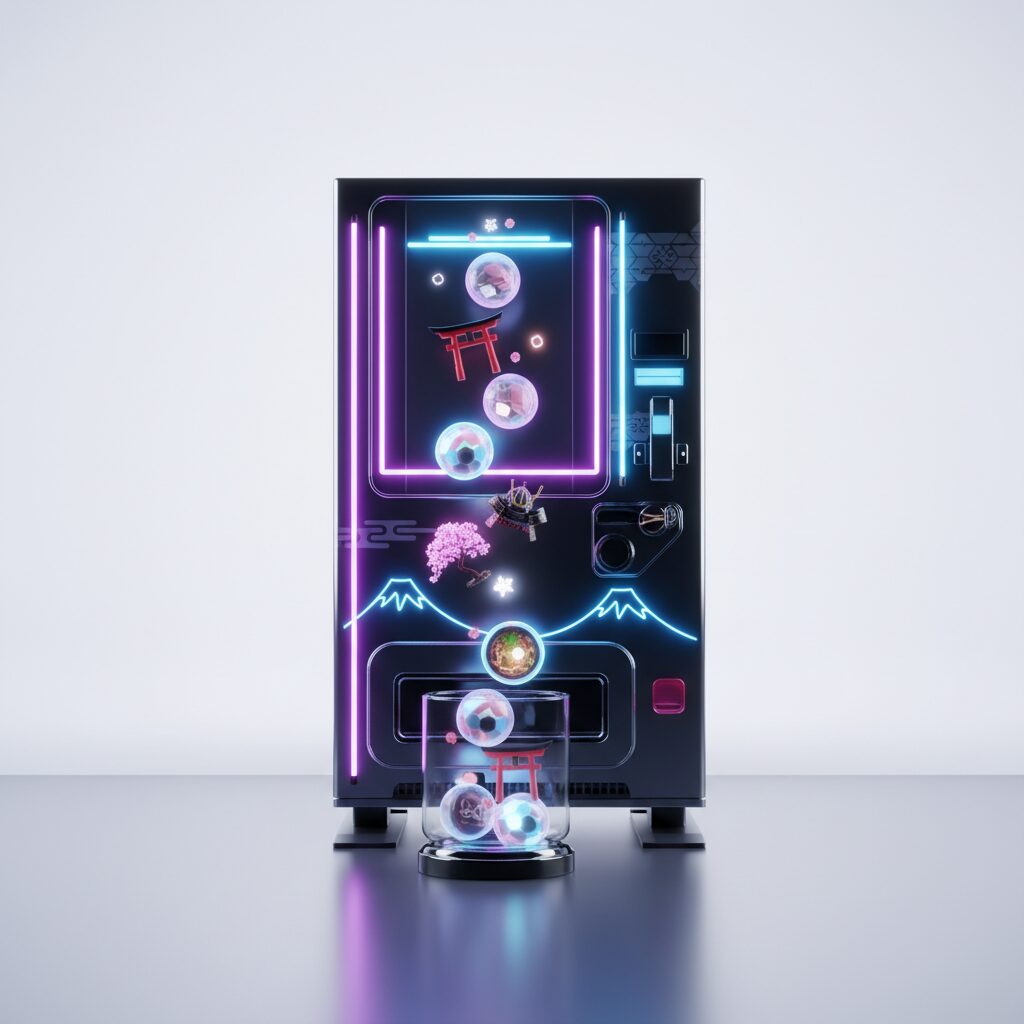
You see them before you even learn to recognize the street signs. They are a constant, humming presence in the urban landscape, glowing softly in the neon-drenched canyons of Tokyo and standing as lonely sentinels on quiet country roads. I’m talking about Japan’s vending machines, the jihanki (自動販売機). It’s easy to dismiss them as a simple quirk, a testament to a nation’s love for automation and cold coffee in a can. But if you spend enough time here, you start to realize they aren’t just a convenience. They’re a quiet lecture in Japanese culture, a physical manifestation of the country’s deepest-held social contracts.
Foreign visitors are often mesmerized by their sheer numbers—there’s roughly one for every 30 people, one of the highest densities in the world. They’re captivated by the variety, too. Sure, there are sodas and teas, but there are also hot cans of corn soup, bottles of savory dashi stock for cooking, crepes in a cone, and in some forgotten corner, probably a machine selling stag beetles. The initial reaction is usually amusement, followed by a simple question: why? Why are there so many? Why aren’t they smashed to bits? The answer isn’t a single, neat explanation. It’s a tapestry woven from threads of social trust, economic pragmatism, and a unique relationship with public and private space. To understand the vending machine is to understand a fundamental part of the Japanese mindset.
In many ways, these everyday machines illuminate a cultural duality, much like the intrinsic role of honne and tatemae in defining Japan’s societal fabric.
The Foundation of Trust: An Unwritten Social Contract
Let’s begin with the most striking difference you’ll notice if you come from almost anywhere else in the world. The machines are immaculate. They are rarely vandalized, graffitied, or broken into. Consider what a vending machine actually is: a glass box filled with goods and cash, left completely unattended on a public street, often 24 hours a day. In many cities, this would be an open invitation for theft or damage. It wouldn’t last a week.
In Japan, it does. This isn’t due to some advanced surveillance system or strict policing. It’s because of an exceptionally high level of ambient social trust. There is a deeply rooted, unspoken agreement among people to respect both public and private property. This is the same principle that allows you to see a salaryman sleeping on a late-night train with his phone resting on his lap, or a young woman leaving her designer handbag on a café chair to save her spot while she orders at the counter. The assumption is that no one will take it.
This low crime rate isn’t just a statistic; it’s a lived reality that influences the entire environment. The vending machine perfectly symbolizes this. It operates on the honor system on a societal scale. The owners trust that the public will not damage their property, and the public, in turn, benefits from the immense convenience this trust provides. It’s a virtuous cycle. Every functioning, untouched machine quietly reaffirms this social contract. It’s a vote of confidence in the collective integrity of society, repeated millions of times over on every street corner.
The Automation Fetish: Efficiency in a Shrinking Nation
Convenience in Japan is not merely a luxury; it is a fundamental design principle of everyday life. And nothing exemplifies convenience more than a transaction that requires no human interaction at all. This connects to a broader economic and demographic reality: Japan faces an aging population alongside a shrinking workforce. Labor is costly and, in certain industries, scarce. Within this context, the vending machine is not a novelty but a smart business solution.
It serves as a 24/7 retail point without the need for a cashier, store manager, or customer service staff. The only human involvement is the person who restocks it every few days. This relentless drive for efficiency can be seen throughout Japan. Consider the ticket machines at ramen shops where you pre-order and pay before sitting down, streamlining the entire process and allowing staff to focus exclusively on cooking. Or the automated multi-level parking garages that ferry your car into a concrete hive. The jihanki is simply the most widespread and democratic manifestation of this principle.
The major beverage companies—Suntory, Asahi, Kirin, Coca-Cola—recognized this long ago. They operate extensive networks of these machines, turning them into a highly efficient and direct distribution channel. By placing a vending machine, they essentially open a small, hyper-efficient storefront. There is no rent for retail space, no utility costs beyond electricity, and no payroll expenses. This model is built on minimizing human labor and maximizing reach, a philosophy perfectly aligned with the country’s demographic future.
The Geometry of Convenience: Maximizing Every Square Inch
Stand on any street in a major Japanese city and take a look around. You’ll observe how every inch of space is utilized. Buildings are tightly packed, and there are few of the wide, open lots you might find elsewhere. Japan is a densely populated country with limited flat, inhabitable land. As a result, real estate is highly valuable, and making the most of available space is a national priority.
This is where the physical ingenuity of the vending machine becomes evident. It can occupy areas that would otherwise be commercially unusable. That narrow gap between two buildings? The awkward corner at the end of an alley? The small slab of concrete in front of an apartment building? These spots are all ideal for a vending machine. They excel at transforming “dead space” into a source of income.
A convenience store, or konbini, requires a large footprint, as well as staffing and storage. A vending machine, by contrast, needs almost none of these. This enables a level of service reach that traditional retail cannot match. You’ll find them in the most unexpected locations: deep within residential areas far from the nearest station, halfway up hiking trails for tired walkers, or standing alone in a field beside a rice paddy. Each machine serves as a precisely positioned convenience point, placed exactly where someone might, at some time, want a drink but where a full store would be impractical. They offer an ingenious solution to the dual challenges of dense population and the demand for maximum convenience.
Beyond Drinks: A Universe of Instant Gratification
While most vending machines offer both cold and hot beverages, the wide variety of items available reveals much about the Japanese consumer mindset. If something can be standardized, packaged, and dispensed by a machine, it likely exists somewhere in Japan. This extends far beyond a mere preference for soda.
In the chilly winter months, the same machines that provide chilled green tea in summer switch to offering heated drinks. These are marked by a red label beneath the product, in contrast to the blue label for cold items. Grabbing a warm can of coffee or sweet corn soup to warm your hands on a freezing day provides a small yet meaningful comfort. It reflects a system that is not only automated but also attuned to the seasonal needs of its customers.
Then there are the truly specialized machines. Vending machines selling fresh eggs from local farms. Machines dispensing hot, fried foods like french fries and takoyaki. Machines offering umbrellas on rainy days, located just outside subway stations. Some even sell dashi, the essential soup stock of Japanese cooking, in elegant glass bottles. Each of these distinctive machines tells a story. The dashi machine represents a culture that values home cooking while prioritizing convenience. The hot food machine caters to solo diners or late-night workers. The umbrella machine perfectly exemplifies an immediate response to an urgent need. This is not merely about novelty; it reflects a culture refined in the art of anticipating people’s needs and addressing them with seamless, automated solutions.
The Currency of Habit: Cash, Coins, and the IC Card Revolution
On a more practical level, the vending machine ecosystem thrived for decades because it was perfectly aligned with Japan’s payment habits. Japan has traditionally been a cash-based society. While credit cards have become more prevalent, carrying a substantial amount of cash and, more importantly, coins, has long been the norm. The 100-yen coin is a cornerstone of the Japanese economy, serving as the primary fuel for the vending machine industry.
People are accustomed to having coins and spending them on small daily purchases. The price points for vended drinks—typically ranging from 100 to 160 yen—are ideally suited to this coin culture. The machines are highly efficient at accepting coins and dispensing change, making transactions smooth and effortless.
However, the machines are not stuck in the past. Demonstrating their adaptability, nearly all machines in urban areas are now equipped with readers for Japan’s rechargeable IC cards, such as Suica and Pasmo—the same cards used for train and bus rides. This development is crucial. It indicates that the vending machine’s dominance is not merely a holdover from a cash-heavy era. The core principle—unmanned, instant sales—remains so compelling that the industry has embraced new payment technologies without missing a beat. Tapping your train card to buy a drink in three seconds is an even more refined expression of the convenience they have always provided.
Ultimately, the Japanese vending machine is far more than it appears. It’s a silent testament to a society built on mutual trust. It’s a marvel of logistical efficiency, a smart solution to the challenges of urban density, and a reflection of a consumer culture that demands unmatched convenience. The next time you find yourself on a quiet Japanese street, take a moment to observe one of these glowing boxes. Listen to its soft hum. It’s more than just a place to get a cold drink—it’s the sound of an entire culture, quietly and efficiently, at work.