It’s a question that feels perfectly logical to ask. In a hyper-modern Japan, a country where toilets have heated seats and talking control panels, where nearly every apartment, no matter how small, is equipped with a pristine private bathroom, why on earth would anyone choose to pay money to go bathe with a crowd of strangers? From the outside, the neighborhood sentō, or public bath, seems like a charming anachronism, a relic from a time before private plumbing became the norm. It feels like something that should have faded away, like video rental stores or telephone booths. Yet, they persist. Tucked away on quiet residential streets, marked by a tall chimney and the distinctive hiragana character for hot water (ゆ), these establishments continue to draw in locals night after night. The continued existence of the sentō isn’t just about nostalgia. It’s about a profound social and cultural function that a private bathroom, no matter how advanced, can never replace. To understand the sentō is to understand a fundamental, and often hidden, layer of Japanese community life. It’s not about getting clean—it’s about getting connected.
In the same way that public baths nurture community ties, exploring the harmony within Japan’s satoyama reveals how nature and tradition intertwine to foster deep social connections.
From Necessity to Ritual: A Dip into History
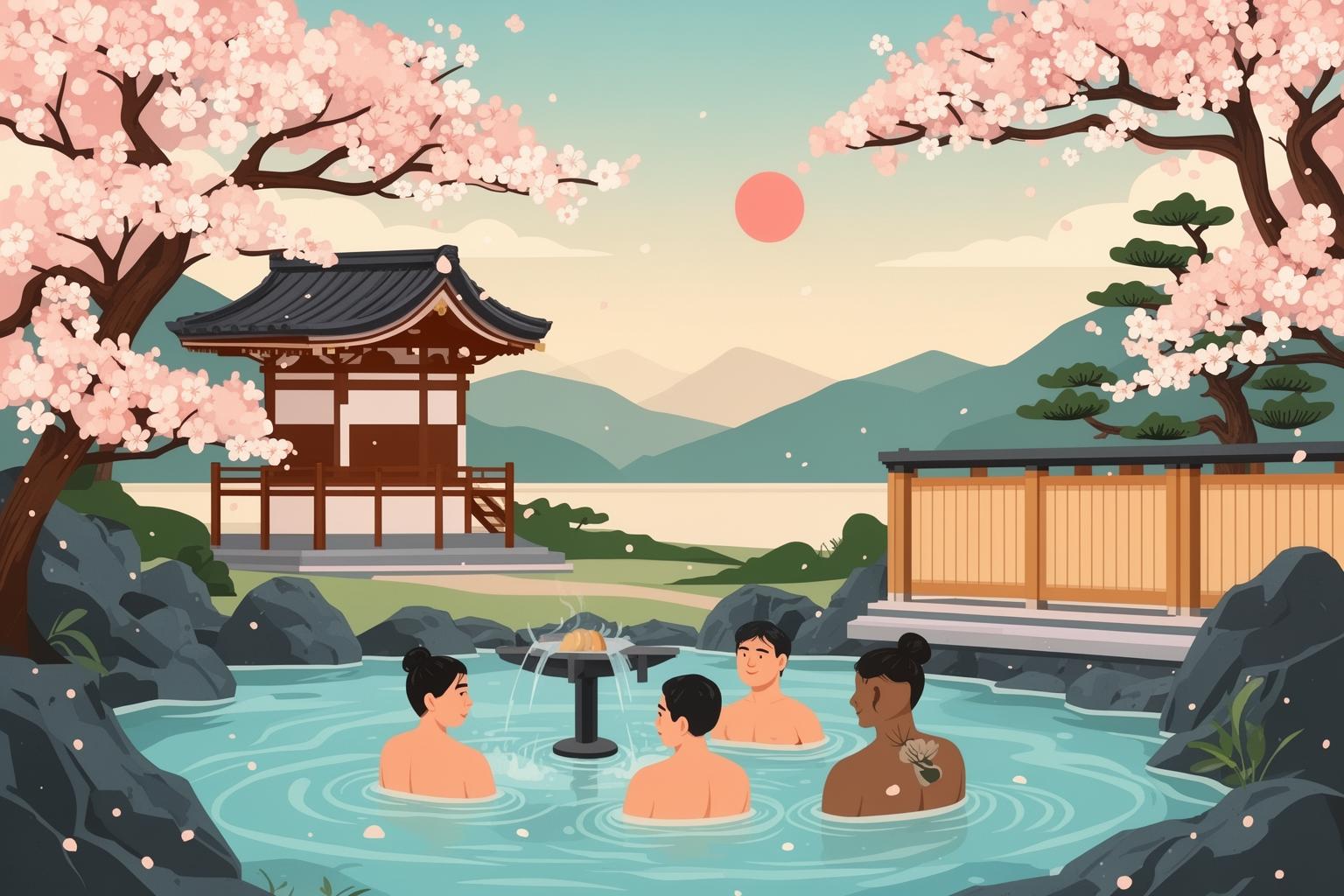
To understand the sentō’s lasting significance in the Japanese psyche, you need to rewind the clock. Throughout most of Japan’s history, the public bath wasn’t a matter of choice; it was an essential necessity. The tradition traces back to ancient times, beginning with purification rituals in Buddhist temples, where bathing was considered a way to cleanse both body and spirit. However, the sentō as a secular, commercial establishment truly thrived during the Edo period (1603-1868). As cities like Edo (modern-day Tokyo) grew with samurai, merchants, and artisans, people lived in crowded wooden tenements called nagaya. These long row houses exemplified compact living but almost always lacked private bathing facilities. Thus, the local sentō was not a luxury but a vital part of everyday life.
It soon became much more than just a place to wash. The sentō served as the neighborhood’s social hub, its informal living room. It was where news was exchanged, gossip spread, and community ties were strengthened amid the steam. After a hard day’s work, people gathered to scrub off grime, then soaked, chatted, and relaxed. It was a democratic space where, for instance, a carpenter might share the bath with a low-ranking samurai. This historical reality established the sentō as a foundation of community life. The daily act of bathing together became deeply woven into the social fabric of the neighborhood. It was never simply about hygiene; it was about belonging.
This communal role persisted well into the 20th century. The post-war economic boom once again saw cities expand, and for decades private baths remained a luxury for many. The sentō reached its height in the late 1960s, with over 18,000 locations nationwide. They were the vibrant heart of local life, a steady and comforting presence in a rapidly evolving world. The eventual decline was inevitable as economic growth brought private bathrooms to the majority. Yet the cultural memory of the sentō as an essential third space—a place that is neither home nor work—remained deeply rooted in the national consciousness.
The Architecture of Connection
The physical layout of a traditional sentō serves as a masterclass in social engineering, carefully designed to guide visitors from the structured outside world into a space of relaxed, communal intimacy. Every element plays a part in facilitating this transition.
The Threshold: From Street to Sanctuary
Your experience begins by passing through the noren, a fabric curtain hanging above the entrance that acts as a symbolic barrier between the public world and the semi-private realm of the bathhouse. Inside, you encounter the getabako, a wall of small wooden lockers for your shoes. Removing your shoes is a fundamental Japanese ritual, signifying the shedding of external dirt and, metaphorically, its associated worries. The area is often overseen by an attendant seated on a high platform called a bandai, a vantage point that allows them to monitor both the men’s and women’s changing rooms—a charmingly old-fashioned and non-voyeuristic system of supervision.
Datsuijo: The Social Antechamber
The changing room, or datsuijo, is much more than a place to undress; it functions as the sentō’s social lobby. The floors are often tatami or warm wood, making the space immediately more inviting than a sterile locker room. Instead of cold metal lockers, you typically place your belongings in a wicker basket (kago) set on an open shelf, fostering a sense of shared trust. Often, there’s an old-fashioned analog scale, a vintage massage chair humming in the corner, and a television broadcasting a baseball game or variety show. This is where conversations begin. Neighbors greet each other, old men discuss the news, and mothers chat while their children play. It’s common to see regulars enjoying a cold bottle of milk or a beer from the vending machine after their bath, lingering and socializing in a relaxed state of undress. The datsuijo is a vital decompression chamber, easing you out of your public persona.
Yudono and Yubune: The Communal Core
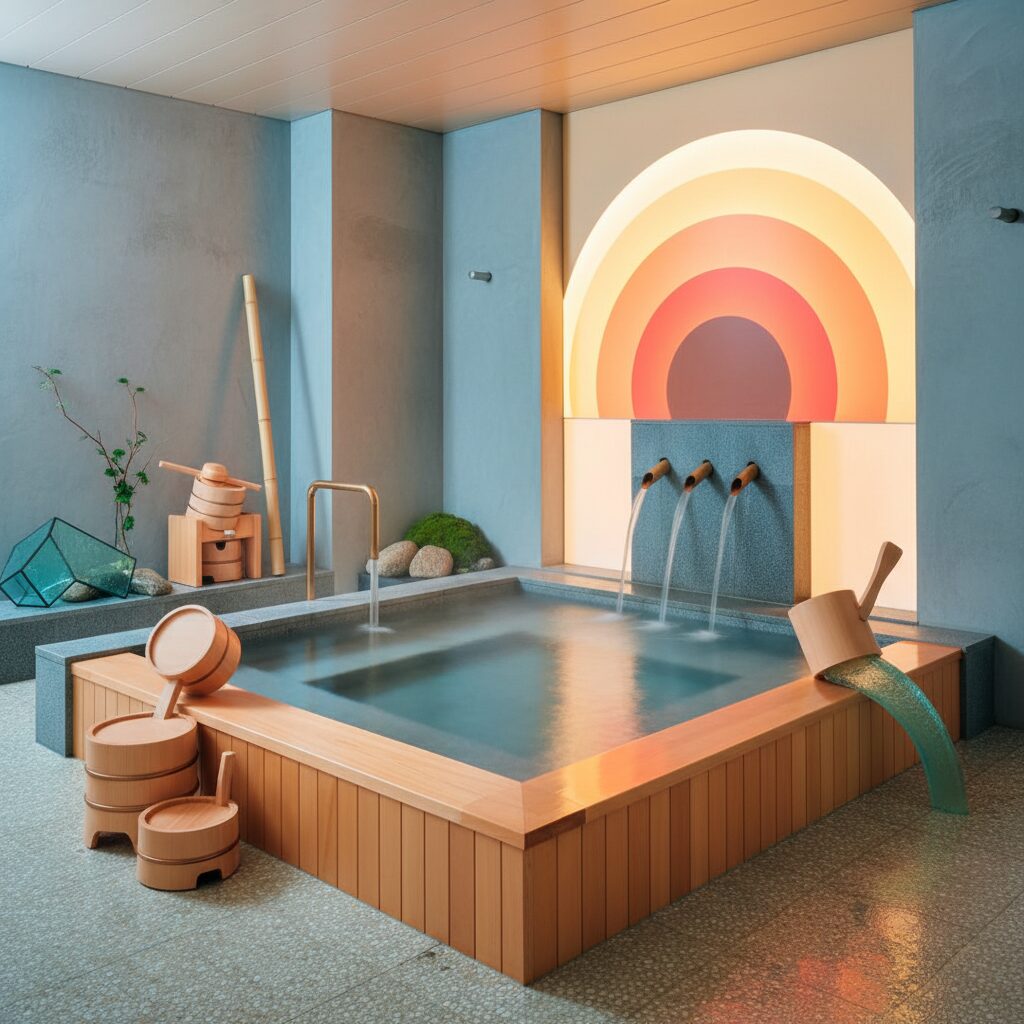
Passing through the sliding glass door into the bathing area, the yudono, you’re met with a wave of warm, humid air, the sound of running water, and the quiet murmur of voices. The space contains rows of washing stations, each with a small stool, bucket, and faucet with a shower head. Here, the most important rule of sentō etiquette takes place: washing and rinsing your body thoroughly before entering the main baths (yubune). This is not only about hygiene but a profound act of consideration for others, ensuring the communal water stays pure. The ritual of scrubbing oneself clean prepares you both physically and mentally for the communal soak.
The tubs themselves represent the heart of the experience. There is almost always a main hot bath, often heated to a scalding 42-43°C (107-109°F), which can take some getting used to. There may also be smaller tubs, such as a jacuzzi-style bath with massaging jets, a bath infused with aromatic herbs or minerals (kusuriyu), or an electric bath (denki-buro) with a mild current designed to soothe sore muscles. For the brave, there is a cold plunge pool (mizuburo). The communal soaking is a quiet, meditative affair. While conversations occur, they tend to be subdued, with the focus on the shared experience of relaxation and allowing the heat to penetrate deeply.
Overlooking it all is often a giant mural, typically a majestic painting of Mount Fuji. This iconic feature, which gained popularity in the early 20th century, is more than mere decoration. In a small, enclosed, often windowless room, the expansive landscape of Fuji-san creates a sense of openness and grandeur. It serves as a shared point of reference, a symbol of national identity and natural beauty that unites everyone in the room, creating the feeling of bathing together within a vast, imaginary landscape.
Hadaka no Tsukiai: The Great Equalizer
To truly grasp why the sentō endures, you must understand the concept of hadaka no tsukiai. Literally translated as “naked communion” or “naked fellowship,” this idea lies at the heart of the bathhouse experience. It signifies a unique form of communication and social interaction that can only occur when the markers of status and hierarchy are removed along with one’s clothing.
Japanese society, especially in the professional realm, is well-known for its hierarchy and formality. Language, posture, and behavior are all carefully adjusted according to one’s age, rank, and relationship with the person they are engaging with. Maintaining this constant performance of social roles can be exhausting. The sentō provides a radical and liberating counterbalance. Within its steamy confines, the company president and the junior employee, the professor and the student, the wealthy landowner and the humble shopkeeper are all brought down to the same level: simply another naked person. Without suits, uniforms, or brand labels signaling status, social hierarchies dissolve.
This environment allows for a different kind of interaction—one that is more direct, honest, and unpretentious. People who might never speak so candidly in the outside world can find themselves openly sharing thoughts and stories. It fosters a raw form of egalitarianism that is uncommon in daily life. This is why a boss might bring the team to a sentō after a challenging project; it’s a way to break down barriers and connect on a more human level. It’s where neighbors can discuss local issues without ceremony, and where older generations can pass wisdom to younger ones in a natural, relaxed atmosphere.
Hadaka no tsukiai isn’t about forced intimacy or deep, soul-baring conversations. More often, it’s about the simple comfort of shared presence. It’s the quiet nod exchanged between strangers, the collective sigh of relief upon entering the hot water, the easy, low-stakes chat about the weather or the local sports team. It’s a form of connection that depends not on words but on a shared physical experience. In a world growing increasingly digitally mediated and socially isolating, this tangible, embodied sense of community holds a powerful appeal.
The Sentō in Modern Japan: An Endangered Species in Evolution
Despite its deep cultural significance, the neighborhood sentō faces undeniable threats. The numbers reveal a stark reality: from a peak of over 18,000 in the late 1960s, fewer than 2,000 traditional sentō remain in Japan today. The reasons are complex—private bathrooms have become ubiquitous, making sentō less essential for daily hygiene; many owners are aging without heirs to continue the family business; and soaring fuel costs have made heating large tubs prohibitively expensive. Each year, numerous classic sentō with their magnificent carved-wood ceilings and intricate tile work are being torn down.
However, the story is not solely one of decline. It is also one of adaptation and renewal. The spirit of the sentō is evolving to fit a new era. On one end of the spectrum, there is the rise of the “Super Sentō.” These large, modern, resort-like facilities, often found in suburban areas, offer a wide variety of baths—including carbonated baths, open-air rock baths (rotenburo), multiple sauna types, and cold plunge pools. But they extend far beyond bathing, featuring restaurants, manga libraries, massage services, and relaxation lounges with reclining chairs and personal TVs. These venues have turned simple bathing into a full-day leisure experience, appealing to families, couples, and groups seeking an all-in-one entertainment destination.
On the opposite end, a passionate movement aims to preserve and revitalize the classic neighborhood sentō. A new generation of younger owners, designers, and community activists is taking charge of historic bathhouses and infusing them with new energy. They appreciate the unique value of these spaces and are reimagining them for modern audiences. Some are painstakingly restored to their Showa-era splendor, marketed to those seeking an authentic, retro vibe. Others have been transformed into cultural hubs, hosting art exhibitions, live music, and collaborations with local breweries offering craft beer on tap in the changing rooms. These revitalized sentō attract a fresh, younger crowd who view them not as daily necessities, but as trendy and unique “third places” to connect with community and experience a tangible piece of cultural heritage.
More Than Just Water
The sentō continues to endure because it fulfills a need that a private bathroom cannot. It provides a remedy for the quiet loneliness of modern urban life. It’s a place where human connection is genuine and free from pretense. For the elderly, it serves as an essential daily checkpoint, a spot to encounter friendly faces and feel part of a community. For young people, it offers a retro-cool retreat and a link to an authentic cultural heritage. For everyone, it’s a space to wash away the stresses of the day in a communal pool of hot water.
The public bath functions as a living museum, a wellness center, and a community hall all combined into one. It’s where the deeply rooted Japanese values of cleanliness, consideration for others, and the importance of the collective are expressed in their most basic form. So, although the number of chimneys may be decreasing, the spirit of the sentō—the spirit of the naked community—remains remarkably resilient. In an era of digital avatars and social distancing, the simple, analogue act of bathing together might be more vital than ever before.