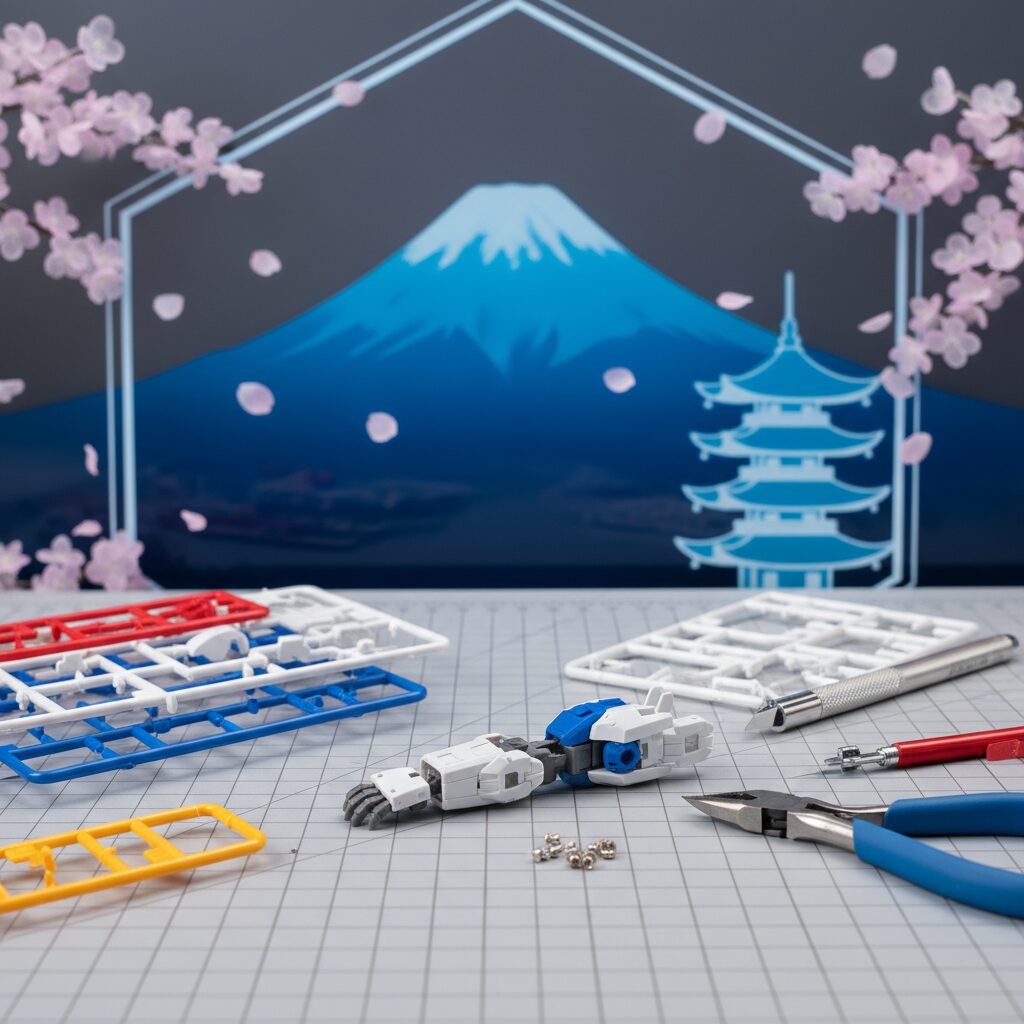
Walk into any major electronics store in Japan—a Bic Camera or a Yodobashi Camera—and push past the floors of gleaming rice cookers and whisper-quiet air conditioners. Head for the toy department. Tucked away, usually in a sprawling section of its own, you’ll find it: a universe of color-coded boxes stacked floor to ceiling, a library of potential. This is the world of Gunpla, and it’s one of Japan’s most fascinating and misunderstood subcultures. From the outside, it just looks like model kits of giant robots from an old cartoon. But to millions of people here, it’s something far deeper. It’s a form of active meditation, a quiet rebellion against the frantic pace of modern life, and a deeply personal creative outlet. You see, the point of Gunpla isn’t really about having the finished robot on your shelf. The point is the process. It’s about the quiet hours spent with a pair of nippers, a set of instructions, and a single-minded focus that melts the rest of the world away. This is the story of how assembling plastic models became a form of Japanese zen.
Just as assembling Gunpla becomes a mindful escape into creativity, 90s JDM car culture offers enthusiasts a nostalgic journey into the precision and passion of mechanical design.
A Titan is Born: From Animation to Obsession

To truly understand Gunpla, you first need to grasp the source material. It all started in 1979 with a TV show called Mobile Suit Gundam. At a time when giant robot anime featured super-powered, invincible machines battling obvious villains, Gundam took a drastically different approach. It portrayed its robots not as superheroes, but as realistic military hardware. These were “mobile suits” that could run out of ammo, break down, and be destroyed. The series was a gritty, complex war drama set in space, delving into politics, the trauma of conflict, and the moral ambiguities of battle. Its protagonist wasn’t a hot-headed hero but a reluctant teenage civilian forced into soldiering.
More Than Just a Cartoon
This sophisticated storytelling was groundbreaking. Although it initially struggled to capture a young children’s audience, it struck a deep chord with older teens and young adults. It was science fiction for a generation raised in post-war Japan, a country constitutionally committed to peace but still wrestling with its past. Gundam provided a fictional platform to explore these complex emotions. The show’s initial run was cut short due to lukewarm ratings, but something unexpected occurred. Reruns cultivated a cult following, with viewers who had been too young to appreciate it before now mature enough to understand its depth. This devoted, slightly older fanbase laid the foundation for the Gunpla phenomenon.
Bandai’s Plastic Revolution
Recognizing the growing popularity, Bandai made a transformative move in the hobby world. They began producing plastic model kits of the show’s mobile suits. Early kits were often crude, requiring glue and paint to resemble their on-screen versions. However, Bandai innovated by pioneering multi-colored plastic molding, so parts were already in the correct colors. More importantly, they engineered the kits to be “snap-fit,” with precisely designed pegs and holes that eliminated the need for messy, toxic glue. Suddenly, anyone could assemble an impressive model straight out of the box. This ease of use was pure genius.
To maintain builder interest, they introduced a grading system. It begins with High Grade (HG), which is simpler and more affordable. Next is Master Grade (MG), offering more parts, intricate inner frames, and greater detail. Beyond these are Real Grade (RG), packing Master Grade complexity into a smaller scale, and ultimately, Perfect Grade (PG), massive, hyper-detailed kits that showcase plastic engineering at its finest. This system establishes a clear progression: start simple, develop skills, and aspire to more advanced levels. It transforms a single purchase into a lasting hobby, a craft to perfect.
The Ritual of Creation: Finding Flow in the Pieces
The true magic of Gunpla lies in the serene, focused ritual of assembly. It’s a series of actions that many find become a meditative practice. The world around us is loud, demanding, and chaotic; building a Gunpla, however, is a quiet, methodical process that remains entirely under your control.
Unboxing the Universe
The experience begins the moment you bring the box home. The artwork on the lid is dynamic and inspiring, promising the cool machine you’re about to create. Removing the lid reveals a neatly packed interior filled with “runners”—plastic frames containing dozens, sometimes hundreds, of carefully numbered parts. There’s a faint, clean scent of polystyrene plastic. For a builder, this moment is pure potential. It’s a self-contained world just waiting to be brought to life. You lay out your cutting mat, arrange your tools—a pair of sharp nippers, a hobby knife, maybe some tweezers—and open the instruction manual. The ceremony has begun.
The Rhythmic Discipline of Nippers and Files
At the heart of the build is a simple, repetitive cycle. Find the part number in the manual. Locate it on the runner. Carefully snip it free. Remove the tiny piece of plastic left from the gate—the “nub”—using a hobby knife or smooth it out with a sanding stick. Then, find the matching piece and snap them together with a satisfying click. Repeat. Do this a hundred times, and you create a leg. Do it five hundred times, and you have a complete mobile suit. This rhythmic, tactile process is hypnotic. It requires just enough focus to engage the conscious mind, preventing it from drifting to work deadlines or personal worries. Your hands are busy, your eyes are fixed, and your mind is calm. This is what psychologists refer to as a “flow state,” a condition of total immersion where time seems to disappear. It’s the same sensation a calligrapher experiences with each brush stroke or a potter at their wheel. The medium differs, but the mental refuge it offers is the same.
From Plastic to Personality
For many, a “straight build” out of the box is only the beginning. The next phase of the craft is customization, where the builder moves from following instructions to making artistic decisions. The first step is often “panel lining,” which involves using a fine-tipped pen to trace the molded lines on the armor, making details stand out and giving the model a greater sense of depth and scale. Next come the decals, tiny stickers or water-slide transfers that add warning labels and insignia, grounding the fantasy machine in a sense of realism. Then there’s painting. Some builders meticulously airbrush each piece for a flawless, custom color scheme. Others go further by engaging in “weathering,” a technique that makes the model look used and battle-worn. They use special paints and powders to replicate paint chips, rust streaks, mud splatters, and laser burns. This is where the model truly evolves into a unique creation. It’s no longer just a Zaku or a Gundam; it’s your Zaku, a machine with a history and a story you’ve inscribed onto its plastic shell.
A Sanctuary for the Modern Mind: Who Builds and Why

So who exactly spends their evenings bent over these tiny plastic parts? The demographic is surprisingly diverse, but a key group, especially in Japan, is the adult male office worker known as the salaryman.
The Salaryman’s Secret Garden
Japanese corporate culture is notoriously demanding. The workdays are long, hierarchies strict, and the pressure to conform to the group immense. Individual achievements often take a backseat to the success of the team or company. Gunpla offers an ideal escape. It is a solitary activity that grants complete autonomy. At your desk, you’re in charge. You make all the decisions. The finished model, a tangible object, is a direct reflection of your skill and patience. In a job where your contribution can feel abstract or invisible, assembling a complex model delivers a clear sense of accomplishment. The workspace—whether a dedicated room or a small corner of the dining table—becomes a private sanctuary, a controllable world far removed from the stresses of the office.
A Shared Language Across Generations
The hobby also acts as a meaningful bridge between generations. The Gundam franchise isn’t a thing of the past; it’s an ever-evolving saga with new anime series, movies, and manga released regularly. This allows a father who built models of the original RX-78-2 Gundam in the 1980s to share the hobby with his son or daughter, who may be fans of newer series like The Witch from Mercury. They can sit together at the same table, working on their kits, exchanging tools and techniques. It’s a quiet form of bonding, a shared language that doesn’t rely on lengthy conversation but rather on a mutual appreciation for the craft.
The Solitary Hobby with a Global Soul
Though building is deeply personal and often done alone, the Gunpla community is vast and worldwide. Online forums, Reddit groups, and YouTube channels abound with builders sharing their work, tutorials, and discussions about different kits. Local hobby shops frequently host informal build gatherings. The pinnacle of this community is the Gunpla Builders World Cup (GBWC), an official Bandai competition where modelers from across the globe submit their customized creations to be judged on skill and artistry. It’s an intriguing paradox: a hobby that offers an escape from the world also connects you to a global network of like-minded enthusiasts. You build alone, but you are never truly alone.
The Philosophy in the Plastic Frame
It may seem unlikely to connect deep cultural concepts to a plastic model kit, but in Japan, the boundaries between pop culture, craft, and philosophy often blend beautifully. The philosophy behind Gunpla reflects some very ancient Japanese ideas.
Wabi-Sabi in Weathering
Take the art of weathering as an example. The aim is to transform a pristine, factory-new model into one that appears imperfect, worn, and aged. This technique is a contemporary expression of the traditional Japanese aesthetic of wabi-sabi, which appreciates beauty in impermanence and flaws. A flawless model is impressive, but a thoughtfully weathered one that tells a story of endurance possesses a different kind of charm—a deeper, more meaningful character. It acknowledges that genuine beauty often lies in the scars and marks left by time and experience.
The Pursuit of the Intangible
The grading system and limitless customization options embody the spirit of the shokunin, the master craftsman. A true shokunin is motivated by the pursuit of continuous improvement, or kaizen. The objective is not just to finish the task but to do it better each time. For a Gunpla builder, this means striving for cleaner nub marks, a smoother paint job, and more convincing weathering effects. The model on display is not merely a final product; it represents a milestone in an ongoing journey of skill refinement. The emphasis is on perfecting the process itself.
Your Desk as a Dojo
In the end, the workbench becomes a kind of modern dojo—a space for training and discipline. Tools are arranged thoughtfully, the task demands focus and patience, and the practice nurtures a state of mindful calm. The completed models displayed on a shelf are more than collectibles; they are tangible records of hours spent in quiet reflection. They stand as monuments to patience. In a world that values speed and distraction, the slow, intentional, and deeply absorbing process of building a Gunpla is more than a hobby. It is a vital ritual, a way to restore balance to the self, one small plastic piece at a time. It demonstrates that sometimes, the most profound peace can be discovered in the careful and patient assembly of a giant, imaginary robot.