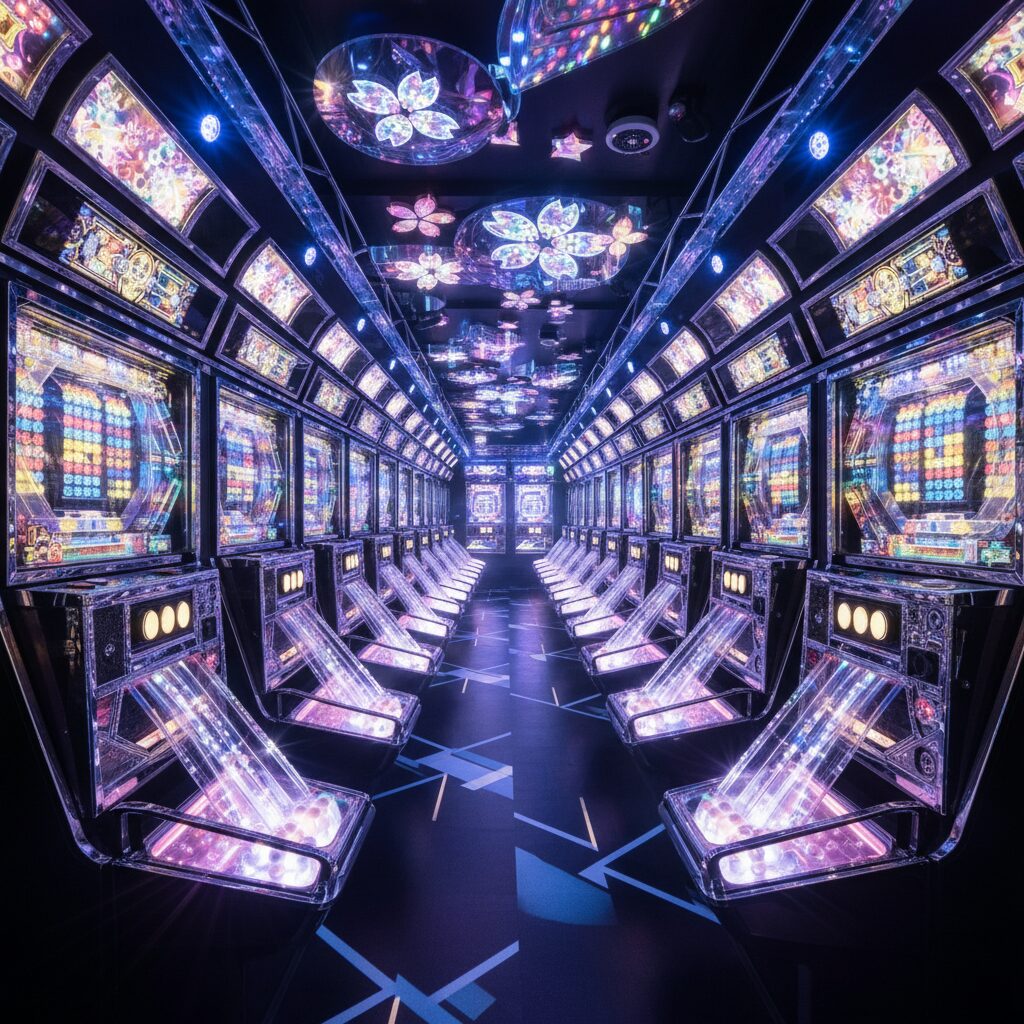
You hear it before you see it. It’s a sound unlike any other in Japan, a country celebrated for its tranquil gardens and serene temples. This is the opposite of serenity. It’s a waterfall of metallic clatter, a tidal wave of crashing, ringing, and synthesized jingles all blended into a single, overwhelming roar. Step through the automatic sliding doors of a pachinko parlor, and the sound hits you like a physical force. Inside, it’s a dazzling cavern of light and noise. Rows upon rows of people sit inches apart, yet utterly alone, their faces illuminated by the frantic animations on the screens before them. They are motionless, save for a single hand delicately turning a small plastic knob. Their eyes are fixed, their expressions unreadable. They are absorbed, lost in a storm of a million tiny steel balls. This is pachinko, and for millions of Japanese people, from salarymen to grandmothers, this chaotic spectacle is a form of relaxation. That’s the puzzle, isn’t it? How can an activity that assaults every one of your senses be a cherished national pastime? It looks like gambling, sounds like a factory floor, and feels like a migraine waiting to happen. Yet, it’s an industry larger than the film industries of Hollywood and Bollywood combined. To understand Japan, you have to understand why so many people willingly plug themselves into these machines. The answer isn’t just about money; it’s a story about legal loopholes, social pressure, and the profound need for a private escape in a very public society.
The frenetic energy of pachinko reflects a broader cultural phenomenon where the desire to escape everyday pressures converges with playful social expression, much like the intriguing dynamics of purikura culture in modern Japan.
A Symphony of Chaos: What Actually Is Pachinko?
Before we delve into the psychology, let’s clarify the mechanics. Foreigners often confuse pachinko with a Japanese slot machine, but that’s not quite accurate. Think of it more as a vertical pinball machine—without flippers and instead featuring a cascade of tiny steel balls rather than just one. You rent a tray of these balls and load them into the machine. The only control you have is a knob that adjusts the force with which the balls are launched onto the playing field, a dense array of brass pins. Most balls simply tumble down and vanish. But the aim is to get a ball into a specific winning gate, a small hole in the center. When that happens, the machine springs to life. The digital screen in the center—which looks just like a slot machine—spins its reels. If the numbers or characters line up, you’ve hit the jackpot. This isn’t a trickle of coins; it’s a flood of steel balls. Buckets fill up, alarms sound, and the machine celebrates your win with a deafening musical number from a popular anime or J-pop group. This is the moment of triumph. However, the true skill, according to dedicated players, lies in the subtle, constant adjustment of that launch knob. A slight turn left or right can, they believe, alter their fate, steering the balls on a more favorable course. Whether this is reality or just a reassuring illusion doesn’t matter. It offers a vital sense of agency in a game that is otherwise almost entirely random. This sensory overload is the whole point. The machines are designed to mesmerize. Popular anime series, famous samurai epics, and pop idol groups are licensed for themes, creating intricate digital stories that unfold as you play. The cacophony isn’t an accident; it’s deliberate. It forms a sound blanket that drowns out the outside world and everything within it.
The Grey Zone: Gambling in a Country That Bans It
Here’s the part that truly confounds outsiders. Article 185 of Japan’s penal code strictly prohibits gambling. So how does a multi-billion yen industry based on games of chance manage to exist? The answer lies in a brilliant display of legal maneuvering, a clever and universally recognized workaround called the “three-shop system.” You don’t win money at a pachinko parlor; you win steel balls. When you finish playing, you take your buckets of balls to a counter inside the parlor, where an automated machine counts them. You then receive a receipt, which you exchange at a different counter for “special prizes” (keihin). These prizes are usually small, gold-plated tokens sealed in plastic cases, their worth matching the number of balls you have won. At this point, you possess your winnings, but they are still not cash. The final step is to leave the parlor and find a separate, legally distinct establishment nearby. Often, it’s a literal hole in the wall—an unmarked window with a small curtain—known as a TUC shop (Tokyo Union Circulation). You hand over your keihin through the slot, and a hand slides back a stack of crisp yen notes. The transaction is complete. Because the pachinko parlor itself never pays out money, and the exchange shop never handles pachinko balls, no direct gambling technically takes place. It’s a system of plausible deniability that everyone, including law enforcement, tacitly acknowledges. This arrangement lends the whole experience a slightly covert, almost shady, yet perfectly normalized vibe. It’s an open secret that keeps the industry thriving and shielded from legal repercussions—a perfect example of how Japan often navigates its own rules through unspoken consensus rather than open conflict.
The Psychology of the Parlor: An Escape Pod from Society
This is where we uncover the true reason behind pachinko’s lasting appeal. It’s not merely the excitement of a possible payout; it’s about what the parlor provides on a psychological level. In a society that highly values group harmony, social obligation, and a constant awareness of one’s position, the pachinko parlor offers a rare and valuable refuge. It is a place where you can be completely, utterly alone while surrounded by hundreds of others. The high-backed chairs create a physical cocoon, blocking your peripheral vision. The deafening soundscape erases any chance for conversation or social interaction. No one will talk to you. No one expects anything from you. You don’t need to worry about proper etiquette, about sensing the mood (kuuki wo yomu), or about maintaining your public face (tatemae). For as long as you stay, you are simply an anonymous individual focused on a single, repetitive task. This isn’t just relaxation; it’s a form of societal decompression. The intense sensory input fully occupies the conscious mind, leaving no space for office worries or family stresses. The constant attention to the flow of balls and subtle adjustments of the knob induces a meditative, trance-like state. It’s a way to achieve mental silence through maximum noise. For many, a pachinko session is a ritual to reset the brain after a tough day. It clears the mind, purging it of the endless duties and expectations that shape much of Japanese life. Moreover, that small knob provides an illusion of control in a world that often feels highly regimented. In a corporate culture where individual initiative can be suppressed and career paths are often predetermined, the ability to personally influence the game’s outcome—however limited that influence may be—is psychologically powerful. It’s a small pocket of agency amidst a sea of conformity.
From Post-War Pastime to Digital Spectacle
Pachinko’s origins are surprisingly modest. It developed from a children’s bagatelle-style game from the 1920s known as the “Corinth Game.” After the devastation of World War II, during Japan’s rebuilding period, these simple mechanical machines provided an affordable and accessible form of entertainment for a population eager for diversion. The early parlors were smoky and basic, a stark contrast to the high-tech digital arcades of today. As Japan’s economy grew, so did pachinko. The machines became more sophisticated, adding electronic components and then video screens. Modern machines are technological wonders, boasting high-definition graphics, surround sound, and complex gameplay that often resembles a video game more than a traditional game of chance. This evolution was crucial for pachinko’s survival, allowing it to adapt to new generations and their entertainment preferences. There is another important, often overlooked, aspect of the industry’s history: its strong connection to Japan’s Zainichi Korean population (ethnic Koreans with permanent residency in Japan). Facing discrimination that excluded them from many conventional jobs in the post-war period, many Zainichi entrepreneurs seized opportunities in the pachinko business. They established and ran many parlors, and to this day, a significant portion of the industry remains controlled by companies with Korean roots. This adds a complex layer to pachinko’s identity, embedding it deeply into the social and economic history of post-war Japan.
The Other Side of the Coin: Addiction and Decline
It would be misleading to present an entirely positive view of this world. Despite functioning as a social pressure-release valve, pachinko has a darker side. Gambling addiction is a serious and often hidden social issue in Japan, with pachinko serving as the main outlet for this compulsion for many individuals. The media occasionally covers tragic incidents of parents so absorbed in the game that they leave young children unattended in hot cars within the parking lot. The immersive and mind-numbing nature of the game makes it highly addictive for vulnerable players. The industry is aware of this and has taken some steps to encourage responsible gaming, yet the problem continues. Furthermore, the golden age of pachinko appears to be waning. The industry has experienced a slow but steady decline over several years. Stricter government regulations have capped the maximum jackpot sizes, making the game less lucrative and, for some, less thrilling. The player demographic is aging, and younger generations, with a wide array of entertainment options on their smartphones, are not engaging with the pastime as much as their parents and grandparents once did. The smoky, noisy parlor now feels like an analog relic in a digital age. While the industry is far from extinct, the ubiquitous parlors that once lined every train station entrance are gradually becoming less common.
The pachinko parlor remains one of modern Japan’s most striking and fascinating contradictions. It is a space that is at once public and deeply private, a legal activity operating on a legal fiction, and a source of meditative calm amid a storm of manufactured chaos. It is deeply rooted in its cultural context—a release valve tailored for a society that demands intense self-discipline. From the outside, it might appear as a mindless waste of time and money, but to its millions of enthusiasts, it means something more. It offers a temporary escape from responsibility, a loud and sparkling sanctuary where, for a few hours, the pressures of the world are replaced by the simple, hopeful clatter of a tiny steel ball finding its place.