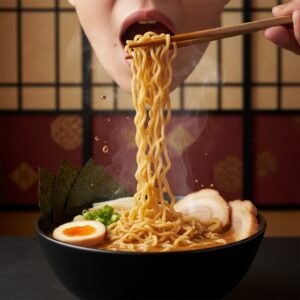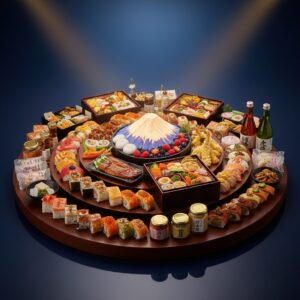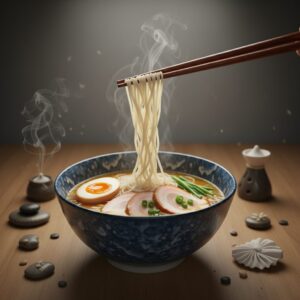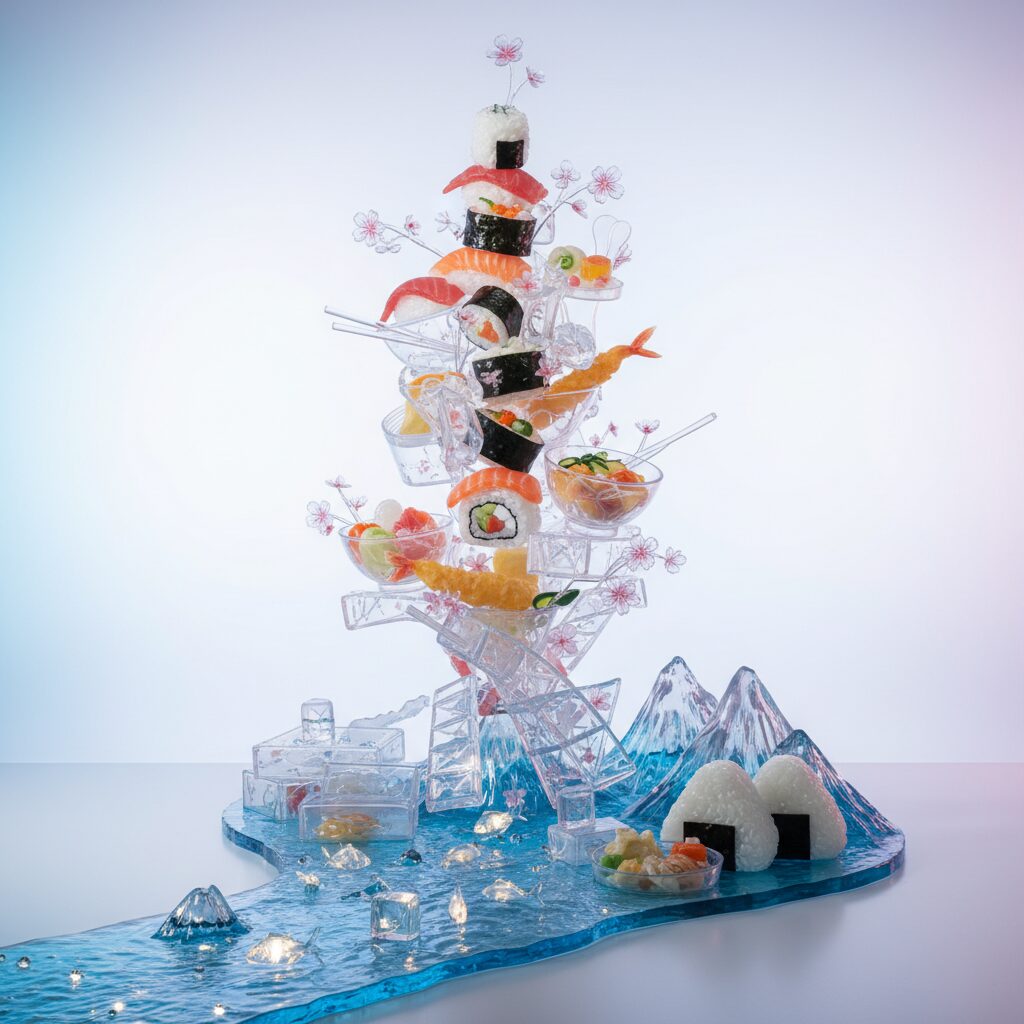
You’ve seen them. Even if you’ve never set foot in Japan, you’ve seen them in photos or travel shows. Stroll down almost any urban street with restaurants, and there they are, gleaming under glass: a perfect bowl of ramen with noodles suspended mid-air, a glistening slice of tuna sushi that looks fresher than the real thing, a frothy beer with condensation trickling down the mug. This is the world of shokuhin sampuru (食品サンプル), Japan’s hyper-realistic plastic food models. At first glance, they might seem like a quirky, slightly dated form of advertising. A charming bit of kitsch. But that’s a superficial reading. These inedible marvels are not just decorations; they are a sophisticated, silent language. They are the ultimate communicators in Japan’s bustling food scene, embodying a cultural approach to commerce and hospitality that is as deep as it is practical. They are a delicious paradox: a complete fabrication designed to tell you the absolute truth about what you’re about to eat.
This intricate interplay between art and authenticity in Japanese cuisine is further mirrored in the philosophy of omakase, where diners entrust every detail to the chef’s expertise.
The Birth of a Brilliant Idea

An Omelet Made of Wax
The story of shokuhin sampuru doesn’t start in a high-tech laboratory but with a simple man and a waxy omelet. In the early 1920s, Japan was rapidly modernizing. Department stores were opening, offering a new type of shopping experience that included restaurants serving both traditional Japanese and unfamiliar Western dishes. For many people, a written menu listing items like “curry rice” or “spaghetti” was abstract. They had no clear idea what the dishes would look like, the portion sizes, or even the ingredients. Enter Takizo Iwasaki, a craftsman from the rural town of Gujo Hachiman in Gifu Prefecture. According to legend, which has since become a foundational myth in the industry, he was inspired by the patterns formed by dripping candle wax. He created a wax model of a classic Japanese omelet, or omurice. The model was so realistic that when he showed it to his wife, she couldn’t tell it apart from a real omelet. Recognizing he was onto something significant, he founded his company, Iwasaki Mokei, in 1932 and began producing wax food models for department stores and restaurants in Osaka. The concept was an instant hit. These models solved a universal problem: they made the invisible visible. Diners no longer had to guess; they could see exactly what they were ordering, which reduced anxiety and encouraged them to try new dishes. It was a revolution in customer service, born from a simple and elegant idea.
From Fragile Wax to Resilient Vinyl
For decades, wax was the preferred material. Craftsmen mastered the art of shaping it, replicating the textures of fried foods, the sheen of sauces, and the delicate structure of vegetables. However, wax had its drawbacks. It was fragile, sensitive to heat, and its colors could fade over time. A display case left in the sun could turn into a melted mess. The real breakthrough came after World War II with the introduction of plastics. Polyvinyl chloride (PVC) was durable, stable, and capable of holding color and intricate details far better than wax ever could. This technological advancement transformed the sampuru industry. Production could be scaled up, and the models became more vibrant and long-lasting than ever before. While the craft remained an art form, the new materials allowed that art to reach a new level of permanence and realism. Today, models are almost exclusively made from these modern resins and plastics, enabling the creation of everything from a perfectly seared steak to a delicate, translucent shard of ice in a cocktail.
More Than Just a Pretty Plate
The Universal Menu
The primary function of shokuhin sampuru is to act as a three-dimensional menu. It serves as a means of communication that easily overcomes language barriers. For foreign tourists who cannot read any Japanese characters, the window display is a blessing. They can simply point to the shiny model of tempura udon and say, “Kore o kudasai” (“This one, please”). Problem solved. However, it’s a misconception that these are just for tourists. Japanese people use them just as much. The display offers a wealth of information at a glance. How much larger is the “large” size ramen compared to the “regular”? What side dishes come with the set meal? Does the tonkatsu come with shredded cabbage? The model instantly answers all these questions, setting expectations with perfect clarity. It follows the principle of “what you see is what you get.” This isn’t only about convenience; it’s about crafting a smooth and reassuring dining experience for everyone. It eliminates the uncertainty that often leads to disappointment, making sure the customer feels confident in their choice even before sitting down.
The Art of Silent Persuasion
Beyond mere communication, sampuru function as powerful marketing and psychological tools. A restaurant’s display case acts as its main advertising space. The most visually attractive, impressive, or profitable dishes are often showcased prominently. A towering, multi-layered parfait or an extravagant sushi platter is designed not only to inform but to captivate. It’s a silent method of upselling. The models evoke a visceral, sensory reaction that a menu’s text alone cannot achieve. You don’t just read about the sizzling hamburger steak; you see the sizzle, frozen in glossy plastic, and your mind begins to imagine the rest. This visual appeal can also help guide customer flow. During a busy lunch rush, a complicated menu can slow down ordering. A clear, visual display lets people decide what they want while still in line, speeding up the entire process and making it more efficient for the restaurant. It’s a subtle yet effective way to manage crowds, all orchestrated by a few well-placed plates of plastic food.
The Craft of Perfect Deception

A Factory of Fakes
Creating shokuhin sampuru is not a mass-production process carried out by machines. It is a painstaking and meticulous craft performed by highly skilled artisans. The process almost always starts with the real dish. A restaurant sends a meal to the sampuru workshop, where craftsmen study it, photograph it, and then begin the replication. First, the individual components—a piece of carrot, a shrimp, a slice of pork—are used to create silicone molds. Liquid polyvinyl chloride is then poured into these molds and baked in an oven until it hardens. This is just the beginning. The raw plastic shapes that emerge are pale and lifeless. The true artistry lies in the painting. Using airbrushes and fine-tipped paintbrushes, artisans layer colors to bring the models to life. They replicate the seared grill marks on a piece of fish, the golden-brown crispiness of tempura batter, and the subtle translucence of an onion slice. Every detail is carefully considered. A glossy topcoat is applied to simulate sauce or oil, while a matte finish might be used for bread or rice. To create a piece of lettuce, colored vinyl is melted in warm water and then expertly shaped and folded by hand, mimicking the natural crinkles of the vegetable. For ramen, the noodles and toppings are painstakingly arranged and fixed in place before being set in a gelatinous resin that perfectly imitates the broth. It’s a fusion of sculpture, painting, and chemistry, all devoted to the art of delicious illusion.
The Capital of Counterfeits
While sampuru workshops can be found throughout Japan, the spiritual home and undisputed capital of the industry remains Gujo Hachiman, the small town where Takizo Iwasaki began his work. Nestled in the mountains of Gifu Prefecture, this picturesque town produces a large percentage of all the fake food in Japan. The industry is deeply woven into the town’s identity. Several workshops still operate here, some of which are direct descendants of Iwasaki’s original company. They have turned the craft into a tourist attraction, offering workshops where visitors can try their hand at making their own sampuru. The most popular experiences involve creating a head of lettuce or a few pieces of tempura. Guided by a master craftsman, you dip a plastic shrimp into warm, yellow-colored wax, then into cold water, watching it magically solidify into a perfectly battered piece of tempura. It’s a fun, hands-on experience that reveals just how much skill and technique go into making even the simplest models. Gujo Hachiman stands as a living monument to this unique Japanese art form, a place where the craft of replication is celebrated as a genuine cultural heritage.
The Unspoken Cultural Code
Omotenashi in Solid Form
To truly appreciate shokuhin sampuru, you need to view them as a tangible embodiment of omotenashi, the Japanese ideal of wholehearted, selfless hospitality. Omotenashi involves anticipating a guest’s needs before they even voice them. It’s about crafting an atmosphere of comfort, clarity, and thoughtfulness. The food replicas perfectly exemplify this principle. They address a customer’s potential questions: What is this dish? How large is it? What are the ingredients? They offer clear and direct answers. This act of proactive explanation is a profound form of hospitality. It communicates to the customer, “We have considered your experience. We want you to feel at ease and assured. We don’t want you to feel puzzled or overwhelmed.” This stands in sharp contrast to many Western dining experiences, where menus can be deliberately vague, and part of the enjoyment is the “surprise” of what arrives. The Japanese approach, as represented by the sampuru, values transparency over mystery.
A Promise on a Plate
Lastly, the sampuru serves as an unspoken agreement between the restaurant and the diner. The model displayed in the window is not an idealized fantasy; it is a guarantee. It reflects the standard of quality, portion size, and presentation that the customer should expect. Often, kitchen staff use these very models as references to maintain consistency. If the actual dish served is noticeably smaller or less appealing than the model, the restaurant has violated this implicit trust. This system offers a strong incentive for restaurants to uphold high standards. They cannot hide behind flowery menu descriptions. Their promise stands openly, cast in solid plastic for all to see. In this way, the enticing illusion of the food model enforces a culture of honesty and dependability. It holds the kitchen accountable, ensuring the beautiful window display is faithfully realized in the dish before you.
So, the next time you find yourself captivated by a display of flawless plastic food in a Japanese window, take a moment to look beyond the novelty. You’re not merely seeing a menu. You’re witnessing the solution to a communication challenge from the post-war era, the product of a long-standing artisanal tradition, and a profound cultural statement. You’re observing a quiet pledge of hospitality and integrity, all conveyed through a beautiful, delicious illusion.