Ask anyone outside Japan to describe its people, and you’ll likely get a string of familiar adjectives: polite, reserved, hardworking, and above all, conformist. The image is one of a society that moves in perfect, harmonious lockstep, a nation of 125 million people who have collectively agreed to color inside the lines. And for the most part, that image isn’t entirely wrong. Social harmony, or wa (和), isn’t just a nice idea here; it’s the cultural bedrock. But it’s also an incomplete picture. Because on the fringes of this meticulously ordered society, you’ll find a loud, flamboyant, and often misunderstood counterpoint: the Yankii.
You’ve probably seen them, even if you didn’t know the name. They’re the characters in anime with impossibly tall pompadours, the kids in movies with modified school uniforms, the figures squatting in a perfect circle outside a convenience store late at night, bathed in the fluorescent glow. The easy translation is “delinquent,” but that word misses the point entirely. To label a Yankii as just a troublemaker is like calling a punk rocker just a guy with a messy haircut. It describes a symptom while ignoring the cause, the culture, and the code.
Being a Yankii is less about committing crimes and more about performing a very specific, highly stylized version of rebellion. It’s a subculture built on aesthetics, ritual, and a fierce, almost theatrical rejection of mainstream norms. Their defiance isn’t chaotic; it’s codified. Their “badness” is a uniform you put on, a way of speaking you adopt, and a set of loyalties you live by. To understand the Yankii is to understand the pressures and expectations they are pushing back against. It’s a story not of simple delinquency, but of a search for belonging and identity in a society that often offers only one approved path.
The unexpected defiance of the Yankii is complemented by other offbeat cultural expressions, such as the ingenious quirky mascot trends that subtly upend Japan’s well-known conformity.
The Ghost in the Machine: Where Did the Yankii Come From?
To trace the origins of the Yankii, one must return to the smoke-filled, engine-revving nights of post-war Japan. The nation was experiencing its economic miracle, a time of rapid rebuilding and unprecedented growth. Corporate loyalty had become the new national creed. A man’s ideal life trajectory was predetermined from birth: attend a reputable school, then a prestigious university, secure a good company job, and remain there until retirement. This was the model for the “salaryman,” the hardworking soldier in Japan’s economic machine. Yet, this path wasn’t suited for everyone. For a generation of working-class youth, especially in sprawling suburbs and industrial towns, this future felt less like a dream and more like a cage.
Their frustration found expression in the roar of motorcycle engines. This marked the rise of the bōsōzoku (暴走族), or “running-out-of-control tribes.” Emerging in the 1970s, these motorcycle gangs became the most visible symbols of youth rebellion in Japan. They weren’t mere thrill-seekers; they were a spectacle. Riding in massive groups, sometimes numbering in the hundreds, they weaved through traffic, ran red lights, and engaged in high-speed standoffs with the police. Their aim wasn’t necessarily to reach a destination, but to be seen and heard, to break the quiet conformity of the night.
Like the Yankii who would come after, the bōsōzoku identity was deeply connected to aesthetics. Their bikes were canvases for customization: seats raised impossibly high, exaggerated exhaust pipes, and bold, elaborate paint jobs. Their uniform was the tokkō-fuku (特攻服), a military-style boilersuit paying homage to the kamikaze pilots of World War II. These suits were adorned with intricate embroidery, showcasing the gang’s name, nationalist symbols such as the rising sun flag, and defiant slogans proclaiming their loyalty and fighting spirit. It was a powerful and provocative image, repurposing symbols of wartime sacrifice for their own form of peacetime rebellion.
As the 80s gave way to the 90s, intense police crackdowns and shifting social attitudes began to dismantle the large bōsōzoku gangs. However, the rebellion did not vanish; it transformed. It became more localized, less about large-scale highway confrontations and more about carving out a space in one’s own neighborhood. The spirit of the bōsōzoku trickled down from the motorcycle gangs to junior high and high school students. They embraced the attitude and aesthetics, but adapted them to their daily lives. This marked the birth of the modern Yankii. The delinquency became less severe, yet the style, sense of group identity, and rejection of mainstream values remained as strong as ever.
The Unspoken Uniform: A Visual Guide to Yankii Aesthetics
The Yankii identity is primarily a visual language—a set of intentional stylistic choices meant to signal non-conformity to insiders and provoke reactions from outsiders. Every aspect of their appearance is a deliberate rejection of the clean, understated, and standardized look prized by mainstream Japanese society. Their style is a uniform of defiance, with each piece telling part of their story.
Hair: The Bleached Banner
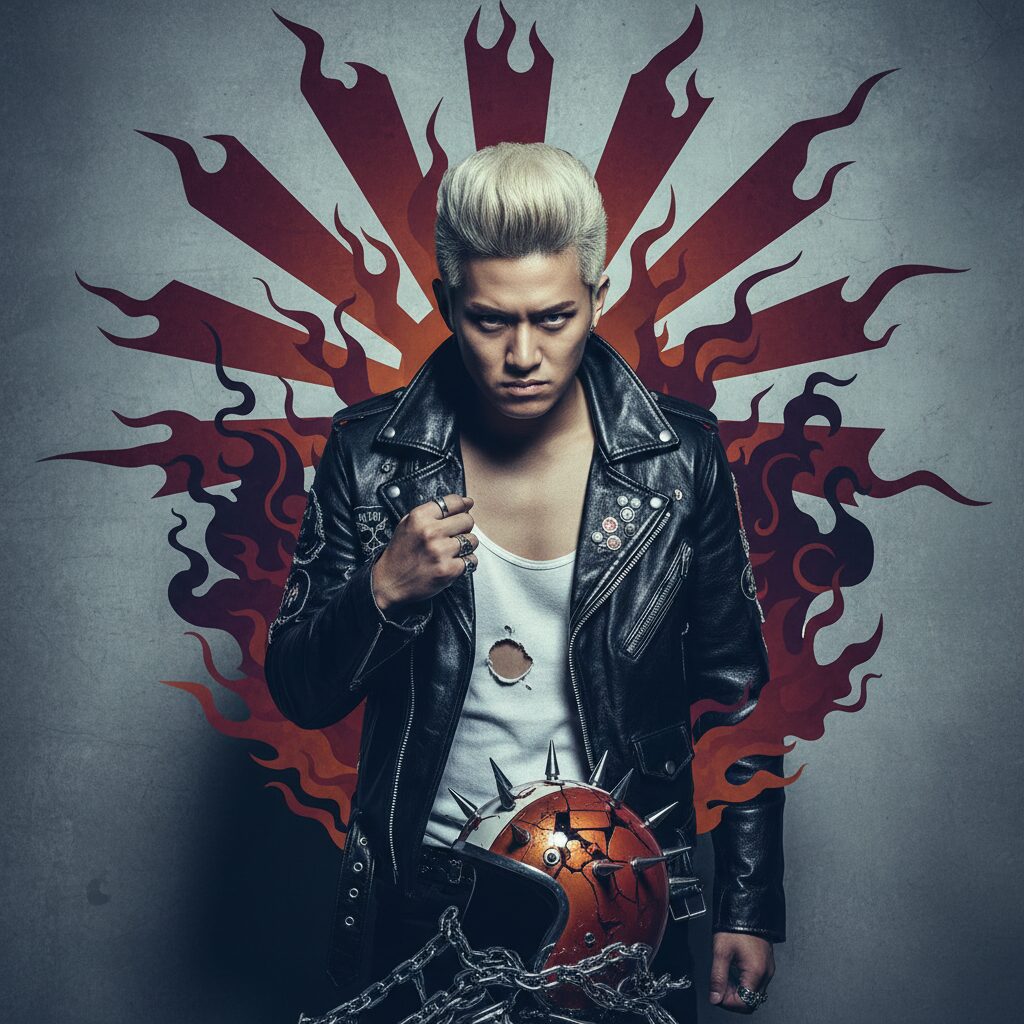
In a country where generations of students have grown up under school rules requiring natural black hair, dyeing it marks the first and most fundamental act of rebellion. For a Yankii, it’s a bold declaration of independence. The classic choice is a harsh, brassy bleach-blonde that sharply contrasts with Japanese skin tones and stands out boldly. The goal isn’t to appear natural but to look artificial and loud.
Beyond color, the hairstyles themselves evoke an earlier era of Japanese toughness. The signature male cut is the regento, or pompadour, often paired with a ducktail in back. Borrowed from 1950s rock-and-roll culture, this look was popularized by tough rock stars and became synonymous with delinquency. Another notorious style is the panchi pāma, or “punch perm,” a tight, curly perm associated with the world of yakuza and old-school tough guys. Female Yankii might bleach their hair, perm it into tight spirals, or tease it into voluminous shapes—defying the simple, straight hairstyles of their more obedient classmates.
The Wardrobe of Defiance
Nowhere is Yankii rebellion more visible than in their treatment of the ultimate symbol of Japanese conformity: the school uniform. Rather than wearing it precisely, they alter it drastically. For boys, this meant the tanran (短ラン), a jacket cut dramatically shorter, and the chōran (長ラン), a long coat almost reaching the knees, both styles inspired by old military school uniforms. These were paired with bontangari pants, cut absurdly wide at the thighs and sharply tapered at the ankles. Seeking out a tailor specializing in these illegal alterations was a rite of passage.
For girls, the classic look involved shortening the standard long pleated skirt by rolling or pinning it at the waist until it was scandalously short, often paired with loose, baggy socks gathered around the ankles. This personalized and sexualized a garment originally designed to erase individuality.
Outside school, the off-duty uniform was equally distinctive. The garment of choice was the full tracksuit, known as a jerāji (from the English word “jersey”). Often in garish colors like gold, purple, or bright blue, and sometimes from flashy luxury brands such as Galfy with its signature big dog logo, these tracksuits were worn everywhere—to convenience stores, pachinko parlors, and dates. Wearing a tracksuit publicly was a powerful statement: it marked rejection of the suit-and-tie world, projecting a lifestyle of leisure or at least freedom from nine-to-five constraints.
Other key accessories completed the look. Both boys and girls often plucked their eyebrows into thin, severe arches. Footwear typically consisted of cheap sandals, often worn with the heel strap crushed down underfoot—a casual sloppiness that infuriated teachers and parents. This act of kakato o fumu (stepping on the heel) symbolized the entire Yankii ethos: a lazy, slouching contempt for doing things the “proper” way.
The Ride: From Roaring Bikes to VIP Sedans
Though massive bōsōzoku gangs have mostly faded, vehicles remain a central aspect of Yankii identity. For younger members, this usually means a 50cc scooter, heavily customized with loud exhausts, neon lights, and numerous stickers—offering mobility and presence in the suburban sprawl where they typically reside.
Older Yankii who have entered the workforce often trade their scooter for a specific kind of car: the VIP-style, or bippu, sedan. These are typically large, older Japanese luxury sedans—such as a Toyota Celsior or Nissan Cedric—heavily modified with lowered suspensions that nearly scrape the ground, wide wheels tilted at extreme angles (known as oni-kyan, or “demon camber”), and dark-tinted windows. Interiors are equally important, often adorned with plush cushions, elaborate curtains, and fuzzy dashboard covers. The bippu car serves as a moving throne room, a bold declaration of status and style that contrasts sharply with the practical, fuel-efficient compact cars favored by most Japanese families.
The Code of Conduct: Rituals, Loyalty, and Local Pride
To view the Yankii merely as a set of fashion choices is to overlook the intricate social world they inhabit. Their style represents only the surface of a culture governed by strict codes of conduct, intense group loyalty, and a deeply local perspective. Their rebellion is directed not at society at large, but at the specific, impersonal demands of mainstream success. In response, they create their own smaller, more intense world.
The Importance of the Crew (Nakama)
Yankii culture is not for loners; it centers fundamentally on the group, the nakama. This chosen family offers the sense of belonging they lack in the rigid hierarchies of school or corporate life. Within the group, strict power dynamics prevail, often reflecting the senpai-kōhai (senior-junior) relationships of broader society, but with greater stakes. Loyalty to the group is unwavering. An insult to one member is an insult to all, and defending the group’s honor is paramount.
Their lives revolve around shared rituals. The most iconic is the late-night gathering. You will find them assembled in the parking lots of 24-hour stores like Don Quijote or outside a local FamilyMart, simply existing together. Here, they perform the well-known “Yankii-zuwari,” or Yankii squat. This posture—a low crouch, balanced on the balls of the feet, often with an elbow resting on a knee—is a non-verbal expression of their identity. It’s a way of occupying public space that is both relaxed and confrontational. It declares, “We are not welcome in the fancy cafes or quiet libraries, so we’ll claim this concrete spot as our own.”
A World of Fierce Localism
One of the most defining aspects of the Yankii mindset is a profound and enduring localism. While ambitious students dream of leaving their rural hometowns for university or work in Tokyo, the Yankii stay put. Their world is their town. They possess encyclopedic knowledge of its backstreets, best lookout points, and rival crews. This fierce local loyalty is sometimes mockingly called a “mild mind” (mairudo maindo), a phrase suggesting a simple, un-intellectual worldview. Yet it’s more accurately seen as a different set of priorities. Their ambition isn’t to climb a corporate ladder in a distant city, but to become a respected figure in the community they’ve always known.
This results in a life path that contrasts with the national trend. Yankii typically complete school, enter the local workforce in blue-collar jobs like construction or mechanics, marry early, and have children young. The souped-up sedan of their youth is eventually replaced by a customized minivan—still lowered and equipped with flashy wheels, but now featuring a car seat in the back. These “Yankii parents” (yan-papa and yan-mama) become pillars of local life. They are the most enthusiastic participants in neighborhood festivals (matsuri), volunteering to carry heavy portable shrines and run food stalls. The same rebellious energy of their youth is redirected into a passionate, pro-social dedication to their community. Though they may have rejected the path of Tokyo’s elite, they often become the most deeply invested citizens of their small worlds.
The Fading Pompadour? The Yankii in Modern Japan
Stroll through a Japanese city today, and you are much less likely to encounter a classic, fully costumed Yankii than you would have in the 1990s or early 2000s. The iconic pompadours and absurdly wide pants have mostly disappeared from the streets. Several factors led to their decline. Stricter school regulations and a generally lower tolerance for public disturbances made maintaining the lifestyle more challenging. The internet spawned countless new niches and subcultures, fragmenting the once singular identity of the Yankii into a multitude of other styles.
Still, the Yankii has not disappeared completely. It has simply become part of Japan’s cultural memory—an enduring and powerful archetype that continues to shape fashion, film, and manga. Series like Tokyo Revengers have recently introduced the bōsōzoku and Yankii aesthetic to a new global audience, igniting a wave of nostalgia and fascination. The look—the bleached hair, the tough-guy stance—is now frequently adopted ironically or as a fashion trend, separated from its original delinquent context.
However, the spirit of the Yankii endures in more subtle forms. It survives in the fierce local pride of rural communities that resist Tokyo’s influence. It can be spotted in the flashy styles of certain host club employees or in the customized minivans crowding suburban shopping mall parking lots. It embodies a fundamental tension within Japanese society that remains: the pull between the collective and the individual, urban sophistication and rural pride, quiet conformity and the urge to stand out.
The Yankii, in all their bleached, squatting, engine-revving glory, remind us that no culture is a monolith. They are the deliberate exception that proves the rule, the imperfection in a flawless facade. They chose to create their own world with its own rules, uniform, and code of honor. In doing so, they forged one of Japan’s most intriguing and lasting subcultures—a rebellion defined not by chaos, but by ritual.