It’s one of the great paradoxes of modern Japan. This is a country celebrated for its astonishing longevity, its meticulous attention to detail, and a quality of life that, in many respects, is the envy of the world. Yet it’s also the country that gave the world a word for which there should be no equivalent: karoshi. Overwork death. A term so chillingly specific it forces you to stop and ask how a society could push dedication to such a fatal extreme.
When most people hear about karoshi, they picture a grim caricature: a salaryman in a rumpled suit, passed out at his desk from sheer exhaustion after a 100-hour work week. That image isn’t entirely wrong, but it’s dangerously incomplete. Karoshi isn’t just about the number of hours clocked. It’s the endpoint of a long and complex journey, a destination paved with immense social pressure, historical momentum, and a deeply ingrained cultural logic that prioritizes the group above all else. It’s a story about how the very virtues that fueled Japan’s post-war economic miracle—loyalty, perseverance, and collective sacrifice—could, under the right conditions, become pathologies. To understand karoshi is to look past the headlines about tragic individual cases and see the invisible architecture of expectations that makes them possible. It’s about dissecting the unwritten rules of the Japanese workplace, where the line between professional duty and personal identity can blur into nonexistence.
The toll of such relentless dedication is also reflected in the modern salaryman’s arduous commute, underscoring the cultural forces that blur the lines between work and identity.
The Anatomy of Overwork
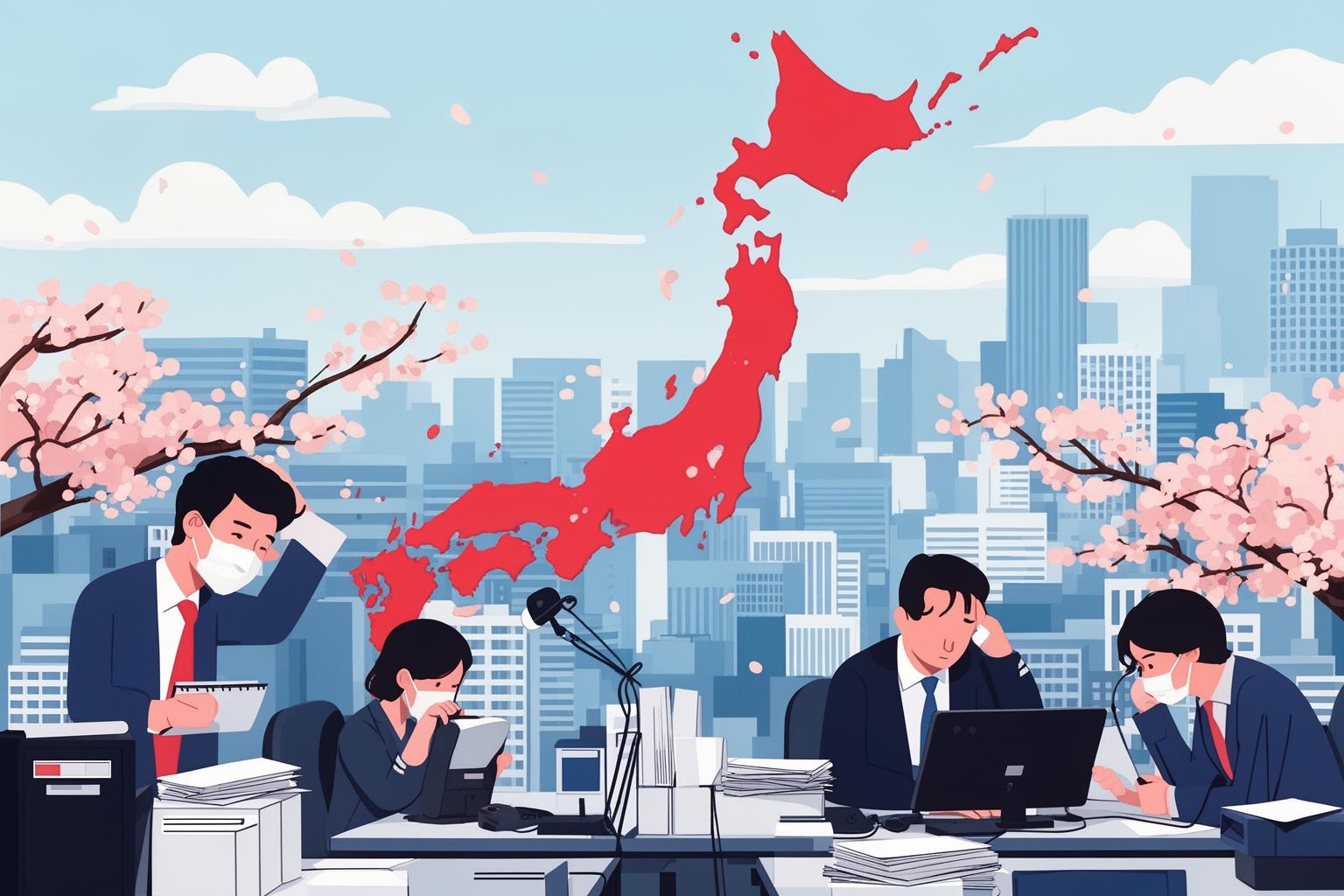
Before exploring the reasons behind it, we first need to grasp what “overwork” genuinely means within the Japanese context. It’s a far more insidious concept than merely staying late to complete a project. The recorded hours often represent just the surface.
More Than What’s on Paper
The initial layer to uncover is saabisu zangyo, or “service overtime.” This refers to unpaid, unrecorded work done out of a sense of duty, pressure, or both. It includes time spent preparing for the next day after officially clocking out, weekend hours devoted to answering emails, or quiet tasks done at home that never show up on a timesheet. It’s a ghost embedded within Japanese labor culture, inflating work schedules while remaining officially invisible. Why does this occur? Because formally recording every single hour of overtime could reflect poorly on a manager’s ability to manage the team’s workload or suggest personal inefficiency. In a culture that strongly discourages causing trouble (meiwaku) for others, the easiest option is often to simply complete the work without reporting it. It’s a silent, collective understanding that keeps the system running, albeit at a significant personal cost.
The Weight of Presence
Next is the unspoken but powerful rule of presence. Productivity is not always the foremost measure of a good employee; visibility is. Leaving the office before your section chief or department head is frequently viewed as a subtle act of insubordination, or at least a lack of commitment. This results in a strange standoff where entire teams may remain at their desks with little to do, waiting for the senior-most person to finally leave. It’s not about completing tasks; it’s about demonstrating dedication. Your physical presence late into the evening serves as proof of your loyalty to the team and company. It sends a strong signal that you are part of the collective, willing to share in the group’s challenges.
This performance extends beyond the office walls. The nomikai, or after-work drinking party with colleagues, constitutes another vital part of professional life. While it can be a genuine chance for bonding, it often acts as an obligatory, unofficial extension of the workday. Here, hierarchies relax somewhat, and honest opinions can be exchanged over beer and sake. However, attendance is rarely optional socially. Frequently declining can mark you as someone who isn’t a team player or genuinely committed. These events further blur the lines between personal and professional time, requiring not only your labor but also your social energy, often late into the night.
The Ghost of the Economic Miracle
This intense work culture did not develop in isolation. Its origins are deeply rooted in Japan’s dramatic post-World War II history. The nation’s recovery from complete devastation was truly miraculous, achieved through collective determination and immense effort.
Forging the Corporate Warrior
In the war’s aftermath, companies became the new symbol of national identity and reconstruction. Corporations offered a sense of stability and purpose that the government, at least temporarily, could not provide. A social contract was established: in return for unwavering loyalty and hard work, the company promised lifetime employment. This was the era of the shushin koyo (lifetime employment) system. Your employer was more than just a workplace; it was a surrogate family supporting you from graduation to retirement.
This led to the ideal of the kigyo senshi, or “corporate warrior.” Primarily men were expected to dedicate themselves to the company, placing its needs above their own and even above their families. Their identity was tied to their job title, their battleground was the global market, and their mission was to rebuild Japan one product, one export, and one grueling workday at a time. This was not merely about earning a salary; it was seen as a patriotic duty. The individual’s sacrifice was framed as a contribution to the nation’s greater good. Long hours, missed holidays, and time away from family were all part of the noble effort to restore Japan’s standing in the world.
When the Contract Frayed
Despite its flaws, this system sustained Japan for decades, fueling its rise to become the world’s second-largest economy. However, when the speculative asset bubble of the 1980s burst sharply in the early 1990s, the social contract began to unravel. The subsequent “Lost Decades” of economic stagnation compelled companies to take the unimaginable steps of restructuring, downsizing, and abandoning the promise of lifetime employment.
The consequences were significant. A new group of “non-regular” workers—contract, temporary, and part-time employees—emerged, lacking the security and benefits of full-time staff. For those still employed full-time, the pressure became far more intense. They had to do more with fewer resources, covering for reduced departments while constantly fearing that their “secure” jobs might be next. The demand for absolute loyalty and sacrifice continued, but the assurance of lifelong security disappeared. The cultural habit of overwork endured, even though its original economic justification had vanished.
The Unspoken Rules of Harmony
To truly understand why someone would work themselves to death, you need to grasp the cultural mindset operating in the background. Japanese society is rooted in values that emphasize the collective over the individual, and these ideals become even more pronounced within the high-pressure corporate environment.
The Tyranny of Wa
At the core of this is wa (和), which roughly means “harmony.” It represents the principle of maintaining a smooth, conflict-free group dynamic. In the workplace, consensus is prioritized over individual opinion, and disrupting this harmony is considered a major taboo. Leaving work “on time” while colleagues are still burdened with tasks can be perceived as selfish, implying that personal time outweighs the team’s collective success. This unspoken pressure to conform and avoid standing out is extremely powerful. It’s often easier to stay late than to endure the silent disapproval of others.
The Virtue of Endurance
This is further reinforced by the cultural ideal of ganbaru (頑張る), the spirit of doing one’s best and persevering through hardship without complaint. Endurance in the face of difficulty is regarded as a sign of strength and moral integrity. In the workplace, this can become a toxic motivator. When everyone silently bears overwhelming workloads, the natural response is not to challenge the system but to ganbaru even harder. Expressing dissatisfaction about long hours or stress is frequently seen as weakness or lack of dedication. The culture glorifies those who stoically bear pain, creating a hazardous cycle where suffering is a mark of honor.
This explains why taking paid vacation is notoriously challenging for many Japanese workers. Although legally entitled to it, many use only a small portion of their allotted days. The fear of burdening colleagues—causing meiwaku—is so strong that they often sacrifice their own well-earned rest. The needs of the group consistently overshadow those of the individual.
From Phenomenon to Legal Reality
For decades, deaths due to overwork were viewed as isolated medical incidents. However, as the numbers increased, a movement led by grieving families began advocating for legal recognition. They contended that these were not random health failures but industrial accidents, directly caused by negligent and exploitative labor practices.
Drawing the Karoshi Line
In the 1980s, the Ministry of Labour started acknowledging the connection between overwork and fatal cardiovascular disease. This ultimately led to the creation of the “karoshi line,” a legal benchmark used to determine if a death or illness qualifies for workers’ compensation. Generally, working more than 100 hours of overtime in the month prior to the incident, or averaging over 80 hours of overtime for two to six consecutive months, is considered strong evidence of a causal link. It’s important to note that this is a legal standard for compensation, not a medical safety threshold. The physical and mental strain begins much earlier.
There are two main categories of karoshi. The first consists of cerebrovascular and ischemic heart diseases—strokes and heart attacks caused by prolonged stress and exhaustion. The second, increasingly common category, is karojisatsu, or suicide resulting from work-related psychological stress. These cases often involve severe harassment, impossible deadlines, or an overwhelming sense of failure and isolation.
High-profile cases, such as the tragic suicide of a young employee at the advertising giant Dentsu in 2015 who worked over 100 hours of overtime in a single month, have periodically shocked the nation, bringing the issue to public attention and compelling both the government and corporations to confront the human cost of their work culture.
The Slow Push for Change
Is the situation hopeless? Not completely. There are indications of a gradual but significant shift. The discussion about work-life balance, once absent, has become a national topic. Concerned about the demographic consequences of an overworked population unable to start families, the government has begun to take measures.
Reform from the Top Down
The most notable legislative initiative is the “Work Style Reform Law” (hatarakikata kaikaku), enacted in 2019. This package of laws introduced, for the first time, a legal limit on overtime hours. It also seeks to encourage more flexible work arrangements, such as teleworking, and requires employees to take at least five days of paid leave annually. These changes are monumental in a country where such matters were previously left to companies’ discretion.
However, enforcement remains challenging. Laws can be amended, but culture is far more resistant to change. Middle managers, being products of the old system, often find themselves in a difficult position. They must enforce the new regulations while still being accountable for demanding output targets. The pressure does not disappear; it merely takes on a different form. Some companies have been accused of simply reclassifying more work as “service overtime” to comply with legal limits.
A New Generation’s Mindset
Arguably, the most powerful driver of change comes from the grassroots. Younger generations of Japanese view things differently. They grew up watching their parents sacrifice everything for their companies, only to see that loyalty go unrewarded during economic downturns. They are generally less willing to accept the old bargain of total dedication in exchange for stability. Many actively seek a life beyond the office. They prioritize hobbies, friends, and personal well-being in ways that would have been unimaginable for their parents’ generation.
This generational shift is slowly transforming the labor market. Companies that adhere to old, harsh work styles are finding it increasingly difficult to attract and retain young talent. The brightest individuals are opting for employers who provide a healthier work-life balance. Yet, this remains a slow, arduous process of change.
Karoshi is not merely a problem of long working hours. It is the tragic result of a nation’s history, economic anxieties, and deeply ingrained social values. It symbolizes a conflict between the collective ideals that rebuilt the country and the individual’s essential need for rest, health, and a life beyond office walls. The ongoing fight against it is more than a labor law issue; it is a quiet, crucial battle for the soul of modern Japan, a nationwide effort to redefine what it means to work hard and to live well.