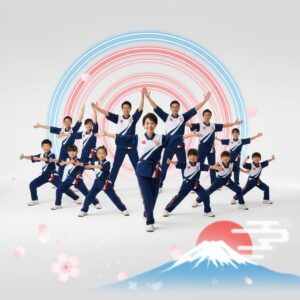
Think about the last “team-building” event your company held. Chances are it involved some lukewarm pizza, a trust fall that felt more like an HR violation, or maybe a slightly awkward happy hour. It was probably optional, and the primary goal was to get through it without saying something career-limiting to your boss. Now, I want you to erase that image from your mind. Replace it with a full-sized athletic stadium, thousands of employees dressed in matching, color-coded uniforms, and your normally mild-mannered department manager screaming himself hoarse through a megaphone. Welcome to the shainai undokai, the Japanese company sports day. And no, this is not optional.
From the outside, it looks like a charmingly retro, oversized school field day. You’ll see classic events like tug-of-war, three-legged races, and giant relay races. But look closer. Notice the synchronized, almost militant warm-up exercises. See the detailed strategy sessions huddled on the sidelines. Feel the palpable tension in the air as the starting pistol fires. This isn’t just a day off from the office to get some fresh air. The shainai undokai is one of the most potent, revealing, and high-stakes rituals in Japanese corporate culture. It’s a physical manifestation of the company’s inner workings, a day-long, non-verbal job interview where your athletic ability is the least important thing being judged. What’s really being tested is your character, your understanding of the group, and your place within the rigid, unspoken hierarchy. This is the office, just with more sweatbands.
Beyond these high-stakes corporate games, the relentless discipline honed in Japanese school clubs, as illustrated by intense school club training, offers further insight into the rigorous team-building practices driving Japan’s corporate culture.
A Field Day Unlike Any Other
The sheer magnitude and gravity of a proper undokai can be astonishing. Forget a neighborhood park; we’re talking about rented stadiums, professional sound systems, and a schedule executed with the precision of a military campaign. Attendance isn’t merely encouraged; it’s often an unspoken expectation, and your absence won’t go unnoticed. Upon arrival, you receive your team’s uniform—typically a t-shirt and a hachimaki, a headband symbolizing effort and fighting spirit. Your team isn’t limited to your immediate department; it’s a carefully assembled cross-section of the entire company, blending fresh-faced new hires with senior executives, back-office accountants with front-line salespeople.
The day’s events combine the familiar with the delightfully bizarre, each one a cleverly crafted test of group dynamics.
The Anatomy of the Games
You won’t find individual showcases like the 100-meter dash here. Every single event is designed to subordinate the individual to the group. The tsunahiki, or tug-of-war, is the quintessential example. It serves as a raw, visceral metaphor for collective struggle. The entire team must pull as a single organism, all at the exact same moment, driven by the chants of their leader. One person out of sync can undermine the entire effort. It embodies the company’s philosophy: individual strength means nothing without unified action.
Then there’s the mukade kyoso, the centipede race. Teams of five or more have their ankles tied together, forcing them to run in perfect sync. It looks comical—a flurry of stumbling legs and panicked shouts—but it’s a harsh lesson in communication and mutual dependence. You have to instinctively sense the rhythm of the people in front of and behind you. Pushing your own pace will only result in a tangled, painful pile-up. The goal isn’t to be the fastest runner, but the most synchronized participant.
Perhaps the most intense event is the kibasen, or cavalry battle. It’s a team-based game where groups of four form a “horse”—three people at the base carrying one rider on their shoulders. The rider’s objective is to snatch headbands off opposing riders’ heads. It’s chaotic, surprisingly physical, and demands a remarkable amount of strategy. Who do you target first? How do you protect your own rider? It’s a miniature battlefield that reveals who can think clearly under pressure and who can lead a charge.
These games are the heart of the undokai, and none can be won alone. They are physical parables embodying the core values of Japanese corporate life.
The Unspoken Curriculum: What’s Really Being Taught
If you think this is all just for fun, you’re completely missing the point. The undokai is a performance where everyone acts as both participant and audience. Your colleagues, managers, and the executives in the VIP tent are all watching. They aren’t merely observing who wins the relay race; they are evaluating character, teamwork, and social intelligence in ways that no quarterly performance review can capture.
Reinforcing the Hierarchy, Sideways
In the office, the corporate hierarchy is clear but often softened by politeness and formal language. On the field, that structure is stripped down and reinforced in a different setting. Your bucho (department head) might deliver an impassioned, fist-pumping speech before the tug-of-war. The kacho (section chief) might be the one coordinating the strategy for the cavalry battle. Their leadership moves from the abstract realm of spreadsheets and meetings to something tangible. They remain in charge, and you are still expected to follow their lead.
For junior employees, the undokai represents a crucial test. The company seeks genki—energy, enthusiasm, and a positive spirit. Are you cheering loudly for your teammates, even after a defeat? Are you helping to set up or clean up without being asked? Are you running your relay leg with full effort, even if your team is trailing? A cynical or lethargic attitude is social suicide. It signals you are not a team player and don’t grasp the importance of contributing to the group atmosphere. Your willingness to shout, sweat, and even look a bit foolish for the team directly measures your commitment to the company.
The Pressure Cooker of Teamwork
Japanese work culture centers on the concept of awaseru, matching your pace and energy to those around you. The undokai is a practical, fast-paced training ground for this skill. In the centipede race, you are literally compelled to awaseru your stride alongside your colleagues. Failing to do so means immediate, public failure. This experience forges a powerful, non-verbal bond. You learn to trust and anticipate your coworkers’ movements in a way no icebreaker exercise ever could.
It’s also a safe space for the company to observe how you handle failure. When your team’s tower of boxes collapses in a relay race, do you blame the person before you? Or do you rush to help rebuild, shouting encouragement? When the opposing team snatches your rider’s headband in the kibasen, do you hang your head in defeat? Or do you quickly form a defensive circle to protect the remaining teammates? The undokai reveals the employees who are resilient, supportive, and prioritize the group’s morale over personal disappointment.
Reading the Air on the Playing Field
The most advanced skill on display is kuuki wo yomu, or “reading the air.” This is the subtle, uniquely Japanese art of gauging a situation’s social context and responding appropriately without explicit directions. The undokai is full of moments demanding keen social awareness.
For example, what do you do if you’re racing against your 60-year-old CEO? You absolutely do not slow down and let him win—that would be patronizing and deeply insulting. You run your hardest, because to do otherwise would show disrespect for the spirit of the competition and your team’s effort. However, if you win, your celebration should be respectful. You might bow quickly in his direction or offer praise for his effort. The goal is to demonstrate that you can be a fierce competitor while simultaneously respecting the social hierarchy. It’s a delicate balance, and your ability to navigate it gracefully is being silently judged by everyone.
The Evolution and Modern Dilemma of the Undokai
The tradition of the company sports day is not new. It dates back to the late 19th century when Japanese companies, influenced by Western customs, began adopting organized physical exercise to cultivate a healthy and disciplined workforce. This practice surged during the post-war economic boom, becoming a fundamental part of the lifetime employment system. The undokai served as a vital ritual for creating a family-like bond and unwavering loyalty among employees who anticipated spending their entire careers at a single company.
However, in the 21st century, that model is evolving. Lifetime employment is no longer assured. Younger generations are more protective of their personal time and may perceive a mandatory weekend event as pawahara, or power harassment. Moreover, the significant cost and logistical challenges of organizing such a large event are prompting many companies to rethink their approach.
Consequently, the undokai stands at a crossroads. Some companies have discontinued it altogether. Others have sought to modernize it by hiring professional event planners to introduce trendier activities like bubble soccer or giant inflatable obstacle courses. Many have transformed it into a voluntary “Family Day,” inviting employees to bring their spouses and children to soften its compulsory, corporate nature. Yet, a notable number of traditional, large-scale Japanese corporations still adhere to the classic format. They believe the undokai offers a visceral, unscripted, deeply communal experience that cannot be replaced by Slack channels or corporate training sessions. For them, it’s a way to forge a unified tribe out of a diverse group of employees—a goal they consider increasingly vital in an era of remote work and fractured company loyalty.
Surviving (and Thriving) at Your First Undokai
If you find yourself working for a Japanese company, there’s a strong likelihood you’ll eventually receive an email announcing the date of the annual sports day. My advice is straightforward: attend. And when you do, fully engage. This is your opportunity to reveal a side of yourself that your colleagues rarely see in the office and to foster relationships that will benefit your entire career.
The Unwritten Rules of Participation
First, the essentials. Arrive punctually. Wear the team uniform assigned to you. Learn the company cheer or song, and don’t hesitate to shout it out. During the events, give your best effort. No one expects you to be an athletic star, but they do expect you to try. Effort is valued much more than talent.
Your conduct on the sidelines is equally important. Cheer for everyone, not just those you know. Offer to help carry equipment or hand out drinks. Congratulate the winning teams and comfort the losing ones. Be an active, positive presence. The worst thing you can do is be a passive, cynical observer glued to your phone. That marks you as someone disconnected from the group.
Lastly, and this is vital, you must attend the uchisage, the party after the event. This is often a large banquet or barbecue held at the stadium or a nearby restaurant. This is where hierarchies relax somewhat, and you can share a drink with your boss and laugh about the day’s mishaps. Missing the uchisage is a significant social faux pas. It’s viewed as a rejection of the camaraderie the entire day was meant to foster.
A Woman’s Perspective
As a woman, navigating the undokai can sometimes require an additional layer of awareness. Historically, female employees were often relegated to supportive roles—distributing lunches, tending minor injuries, or performing coordinated cheer dances. While this is changing rapidly, especially in more progressive companies, encountering some dated attitudes is not unusual.
My advice is to challenge these stereotypes proactively. Volunteer for the tug-of-war. Join the cavalry battle team. Run your leg of the relay with fierce determination. Demonstrate that you are there to compete as a full team member. At the same time, it’s wise to also show your value as a supportive player. Cheering for others and assisting with logistics are not signs of weakness; they indicate a well-rounded contributor. It’s about striking a balance between being a strong competitor and a harmonious part of the group.
In the end, the shainai undokai is much more than just a series of games. It’s a microcosm of Japanese society, a living diagram of the complex web of relationships, obligations, and unspoken expectations that define corporate life. It’s a day of forced fun, genuine camaraderie, and intense social scrutiny. You will leave tired, sore, and probably covered in dirt. But you will also leave with a deeper understanding of your colleagues and your company. The goal isn’t to win the centipede race. The goal is to show that you know how to run it together, in perfect, stumbling, laughing synchronicity. That is the true victory.