Before your phone became a portal to every ghost kitchen and chain restaurant within a five-kilometer radius, getting food delivered was a different kind of ritual. There was no map tracking a cyclist’s meandering path, no star ratings, no algorithm suggesting you add a soda to your order. In Japan, there was the telephone, the familiar voice of the lady from the neighborhood soba shop, and the eventual, distinctive buzz of a scooter engine. This was the world of demae—a system of food delivery that feels impossibly analog, deeply personal, and, in a country that often seems to be living ten years in the future, a powerful link to a more tangible past.
Imagine this: A man on a Honda Super Cub scooter, zipping through a narrow residential street. He’s steering with one hand. With the other, he balances a tall, lacquered wooden box on his shoulder, a box filled with teetering stacks of ceramic bowls brimming with hot, sloshing noodle soup. He does this in the rain. He does this in the sweltering August humidity. This isn’t a stunt; it was, for decades, just how lunch got delivered. This practice, a ballet of balance and neighborhood trust, is the heart of demae culture. It’s a story not just about food, but about ingenious design, unspoken social contracts, and the quiet fade of a uniquely Japanese way of life.
The analog charm of demae delivery echoes a bygone era of personal service, much like the transformative shift seen during the 1970s family restaurant revolution, which reshaped Japan’s dining landscape.
The Pre-App Slurp: An Ecosystem of Trust
Long before the sleek user interfaces of Uber Eats and Wolt, demae operated on a currency of familiarity. You didn’t scroll through endless options; instead, you reached for the magnetized menu stuck to your refrigerator—a flimsy piece of laminated paper from the local ramen-ya or soba-ya you’d known for years. The transaction started with a phone call, often directed to the owner themselves. There was no need to painstakingly recite your address because they already knew it. You were Tanaka-san from the third-floor apartment with the fussy cat, or the Suzuki family at the end of the lane.
This system flourished in the dense, walkable neighborhoods that characterize much of urban Japan. It was designed for the everyday, not the exceptional. Demae was the lifeline for the salaryman working from home, the small factory owner unable to leave the shop floor, or the family on a rainy Sunday when no one felt like cooking. The menu was a list of comforting, unpretentious staples: a steaming bowl of kitsune udon, a hearty plate of katsudon (a breaded pork cutlet over rice and egg), or the quintessential shoyu ramen. This wasn’t celebratory food; it was nourishment, delivered with minimal fuss and maximum warmth.
The relationship was symbiotic. The restaurant, typically a small, family-run operation, had a built-in customer base. The customer had a dependable source of hot food that felt like an extension of their own kitchen. There was an implicit understanding—a social contract that went beyond a simple commercial exchange. You were supporting a local business, a neighbor, and in return, they were nourishing you. This wasn’t about the disruptive convenience of the gig economy; it was about the sustaining convenience of community.
The Okamochi: A Masterpiece of Analog Engineering
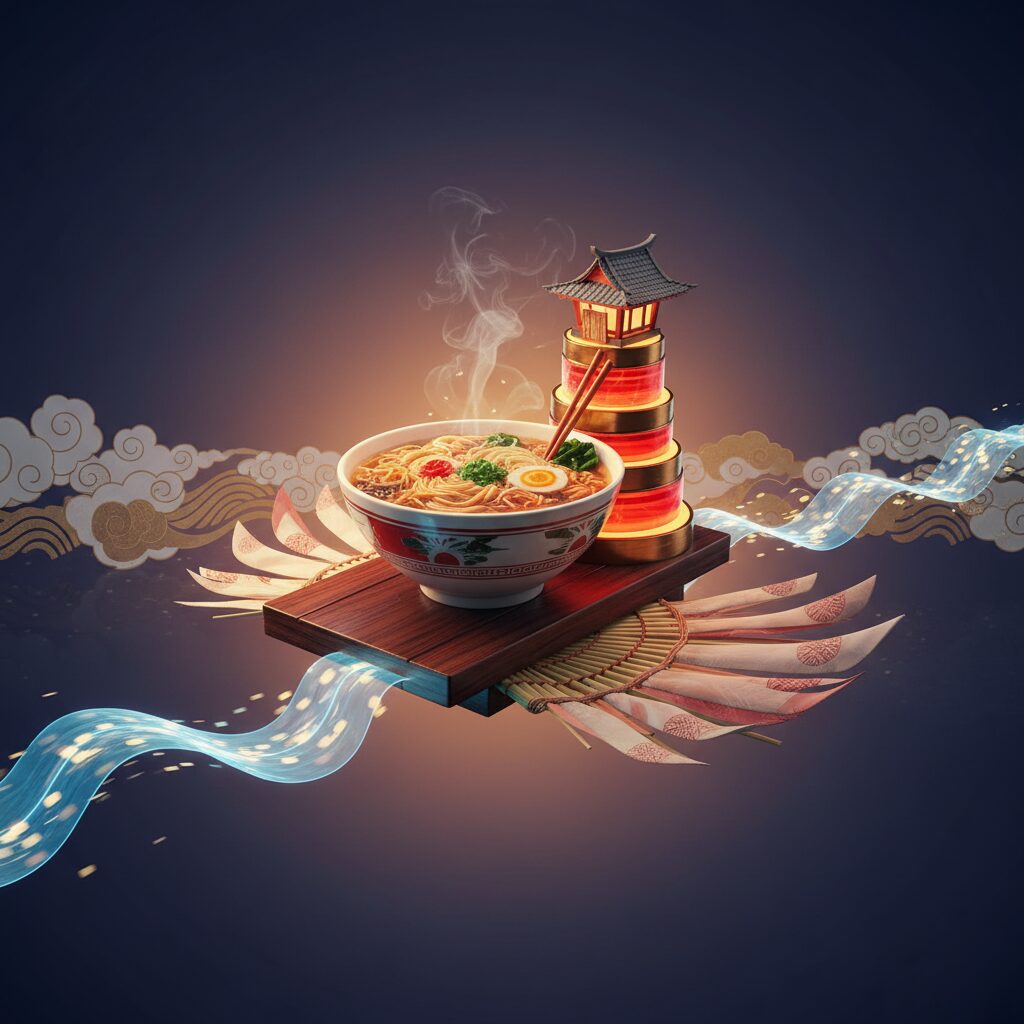
The true symbol of the demae world is the okamochi (岡持ち), the seemingly simple box that made it all possible. Calling it merely a box does it a disservice; the okamochi is a marvel of functional design, a piece of folk engineering refined over generations. Usually made from wood or, later, lightweight aluminum, its shape was entirely determined by its purpose: to carry stacks of fragile, soup-filled bowls on a moving vehicle without disastrous spillage.
At first glance, it appears as a tall, slender cabinet with a handle on top. But its brilliance lies inside. The interior is bare, allowing for maximum adaptability. Bowls of ramen or donburi were stacked directly one on top of another, the lip of each fitting snugly onto the one below. The sheer vertical walls of the box and the tight fit kept the stacks stable. The snug enclosure also acted as a surprisingly effective insulator, trapping the steam from the hot food and ensuring it arrived at the customer’s door not just warm, but piping hot.
Balancing Act on a Super Cub
Naturally, the okamochi was only part of the equation. The other half was the human element—the driver who executed this daily feat of kinetic artistry. The vehicle of choice was almost always the Honda Super Cub, a small-engine scooter famous for its durability and fuel efficiency. It was the workhorse of postwar Japan, and the demae delivery person was its most daring rider.
The technique was something to admire. The driver sat slightly askew, one hand on the throttle and brake, the other lifting the fully loaded okamochi onto their shoulder. The box wasn’t strapped down or secured in a rack; it was held by the rider’s hand and sheer luck. This approach allowed the driver to act as a human gimbal, their body absorbing the shocks and vibrations of the road, their arm subtly adjusting the box’s angle to counter the forces of acceleration, braking, and turning. It was a physical skill developed through countless trips, a form of muscle memory bordering on circus art.
Picture the scene: weaving through traffic, navigating narrow alleyways barely wide enough for one person, the driver kept the tower of soup perfectly level. The clatter of porcelain from inside the box was a familiar neighborhood sound, a rhythmic announcement that someone’s lunch was on the way. It was a performance of intense concentration and casual mastery, a spectacle of physics and nerve unfolding on the streets of Japanese cities thousands of times a day.
The Ritual of Return: A Cycle of Connection
Perhaps the most revealing aspect of demae culture, and the one that feels most foreign compared to our disposable present, is what occurred after the meal. The food arrived in the restaurant’s actual dishware—sturdy ceramic bowls and proper lacquered trays. There were no plastic containers, no flimsy disposable chopsticks, no heaps of trash to manage afterward. Essentially, you were borrowing the restaurant’s tableware for an hour.
This simple reality fundamentally altered the nature of the transaction. It stopped being a one-way exchange and became a closed loop. After finishing your noodles, the ritual continued. The customer was expected to give the bowls a quick rinse under the tap—a small act of courtesy—and place them on the tray just outside their front door. No bags, no hassle. You simply left them there.
Hours later, sometimes during their next delivery run in the neighborhood, the same driver or another shop staff member would stop by to collect the empties. The quiet return of the scooter and the gentle clink of ceramic being gathered was the final moment in the rhythm of the demae exchange. It was a system that extended the restaurant’s presence into the customer’s home and back again.
A System Built on Unspoken Trust
This entire system relied on a level of social trust that is difficult to imagine in many other cultures. The restaurant owner trusted that their valuable, non-disposable bowls would not be broken, lost, or stolen. The customer trusted that the shop would reliably return to retrieve them, preventing a pile of dirty dishes from gathering on their doorstep. No deposits were required, no contracts signed. It was an honor system scaled to a city-wide level.
This cycle of delivery and collection strengthened the neighborhood bond. It was a recurring, low-pressure interaction that knitted the community together. It stood in stark contrast to the anonymous, transactional nature of modern delivery apps, where the driver is a faceless icon on a map and the packaging is designed to be discarded immediately. Demae was, by its very nature, sustainable and relational. It demanded a shared understanding of etiquette and mutual respect.
The Slow Fade of the Demae Man
The sight of a daredevil rider carrying an okamochi balanced on their shoulder is now rare, a fleeting remnant of a bygone era. The decline of traditional demae was not abrupt but a gradual fading, driven by the relentless pressures of modernization. The rise of inexpensive and effective disposable packaging played a significant role, removing the need for return trips to collect dishes and greatly simplifying logistics.
At the same time, the economic landscape changed. Small, family-run eateries faced mounting competition and increasing labor costs. Maintaining a dedicated delivery staff became a luxury many could no longer afford. The physical demands and skill required for the job also made it harder to find willing young workers. Then the digital revolution arrived. Platforms like Demae-can (which, despite its name, was an early aggregator service) and later global giants like Uber Eats introduced a new model. They provided restaurants with access to a large delivery fleet without the overhead of hiring staff and offered customers a vast selection far beyond their local soba shop.
The old system couldn’t compete with the variety or digital convenience. The quiet efficiency of neighborhood networks was replaced by the data-driven efficiency of the platform economy. While you can still see a demae delivery in some older, more traditional neighborhoods or serving company offices in business districts, it has become an exception rather than the norm—a living fossil in a rapidly evolving ecosystem.
An Enduring Icon of Showa Nostalgia

While demae may have disappeared from the streets, it remains vividly alive in Japan’s cultural memory, especially as a powerful symbol of the Showa Era (1926–1989). In anime, manga, and films, the image of the demae delivery person serves as a strong visual shorthand, instantly evoking a sense of a simpler, more communal time. It’s the ramen that arrives at the struggling animator’s desk during a last-minute deadline; it’s the udon delivered to a family gathered around a kotatsu on a winter night.
The demae man often appears as a recurring side character, a friendly presence who connects the protagonist to the broader world beyond their apartment. The scooter’s arrival acts as a punctuation mark in daily life, a small moment of comfort and connection. This familiar trope has embedded the okamochi and the Super Cub into the national consciousness as icons of mid-century working-class existence. They symbolize an era of analog solutions, physical perseverance, and a kind of straightforward, unpretentious reliability.
This nostalgia extends beyond just a delivery method; it’s for the social fabric that it embodied. The disappearance of demae mirrors the breakdown of the close-knit neighborhood networks that once shaped urban life. In its place is a more fragmented, convenient, yet arguably more impersonal world. The demae man knew your street; the app merely knows your location data.
In hindsight, the demae system feels like both an ingeniously simple solution and an irresistibly charming relic. It was a seamless blend of product, tool, and human skill born out of necessity but maintained through a culture of trust and mutual responsibility. The next time you tap your phone and watch a bicycle icon move across the screen, take a moment to remember the old way: the roar of a tiny engine, the clatter of porcelain in a wooden box, and the remarkable, gravity-defying art of delivering a perfect bowl of noodles. It serves as a reminder that sometimes, the most elegant solutions aren’t found in an app, but in the simple, practiced balance of a man on a scooter, bringing a hot meal to a neighbor.