Ask someone outside Japan about JDM car culture, and their mind likely jumps to a very specific scene. They picture neon-drenched Toyota Supras and Nissan Skylines from the Fast & Furious franchise, all massive wings, wild vinyl graphics, and thunderous exhausts spitting flames. It’s a vision of pure, unapologetic spectacle—speed made loud and visible. And while that slice of the culture certainly exists, it’s the flashy, export-friendly version. It’s not the heart of the matter.
The real soul of Japan’s tuning scene is a much quieter, more intense affair. It’s less about shouting and more about a confident whisper. It’s a subculture built on a philosophy of subtraction, where perfection is achieved not when there is nothing left to add, but when there is nothing left to take away. It’s found in the late-night quiet of a sprawling parking area, where enthusiasts gather not to rev their engines in a cacophony of noise, but to quietly circle each other’s machines, heads bowed in appreciation of a perfectly flush wheel fitment or the subtle gleam of a rare titanium component. This is a world where the highest compliment isn’t how fast your car looks, but how thoughtfully it’s been built. To understand it, you have to look past the noise and learn to appreciate the silence in between.
The measured aesthetic of Japan’s tuning scene finds an intriguing parallel in the understated rhythms of Japanese City Pop, inviting enthusiasts to experience another layer of the nation’s cultural tapestry.
Beyond the Sticker Bomb: Defining “Authentic” JDM
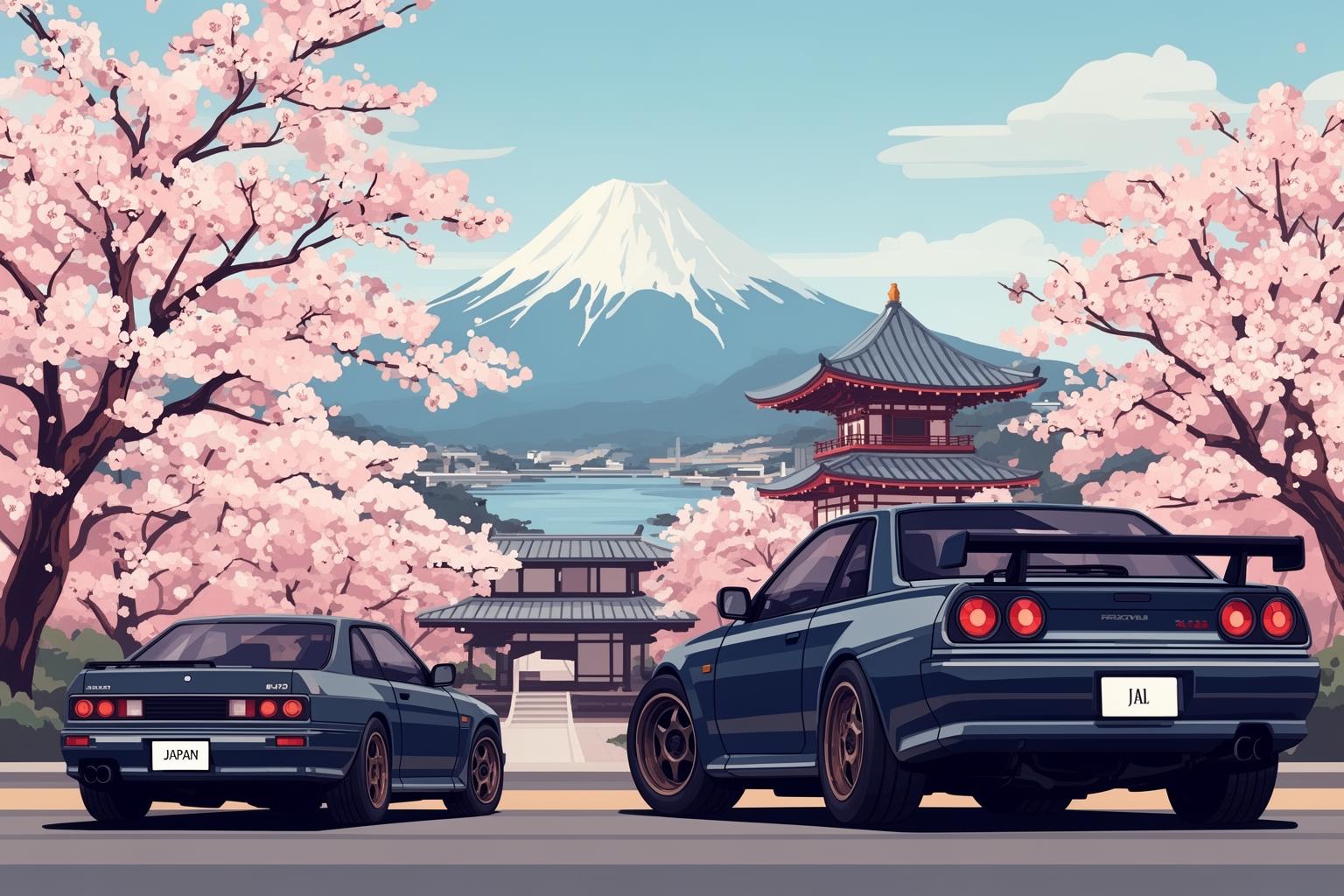
First, let’s address a common misconception. JDM stands for Japanese Domestic Market. Technically, it refers to cars and parts manufactured and sold exclusively for Japan. These vehicles often feature different engines, options, and regulatory standards compared to their export versions. A genuine JDM car is one originally sold in Japan. However, that is merely the literal definition. In practice, JDM has grown into a philosophy of modification that largely transcends the car’s origin and focuses instead on the approach taken.
This philosophy contrasts sharply with many Western tuning approaches. In certain communities, particularly in American muscle car culture, the emphasis is often on overwhelming power and presence. Bigger engines, louder supercharger whines, wider tires, and more aggressive stances symbolize dominance. It’s a culture of accumulation, making the car an unmistakable, almost intimidating force. While it has a raw, visceral allure, it’s an entirely different language.
The JDM mindset, on the other hand, adopts a more measured approach. It revolves around balance. Power is meaningless if the chassis can’t support it. Speed counts for little if the brakes aren’t up to the task. Every modification must have a purpose and harmonize with the rest of the vehicle. An owner might invest heavily in lightweight suspension parts that go unnoticed by most, simply because they subtly enhance the car’s response and feedback. The aim isn’t merely to boost straight-line speed, but to create a more cohesive, responsive, and intuitive extension of the driver’s will. This is the pursuit of functional beauty, where the most elegant solution is also the most effective one.
The Philosophy of “Shibui”: Finding Beauty in Restraint
To truly understand the aesthetic underpinning this culture, you need to be familiar with a Japanese concept that lacks a simple English equivalent: shibui (渋い). Shibui refers to a particular kind of beauty that is simple, subtle, and unobtrusive. It’s a beauty that doesn’t demand attention. It’s the quiet confidence of a perfectly tailored, unadorned suit, the earthy texture of a handcrafted ceramic bowl, or the stark elegance of a single piece of calligraphy. It represents quality and sophistication that you sense more than see.
This aesthetic acts as the invisible force guiding the JDM enthusiast and is expressed in several key ways.
Clean Lines and Purposeful Form
Authentic JDM-style cars are rarely seen with overly large or non-functional body kits. Modifications tend to be so subtle that the untrained eye might overlook them. The factory body lines, crafted by skilled professionals, are respected and enhanced rather than erased. A small, functional front lip spoiler that provides genuine downforce is favored over a massive, purely decorative bumper. A carbon fiber hood is selected for its weight reduction, not just aesthetics. Every element has a purpose. This is the art of subtraction: refining and distilling the car’s form to its purest, most effective expression.
The Obsession with Fitment
This meticulous attention is most evident in wheel fitment. The millimeter-perfect alignment between the wheel edge, tire stretch, and fender curve is treated with near-religious devotion. Known as tsuraichi (面一), which roughly means “to be flush with,” achieving perfect tsuraichi is an art requiring deep knowledge of wheel offsets, suspension geometry, and tire sizes. It’s not about mounting the biggest wheels possible; it’s about creating one seamless visual line from the body panel to the wheel. When executed correctly, it appears effortlessly right—a state of visual harmony deeply gratifying to those who appreciate it. It’s shibui in motion.
The Understated Interior
Inside, the same principle applies. The emphasis is on the driver’s connection to the machine. You won’t find excessive gauges, neon lights, or huge sound systems. Instead, there is a purposeful, driver-focused cockpit. Stock seats may be replaced with a single, lightweight Bride or Recaro bucket seat that holds the driver securely. The factory steering wheel might be swapped for a classic Nardi or Momo wheel that offers improved grip and feel. The gear knob is selected for its weight and height, enhancing the shifting experience. Anything unnecessary for driving—rear seats, sound deadening, interior trim—is often removed. The result is a spartan, functional space that is immaculately clean and composed of high-quality, purposeful components.
The Driver as the Final Component: Skill Over Spectacle

No matter how perfectly tuned, the car represents only half of the equation. The other half is the driver. In Japan, there is a profound cultural respect for gijutsu (技術), or skill, developed through relentless practice and dedication. This respect extends from sushi chefs to calligraphers—and, without question, to drivers as well. The ultimate aim is to reach a state of harmony with the machine, where the car responds to your inputs as if it were a natural extension of your body.
This is why the true proving grounds for JDM culture are not drag strips, but rather winding mountain roads and technical race circuits. The touge (峠), or mountain pass, serves as the spiritual home of this driving philosophy. These tight, twisting roads, filled with hairpin turns and elevation changes, are not conquered by raw horsepower alone. Instead, they demand skill, precision, and a deep understanding of the car’s limits. A smaller, lighter, and more balanced car like a Mazda Miata or a Toyota AE86, in the hands of a skilled driver, can easily outmaneuver a more powerful but heavier car on the touge. It’s a realm where driver skill acts as the great equalizer, and the flowing dance of finding the perfect racing line through a series of corners becomes the ultimate form of expression.
Even during organized track days, the mentality remains the same. It’s not about boasting your car’s peak horsepower. Instead, it’s about your lap times and the consistency with which you hit braking points and apexes, lap after lap. The quiet respect earned from fellow drivers who see your clean, precise driving holds far more value than any loud display of power on the main straight. The machine is a tool, and true artistry lies in how you wield it.
The Community and Its Unspoken Codes
This entire subculture is united by a community governed by a strict, though unwritten, code of conduct. The best place to observe this is during a late-night gathering at a major highway service area, or Parking Area (PA), such as the renowned Daikoku Futo or Tatsumi PA near Tokyo. To an outsider, it may appear to be merely a parking lot filled with cars. However, it is a living, breathing social club—a mobile museum where owners showcase their meticulously crafted machines.
Etiquette is of utmost importance. You don’t touch another person’s car without explicit permission. Excessive noise is forbidden—no engine revving contests, no loud music. This is partly out of respect for others and partly for a practical reason: to avoid drawing the attention of the police, who are quick to disperse such gatherings. The goal is to remain under the radar. This inherent need for discretion is another reason the culture values subtlety over flamboyance.
Conversations are often quiet and technical. Owners exchange information about rare parts or tuning techniques. The highest form of social currency is knowledge and taste. A shared nod of approval between two strangers over the choice of a rare brake caliper or a flawlessly welded exhaust manifold forms the foundation of the community. It’s a culture of “if you know, you know.” Validation comes not from the masses, but from the small group of dedicated enthusiasts who truly appreciate the time, effort, and philosophy invested in the build.
The Soul of the Machine: Why It Endures
It would be incorrect to assume that JDM culture opposes speed or power. It absolutely does not. The difference is in its interpretation of performance. Performance isn’t measured by a single figure on a dynamometer; it’s a holistic attribute—a combination of power, balance, reliability, driver feedback, and aesthetic unity. It embodies the pursuit of a machine that is greater than the sum of its parts.
This explains why a twenty-five-year-old Nissan Skyline GT-R is still highly regarded. While it may not be the fastest car by today’s standards, it symbolizes a peak of balanced, technology-driven performance from its time. It was created with a clear, focused intention, and enthusiasts aim to maintain and enhance that original character rather than overwrite it with sheer force.
In essence, JDM culture is a form of disciplined self-expression. It represents a deep, personal connection between an owner and their machine. It reflects a cultural mindset that values mastery, patience, and the profound beauty of subtle excellence. It’s a silent roar, understood not by those who simply hear it, but by those who know how to truly listen. And in a world growing louder every day, that quiet confidence may be more appealing than ever.