You asked what it is about sitting in a steaming hot spring while it snows that makes it the definitive “Japow” experience. It’s a great question, because the image itself has become a kind of cultural shorthand for winter in Japan. You see it on every travel brochure and Instagram feed: a serene-looking person, shoulders deep in milky blue water, snowflakes melting on their hair as steam billows into a frozen forest. It looks idyllic, sure. But to understand why this experience resonates so deeply, you have to look past the postcard image. It’s not just about getting warm in a pretty setting. It’s about willingly participating in a series of profound contrasts that speak to the very core of Japanese aesthetics and its relationship with nature. The snow-covered outdoor bath, the yukimi rotenburo, isn’t an amenity; it’s a destination. It’s a ritual that combines the raw power of the earth with a quiet, contemplative human tradition. This experience is the reason many people feel they’ve truly understood something about Japan, long after the powder has been skied and the boots have been put away. It’s a physical encounter with the philosophy of a place, where silence speaks volumes and the collision of elements creates a perfect, transient harmony.
This intricate interplay between the serene onsen experience and Japan’s broader cultural contrasts is mirrored in the subtle balance between true feelings and social facades, as explored in the subtle dynamics of honne and tatemae.
The Art of Contrast: A Lived-In Painting
The immediate, overwhelming sensation of a snow onsen lies in its striking contrast. This principle is foundational to much of Japanese art, from the bold black ink on white paper in calligraphy to the solitary, vivid red maple leaf set against the muted green moss in a Kyoto garden. Beauty is found not only in harmony but in the tension and balance between opposing forces. The yukimi rotenburo offers perhaps the most immersive way to experience this concept, engaging all the senses simultaneously.
Atsui and Tsumetai: The Body as a Boundary
The moment you enter the scene, your body becomes the canvas. The air is the first to register—frigid, sharp, and so pure it almost hurts to inhale deeply. It bites at your exposed skin, a stark reminder of winter’s relentless grip. Then, as you lower yourself into the water, the heat is immediate and intense—a liquid embrace that pushes back against the cold with undeniable authority. This thermal shock brings you fully into the present moment. There is no room for wandering thoughts, only the raw, unmistakable sensations of hot (atsui) and cold (tsumetai).
Your body stands as a living boundary between these extremes. From your shoulders down, you are swathed in volcanic warmth, muscles unwinding from the day’s strain. Your blood pulses faster, and a deep, primal sense of safety settles over you. Yet from the neck up, you are exposed to the elements—the crisp air on your face, the cool touch in your lungs. Snowflakes, impossibly delicate, land on your forehead and eyelashes, melting instantly. This duality is not discomforting; it’s exhilarating. It sharpens your awareness, making you feel vividly alive. The experience shows that comfort and adversity, warmth and cold, do not exclude each other. Rather, each intensifies the other. The heat feels fiercer because the air is so cold. The cold feels sharper because the water is so warm. This physical lesson in duality reflects a core concept in Eastern philosophies, where opposites like yin and yang are complementary forces that create wholeness.
Stillness and Movement: A Fleeting Masterpiece
Visually, the scene illustrates this principle as well. The landscape is defined by stillness. The ancient rocks lining the pool, covered with a thick layer of snow, have stood for centuries. Surrounding pine trees, heavy with snow, serve as silent, motionless sentinels. The ground remains a pristine, untouched canvas. This is a realm deeply asleep, frozen in time.
Yet within this profound stillness, there is constant, gentle motion. Steam rises from the water’s surface, swirling and dancing in mesmerizing, unpredictable patterns before fading into the cold air. It visually embodies the earth’s own breath. Above, snowflakes drift down in a quiet, ceaseless ballet—no two flakes alike, their descent a subtle, captivating spectacle. They fall onto the water and vanish instantly, releasing a faint, almost imperceptible sizzle.
This interplay between permanence and fleetingness is central to the Japanese aesthetic of mono no aware, often translated as “the pathos of things.” It is a tender sadness or awareness of the transience of beauty. Cherry blossoms captivate because their bloom is so brief. The snowy onsen scene holds the same power. You are witnessing a moment of perfect, unrepeatable beauty. The curl of steam, the unique pattern of falling snow—these will never occur in exactly the same way again. By sitting in the onsen, you become more than an observer of this living artwork; you become part of it. You are the warm, breathing presence in a world of beautiful frozen stillness, a participant in its ephemeral magic.
Nature as a Sacred Space: Beyond the Scenery
To fully appreciate the significance of the onsen experience, it is important to understand that in Japan, nature has never been merely a backdrop for human activity. It is a powerful, living force, a source of spiritual energy and purification. The modern idea of an onsen as a spa or resort is a relatively recent concept. For centuries, these geothermal springs were regarded as sacred places where the divine and human realms intersected.
Shinto Roots: The Sacredness of Water and Mountains
Japan’s indigenous faith, Shinto, is a form of animism. It teaches that kami—gods, spirits, or divine essences—inhabit natural objects and phenomena. Towering mountains, ancient trees, mighty waterfalls, and distinctively shaped rocks are all believed to be potential abodes of these kami. Geothermal hot springs, emerging from the volcanic depths of the earth, were seen as especially powerful places. They were viewed as direct gifts from the subterranean world, tangible manifestations of the planet’s primal energy.
Bathing in an onsen was originally understood as a spiritual ritual, a form of purification called misogi. By immersing themselves in these sacred waters, people could cleanse not only their physical bodies but also their spiritual impurities. Many onsen towns developed around shrines dedicated to the local kami of the springs, and pilgrims traveled long distances in search of healing and renewal. Soaking in an outdoor onsen, particularly one surrounded by the quiet presence of a snow-covered mountain, links you to this ancient tradition. You are bathing in water that has been revered for centuries. The act carries a deep sense of reverence and gratitude. It is a form of communion with the powerful spirits of the place, a humbling reminder of your small place within a much larger, living world.
Yukimi: The Art of Snow Viewing
Another dimension of cultural meaning comes from the tradition of yukimi (雪見), or snow viewing. Similar to hanami (cherry blossom viewing), yukimi is not a passive act of observation; it is a mindful, devoted practice of appreciating the serene beauty of a snowy landscape. This tradition has deep roots in Japanese art and literature, particularly flourishing during the Heian period (794-1185) among the court aristocracy. They composed poetry, played music, and drank sake while reflecting on the transformative effect snow had on the world.
Yukimi is traditionally practiced from a place of warmth and comfort, creating a pleasing contrast with the cold scene outside. A traditional teahouse with a large window overlooking a garden, or the engawa (veranda) of a house, are classic settings for this practice. The ultimate form of this tradition, however, is the yukimi rotenburo. This elevates the experience from simple viewing to full immersion. You are not just observing the beautiful scene through a window; you are sitting amidst it. The onsen provides the essential warmth and comfort that lets you stay for a long time, fully absorbing the quiet majesty of the winter landscape. The falling snow becomes not just something you see but something you feel on your skin. It embodies the perfection of an age-old aesthetic pursuit.
A Social Ritual of Silence and Release
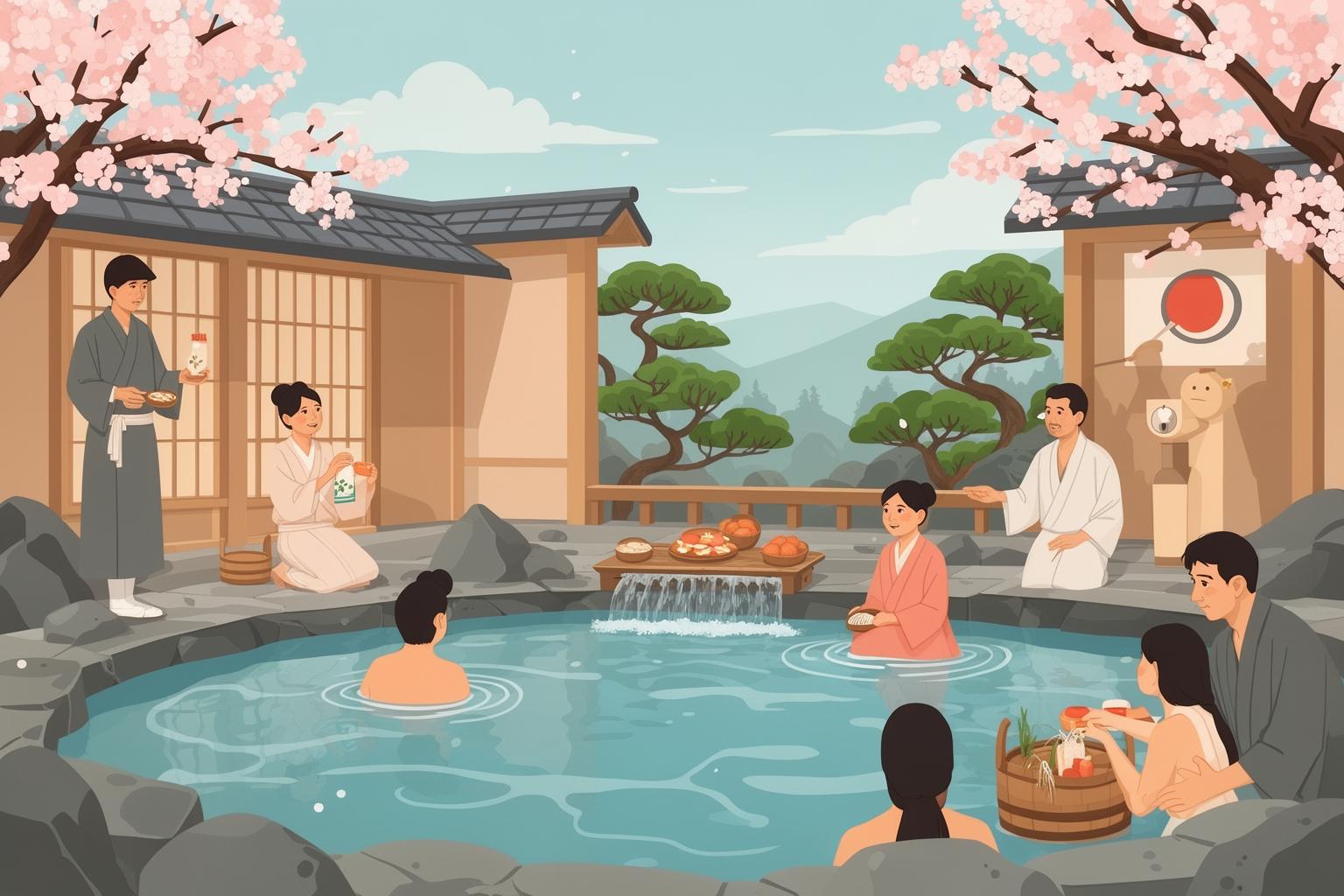
While the onsen experience is deeply personal and reflective, it is also profoundly social. However, it follows a different set of social rules than those found elsewhere. It is a space for release, equalization, and often, a comfortable shared silence that is distinctly Japanese.
The Great Equalizer: Hadaka no Tsukiai
In Japan, there is a concept called hadaka no tsukiai, which roughly translates to “naked communion” or “naked friendship.” This idea suggests that when people bathe together, stripped of their clothes and, by extension, the external symbols of social status—their business suits, uniforms, brand names—they can connect on a more basic, open, and equal level. In a society as hierarchical and formal as Japan’s, this serves as a powerful social release.
At the onsen, the company president and junior employee, the farmer and the city-dweller, are all made equal by the water and steam. The strict etiquette and formal language that govern daily interactions can soften. This doesn’t necessarily result in much conversation. Often, the communion is silent—a shared nod, a quiet sigh of contentment, mutual appreciation of the falling snow—these are the ways communication happens. The snowy setting enhances this mood: snow muffles outside sounds, creating a bubble of deep tranquility. In this shared quiet, a unique bond emerges, an unspoken understanding rooted in a mutual experience of peace and beauty. It’s a form of socializing that requires no words.
From Toil to Tranquility: The Cycle of Reward
Historically, the onsen has served as a place of recovery and reward. For centuries, samurai retreated to hot springs to heal wounds after battle. Farmers soaked their aching bodies after the hard labor of planting or harvesting rice. It was a place to recover physically and mentally—a ritual of restoration.
This tradition persists today, particularly within the “Japow” experience. For many, the snow onsen is an essential second act after a day skiing or snowboarding in Japan’s legendary powder. After hours of intense physical exertion in the cold, carving down mountains and pushing the body to its limits, there is no greater reward than sinking into a volcanically heated bath. The hot, mineral-rich water soothes sore muscles and tired limbs like nothing else. It completes a cycle of effort and release, exertion and recovery. The onsen is not merely a pleasant evening activity; it is a vital restorative ritual that enables you to rise and do it all again the next day. This transforms the bath from a luxury into a necessity—a fundamental part of mountain culture and the key to fully embracing the physical demands of a winter in Japan’s highlands.
The Soul of the “Japow” Experience
The term “Japow” is a colloquial blend of “Japan” and “powder,” coined by the international ski and snowboard community to describe the uniquely light, dry, and abundant snow found in regions like Hokkaido and Nagano. Over time, however, the word has come to encompass much more than just weather conditions. It now represents the entire ecosystem of a Japanese winter adventure: the exceptional food, the warm hospitality, the distinctive culture, and, most importantly, the onsen at its heart.
More Than Just Powder Snow
While excellent snow exists worldwide, the yukimi rotenburo is exclusive to Japan. This cultural element transforms a Japanese ski trip from a memorable vacation into an unforgettable, almost spiritual experience. The onsen serves as the connection between the high-energy excitement of modern snow sports and the country’s ancient, reflective spirit. It marks the moment when you transition from a tourist consuming a product (the snow) to a participant in a centuries-old cultural tradition. It is the quiet core of the vibrant, exhilarating joy found on a powder day. Without the onsen, “Japow” would be just powder. With it, it becomes a full cultural immersion, a journey that nourishes the body, mind, and spirit.
A Moment of Ma (間)
To truly appreciate the power of the onsen, it helps to understand the Japanese concept of Ma (間). Ma is famously hard to translate directly, but it denotes the space between things, the interval, the pause. It is not a void, but a meaningful emptiness. It is the silence between musical notes that gives the melody its rhythm and strength. It is the blank space on a scroll that defines the painted subject’s shape and focus.
The snow onsen perfectly embodies Ma. It is a conscious pause in life’s fast pace. It is a space rich with sensory contrasts—hot, cold, the sight of steam—yet its ultimate effect is to quiet the mind. The silence is not empty, but filled with the faint whisper of falling snow. The stillness is not lifeless, but brimming with the potential of the dormant nature surrounding you. In our hyper-connected, overstimulated world, sitting quietly in a hot pool, doing nothing but watching snow fall is a radical act. It is a moment of pure Ma, a space to reset, breathe, and simply be. This kind of relaxation goes beyond soothing tired muscles; it is a recalibration of the soul.
The Silent Sermon of the Snow Bath
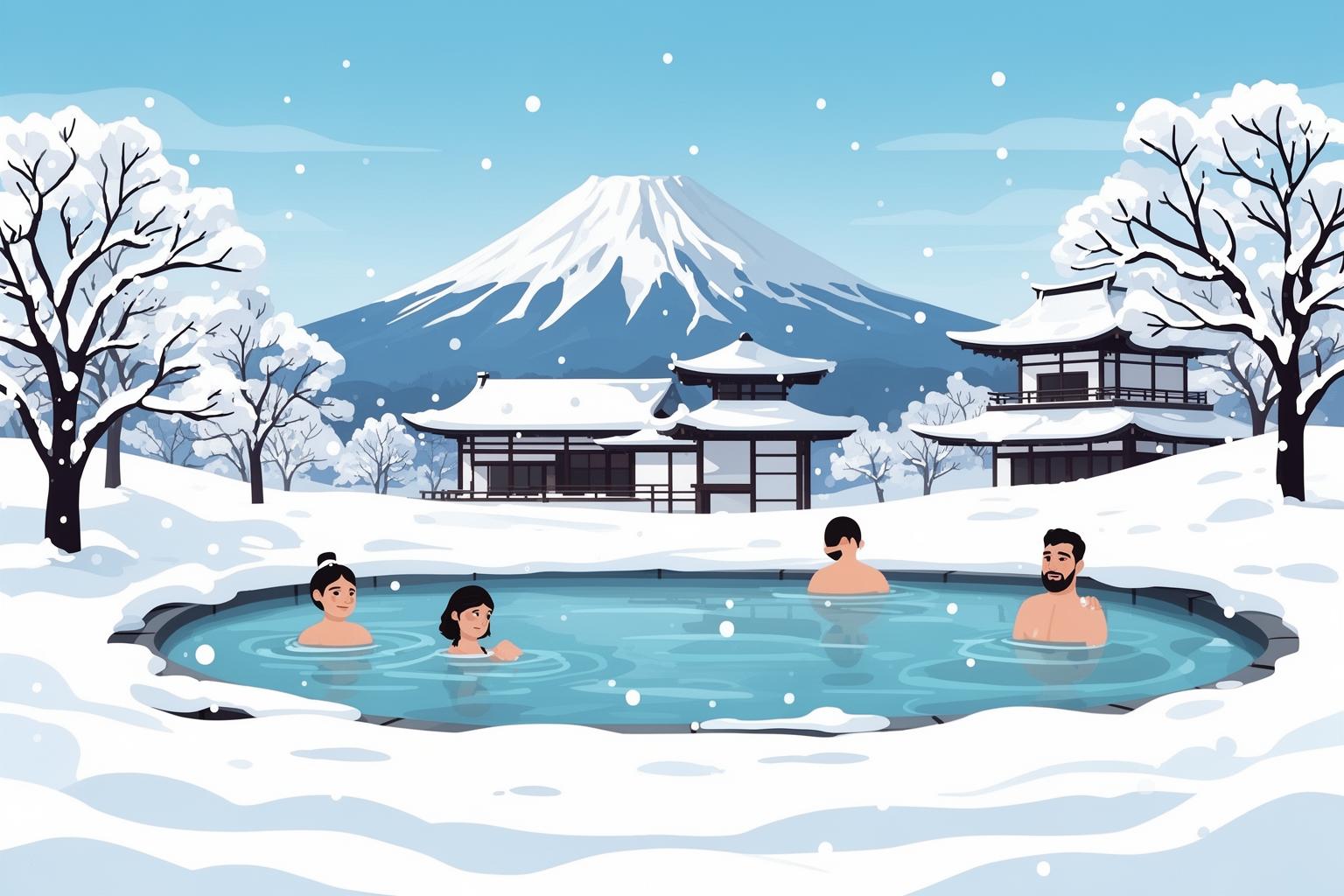
So, when you see that image of a snow-covered onsen, you’re not merely looking at a beautiful hot tub. You are witnessing the intersection of geology, spirituality, aesthetics, and social ritual. You are observing a place where nature’s most extreme forces—volcanic heat and glacial cold—converge to create a haven of perfect serenity.
It’s an experience shaped by the elegant tension of contrast. It represents a connection to an ancient reverence for the natural world, where a bath can serve as a form of prayer. It’s a unique social space where silence becomes a means of communication and an opportunity for quiet communion. It is the essential, soul-soothing reward that completes the cycle of effort and enables the next day’s adventure. The yukimi rotenburo is the ultimate Japow experience not because it’s merely pleasant or relaxing, but because it is profound. It offers a silent sermon, delivered through steam and snow, conveying everything you need to understand about Japan’s deep and enduring relationship with the beauty of its seasons. It’s a sensation that sinks into your bones, a memory of warmth and stillness you carry long after leaving the mountains.