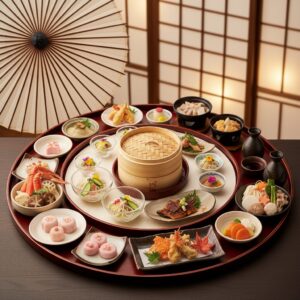
Spring in Japan is a season of profound contradictions. The entire world knows the sweet, impossibly gentle side of it. We see the photos of cherry blossoms, those pale pink clouds that drift through parks and line riverbanks, consumed with an almost religious fervor. It’s a time of picnics under the petals, of sakura-flavored everything, a national sigh of relief as the world softens into pastels. But that’s only half the story. While the cities are celebrating the blossoms, another, much older ritual is unfolding in the mountains that form the country’s rugged spine. This ritual isn’t about sweetness; it’s about its opposite. It’s about a sharp, bracing bitterness.
This is the world of `sansai`, or wild mountain vegetables. These are not the neatly cultivated greens you find in a supermarket aisle. They are the first defiant shoots to push through the cold, muddy soil as the snow recedes. They are foraged, not farmed. And their defining characteristic is a flavor that can be, to the uninitiated palate, frankly shocking. We’re talking about an earthy, astringent, and often intensely bitter taste that seems to run counter to everything we associate with delicate Japanese cuisine. Yet, for a few short weeks each year, these humble, wild plants are celebrated, sought after, and served with a reverence usually reserved for the most prized delicacies.
So, what’s going on here? Why does a culture that has perfected the subtle art of `umami` and values visual and culinary harmony embrace these unruly, challenging flavors? The answer, as is so often the case in Japan, lies in a ritual that’s about far more than just what’s on the plate. Eating `sansai` is a physical and spiritual act. It’s about shaking off the sluggishness of winter, literally consuming the vitality of the new season, and connecting with a cycle of life that is ancient and deeply ingrained in the Japanese consciousness. It’s a culinary reset button, a bitter medicine that awakens the body and soul. To understand `sansai` is to understand that in Japan, the changing of the seasons is not just something you observe; it’s something you ingest.
Embracing both culinary tradition and seasonal transformation, readers can further explore Japan’s complex palate by delving into bitter greens that celebrate nature’s provocative flavors.
The Taste of a Thawing World

Before diving into the philosophy, let’s first focus on the taste. Calling `sansai` simply a “vegetable” is like referring to a wolf as just a “dog.” Although technically accurate, it misses the essence entirely. These are not tame, predictable plants—they are wild, and their flavor reflects that wildness. Their taste directly mirrors the rugged environment from which they arise, presenting a complex, untamed profile that evokes mountain soil, melting snow, and the vibrant energy of new growth.
A Cast of Wild Characters
The term `sansai` doesn’t refer to a single plant but rather a whole category, each member with its unique character and role in the springtime succession. Across Japan, there are hundreds of edible varieties, but a few standout players lead the spring feast.
The first to emerge, often pushing through the last patches of snow, is `fukinoto`, the flower bud of the butterbur plant. It resembles a small, tightly furled green cabbage and embodies the concentrated bitterness of the season within its leaves. Highly aromatic, its scent fills the kitchen, and its flavor is remarkably intense. It serves as a seasonal wake-up call, signaling winter’s end with a sharp jolt. It’s never eaten raw; its strength requires taming, most famously achieved in `fuki-miso`, a condiment where the minced bud is slowly simmered with miso, sake, and sugar, transforming its fierce bitterness into a deep, complex, and irresistibly savory paste.
Next is the undisputed king: `taranome`. This young bud from the Japanese angelica tree—a spiny, assertive plant—produces shoots of exceptional richness. It offers a nutty, slightly resinous flavor with a pleasant bitterness that is milder than that of `fukinoto`. When cooked, its texture turns uniquely creamy. `Taranome` is almost always served as tempura, where the light, hot, crispy batter creates the perfect textural contrast and the quick frying tempers the bitterness just enough to let its noble flavor shine. Finding perfectly fried `taranome` on your plate, lightly sprinkled with sea salt, is one of spring’s great rites.
Following closely are fiddlehead ferns, familiar in other parts of the world but cherished in Japan as a type of `sansai`. The most common is `kogomi`, the tightly coiled young shoot of the ostrich fern. It boasts a vivid green color and a satisfyingly crisp texture. Its flavor is milder and more approachable, with subtle asparagus-like notes and a touch of mountain astringency. Another popular fern is `warabi`, or bracken, which demands more care. Known for its high content of `aku`, a harshness we’ll explore later, it must be properly prepared before consumption. Its taste is earthier, adding a deeper note to the spring melody.
Finally, there are plants like `udo`, often called mountain asparagus. This thick, pale stalk can be eaten raw when fresh, julienned and tossed in a vinegar-miso dressing. It’s incredibly crisp and refreshing, with a unique aroma reminiscent of gin or pine. Its bitterness is clean and invigorating, a sharp contrast to the lingering depth of `fukinoto`’s bitterness.
Embracing the ‘Nigami’
Bitterness, or `nigami`, is the thread that runs through all these plants. In Western cuisine, bitterness is often something to be balanced, masked, or avoided. In the world of `sansai`, it takes center stage. Bitterness signals potency, wildness, and medicinal power. The Japanese palate, refined over centuries, doesn’t merely tolerate bitterness; it actively seeks it out. It’s appreciated as a flavor of complexity and depth—a taste for mature palates. It refreshes the palate and, according to tradition, cleanses the body. This bitterness isn’t the dull, one-dimensional kind found in bad coffee; it spans a dynamic range—from the sharp shock of `fukinoto` to the gentle, woodsy astringency of `kogomi`. To appreciate `sansai` is to understand that not all pleasures are sweet.
The Ritual of the Hunt
The journey of `sansai` from the mountain to the plate holds equal importance to its flavor. These vegetables are not agricultural products but gifts from nature, and collecting them is a ritual called `sansai-tori`, or mountain vegetable picking. This is not a casual walk in the woods; it is a deliberate, knowledgeable, and deeply respectful practice of foraging that connects people intimately with the land and its rhythms.
An Excursion, Not a Shopping Trip
To engage in `sansai-tori` is to fully immerse oneself in the early spring landscape. It involves trading urban sidewalks for muddy mountain paths, often with snow still resting in shaded hollows. The experience stimulates all the senses: the scent of wet earth, the sound of melting snow flowing downhill, and the crisp air that carries winter’s lingering presence. Those who partake are often older, carrying a lifetime of knowledge handed down through generations. They move with quiet assurance, eyes carefully scanning the forest floor for subtle signs of new growth.
This is not a pursuit for the impatient or uninformed. For every tasty `taranome` bud, there is a poisonous mimic. Distinguishing between them can mean life or death, instilling a profound respect for the environment. One must be fully present, attentive, and acutely aware of their surroundings. The forager learns to read the landscape—to know, for instance, that a certain fern thrives in damp soil near streams, or that a specific shoot prefers a sunny clearing. This form of ecological literacy is rapidly fading in the modern era.
The Proper Tools and a Humble Mindset
The forager’s gear is simple and timeless: a woven basket, or `kago`, to carry the harvest while allowing airflow; a small, sharp knife for clean cuts that enable the plant to regenerate; sturdy, waterproof boots; and gloves to protect against thorns and dirt. In many regions of Japan, especially where bears roam, carrying a `kuma-yoke`—a small bell whose steady ringing alerts bears—is essential to avoid surprise encounters. The gentle tinkling of these bells through the quiet mountain forest is a familiar soundtrack of Japanese spring.
Yet the most vital tool is the right mindset. An unwritten code governs `sansai-tori`: never take everything. Stripping a patch bare is seen as greedy and foolish because it destroys the source for future seasons. The principle is to harvest only what you need, leaving enough for others and for the plant to rejuvenate. This practice of sustainable harvesting long predates modern environmentalism. It is rooted in Shinto beliefs that the mountains are sacred, home to `kami` (deities or spirits). The vegetables gathered are not resources to be exploited but gifts—`o-suso-wake`, or shares—from the mountain gods. The appropriate response is not greed but gratitude.
Taming the Wild: The Art of Preparation
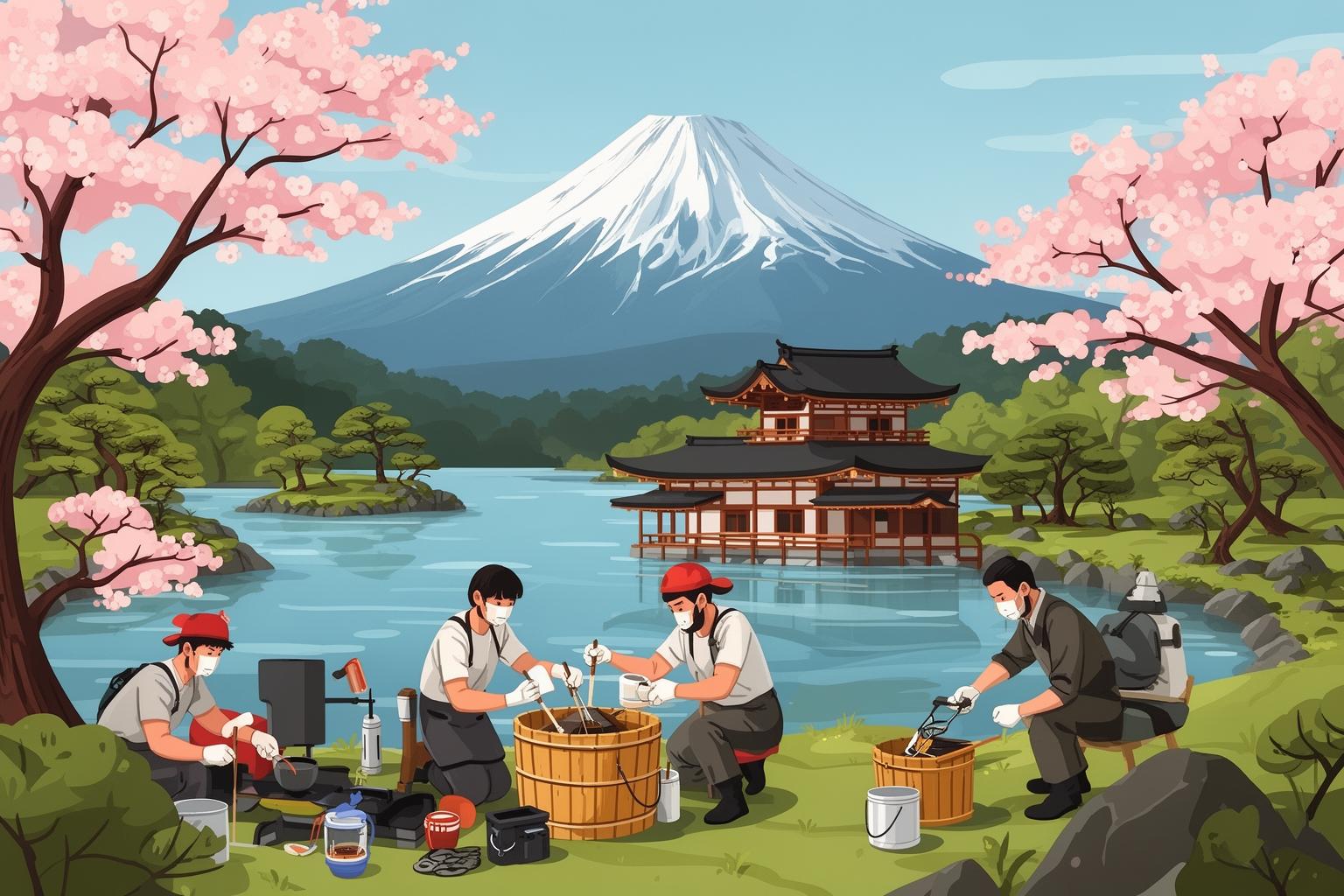
Once the `sansai` are brought down from the mountain, a second, equally significant ritual begins in the kitchen. You cannot treat these vegetables like a carrot or a head of lettuce by simply chopping and cooking them. Their wild nature demands careful technique. The aim is not to erase their character but to make their potent qualities palatable, a process centered around the essential concept of `aku-nuki`.
The Dialogue with ‘Aku’
`Aku` (アク) is a wonderfully nuanced Japanese term with no direct English equivalent. It can mean scum, the frothy impurity that rises to the surface of a simmering stock. It can refer to lye, a harsh alkaline substance. In food contexts, it describes an unpleasant bitterness, astringency, or even toxicity found in certain ingredients. `Sansai` are rich in `aku`. This acts as the plant’s natural defense mechanism and is the source of its intense flavor. The process of `aku-nuki` is the art of removing this bitterness.
This process is not uniform. Each vegetable requires its own dialogue. For `warabi` (bracken fern), which contains a carcinogenic compound, the preparation is intensive. The ferns are dusted with wood ash or baking soda and then soaked in boiling water overnight. This neutralizes toxins and softens the fibers. For others, like `zenmai` (royal fern), the process might involve prolonged boiling, massaging, and drying over several days. Many simply need blanching in boiling water or a long soak in cold, running water to moderate the bitterness.
The philosophy behind `aku-nuki` is profound. It is not about “purifying” the vegetable in a negative sense, as if its wildness were a flaw. Rather, it is a respectful negotiation. The cook acknowledges the plant’s strength and carefully prepares it for human consumption. The bitterness is not fully removed; just enough remains to preserve the vegetable’s identity and its medicinal properties. It is a delicate balance and a testament to the intimate knowledge Japanese cuisine holds of its ingredients.
Simplicity as the Ultimate Respect
Once the `aku` has been managed, the final cooking methods are almost always remarkably simple. The hard work has already been done through foraging and preparation. Now it is time to let the ingredient speak for itself. Rarely will you find `sansai` smothered in heavy sauces or complex stews. The cooking methods aim to highlight rather than conceal.
Tempura is perhaps the most beloved way to enjoy them. A feather-light batter and a quick dip in searingly hot oil create a perfect package. The exterior is crisp and delicate while the inside is steamed to tender perfection. The heat softens any lingering harshness and unlocks the vegetable’s unique aroma. Served with just a pinch of salt or a quick dip in `tentsuyu` (tempura dipping sauce), it is a sublime experience. `Taranome` and `fukinoto` are particularly stunning as tempura.
Another common preparation is `ohitashi`. The blanched vegetables are steeped in a chilled, light broth made from `dashi` (kombu and bonito stock), soy sauce, and mirin. This method gently seasons the `sansai` while allowing their natural flavor to shine. It is a clean, elegant way to enjoy the crisp texture of `kogomi` or the subtle taste of `udo`.
Finally, there is `aemono`, where the prepared vegetables are dressed with a simple paste. This might be a nutty `goma-ae` (sesame dressing), a savory `shira-ae` (tofu dressing), or a tangy `sumiso-ae` (vinegar and miso dressing). Again, the dressing complements but does not overpower. Each bite celebrates the unique texture and flavor painstakingly drawn from the wild plant.
The Deeper Meaning: Why We Crave the Bitter
We have a flavor that is an acquired taste, a harvest that demands difficult and sometimes hazardous labor, and a preparation that is meticulous and time-intensive. Why go through all this effort? Because the value of `sansai` extends beyond the culinary. It is medicinal, seasonal, and historical. Consuming `sansai` is an act laden with layers of meaning that resonate deeply with the essence of Japanese culture.
The Body’s Spring Renewal
Traditional knowledge, now increasingly supported by modern science, has long maintained that the bitterness of `sansai` is medicinal. The bitter compounds—polyphenols, alkaloids, and other phytonutrients—were believed to awaken the body from its winter dormancy. After months of consuming a diet heavy in preserved foods such as pickles, salted fish, and starchy root vegetables, the body was thought to become sluggish. The potent, fibrous `sansai` were regarded as a natural detox, a spring tonic aimed at cleansing the blood, stimulating digestion, and dispelling the lingering heaviness of the cold months.
Eating `sansai` was a way to rouse the metabolism back to life. This notion of food as a tool for seasonal adjustment is central to traditional Japanese wellness. One eats what the season offers not only for taste but to align the body with the natural world around it. The bitterness was a sign of its potency—a flavor that indicated the food was working its magic.
Embracing the Essence of ‘Shun’
No concept is more central to Japanese cuisine than `shun` (旬). `Shun` is the peak moment of seasonality, the fleeting period when an ingredient is at its very best in flavor, nutrition, and abundance. `Sansai` embody `shun`. Their season is breathtakingly brief—at most a few weeks, and for some, only a few days. This transience makes them exceptionally precious.
In today’s globalized world, we are accustomed to having anything we desire at any time. Strawberries are available in December, asparagus in October. This convenience has a price: a disconnection from the natural rhythms of our environment. `Sansai` stand as a powerful defiance of this. They cannot be mass-cultivated or imported from afar. They can only be enjoyed when the mountain chooses to offer them. Eating `sansai` is taking a literal bite out of the season. It is a way of marking time and participating in the year’s cycle in the most immediate and intimate way. It offers a taste of a specific moment, in a specific place, that will not return until the following year.
A Flavor of History and Endurance
Lastly, eating `sansai` is an act of remembrance. For modern urban diners who enjoy these vegetables at upscale restaurants, they are a delicacy. However, for generations living in Japan’s mountainous regions, `sansai` were not a luxury but a necessity. They were a vital source of vitamins and minerals after the lean winter months when stored foods dwindled. They were foraged out of survival—a crucial bridge sustaining life until the first farm crops were ready.
This history imparts a sense of gratitude and resilience. Foraging and eating `sansai` connects people to a harsher, more self-sufficient past. It recalls a time when life was more precarious and the connection to the land was absolute. This ancestral memory adds profound depth to the experience. It explains the reverence with which the plants are gathered and the care taken in their preparation. This was not merely food; it was survival.
Ultimately, the modest `sansai` tells a rich and multifaceted story. It speaks of nature’s beautiful harshness, the wisdom of tradition, and the importance of living in harmony with the seasons. The sharp bitterness that initially shocks the palate is the key to it all. It is the taste of the earth waking from a long slumber. It is the taste of a body being renewed. It is the taste of history—a flavor of resilience handed down across generations.
In a world fixated on sweet, effortless comforts and year-round availability, the deliberate pursuit of something so fleeting, wild, and demanding is a radical gesture. It reminds us that true vitality is not always found in softness and ease but sometimes in the bracing, bitter shock of the real.