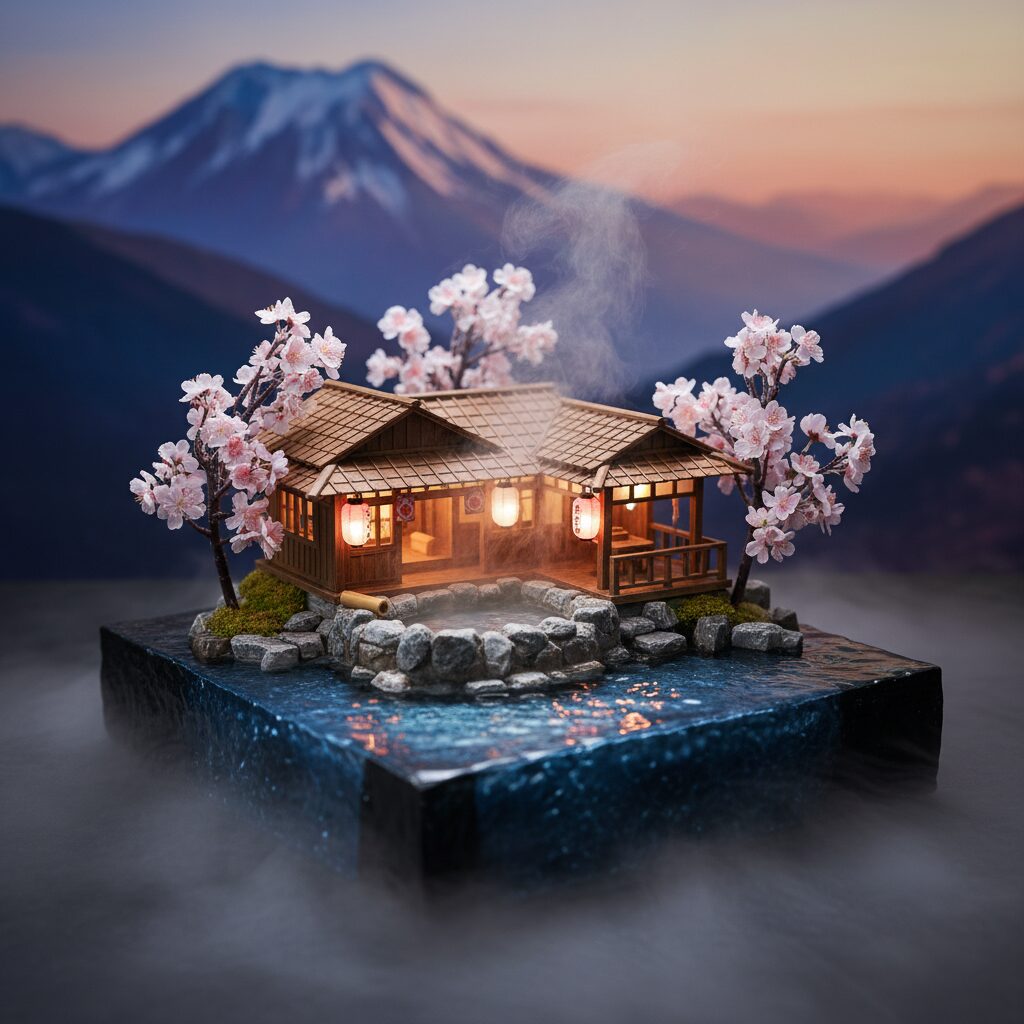
You’ve probably seen the pictures: steam rising from a stone-lined pool, snow-dusted pines in the background, perhaps a macaque or two looking blissfully relaxed. This is the postcard image of the Japanese onsen, or hot spring. It’s an image that communicates tranquility, nature, and a kind of deep, elemental comfort. But to equate an onsen with a simple hot tub or a luxury spa day is to miss the point entirely. It’s like comparing a multi-course, culturally significant meal with a quick snack. Both might fill you up, but only one nourishes you on a level that goes far beyond the physical.
The real question is why this specific activity—communal bathing in geothermally heated water—is so deeply woven into the fabric of Japanese life. It’s not just a vacation activity; it’s a cultural institution, a social ritual, and a form of therapy for both mind and body. It is a place where conversations happen, where families bond, and where the relentless pressures of a highly structured society can, for a moment, be washed away. Understanding the onsen is understanding a fundamental pillar of the Japanese concept of well-being. It’s about more than just getting clean or warming up. It’s about a return to a purer, more connected state of being, both with yourself and with those around you. It’s about stripping away everything that defines you in the outside world—your suit, your job title, your worries—and finding a quiet, shared humanity in the water.
This immersion in nature and tranquility not only nurtures the body and soul but also invites a deeper exploration of Japan’s rich spiritual heritage as seen in insights on Japan’s spiritual gateways.
The Foundation: What Makes an Onsen an Onsen
First, let’s set the ground rules. Not every hot bath in Japan qualifies as an onsen. The term is legally protected by the Onsen Law, a 1948 legislation that defines specific standards. To be officially recognized as an onsen, the water must be naturally heated to at least 25°C (77°F) at its source and contain at least one of nineteen designated minerals, including sulfur, iron, or metasilicic acid. Water that is artificially heated but meets the mineral requirement is referred to as a kōsen. This distinction is not mere bureaucratic nitpicking; it acknowledges that the true essence of an onsen derives from the earth itself. The unique mineral makeup of each spring is believed to provide various therapeutic benefits, such as soothing skin conditions, relieving muscle pain, and improving circulation. In Japan, people discuss the quality of onsen water much like wine experts describe terroir. They note the color, the faint sulfur scent, the silky sensation on the skin, and even travel to specific regions to experience certain types of springs.
This geological connection is fundamental. Japan lies on the Pacific Ring of Fire, an area known for intense volcanic and seismic activity. While this means a persistent risk of earthquakes and tsunamis, it also endows the archipelago with thousands of natural hot springs. These springs are gifts from the restless earth, offering a calming contrast to its destructive power. This duality aligns closely with a prevalent Japanese philosophical outlook: finding beauty and harmony within a powerful, and sometimes perilous, natural world. From the beginning, the onsen experience is deeply rooted in an immediate, physical bond with the land.
The Naked Truth: Hadaka no Tsukiai
Here we reach a concept often considered the biggest challenge for visitors, yet it lies at the very heart of the onsen’s social purpose: communal nudity. In most onsen, bathing is done entirely naked, with baths strictly separated by gender. This practice isn’t about exhibitionism or sexuality—in fact, it’s quite the opposite. It aims to erase external markers of status and identity to foster a pure, egalitarian sense of fellowship. This is known as hadaka no tsukiai, loosely translating to “naked communion” or “naked friendship.”
In a society as hierarchical and role-oriented as Japan’s, this holds deep significance. At work, you are manager or subordinate, senior colleague or new hire, with interactions shaped by a complex system of honorifics and unspoken rules. At the onsen, all of that fades away. Your business suit, expensive watch, company ID—all are left behind in a locker. Stripped of these outward symbols, a company president and a junior employee simply become two people sharing a bath. This creates a different kind of communication that is more open and unguarded. Sometimes business deals are finalized, and tough conversations arise in the disarming setting of the onsen, where usual power dynamics dissolve amid the steam.
This does not mean the environment is unregulated. A quiet etiquette governs behavior. Staring is rude, and loud, boisterous conversation is generally discouraged unless within a private group. The nudity is incidental—necessary for the experience, but not its focus. The small towel provided is used for washing and for modesty when walking around the bathing area, but it is never placed in the bath water. By following these simple rules, everyone helps maintain a shared atmosphere of respectful vulnerability.
The Ritual of Purification: More Than Just a Wash
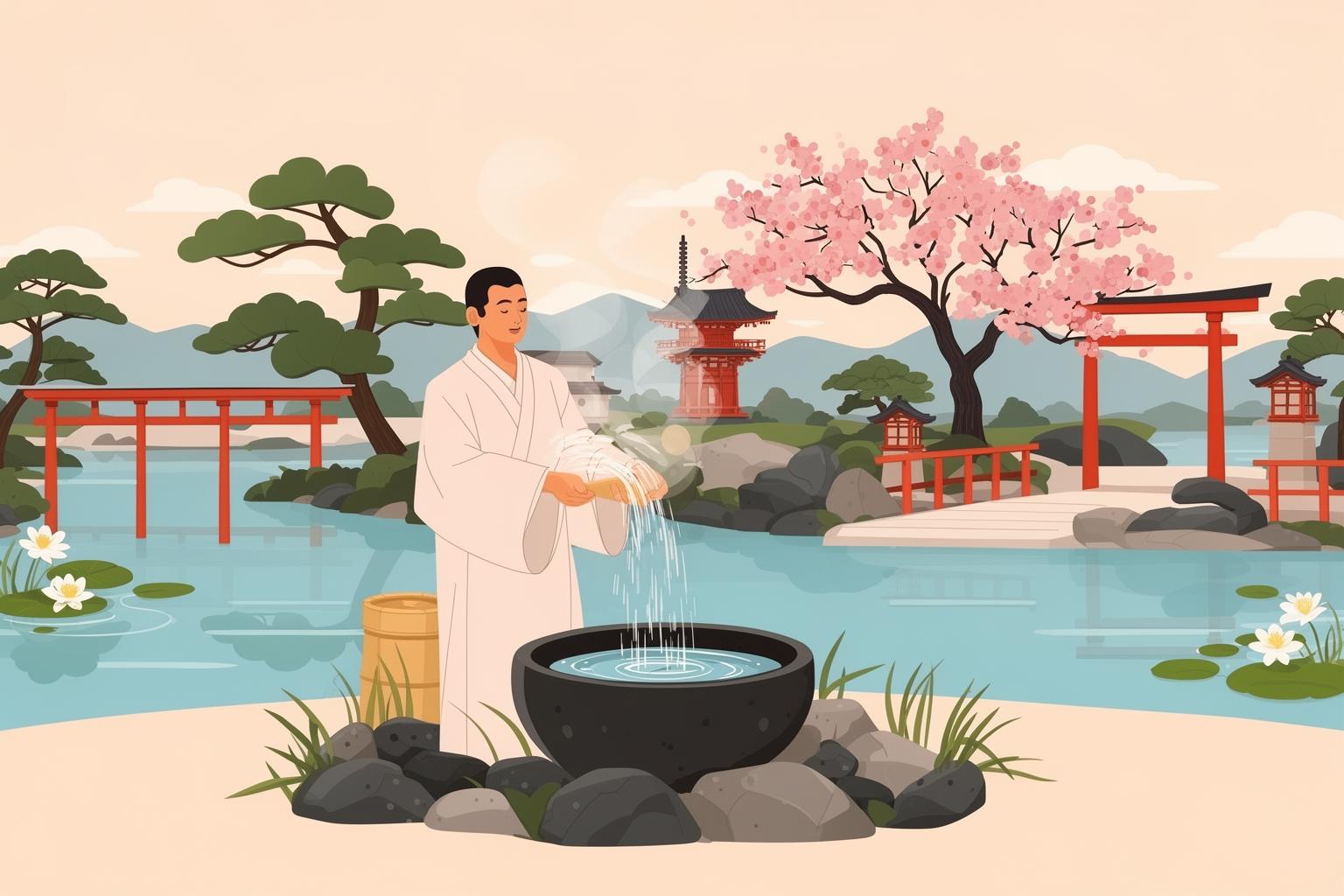
Entering an onsen is more than just jumping into the water; it’s a ritual with specific steps that are as vital as the soak itself. This structured process is essential to appreciating its role in relaxation, encouraging you to slow down, be mindful, and transition from the outside world to the tranquil atmosphere of the bath.
Step One: The Kakeyu
Before reaching the washing area, you’ll find small basins or buckets near the entrance to the main bath. You’re expected to scoop hot water from the bath and pour it over your body, beginning with your feet and moving upward to your waist and shoulders. This is called kakeyu. It serves two purposes: practically, it helps your body adjust to the water temperature, preventing a sudden shock; culturally, it’s a sign of respect. You rinse off the surface dust from the outside world before entering the washing area, showing reverence for the clean, shared space.
Step Two: The Thorough Cleansing
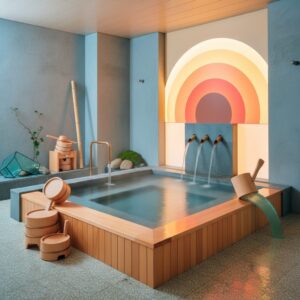
After the kakeyu, you proceed to the washing area, which features rows of low stools, each with a faucet, shower wand, and bucket. Here, you must wash your entire body thoroughly with soap and shampoo—this is non-negotiable. The onsen bath is for soaking, not cleaning. Entering the pristine, mineral-rich water while still soapy or dirty is a grave breach of etiquette. Sitting on the small stool, often made from fragrant hinoki (Japanese cypress), and scrubbing yourself meticulously becomes part of the mental unwinding. Your focus narrows to this simple task, physically cleansing yourself in preparation for a deeper, spiritual cleansing in the bath.
Step Three: The Soak
Once clean and rinsed, you’re ready to enter the onsen. You should do so slowly and gracefully, avoiding splashing. The aim is to slip quietly into the water and become part of the serene scene. This is the moment of release. The water, usually between 40-43°C (104-109°F), penetrates deep into your muscles, easing tension. The minerals work their subtle effects. Your mind, already relaxed by the preparatory ritual, is free to wander. Some close their eyes and meditate; others may engage in quiet conversation. In a rotenburo, or outdoor bath, the experience is even more heightened. You might feel a cool breeze on your face, contrasting with the hot water, hear leaves rustle, crickets chirp, or the gentle flow of a nearby stream. This is where the onsen’s connection to nature becomes most vivid.
This multi-step process turns a simple bath into a mindful practice—a structured meditation that guides you from external stress to internal calm.
A Deeper Connection: Nature, Spirituality, and the Onsen
The significance of nature in the onsen experience cannot be overstated. It connects directly with the animistic beliefs of Shinto, Japan’s indigenous religion, which teaches that deities, or kami, inhabit natural objects and phenomena—in mountains, rivers, ancient trees, and notably, in the bubbling hot springs that arise from the earth. For centuries, onsen have been regarded as sacred places, gifts from the kami. Bathing in their waters was a purifying ritual, known as misogi, cleansing not only physical dirt but also spiritual impurity, bad luck, and fatigue.
This spiritual aspect remains present today, even if most bathers do not consciously view it in religious terms. The finest onsen are designed to harmonize with their natural environment. A rotenburo might be constructed using natural rocks to blend seamlessly into a riverbank. A large window in an indoor bath might be perfectly positioned to frame a view of a distant mountain or a carefully tended Japanese garden. The aim is to erase the boundary between the bather and the natural world. Soaking in an onsen becomes an act of communion with nature. You are not merely observing a beautiful view; you are fully immersed in it, feeling the heat from the earth below and the air from the sky above. This complete immersion is deeply restorative, serving as a powerful antidote to the concrete and glass of modern urban life.
The Ryokan: A Complete Ecosystem of Relaxation
The onsen is seldom an isolated experience. It is usually the highlight of a stay at a ryokan, a traditional Japanese inn. The ryokan sets the scene and completes the relaxation ecosystem that makes an onsen visit so effective. The entire experience is carefully designed to pull you away from your daily routine.
Upon arrival, you change out of your street clothes and into a yukata, a lightweight cotton robe. This becomes your uniform throughout your stay, worn to the bath, at dinner, and on strolls around town. Much like the nudity in the bath, the yukata serves as a great equalizer. Everyone wears the same simple, comfortable garment, which helps dissolve social barriers and fosters a shared sense of leisure.
Dinner is usually a kaiseki meal, a multi-course artistic banquet featuring local, seasonal ingredients. It’s a slow, mindful dining experience that delights all the senses. After dinner, you might enjoy another soak in the onsen before retiring to your tatami mat room for the night. While you dine, your futon is laid out, and the room’s simple, uncluttered design promotes tranquility.
The full ryokan experience—the yukata, the kaiseki meal, the tatami room, and the flawless, discreet hospitality (omotenashi)—is crafted to support and amplify the restorative benefits of the onsen. It offers a comprehensive, holistic retreat that nurtures well-being on every level: physical, mental, and aesthetic. You don’t just visit the onsen; you immerse yourself in its world for a day or two.
The Enduring Appeal in Modern Japan
In a country renowned for its strong work ethic and high-pressure social atmosphere, the onsen acts as an essential release valve. It is one of the rare places where doing nothing is not only accepted but actively encouraged. It provides a sanctioned space for vulnerability, quiet reflection, and a deep, uncomplicated form of social bonding. For families, it offers a chance to connect across generations. For couples, it serves as a romantic retreat. For groups of friends or colleagues, it creates an opportunity to bond beyond the rigid structures of everyday life.
The practice of tōji, or therapeutic bathing, continues to hold significance. People with chronic conditions still spend a week or more at an onsen resort, following a prescribed soaking regimen to ease their symptoms. But for most, the therapy is as much mental as it is physical. It is a pilgrimage away from the noise and demands of urban life, a journey to a quieter place where the rhythm of existence is governed by rising steam and shifting seasons.
The Japanese onsen, therefore, is much more than just a hot spring. It is a complex cultural ritual embodying core Japanese values: purity, respect for nature, the importance of community, and the beauty of mindful practice. It is a place where social masks are removed, the body is healed, and the spirit is purified by water flowing directly from the earth’s heart. It is, in the truest sense, a sanctuary.