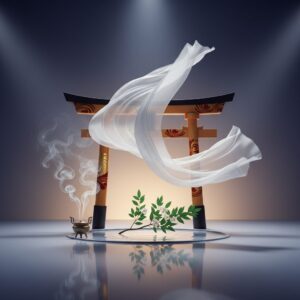
The air in mid-August in Japan is thick enough to swim through. It’s a heavy, wet heat, filled with the incessant, high-pitched hum of cicadas that seems to vibrate in your very bones. Days are for enduring, for seeking shade and the temporary relief of an ice-cold drink. But as dusk falls, a different kind of energy settles over the islands. The cicada drone softens, replaced by the gentle clinking of wind chimes and the distant laughter of children enjoying the cool of the evening. It’s during this suspended moment, between the oppressive heat of the day and the deep ink of night, that you might see it: a flicker of orange on a dark mountainside, a soft glow on the surface of a river. This isn’t a wildfire, nor is it the neon blaze of the city. This is something else entirely. This is an okuribi—a sending-off fire.
These fires are the final, poignant act of Obon, the annual period when it’s believed the spirits of ancestors return to the world of the living to visit their families. If you’ve heard of Obon, you might picture lively festivals, spinning lanterns, and rhythmic drumming accompanying traditional dances. And you’d be right. But that’s only half the story. Obon is a reunion, a joyful, sometimes chaotic, multi-generational homecoming that bridges the gap between the physical and spiritual worlds. For a few short days, the departed are not memories, but present, honored guests. And like any beloved guest, their departure is marked with ceremony. Okuribi are the solemn, beautiful farewells. They are beacons lit not to celebrate, but to guide; not to entertain, but to accompany. They are a promise whispered in smoke and flame: “Thank you for visiting. Go safely. We will see you again next year.” To witness one is to feel the profound, quiet weight of remembrance, a shared moment of love and loss that glows brightly against the summer darkness.
The enduring glow of these ancestral fires finds a modern counterpart in the heated Michelin-star conflict that powerfully underscores Japan’s dynamic cultural contrasts.
The Heart of Obon: A Reunion of Worlds
To grasp the significance of an okuribi, you first need to understand the concept of a welcome. The sending-off fire marks the conclusion of a spiritual journey that began a few days earlier with its counterpart: the mukaebi, or “welcoming fire.” Obon, which generally occurs in mid-August (or mid-July in some areas following the old lunar calendar), is fundamentally a festival of reunion. It is a deeply rooted cultural and spiritual event, blending Buddhist tradition with ancient Japanese animist beliefs about the spirit world.
Picture your home, but prepared for invisible guests. The family’s Buddhist altar, the butsudan, is carefully cleaned and adorned. Offerings of fresh fruit, cool water, sake, and the ancestors’ favorite dishes are arranged. Special decorations, such as the shoryodana or “spirit shelf,” are also set up. Occasionally, a cucumber carved to resemble a horse and an eggplant shaped like an ox are placed among the offerings. These are called shoryo-uma, or spirit steeds. The swift cucumber-horse is meant to bring the spirits home quickly, while the slow, sturdy eggplant-ox carries them back to the other world at a leisurely pace, loaded with the family’s offerings and love.
On the first evening of Obon, families light the mukaebi. At its simplest, this can be a small, controlled flame created by burning dried hemp stalks (ogara) in a special ceramic dish called a horoku just outside the front door. The flame is small, crackling in the humid air, but its significance is vast. The smoke serves as a fragrant, vertical invitation—a signal rising into the twilight that says, “We are here. This is your home. Welcome back.” During these days, the boundary between worlds feels permeable. The spirits are believed to be genuinely present, sharing meals, listening to family news, and resting in the familiar comfort of home. It is this profound feeling of presence that makes their eventual departure so poignant.
Okuribi: Guiding the Spirits Home
The word okuribi (送り火) literally means “sending-off fire,” and its purpose is equally straightforward. After several days of reunion, the moment arrives for the spirits to begin their journey back to the ano yo—the other world, the afterlife. The okuribi serves as their guiding light, illuminating their path to ensure they do not lose their way home. Fire’s symbolism here is rich and profound. In both Shinto and Buddhist traditions, fire acts as a purifier and a transformative force. It cleanses, consumes, and bridges the earthly realm with the divine.
The mood of an okuribi differs markedly from that of the welcoming mukaebi. Whereas the welcome carries a quiet anticipation, the farewell is suffused with a gentle melancholy known in Japanese as setsunai. It’s a bittersweet sorrow, a blend of gratitude for the visit and sadness at the parting. Families gather again, this time to light a fire in the very spot where the first was kindled. They watch as the flames engulf the ogara, the smoke now bearing a new message: one of farewell, safe journey, and love that transcends the boundary between life and death.
Experiencing an okuribi is a contemplative moment rather than a boisterous celebration. People stand silently, their faces lit by the flickering flames, each absorbed in their own memories and thoughts. It is a communal ritual offering deeply personal reflection. One might recall a grandmother’s laugh, a father’s guidance, or a child gone too soon. The fire becomes a symbol for all that unspoken grief and love—an acknowledgment shared by all that these bonds endure, and that the cyclical ritual of welcoming and farewelling helps keep those connections warm and alive.
The Grand Spectacle: Kyoto’s Gozan no Okuribi
Nowhere is the practice of okuribi more renowned or breathtaking than in Kyoto. On the night of August 16th, the ancient capital transforms into the stage for the Gozan no Okuribi (五山送り火), or “the five mountain sending-off fires.” This is okuribi on a grand scale, a city-wide act of remembrance that has been carried out for centuries.
As darkness settles over the Kyoto basin, five massive bonfires are ignited in succession on the mountainsides surrounding the city. Each fire creates a huge, glowing character or symbol, visible from miles away. The spectacle is timed with military precision, producing a powerful, unfolding visual story.
The Five Sacred Fires
First, at 8:00 PM, the character for “great” or “large,” dai (大), is lit on Mount Daimonji-yama. This is the most iconic of the five, a flawlessly formed kanji of flame that burns with remarkable clarity against the dark mountain. It feels primordial, a message sent to the cosmos.
Ten minutes later, at 8:10 PM, two more fires are kindled simultaneously on mountains to the west. These represent the characters myō (妙) and hō (法), which together convey a fundamental concept in Nichiren Buddhism, referring to the sublime teachings of the Buddha. Their presence adds a distinctly spiritual tone to the event.
At 8:15 PM, on a mountain further west, a funagata (舟形), or boat shape, emerges in fire. The symbolism is poignant and clear: this is the vessel that will carry ancestral spirits across the Sanzu River, Japan’s equivalent of the River Styx, back to the world of the dead.
Five minutes later, at 8:20 PM, another dai character is ignited, known as Hidari Daimonji (左大文字), or the “left-hand great character,” to differentiate it from the first.
Finally, at 8:30 PM, the last fire appears on a mountain to the north: a toriigata (鳥居形), the shape of a Shinto shrine gate. The torii is a classic symbol of a gateway between the mundane and the sacred, serving as a fitting final portal for the spirits’ journey.
For about thirty minutes, these five fiery symbols remain suspended in the darkness, and the entire city seems to hold its breath. Streets are closed, building lights dimmed, and hundreds of thousands of people gather along riverbanks, bridges, and rooftops to watch in near silence. The only sounds are the city’s hum, the chirping of crickets, and the quiet murmurs of the crowd. The wood for the bonfires is collected and prepared over many months by local preservation societies. People can purchase special wooden sticks called gomagi on which they write the names of their deceased loved ones and prayers. These gomagi are then incorporated into the massive pyres, so the fire literally burns with the personal remembrances of countless individuals, transforming a grand public spectacle into an intimate, personalized farewell.
Beyond the Mountains: Diverse Forms of Okuribi
While Kyoto’s Gozan no Okuribi is the most renowned example, it is far from the only way this farewell is expressed. Throughout Japan, communities have their own distinctive and equally moving customs for guiding the spirits home. The underlying intention remains constant, but the form varies, often influenced by local geography and history.
Tōrō Nagashi: The River of Light
One of the most visually poetic variations of okuribi is tōrō nagashi (灯籠流し), the floating of paper lanterns. Rather than a fire lit on a mountain, thousands of small individual flames drift upon rivers, lakes, or the sea. Families inscribe messages of love and the names of their ancestors on the paper sides of the lanterns. Inside, a small candle is ignited, and the lantern is gently set afloat on the water’s surface.
The sight is enchanting. A river of light flows through the darkness, each lantern a delicate vessel carrying a family’s prayers. Water, a profound symbol of transition and the passage of time, becomes the pathway for the spirits’ journey home. Well-known tōrō nagashi ceremonies, such as the one in Hiroshima commemorating the atomic bombing’s anniversary, combine personal remembrance of Obon with a collective prayer for peace, forming a spectacle of poignant beauty. As the lanterns gradually drift away, they embody a gentle, slow departure—a fading rather than an abrupt ending like a fire going out.
The Dance of Departure: Bon Odori
Even the famed Bon Odori (盆踊り), the Bon dance, is closely tied to the act of seeing off the spirits. These communal dances, held in temple courtyards and public parks, are more than just summer festivals. Originally, they were folk dances designed to welcome and entertain ancestral spirits during their visit. The dancing, often performed in a circle around a central platform called a yagura, represents the changing seasons and the endless cycle of life, death, and rebirth.
In many places, the final night of Bon Odori aligns with the okuribi. The dancing takes on a new tone, becoming a last joyful celebration with the spirits—a way to send them off with energy and gratitude rather than sorrow. It serves as a communal, affectionate farewell before the quiet lighting of fires or releasing of lanterns. This reunion, though temporary, is acknowledged as a joyful occasion worth celebrating.
Intimate Flames: The Household Farewell
For many families, especially in rural areas, okuribi remains a small, intimate ritual conducted at home. It reflects the mukaebi in its simplicity. The same horoku dish is brought out, the same ogara hemp stalks are lit. The family gathers at the entrance of their home, watching the small fire flicker and fade. They may burn the cucumber horse and eggplant ox, symbolically setting the spirits’ transportation free. This quiet, personal act lies at the heart of the tradition—a direct and unbroken connection to generations who have performed the same simple ritual in the same place for centuries. It reminds us that the grandest spectacles often arise from the humblest and most personal expressions of faith.
Smoke and Soul: The Spiritual Underpinnings
What gives these fires their profound emotional impact is the deep spiritual logic that supports them. Okuribi is more than a mere folk tradition; it is a tangible expression of key ideas in Japanese spirituality, especially the Buddhist concept of mujō (無常), or impermanence. The fire blazes brightly and intensely before fading into embers and ash. It serves as a perfect metaphor for life itself—beautiful, fleeting, and ultimately finite. Watching the flames die down becomes a meditation on this essential truth.
This Buddhist perspective is effortlessly blended with ancient indigenous Shinto beliefs. Shintoism honors nature, especially mountains, which are regarded as sacred places where deities (kami) reside and spirits dwell. Lighting a fire on a mountain, as done in Kyoto, is therefore a powerful act of communication with the spiritual world, performed in a sacred setting. The smoke rising from the okuribi is not merely the residue of combustion; it is viewed as a messenger, carrying prayers and the family’s love and respect upward to the heavens, or ten, guiding the spirits on their path.
The ritual establishes a necessary framework for grief and remembrance. It provides a designated moment and specific actions to channel feelings of loss. In a culture that often values emotional restraint, these ceremonies create a safe and acknowledged space for communal mourning and contemplation. The annual cycle of Obon—the preparation, the welcoming, the reunion, and the farewell—reinforces the idea that death is not a final separation, but a transition. The ancestors are not gone forever; they have simply moved to another place, and they will return.
A Quiet Farewell in a Modern World
In an era of skyscrapers, bullet trains, and digital everything, one might question the relevance of an ancient ritual like okuribi. Does it still hold significance, or has it become merely another piece of cultural heritage—a beautiful yet hollow spectacle for tourists? The enduring power of these fires suggests the former. Urbanization has certainly altered circumstances—strict fire regulations in Tokyo make household okuribi nearly impossible for many apartment residents. Yet the tradition adapts. People visit temples that hold collective okuribi ceremonies, or they find meaning in the grand public displays.
Above all, okuribi persists because it speaks to a universal human need: the desire to maintain a connection with those we have lost. It offers a tangible way to process memory and loss. The fire serves as a focal point, a physical anchor for intangible emotions. It externalizes the inner experience of remembrance, allowing it to be quietly shared with family and community.
So, the next time you are in Japan during the sweltering heat of mid-August, look toward the mountains at dusk. Listen beyond the drone of cicadas. You just might see it—a single, steady flame burning against the darkness. It is not an ending. It is a promise. It is the quiet, luminous language of farewell, a testament to the idea that bonds of love are stronger than death and that every goodbye holds the hope of another hello. It is a light guiding the spirits home, until they return again next year.