It almost always starts the same way. You’re somewhere deep down a YouTube rabbit hole, hours after you meant to go to bed. The algorithm, in its infinite and inscrutable wisdom, serves up a new recommendation. The thumbnail is a simple, serene, black-and-white photograph of a woman smiling. The title is in Japanese, but the English part reads: Mariya Takeuchi – “Plastic Love.” You click, mostly out of curiosity. And then, the music starts.
A shimmering synth chord hangs in the air, followed by a crisp drum machine beat and a bassline so smooth and confident it feels like it’s been your friend for years. Then, Takeuchi’s voice comes in—effortless, bittersweet, gliding over a melody that is somehow both joyful and deeply melancholic. You don’t understand the lyrics, but you understand the feeling completely. It’s the sound of a city at dusk, of fleeting romance, of a kind of sophisticated loneliness that feels more glamorous than sad. You are instantly hooked. Before you know it, you’ve spent the rest of the night exploring a world of artists you’ve never heard of: Anri, Tatsuro Yamashita, Miki Matsubara, Toshiki Kadomatsu. You’ve discovered City Pop.
This experience, or some version of it, has been shared by millions of people around the world over the past decade. A genre of music that was, for decades, a cultural artifact largely confined to Japan has enjoyed a stunning global revival, becoming the de facto soundtrack for a certain kind of imagined Japan. It’s the background music for countless YouTube mixes titled “Japanese City Pop to drive to at night” or “City Pop for a rainy day in Tokyo.” It’s the sonic wallpaper for a generation of listeners, many born long after the songs were recorded, who have never even set foot in Japan.
This raises a fascinating question: Why now? Why has this particular sound, born from the economic optimism of 1980s Japan, found such a massive and devoted international audience in the 21st century? The answer is more complex than just a few catchy tunes. The global appeal of City Pop isn’t just about the music itself; it’s about the world the music represents. It is a portal to ‘another Japan’—a hyper-stylized, eternally chic, and technologically ascendant nation that feels like a dream of a future we were promised but never received. It’s pure, uncut escapism, a nostalgic balm for a present that feels increasingly chaotic and uncertain. To understand City Pop is to understand the power of a perfectly constructed fantasy.
For readers captivated by the nostalgic allure of City Pop, decoding City Pop offers a fascinating exploration of its rich cultural backdrop.
What Exactly Is City Pop?
Ask ten different fans to define City Pop, and you might receive ten distinct answers. It’s a notoriously elusive genre, more of a feeling or aesthetic than a strict set of musical rules. Even at its peak, the term served as a broad marketing label, a catch-all for a fresh wave of Japanese music breaking away from the sentimental folk (fōku) and ballads (kayōkyoku) of the 1970s. Yet, despite its ambiguity, clear sonic threads connect it all.
The Anatomy of a Vibe
At its heart, City Pop is a sophisticated blend. It’s the sound of Japanese musicians looking westward, drawing inspiration from the American genres dominating the airwaves, and reimagining them with a distinctively Japanese touch. The components are familiar: smooth grooves of American soft rock and AOR (Album-Oriented Rock), the rhythmic drive of funk and disco, lush soul and R&B arrangements, and even the breezy melodies of Hawaiian and exotica music.
What sets it apart is the polish. This music was crafted with huge budgets during Japan’s economic peak. The production quality is impeccable. Every element is crisp, clean, and perfectly balanced in the mix. You hear tight, virtuosic horn sections; layers of shimmering synthesizers like the Yamaha DX7; intricate, melodic basslines that often shine front and center; and a percussive groove both danceable and effortlessly cool. This was music designed to sound incredible on state-of-the-art stereo systems and Sony Walkmans—symbols of Japan’s technological and economic prowess, distilled into musical form.
Lyrically, City Pop depicts a new kind of urban life. The themes shifted away from traditional Japanese motifs of seasons and pastoral beauty toward a distinctly modern, cosmopolitan experience. The songs are filled with imagery of seaside highways, neon-lit skylines, summer romances, late-night cocktails, and international travel. It’s a soundtrack of leisure, freedom, and newfound affluence—a sonic portrait of the young, urban professional class that emerged during the economic boom.
The Key Architects of the Sound
While Mariya Takeuchi and her husband, the legendary producer and musician Tatsuro Yamashita, often serve as entry points for newcomers, they are just two stars in a vast constellation of talent. Yamashita is widely regarded as one of the genre’s godfathers. His albums, like For You (1982), are masterclasses in production, blending funk, soul, and pop with breathtaking orchestral precision. His obsessive dedication to sound quality made his records audiophile benchmarks.
Then there’s Toshiki Kadomatsu, a prodigy who introduced a harder, funkier edge to the genre. His music features razor-sharp guitar riffs, explosive horn arrangements, and slapping basslines built for the dance floor. Tracks like “If You Wanna Dance Tonight” are pure, high-energy funk, while his work producing Anri’s classic album Timely!! (1983) helped define the sun-drenched, resort-pop side of City Pop. Anri’s “Cat’s Eye” and “Last Summer Whisper” are quintessential City Pop anthems, evoking images of cruising along the coast with the top down.
Others explored different facets of the sound. Miki Matsubara’s debut single, “Mayonaka no Door / Stay With Me” (1979), with its iconic saxophone intro and soulful vocals, became a posthumous global hit thanks to the internet. Taeko Onuki, an early Yamashita collaborator, crafted a more introspective and artful version of City Pop, marked by sophisticated chord progressions and poetic lyrics. Takako Mamiya’s single album Love Trip (1982) was a commercial flop upon release but has since become a cult classic, celebrated for its dreamy, ethereal vibe. These artists, along with hundreds more, forged a rich and varied musical landscape, all united by a shared sense of optimism and urban cool.
The Soundtrack of an Economic Miracle
To truly grasp why City Pop sounds the way it does, you need to understand the world from which it emerged. The music is deeply intertwined with the socio-economic environment of late 1970s and 1980s Japan. This period, known as the “Japanese economic miracle,” marked unprecedented growth and prosperity that reshaped the country and its global identity.
Life in the Bubble
Following the devastation of World War II, Japan rebuilt itself with remarkable speed. By the 1980s, it had risen to become an economic superpower. The phrase “Japan Inc.” entered the global vocabulary, symbolizing an unstoppable force of industrial and technological innovation. Japanese brands such as Sony, Toyota, and Honda became synonymous with quality and reliability. Tokyo’s stock market and real estate prices soared to extraordinary levels, creating what would later be called the “bubble economy.”
For the average person, this meant a time of exceptional stability and wealth. Lifetime employment was common, wages were high, and disposable income was abundant. A pervasive sense of limitless optimism filled the culture. It seemed as though Japan had not only caught up with the West but was now paving the way into the 21st century. This confidence was reflected in a surge of consumerism and leisure activities. People had the means to spend on fashion, technology, travel, and nightlife.
An Urban Fantasy Forged in Steel and Glass
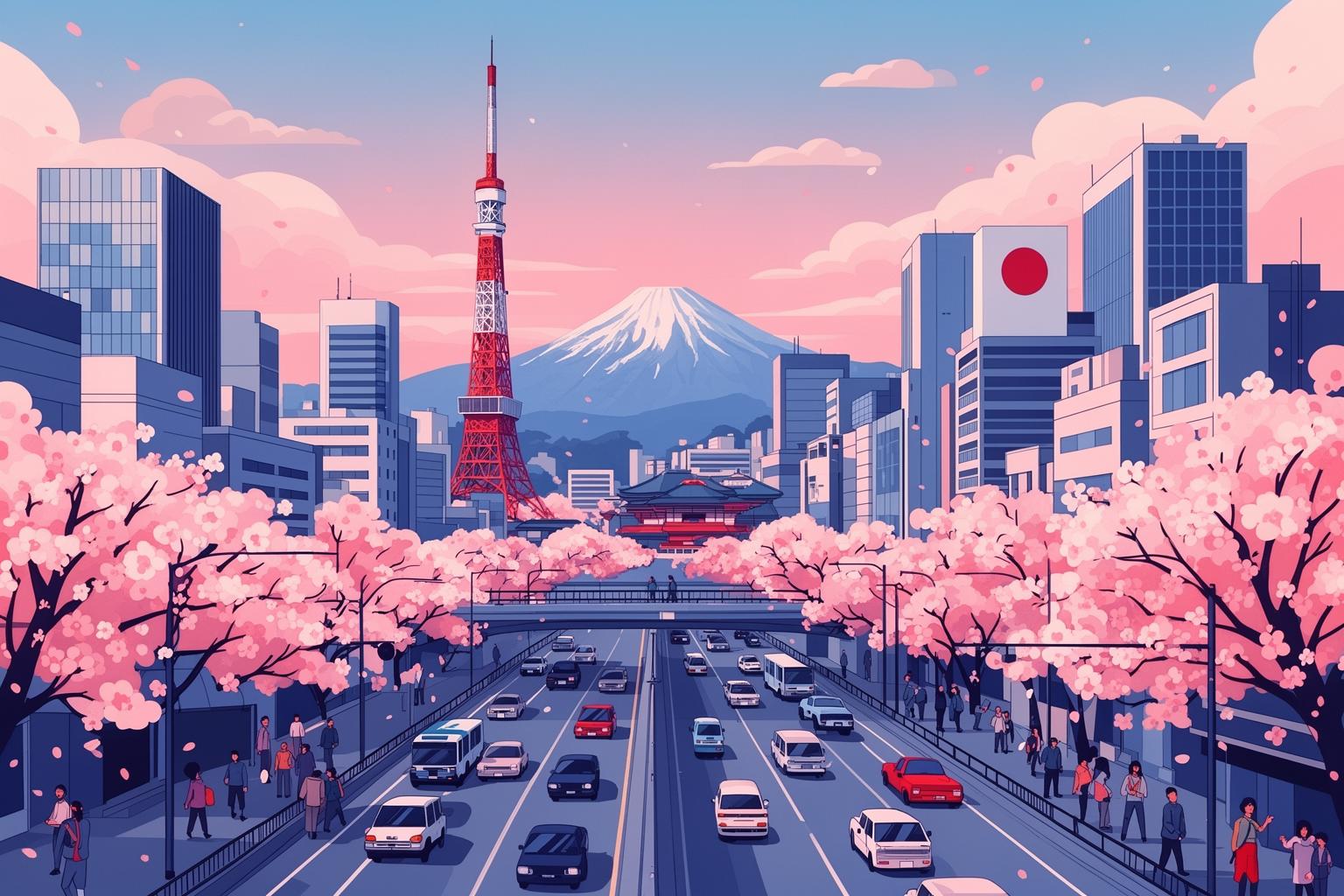
City Pop served as the perfect soundtrack for this era. It was the anthem of the emerging urban landscape. The sleek, futuristic skyscrapers rising in Shinjuku and the dazzling neon lights of Ginza formed the physical backdrop for the music’s sonic world. The lyrics did more than depict this life; they romanticized it.
The music was aspirational, embodying the escape from rural life to the excitement and possibilities of the city. It celebrated the freedom that came with car ownership, enabling romantic drives to the beaches of Shonan or the mountain resorts of Karuizawa. It captured moments of sipping cocktails in a hotel bar on the 40th floor, gazing out over a sea of city lights. Even the melancholy woven through many songs—the “plastic love,” the fleeting encounters, the bittersweet farewells—is a refined, romanticized sadness. It’s the melancholy of the privileged, a heartache rather than a financial struggle.
The link between the music and the economy was clear. Corporations often sponsored album production, and songs were frequently featured in commercials for cars, electronics, beer, and cosmetics. The music not only mirrored the consumer culture but actively shaped it. It helped construct the fantasy that these products were the keys to living the glamorous lifestyle portrayed in the songs.
The Great Rediscovery: How the Algorithm Resurrected a Genre
After the economic bubble burst in the early 1990s, Japan entered a prolonged period of stagnation known as the “Lost Decades.” The optimism of the ’80s faded, taking with it the cultural enthusiasm for its soundtrack. City Pop drastically fell out of favor, becoming hopelessly outdated—the equivalent of “dad rock” or cheesy elevator music—a painful reminder of a bygone era of excess. For nearly twenty years, the genre remained dormant, its records collecting dust in secondhand shops.
Its revival wasn’t fueled by a Japanese cultural renaissance or a clever record label marketing strategy. Instead, it was sparked, seemingly by chance, by the strange and wonderful mechanisms of the internet.
The YouTube Anomaly and the Vaporwave Connection
The global rediscovery of City Pop is deeply intertwined with Mariya Takeuchi’s “Plastic Love.” In the mid-2010s, an unofficial upload of this eight-minute track, paired with the now-iconic photo of Takeuchi, began appearing in the recommendations of millions of YouTube users. No one is entirely sure why the algorithm fixated on this particular song, but it spread like wildfire. Listeners were captivated by its irresistible groove and poignant melody.
Meanwhile, niche online music communities were ready for this sort of discovery. The Vaporwave scene, a microgenre built on sampling and slowing down ’80s and ’90s smooth jazz, lounge music, and R&B, had already established an aesthetic rooted in corporate, consumerist nostalgia. Vaporwave producers started sampling City Pop tracks, drawn by their polished production and evocative atmosphere. This introduced the music to a new audience already versed in the language of retro-futurism and ironic nostalgia. The connection to Vaporwave aesthetics—glitchy visuals, classical statues, ’90s computer graphics, and Japanese characters—helped position City Pop as something cool, mysterious, and exotic.
A Global Community of Digital Crate Diggers
What followed was a grassroots surge of interest. YouTube became a vast, shared archive. Channels dedicated to uploading rare City Pop albums emerged, run by fans across the globe. These weren’t official releases; they were rips from old vinyl records and cassette tapes, often retaining the warm crackle and hiss that only added to their nostalgic appeal.
The comment sections of these videos turned into virtual meeting places for this new global subculture. Fans exchanged information, recommended other artists, and tried to translate lyrics. A collective mythology began to develop around the music. Released from its original cultural context, listeners projected their own meanings and fantasies onto it. Often paired with looped clips from ’80s anime like City Hunter, Kimagure Orange Road, or Sailor Moon, the music became intertwined with a broader, romanticized vision of ’80s Japan.
This wasn’t a passive listening experience; it was an active process of discovery and curation. Finding a great City Pop track felt like uncovering a hidden gem—a secret history of pop music the West had completely missed. This feeling of discovery played a major role in its appeal, fostering a passionate and knowledgeable global fanbase long before mainstream media or the Japanese record industry took notice.
The Allure of ‘Another Japan’: Why It Resonates Today
The algorithmic fluke and the Vaporwave connection explain how City Pop was rediscovered, but they don’t entirely reveal why it has struck such a deep chord with a global audience in the 2020s. The music’s lasting appeal comes from the compelling fantasy it presents—an escape to a world that feels impossibly far removed from our own.
Nostalgia for a Future That Never Was
For most non-Japanese listeners, the allure of City Pop isn’t rooted in traditional nostalgia. You can’t be nostalgic for a time and place you never experienced. Instead, it connects to something more specific: a phenomenon known as anemoia, or nostalgia for a time you’ve never lived through. City Pop embodies the sound of a past that feels like a brighter future.
Consider the world it portrays: a society at the height of its economic strength, with rising living standards and a collective faith in progress. It was a pre-internet, pre-9/11 era, seemingly untouched by the ambient anxiety, political division, and information overload that define today’s world. The future, as envisioned in the 1980s, was one of flying cars, technological ease, and sleek, minimalist style. City Pop is the soundtrack to that imagined future. Listening to it lets us vicariously experience a moment of peak optimism, sharply contrasting with the often dystopian perspectives of the present.
It’s a vision of modernity that is clean, efficient, and prosperous. The music is meticulously crafted and emotionally genuine, free from the layers of irony and cynicism that characterize much of today’s pop music. It offers a gateway to a world that feels simpler, more elegant, and fundamentally more hopeful.
The Aesthetic Package
The appeal of City Pop isn’t solely sonic. It’s a complete aesthetic experience. The album artwork from the era plays a vital role in its attraction. Artists like Hiroshi Nagai and Eizin Suzuki developed a distinct visual language for the genre, featuring bright, idealized paintings of California-style swimming pools, palm trees, and coastal highways beneath clear blue skies. These images are as iconic as the music itself, evoking a world of endless summer and carefree leisure.
This visual element, combined with imagery from 1980s anime and live-action films, created a strong and cohesive aesthetic universe. It’s a vision of Japan that is clean, cool, and impossibly stylish. This aesthetic aligns perfectly with the visual languages of social media platforms like Instagram, Pinterest, and TikTok, where mood boards and aesthetic collages have become dominant forms of cultural expression. The City Pop “vibe” is instantly recognizable and easily shareable, playing a crucial role in its ongoing spread within online culture.
It presents a very specific, curated version of Japan—one that conveniently leaves out the rigid social hierarchies, demanding work culture, and gender inequality that were also part of the era’s reality. It’s a fantasy, and its power lies in its selective focus. It offers all the glamour without any of the hardship.
City Pop in Japan Today: A Complicated Homecoming
For years, the global City Pop boom was a phenomenon occurring almost entirely outside Japan. However, eventually, the sound of its own past, amplified by millions of foreign fans, became too loud for Japan to overlook. The genre’s return home, nevertheless, has been a complex process.
The Prodigal Sound Returns
The initial signs of its comeback were commercial. Record labels, recognizing they were sitting on a goldmine, started reissuing long-out-of-print albums on vinyl and made their back catalogs available on streaming services for the first time. Tower Records in Shibuya created a large City Pop section, catering to both foreign tourists and a new generation of curious young Japanese listeners. Artists who had long since retired found themselves the focus of international acclaim, with some, like Mariya Takeuchi, achieving a level of global fame that had eluded them even at the peak of their careers.
A new wave of contemporary Japanese artists began openly drawing inspiration from the City Pop sound. Musicians like Vaundy, Fujii Kaze, and Awesome City Club incorporate the lush arrangements, funky basslines, and breezy melodies of the ’80s into their modern pop style. For these younger artists and fans, the music is separated from the direct experience of the bubble economy. They discover it much like the global audience did—as a cool, retro aesthetic, free from historical baggage.
A Sound of Contradiction
For many Japanese who actually lived through the ’80s and the subsequent economic collapse, the City Pop revival can feel bittersweet. The music recalls a time of great prosperity and national pride, but it also serves as the soundtrack to a massive national failure. The bubble’s collapse triggered decades of economic pain, insecurity, and a loss of confidence that Japan is still struggling with.
To them, the carefree optimism of City Pop can sound hollow or even tragic in hindsight. It’s the music that played while the country headed toward a cliff. This adds a layer of cultural complexity often invisible to international listeners who embrace the music as a pure, uncomplicated fantasy. While foreigners hear a dreamy escape, a Japanese person of a certain age might hear echoes of a promise that was spectacularly broken.
This tension is what makes City Pop endlessly fascinating. It is a time capsule of a distinct historical moment, yet its emotional core remains universal. It is a sound born of Japanese culture, yet it speaks a language of longing and escape that resonates worldwide. It is the perfect soundtrack for a city of the imagination, built from shimmering synthesizers, bittersweet melodies, and neon-lit dreams—a place we can all visit anytime we want, simply by pressing play.