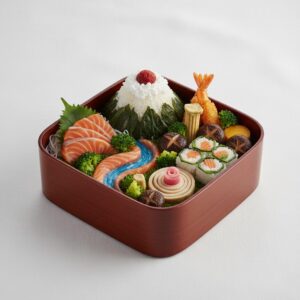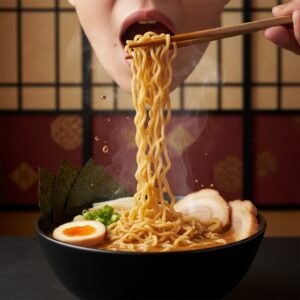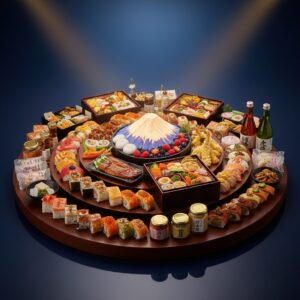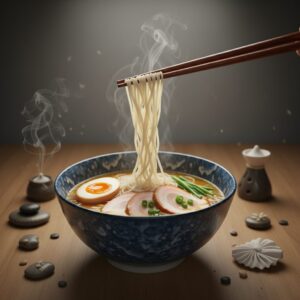
You’ve seen them. Of course you have. It’s impossible to walk down a bustling Tokyo side street or a quiet Kyoto alley without encountering them. Behind a pane of glass, gleaming under a soft light, sits a perfect bowl of ramen. The broth has a rich, fatty sheen, the noodles are captured mid-lift by a pair of phantom chopsticks, and the soft-boiled egg is frozen in a state of molten-yolk perfection. Beside it might be a plate of gyoza, one of them sliced open to reveal a juicy, textured filling, its bottom seared to a flawless golden-brown crisp. It all looks incredible. Delicious. Ready to eat. Except it isn’t.
This is the world of shokuhin sampuru, the hyper-realistic fake food samples that are a ubiquitous and frankly mesmerizing feature of Japan’s culinary landscape. For first-time visitors, it’s a source of wonder and slight confusion. Why go to such extraordinary lengths to create inedible replicas of every single dish on the menu? It seems like an expensive, elaborate, and perhaps slightly kitschy tradition. But when you ask why they exist, you’re not just asking about a quirky marketing tool. You’re pulling at a thread that unravels a deep and fascinating part of Japanese culture—a story about trust, hospitality, and the quiet ritual of choosing a meal.
These models are far more than just three-dimensional menus. They are a silent promise, a cultural contract written in vinyl chloride and resin. They represent an unspoken agreement between the restaurant and you, the customer, that what you see is precisely what you will get. In a culture that places immense value on managing expectations and avoiding ambiguity, the sampuru is the ultimate form of transparency. It’s a visual handshake, assuring you that there will be no surprises, no disappointments, no gap between the fantasy and the reality. To understand these beautiful, inedible objects is to understand a fundamental aspect of the Japanese approach to service, craftsmanship, and the simple, profound act of sharing a meal.
The meticulous attention to detail in every faux dish mirrors Japan’s broader culinary philosophy, inviting curious diners to further explore the seasonal allure of sansai and uncover another facet of the nation’s rich food culture.
A History Baked in Wax

The story of shokuhin sampuru doesn’t originate in the kitchens of ancient Japan but rather in the entrepreneurial spirit of the early 20th century. As Japan opened up and began embracing Western culture during the Taisho and early Showa periods, its culinary tastes evolved as well. Restaurants offering unfamiliar foreign dishes such as omurice (omelet rice) and crispy tonkatsu began to appear, particularly in the growing department stores of major cities.
This created a challenge. The average Japanese person had no idea what these dishes looked like. A name on a printed menu—korokke, katsuretsu—meant little without a visual cue. How could one convince a customer to order something they couldn’t even imagine? This was a perfect opportunity for an innovator, and that innovator was Takizo Iwasaki. According to legend, Iwasaki, a craftsman from Gujo Hachiman in Gifu Prefecture, was inspired one night in the 1930s by the delicate, transient shapes of melting candle wax dripping into water. He realized that if he could replicate the intricate forms of food using wax, he could solve the restaurant’s problem.
His first creation was a flawlessly realistic omurice, complete with a glossy drizzle of ketchup. It was so lifelike that his wife famously couldn’t distinguish it from the real dish. Iwasaki recognized he had discovered something special. He established his company, Iwasaki Mokei, in 1932 and began producing wax food models for restaurants and department store eateries. The idea was an immediate and overwhelming success. Suddenly, the unfamiliar world of Western and Chinese cuisine became approachable. Diners no longer had to guess; they could simply point and say, “I’ll have that one.”
However, the true surge in demand came after World War II. During the post-war economic boom, a newly prosperous middle class had disposable income and a growing desire to eat out. The restaurant sector expanded rapidly, increasing the need for sampuru. These models became essential tools, standard equipment for any serious dining establishment. They were the perfect silent sellers: working around the clock, never miscommunicating an order, and presenting the food in its most idealized form—always fresh and beautifully arranged. The craft, originally made in wax, gradually shifted to more durable and stable synthetic resins and plastics in the 1970s and 80s, enabling even finer detail and longevity. Yet the foundational principle introduced by Iwasaki remains unchanged: to show, not just tell.
The Ritual of Reassurance
To regard shokuhin sampuru simply as a historical fix for a marketing issue is to overlook their deeper cultural importance. Their continued presence in an era dominated by digital menus and online photo galleries highlights the essential role they hold in Japanese dining customs. This practice is intimately connected to the concept of omotenashi—a distinctive, wholehearted style of hospitality that anticipates guests’ needs before they are even voiced.
A Contract of Clarity
At its essence, Japanese culture often aims to reduce friction, ambiguity, and potential conflict in social exchanges. This pursuit of clarity is embedded in everyday life and is clearly visible in the restaurant window. The sampuru display acts as a binding visual agreement. It communicates, “This is the portion size. This is the exact number of shrimp. This is how the sauce will be served.” There is no space for misinterpretation. When the actual dish arrives at the table, its similarity to the model in the window is often striking. It’s not merely similar; it’s nearly an identical replica.
This is not a reflection of a lack of creativity; rather, it’s about fulfilling a promise. It proactively addresses the small questions that could cause a flicker of anxiety or disappointment for customers. Will it be large enough? Does it include soup? What sort of pickles are those? The sampuru answers all these questions without uttering a word, smoothing the path from the street to the table. This act of eliminating uncertainty represents a profound form of customer care, putting diners at ease and assuring them they are in trustworthy, dependable hands.
The Universal Language of Food
Beyond setting expectations for locals, sampuru serves as an extraordinary tool for accessibility. It democratizes the dining experience, making it approachable for everyone, regardless of age, literacy, or nationality. A child who cannot yet read can easily point to the curry they want. An elderly person can judge the meal size before ordering. Most importantly in recent decades, a foreign visitor who doesn’t speak Japanese can confidently order a complex dish.
This is omotenashi in its purest expression. The restaurant has foreseen the challenges a guest might encounter and offered a beautiful, intuitive solution. There’s no need to struggle with a translation app or risk misunderstanding the staff. The entire menu is presented as a visual feast. This simple act of showing makes Japanese restaurants feel inviting and accessible, even amid significant language barriers. It’s a message that says, “You are welcome here, and we have made it easy for you.”
The Appetizer for the Eyes
In Japan, selecting a meal often begins on the sidewalk. Friends or family gather around the display case, engaging in shared decision-making and growing anticipation. “Oh, the tempura udon looks great today.” “Look at the shine on that unagi!” This kind of window shopping for food is a vital part of the dining ritual. It serves as a preview, a trailer for the meal that’s about to come. It stimulates the appetite in a way that a written menu never could.
The three-dimensional nature of the models stimulates the senses far more effectively than a flat photograph. You can gauge the volume of the rice, the texture of the fried batter, the depth of the bowl. This visual and spatial information aids you in making a more satisfying choice. By the time you enter the restaurant, you’re not merely ordering—you’re confirming a choice you have already made. The anticipation has been built, the decision visualized, and the meal becomes the delicious culmination of that process.
The Art of the Inedible

It’s important to recognize that these are not inexpensive, mass-produced plastic toys. Shokuhin sampuru are meticulously handcrafted artworks, created by highly skilled artisans. The industry is small and specialized, centered in places like Gujo Hachiman, Takizo Iwasaki’s hometown, which remains the hub of fake food production. The astonishing level of detail stems from a dedication to craftsmanship that is distinctively Japanese.
From Kitchen to Workshop
The process of creation is an intriguing blend of culinary and artistic methods. It often starts with the restaurant sending the actual food to the sampuru workshop. Artisans then carefully deconstruct the dish and make silicone molds of every single component—each slice of pork, every green onion, and each grain of rice. Liquid plastic, typically vinyl chloride, is poured into these molds and baked in an oven to harden.
Once the basic shapes are formed, the real artistry begins. The pieces are assembled and hand-painted with great precision. This is where the magic unfolds. Artisans use airbrushes and fine brushes to replicate the subtle gradients of grilled fish skin, the translucent glow of squid sashimi, or the delicate char marks on a yakitori skewer. They have mastered numerous techniques to mimic different textures. A glossy finish is achieved with a layer of clear varnish. The crispy, bubbly texture of tempura batter is recreated using carefully applied layers of wax and paint. Even the fizz in a glass of soda is captured with tiny suspended bubbles. The aim is not just realism, but a heightened sense of reality—food that appears even more appetizing and appealing than the real thing.
The Spirit of the Craftsman
This pursuit of perfection reflects a broader cultural ideal known as shokunin kishitsu, or the craftsman’s spirit. It’s a mindset focused on mastering a craft through years of repetitive, dedicated practice, and taking immense pride in the quality and detail of one’s work, regardless of how modest the task. The sampuru artisan is a true shokunin. They may spend years perfecting how to paint beef marbling or make a piece of plastic lettuce look crisp and fresh. Their work exemplifies the belief that anything worth doing is worth doing with absolute, uncompromising attention to detail.
The cost of these models reflects this artistry. A single intricate dish can cost hundreds of dollars, and a full display can involve an investment of thousands. For restaurant owners, this expense is worthwhile. A carefully made sampuru can last for years, serving as a durable and effective marketing tool that pays for itself many times over by attracting customers and simplifying the ordering process.
Fake Food in a Real World
One might assume that in the 21st century, with the advent of Instagram, QR code menus, and high-resolution photography, the tradition of shokuhin sampuru would be declining. Yet, it persists, and for good reason. The tangible, three-dimensional model carries a psychological impact that a digital image simply cannot match.
A photo on a screen is fleeting and easily altered. We are all familiar with food photography using clever lighting and editing to make a dish appear better than it truly is. The sampuru, however, feels solid, real, and genuine. Its physical presence in the window is a testament to the restaurant’s pride in their product. It’s a bold statement that they have nothing to conceal.
Moreover, the tradition has evolved. While remaining an essential tool for restaurants, shokuhin sampuru has also become a cherished cultural icon. Tourists and locals alike can purchase miniature sampuru as keychains and phone charms—tiny, perfect tempura pieces or miniature sushi rolls make quirky souvenirs. In places like Kappabashi Kitchen Town in Tokyo or Gujo Hachiman, you can even find workshops where you can try your hand at crafting your own sampuru, offering a fun, hands-on experience that enhances appreciation for the craft.
Ultimately, Japan’s fake food is among the most sincere things you will encounter. It’s a tradition born from a desire to make the unfamiliar approachable, and it continues to thrive today as a cornerstone of hospitality. It is a silent, beautiful system for building trust, setting expectations, and turning the simple act of choosing dinner into a moment of stress-free pleasure. The next time you find yourself captivated by a display of glistening, flawless, and utterly fake food in a window, pause for a moment. You’re not merely looking at a menu. You’re witnessing a physical expression of a culture’s profound respect for both the food and the person who has come to enjoy it.