Imagine standing in a narrow street in a mountain village as night falls. The air, crisp and cold, suddenly crackles with heat. The rhythmic thud of drums vibrates in your chest, and a low, guttural chant rises from a hundred throats. Then you see it: a procession of men, stripped to their waists, their bodies gleaming with sweat in the orange glow. Each one hefts a colossal torch—a bale of bamboo and straw five meters long, spitting a furious torrent of embers into the sky. They surge past you, so close you can feel the wave of heat wash over your face, the acrid smell of smoke filling your lungs. Sparks rain down like fiery snow, and for a moment, the world is reduced to a terrifying, exhilarating dance of shadow and flame.
This isn’t a scene from a historical epic. This is a himatsuri, a Japanese fire festival, and it’s an experience that fundamentally shakes your understanding of Japan. We often think of this country through a lens of serene temples, meticulous gardens, and profound public order. It’s a place where rules are followed and harmony is the ultimate social currency. So what, then, do you make of these nights of ritualized chaos, where entire communities seem to embrace the most destructive element with a fervent, almost reckless passion? These festivals are far more than a tourist spectacle. They are a raw, unfiltered expression of Japan’s ancient and deeply ambivalent relationship with fire—a force worshipped as a divine purifier and feared as an existential threat. To witness a himatsuri is to pull back the curtain on the modern nation and glimpse the primal heartbeat that still thumps beneath.
This primal heartbeat also pulses through other aspects of Japanese culture, where modern innovation meets deep tradition, much like the way third-wave coffee has redefined the classic kissaten.
The Double-Edged Flame: Purification and Destruction
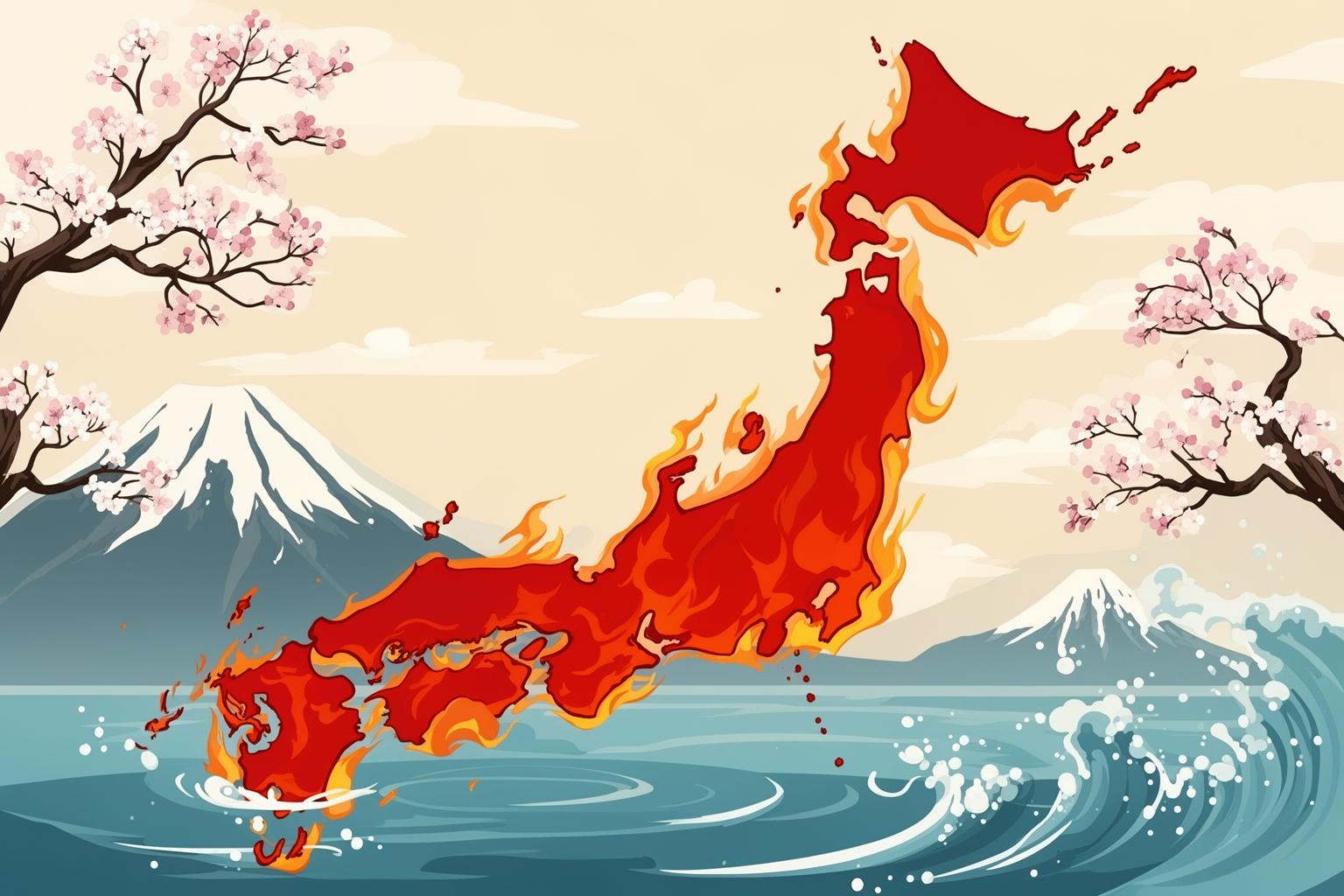
To understand why a town would willingly ignite a massive pyre at its center, you first need to comprehend the dual nature of fire in the Japanese mindset. Fire is neither simply good nor bad; it embodies both aspects, a potent force that gives and takes in equal measure. This duality is rooted in Japan’s oldest religion and its most tragic history.
Shinto and the Sacred Fire
At its heart, Shinto is a faith focused on purity. The world is filled with impurities or spiritual pollution, called kegare, which can build up through contact with death, illness, or even the everyday stresses of life. To maintain harmony and properly connect with the kami—the gods or spirits dwelling in all things—purification is essential. And there is no more powerful purifier than fire.
In Shinto ceremonies, fire serves as a divine cleanser. It burns away misfortune, repels evil spirits, and sends prayers skyward in clouds of smoke. This is why at the start of the new year, dondoyaki ceremonies take place across Japan. People bring their old omamori (good luck charms), daruma dolls, and other sacred items from the previous year to a local shrine or temple. These objects are not merely discarded; they are ritually burned in a grand bonfire. This act releases the spirits or energies contained within, thanks them for their service, and purifies the space for new blessings in the coming year. It is a poignant, symbolic gesture of renewal.
The sacred flame, called goshinbi, is central to fire festivals. Often, the torches and bonfires are lit from a flame carefully maintained at the local shrine, believed to carry the essence of the resident kami. By carrying this fire through the streets, participants hold more than a burning log; they bear a piece of the divine, spreading its purifying power throughout the community, cleansing homes, businesses, and the very souls of the people.
The Edo Flower: A History Written in Ash
Yet for every act of divine purification, there lingers a memory of devastating destruction. Japan, a land built of wood and paper, has endured a long and brutal history with fire. For centuries, its cities were tinderboxes waiting for a spark. Densely packed wooden houses with paper screens, combined with strong winds and primitive firefighting methods, meant that a small kitchen fire could escalate into an inferno swallowing entire districts within hours.
Nowhere was this more true than Edo, the city now known as Tokyo. Fires were so frequent there they earned the grim nickname Edo no hana, the “Flowers of Edo.” This was a fatalistic acknowledgment that periodic, fiery devastation was simply part of life. The most notorious was the Great Fire of Meireki in 1657, a blaze that burned for three days, destroying nearly three-quarters of the city and claiming over 100,000 lives. This tragedy deeply imprinted itself on the nation’s collective memory.
This history fostered a profound fear of fire. It influenced urban planning, led to the creation of the first organized firefighting brigades (hikeshi), and instilled deep respect for fire’s uncontrollable power. This fear still persists, coexisting with spiritual reverence and creating the tension that makes the himatsuri so captivating. These festivals serve as a way to confront this historical terror, taming the destructive force by making it part of a controlled, sacred ritual. By wielding the flame themselves, participants symbolically take command of what once terrified their ancestors, turning an agent of destruction into a tool of renewal and a display of communal strength.
Anatomy of a Himatsuri: More Than Just a Bonfire
Although the fundamental principles of purification and historical memory are shared, no two fire festivals are exactly the same. They range from solemn processions to scenes resembling full-blown riots. Yet, they all share certain core elements that reveal the true essence of these events: community, courage, and a controlled descent into chaos.
The Men in Loincloths: Community, Courage, and Chaos
The central figures of nearly every major fire festival are the men who carry the flames. They are usually local residents—farmers, fishermen, shop owners, and office workers—who, for this single night, become something more elemental. Wearing minimal festival attire, often just a fundoshi (a traditional loincloth) and a happi coat, they subject themselves to an extreme test of physical and mental endurance.
For many younger men, taking part is a rite of passage. It’s a way to demonstrate their strength, courage, and dedication to their community. Carrying a multi-hundred-pound burning torch or charging into a wall of flame is a public affirmation of one’s manhood and commitment. However, this is not about individual glory; the focus is overwhelmingly on the group. The chants are synchronized, the movements coordinated (even when they appear chaotic), and the success of the festival depends on everyone working together. It’s a powerful act of social bonding that reaffirms connections in an age where community ties can often feel fragile. They face the fire as one, and in doing so, they fortify the invisible bonds that hold their town together.
The Tools of the Trade: From Giant Torches to Towers of Flame
The astonishing variety of Japan’s fire festivals each brings its own unique traditions and spectacular ways of engaging with flame.
At the Nachi no Ogi Matsuri in Wakayama, the festival serves as a ritual purification of the nearby Nachi Falls, one of Japan’s most sacred waterfalls. Here, men dressed in white carry twelve enormous ogi (torches), each weighing about 50 kilograms, down a stone staircase from the Kumano Nachi Taisha shrine. The torches embody the spirit of the waterfall, and their blazing descent is a magnificent and almost terrifying spectacle of faith and raw physical power.
Perhaps the most famous—and arguably the most intense—is the Dosojin Matsuri in Nozawa Onsen, a ski village in Nagano. This festival is essentially a ritualized battle. A massive wooden shrine, or shaden, is built and then defended by men of certain “unlucky” ages (42 and 25). The rest of the village’s men, armed with flaming torches, relentlessly assault the shrine, attempting to set it alight. The defenders fend them off in a chaotic, fiery melee lasting for hours. The festival serves as a prayer for a bountiful harvest and healthy children, and its climax—when the shrine is finally set ablaze in a controlled burn—symbolizes the defeat of evil and the hope for renewal.
In Kyoto, the Kurama no Hi Matsuri offers a different but equally dramatic experience. It begins after dusk, when fires are lit in front of houses throughout the village. The procession starts with children carrying small torches, followed by teenagers, and concludes with men carrying enormous pine torches weighing up to 100 kilograms. The streets are so narrow that spectators are showered with sparks as the men chant and parade toward the Yuki-jinja Shrine. It’s an intimate and overwhelming display of tradition handed down through generations.
The Sacred and the Intoxicated: The Role of Sake
Discussion of these festivals would be incomplete without mentioning the vital role of sake. It flows freely before and during the events, and it’s not merely for celebration. The ritual consumption of purified sake, known as omiki, is an offering to the gods and a means for participants to spiritually prepare for the ordeal ahead. On a practical level, it acts as a social lubricant and liquid courage. It lowers inhibitions, allowing participants to enter a more primal, almost trance-like state where they can surpass pain and fear. The alcohol blurs the boundaries between the sacred and the profane, the human and the divine, enabling full immersion in the ritual’s raw energy.
Feeling the Heat: The Spectator’s Experience
Attending a himatsuri as an outsider is an overwhelming sensory experience in the most exhilarating way. It stands in stark contrast to the polite, sanitized cultural displays often offered to tourists. Here, you are not just a passive onlooker; you become part of the atmosphere, whether you welcome it or not.
A Sensory Overload
The first sensation you notice is the heat. Even from what seems like a safe distance, waves of warmth from a massive bonfire or a passing torch are intense, touching your cheeks, hands, and chest. Then comes the scent—not merely the clean smell of burning wood, but also the sharp, resinous aroma of pine, the acrid sting of ash, and the subtle sweetness of festival food drifting from nearby stalls. The soundscape is a rich symphony of crackling flames, the deep thump of taiko drums, the sharp clatter of wooden blocks, and the synchronized, rhythmic chanting of the participants. Visually, it is strikingly dramatic. The darkness of night contrasts with roaring columns of orange and yellow flames, sparks flutter like swarms of fireflies, and the bold silhouettes of participants move against the blazing backdrop. It’s this total sensory immersion that makes the experience so compelling. It bypasses the analytical mind and connects directly to something more primal.
Safety Third? The Illusion of Danger
For a first-time spectator, the reaction is often a blend of amazement and genuine worry. “How is this permitted?” you might ask yourself. “Isn’t this incredibly hazardous?” On the surface, it certainly appears that way. Men wield enormous fiery implements, sparks fall onto crowds and old wooden buildings, and the overall atmosphere feels like barely controlled chaos.
Yet beneath this turmoil lies a deeply rooted, often unspoken system of control. These festivals have been observed for centuries, with fire-handling knowledge passed down through generations. Participants know how to grip the torches, how to move, and how to read the wind. Local volunteer fire brigades are always on standby, discreetly positioned with hoses and extinguishers. Routes are carefully planned to minimize risk. Although the danger feels immediate and real—and minor injuries do occur—it is a calculated risk. This perceived danger is essential to the festival’s significance. It’s the encounter with genuine risk that transforms participation into a true test of courage and faith, elevating the event beyond performance into a profound ritual with very high stakes.
The Fire Within: What Himatsuri Mean Today
In a hyper-modern, increasingly secular Japan, one might assume these ancient, seemingly irrational festivals would disappear. Yet, many continue to thrive, attracting not only locals but also visitors from across Japan and around the world. Their survival highlights the essential role they still play in the cultural life of the nation.
Keeping the Flame Alive in Modern Japan
This doesn’t mean they are without challenges. Rural depopulation poses a serious threat; with fewer young people in the countryside, some communities find it difficult to gather enough participants to maintain their traditions. Stricter safety regulations and liability concerns also pressure festival organizers to moderate the very wildness that gives these events their impact. Some festivals have been scaled down, while others have cautiously invited outsiders or tourists to join in certain roles just to maintain numbers.
Nevertheless, the dedication to preserving these traditions remains strong. For many communities, their himatsuri serves as the cornerstone of local identity. It’s the one time each year when the entire town unites around a single, shared purpose. It connects them to their ancestors and serves as a promise to future generations. Thus, they adapt, finding ways to balance modern demands without extinguishing this sacred flame.
A Primal Connection in a Digital World
Ultimately, the lasting power of the himatsuri comes from what it offers: a link to something real, tangible, and profoundly primal amid an age of digital abstraction. It acts as a powerful antidote to the sterile predictability of contemporary urban life. For one night, the community collectively agrees to step beyond everyday norms and embrace something elemental.
Gazing into the heart of a festival bonfire, you share in the same awe and fear humans have experienced before fire for thousands of years. You witness a direct, unbroken tradition stretching back centuries—a ritual performed on that very spot by countless generations. It profoundly reminds us that beneath the polished surfaces of bullet trains, skyscrapers, and convenience stores, Japan is a land of deep, ancient currents. The fire festivals bring those currents to the surface, reminding everyone of the raw, untamable, and beautiful power at the core of both nature and the human spirit. They assert that even in the most orderly of societies, there must always be room for the sacred chaos of the flame.