You’ve probably seen pictures of them, even if you didn’t know what you were looking at. A warm, inviting glow spilling out from under a simple curtain onto a dark city street. Inside, a narrow space, hazy with the steam from a simmering pot of oden and the smoke from a grill. A crowd of people, still in their work clothes, packed shoulder-to-shoulder along a worn wooden counter. They’re laughing, nursing small glasses of beer or sake, and picking at simple dishes. But something is missing. There are no chairs. Not a single one.
This is the world of the tachinomi, Japan’s standing bars. The name is brutally literal: tachi (立ち) means to stand, and nomi (飲み) means to drink. It’s a simple concept that, on the surface, seems almost punishing. After a long day, often spent on your feet commuting and navigating a busy office, why would anyone willingly choose to stand in a crowded bar? Why not find a comfortable seat, settle in, and relax?
That’s the question that gets to the heart of it all. Because the tachinomi isn’t about a lack of furniture. It’s a finely tuned social institution, a masterpiece of cultural design that serves a very specific and crucial purpose in the rhythm of Japanese urban life. It’s a transitional space, a social pressure-release valve, and a haven for a kind of fleeting, low-stakes connection that’s hard to find elsewhere. To understand the tachinomi is to understand the unspoken needs of the Japanese worker, the delicate balance between group obligation and individual release, and the beautiful efficiency that shapes so much of this culture. Forget the tourist brochures; this is where you can see the real, unscripted moments that happen after the office lights go out.
While the tachinomi offers a unique social outlet, Japan is also home to other deeply personal hobbies, such as the intricate world of Gunpla.
The Anatomy of a Tachinomi: Engineered for Flow
The initial impression when stepping into a classic tachinomi is often one of organized chaos. The space seems impossibly small, yet it functions perfectly. This isn’t a design flaw; it’s the entire point. The space itself defines the social contract.
More Than Just the Absence of Chairs
The most noticeable feature—the lack of seats—is the key driver of the experience. Standing is inherently temporary. It suggests a degree of impermanence. You’re not settling in for the night; you’re just stopping by. This simple physical fact transforms the entire social dynamic. It lowers the commitment threshold—you don’t have to dedicate yourself to a full meal or a lengthy evening. It also fosters a steady, gentle flow of customers. No one lingers for hours, meaning there’s almost always a spot opening shortly. The standing format acts as a great equalizer; everyone, from a senior manager to a junior employee, shares the same type of space, if only briefly.
The counter serves as the altar. It’s the room’s centerpiece, often a single wooden slab that has absorbed decades of conversations and spilled drinks. This is where you order, receive your food and drink, and pay. The direct connection to the staff—usually just one or two people managing the entire operation—is a model of efficiency. There’s no waiting for a server to find you. You’re always within arm’s reach of what you need. This layout reduces friction and promotes flow, ensuring the system keeps moving even on the busiest nights.
The Economics of Standing
This spatial efficiency translates into affordability, which is fundamental to tachinomi’s appeal. Because the space is small and there are no tables and chairs occupying room, the rent per customer is much lower. The high turnover means more customers can be served in less time. Staffing needs are minimal. All these factors combine to create a business model that supports remarkably low prices.
A draft beer may cost half as much as it would at a sit-down izakaya (Japanese-style pub). A small dish—such as a couple of grilled chicken skewers, a piece of simmered daikon radish, or a small bowl of pickled vegetables—often costs just a few hundred yen, equivalent to a couple of dollars. This isn’t just about cheapness; it’s about accessibility. It turns the after-work drink into a casual, spontaneous choice rather than a planned expense. You can pop in for a quick beer and snack for under 1,000 yen (less than ten dollars), making it a near-daily ritual for many.
A Menu Tailored for Speed and Salt
The food at a tachinomi is perfectly suited to its setting. This isn’t a place for delicate, multi-course meals. The menu features dishes that are quick to prepare, easy to eat while standing, and pair excellently with alcohol. The flavors tend to be bold, salty, and savory, designed to prompt another sip of beer or sake.
Typical offerings include yakitori (grilled chicken skewers), motsuni (a hearty stew of beef or pork offal), and oden (various ingredients simmered for hours in a savory dashi broth). Other common items are deep-fried skewers (kushiage), grilled mackerel slabs, or simple cold dishes like potato salad or salted cabbage. Everything is served in small portions. The aim isn’t to fill you up; it’s to provide something to complement the drinks and conversation. The food is part of the rhythm, a beat between sips, giving another reason to linger just a bit longer before heading home.
The Social Contract: Unspoken Rules of the Standing Bar
Entering a tachinomi means implicitly accepting a set of unwritten rules. It’s a social environment governed by a shared understanding of its purpose, and successfully navigating it requires a level of social awareness the Japanese refer to as kuuki wo yomu, or “reading the air.”
The Philosophy of “Ippai Dake”: Just One Drink
At the heart of tachinomi culture lies the concept of ippai dake (一杯だけ), meaning “just one drink.” This phrase is the key that unlocks the entire social function of the standing bar. When a coworker turns to another at 6 PM and asks, “Ippai dake?“, it’s a low-commitment, high-reward offer. It’s not a request for a two-hour dinner nor a formal, planned gathering. It’s simply a suggestion for a brief, 15-to-30-minute pause at the end of the day.
This greatly lowers the social barrier. Saying yes to “just one” is easy because it has a clear, limited scope. It’s the ideal way to share a quick, meaningful conversation with a colleague without becoming entangled in the demands of a longer engagement. Naturally, “one drink” can sometimes turn into two or three, but the initial idea of brevity is what makes the whole system function. The tachinomi is the tangible expression of the ippai dake philosophy: a space created for the art of the brief, restorative drink.
Transient Intimacy: Proximity Without Obligation
The crowded nature of a popular tachinomi naturally creates a kind of physical intimacy. You’ll brush shoulders with neighbors. You coordinate your movements to reach for a dish or take a sip. In many Western cultures, this closeness to strangers might feel uncomfortable or intrusive. Here, it fosters a unique atmosphere of temporary community.
Because everyone recognizes the transient character of the space, this closeness comes without typical social expectations. You might strike up a chat with the salaryman beside you about his day or the quality of the simmered tofu. You share a moment, a laugh, a gripe about the weather, then one of you finishes a drink, pays, and slips back into the night. There’s no pressure to exchange contact information or forge lifelong friendships. It’s a form of fleeting, anonymous intimacy that offers a sense of connection without social demands. It’s a place to feel part of the city’s human tapestry for a moment before retreating to your own world.
Reading the Flow
Success in a tachinomi, as in much of Japanese society, depends on your ability to read the context. When the bar is crowded, you instinctively make yourself smaller to let someone in. You avoid spreading your belongings around. You order quickly and confidently. When finished, you don’t loiter with an empty glass, especially if you see others waiting.
Payment also contributes to this smooth flow. In many traditional spots, a cash-on-delivery system called kyasshu on is used. You place your cash in a small tray on the counter, and the owner takes the correct amount for each item as it’s served. This eliminates the need to ask for a bill and wait to pay, allowing for an even quicker and more graceful exit. It’s all part of an unspoken choreography—a collective effort to preserve the harmony and efficiency of the space.
A Space for Everyone?
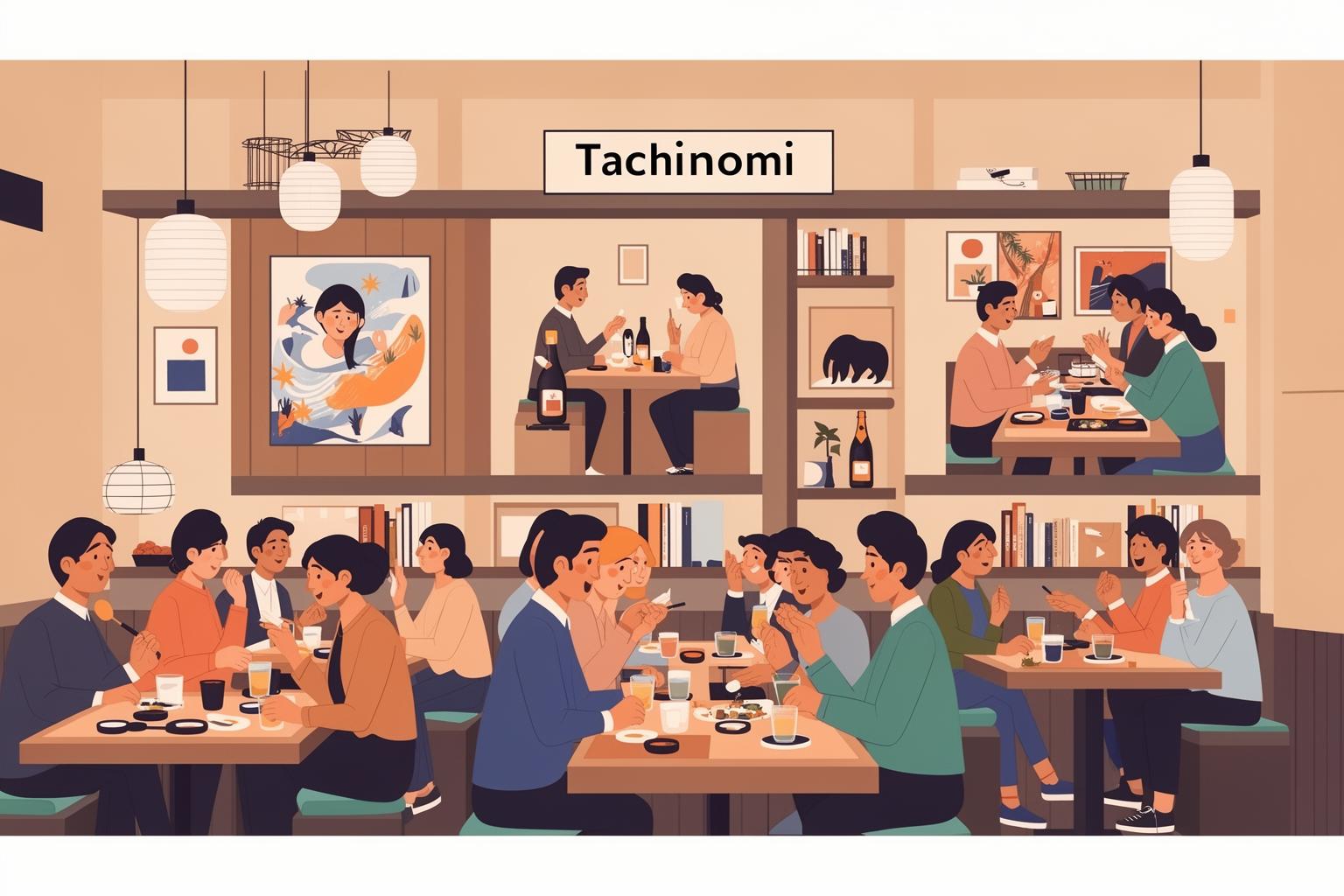
Although the typical image of a tachinomi features older men in suits—the venerable salarymen—its role and clientele have been broadening and evolving for decades. The standing bar’s history is grounded in practicality, yet its modern form is far more varied.
Historical Roots: From Edo Street Stalls to Post-War Gathering Spots
The idea of eating and drinking while standing is not new in Japan. It dates back to the Edo period (1603-1868), when street stalls served quick snacks like soba noodles and sushi to busy urbanites. However, the modern tachinomi truly emerged during the bustling post-war era. As Japan underwent rapid economic recovery, laborers and an expanding white-collar workforce sought affordable, quick, and revitalizing drinks after long workdays. Tachinomi venues appeared near major train stations and entertainment districts, becoming vital parts of city life. These spots were rough, practical, and predominantly male, functioning as crucial decompression areas for those rebuilding the nation.
The Modern Evolution: From Rough to Refined
Today, while the classic Showa-era tachinomi remain beloved, a fresh wave has completely reinvented the concept. The foundational elements—standing, efficiency, affordability—persist, but the styles and offerings have greatly expanded. Now, you can find sleek standing wine bars serving charcuterie and cheese, craft beer tachinomi with numerous rotating taps, and even sake bars specializing in premium brews by the glass.
These “neo-tachinomi” are frequently brighter, cleaner, and more design-forward. They have shattered the stereotype of smoky, male-only bars and openly welcome a wider audience. It’s now common to see groups of young women, couples on casual dates, or creative professionals from nearby offices enjoying the standing bar atmosphere. This transformation has secured the tachinomi’s ongoing relevance, updating a centuries-old tradition for a new generation’s preferences.
Ohitorisama Welcome: A Haven for the Solo Drinker
One of the tachinomi’s most important contemporary roles is as a refuge for the ohitorisama—people who take pleasure in doing things alone. For solo diners or drinkers, entering a restaurant filled with tables for two or more can feel daunting. The counter-focused layout of a tachinomi eliminates this social unease. Standing alone at a counter feels natural and anonymous in ways that sitting solo at a table rarely does.
It provides an ideal blend of solitude and community. You can be immersed in your own thoughts, scrolling through your phone or just watching the bartender at work, while still surrounded by the gentle buzz of others. For women in particular, a well-lit, welcoming tachinomi can feel like a much safer and more comfortable option for solo drinking than a traditional bar. It’s a space where you can be alone without feeling lonely.
Tachinomi as a Cultural Barometer
Ultimately, the humble standing bar is more than just a spot to have a drink. It offers insight into the Japanese psyche and the framework of its work culture, existing to fulfill a deep-seated need.
A Buffer Between Work and Home
The tachinomi is a classic example of a “third place,” a term for a location that is neither home (the first place) nor workplace (the second place). In Japan, where the boundary between professional and private life can be sharply defined, this third place acts as an essential psychological airlock. The workday is often shaped by strict hierarchies, formal communication, and intense pressure, while home serves as a space for private, familial responsibilities.
The tachinomi occupies the liminal space between the two. It’s where ties can be loosened, both literally and figuratively. It’s a place to vent about your boss, share an authentic laugh with a colleague, and mentally shift from the role of “employee” to that of “husband,” “father,” or simply “self.” This ritual of decompression is crucial for maintaining psychological balance in a high-stress work environment. It provides a brief, controlled respite before re-engaging with the demands of domestic life.
Fostering “Nominication”
Japan is well known for the concept of nominication, a blend of the Japanese word for drink, nomu, and “communication.” It describes the idea that drinking together can break down barriers and promote more honest communication. While this is often linked to large, sometimes obligatory company drinking events, the tachinomi offers a more natural and voluntary form of it.
At a tachinomi, free from office formalities, colleagues can connect on a more personal level. Hierarchies soften at the counter. A quiet junior employee might feel more at ease sharing an idea, or a manager might reveal a more personal, vulnerable side. These brief and informal interactions build the trust and camaraderie that are vital for a well-functioning Japanese workplace. It’s nominication in its purest form: brief, effective, and voluntary.
So, the next time you notice a glowing red lantern above a simple curtain, don’t just see a bar without chairs. Recognize it for what it truly is: a marvel of social engineering. It’s a space created not from wood and concrete, but from a profound understanding of human needs—the need for a pause, the need for connection, and the need for a place to simply stand for a moment and catch your breath before moving on. It is the art of the quick drink, a small yet meaningful ritual that helps keep the great, humming engine of urban Japan running smoothly.