Spend enough time in Japan, and you start to feel it. It’s not something you see, exactly, but a certain pressure in the air, a quality of intense, focused gravity. You feel it in the way a chef presents a single, perfect piece of sushi, the culmination of a lifetime’s practice. You see it in the calligrapher’s studio, where a thousand failed attempts are discarded for the one stroke that breathes with life. You witness it in the crowded halls of Comiket, where artists dedicate months to creating intricate comics for a hyper-specific audience that shares their obsession. The common thread is a profound, almost startling depth—a willingness to drill down into a single subject, a single craft, a single aesthetic, until it reveals a universe.
For years, I’ve tried to put a name to this phenomenon. Why does this country produce such incredibly deep, yet often seemingly isolated, artistic worlds? The answer, I’ve come to believe, lies in a concept both simple and profoundly complex: shimaguni konjo (島国根性). The literal translation is “island country spirit,” but that’s too gentle. A more honest rendering is “island mentality.” In Japan, this isn’t just a neutral descriptor of geography; it’s a loaded term that hints at a deep-seated psychological framework. It’s seen as both a source of national strength and a potential weakness. It is the invisible force that has shaped Japan’s relationship with the world, and by extension, its art. This mentality, born from centuries of geographic and self-imposed isolation, created a cultural greenhouse. It fostered an environment where traditions could be honed to an impossible degree of refinement and where subcultures could evolve into baroque, self-referential ecosystems, often shielded from the diluting influence of the outside world. This is the story of how being an island forged not just a nation, but a unique and powerful way of creating.
This intense focus, which can also be seen in the decline of dedicated spaces for standing readers, is a direct product of the shimaguni konjo mentality.
The Deep Roots of the Island Mentality
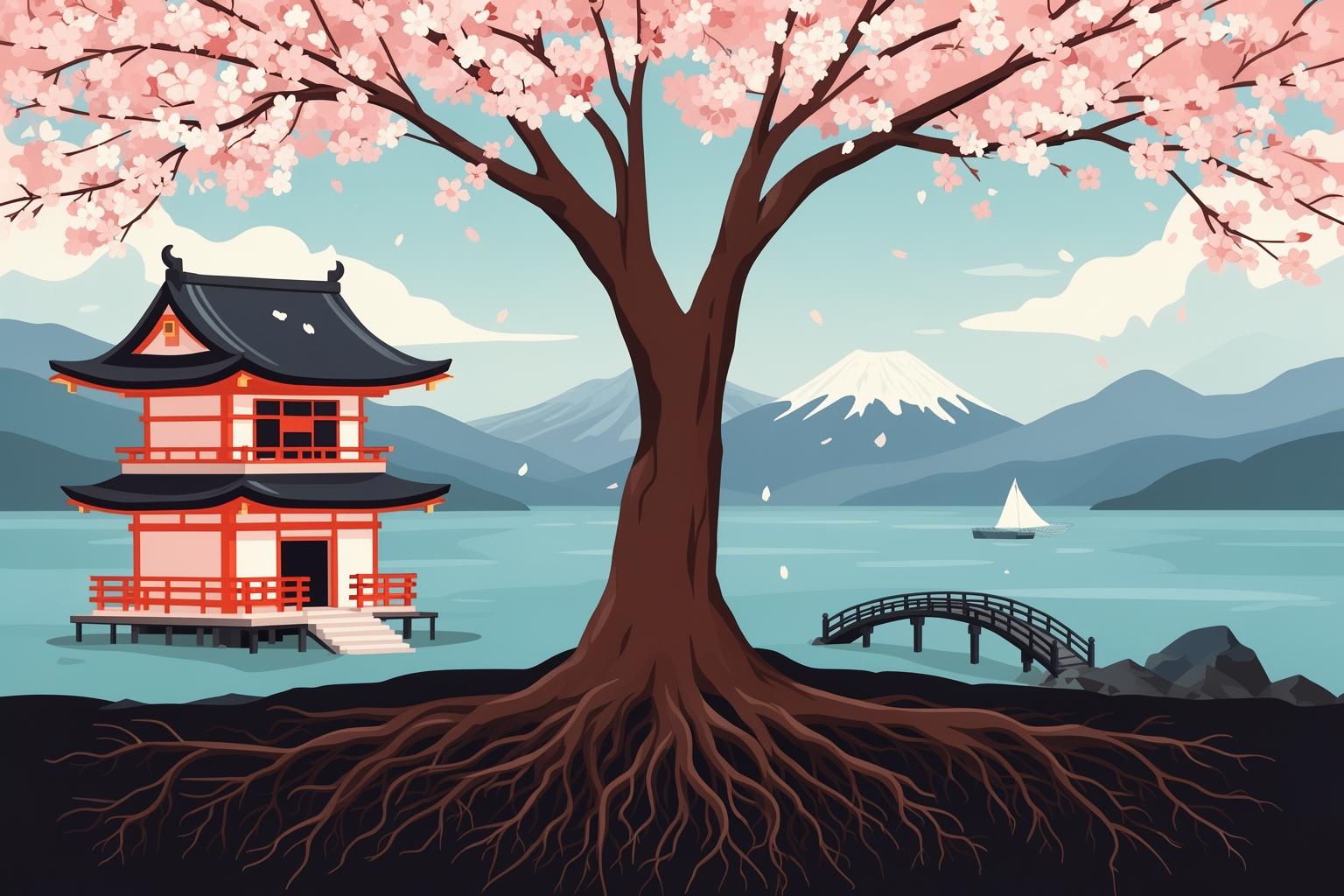
To grasp this mentality, you must begin with the map. Japan is not merely a single island; it is an archipelago of nearly 7,000 islands, a long, slender crescent separated from the vast Asian continent by a formidable sea. For much of its history, crossing this distance wasn’t a brief flight but a perilous journey. This physical separation forms the foundation of shimaguni konjo. It created a natural barrier that limited the casual movement of people, armies, and ideas. Unlike European countries with porous land borders, Japan’s identity was shaped through relative isolation. It was never successfully invaded and occupied by a foreign power until the 20th century.
This geographical reality was solidified by political will during the Edo period (1603–1868) through the policy of sakoku, or “locked country.” For over two centuries, under the Tokugawa shogunate, Japan closed its doors to the outside world. Overseas travel was prohibited, foreigners were largely expelled, and trade was confined to a small, man-made island in Nagasaki harbor. This was not merely a political maneuver; it was a grand cultural experiment. By severing external influences, Japan turned inward. The nation became a petri dish for its culture, allowing indigenous ideas and aesthetics to ferment, concentrate, and evolve on their own terms.
This extended period of isolation profoundly influenced the national psyche, reinforcing a pre-existing concept of uchi-soto (内・外). Uchi means “inside” and refers to one’s in-group—family, company, and by extension, Japan itself. Soto means “outside” and denotes everyone and everything else. Within the uchi, rules are implicit, harmony is essential, and communication relies on subtle, shared context. The soto is the realm of the unfamiliar, where one must be more formal, more guarded, and where the rules differ. Shimaguni konjo essentially applies uchi-soto to the entire nation. Japan represents the ultimate uchi—a familiar, comprehensible world. The rest of the globe is soto.
This dynamic shaped how culture was assimilated. New ideas, when they arrived—Buddhism from Korea, ceramic techniques from China, painting styles from the continent—were not simply adopted. Instead, they were absorbed, carefully studied, and then thoroughly “Japanized.” Stripped down to their essence, they were rebuilt according to Japanese aesthetic principles, refined and perfected over generations within the island’s closed system. The goal was not merely imitation, but mastery followed by surpassing the original, creating a version that was unmistakably Japanese. This process of internalization and refinement is central to understanding the nation’s artistic achievements.
Perfection in a Bubble: The Way of Mastery
The cultural greenhouse of sakoku and the underlying island mentality created ideal conditions for the emergence of the dō (道), meaning “the way” or “the path.” This suffix appears in many of Japan’s traditional arts: sadō (the way of tea), kadō (the way of flowers), shodō (the way of calligraphy), and budō (the martial ways). These are not simply hobbies or skills; they are disciplines, lifelong journeys toward spiritual and technical mastery. The focus is less on the end result and more on the process—the continual repetition and refinement of form, or kata.
This is where the island mentality acts as a powerful artistic driver. In a society with limited external distractions and a strong emphasis on tradition and lineage, an artisan could devote their entire life to a single, narrow pursuit. The world beyond the workshop or tea room practically ceased to exist. What mattered was the gradual improvement of a single form, the subtle modification of a technique passed down from master to apprentice over centuries. The goal was not radical, ego-driven innovation as seen in the West, but achieving a state of unity with the craft, becoming a vessel for a tradition greater than oneself.
Consider a craft like Bizen pottery, which originated in the Kamakura period and has remained largely unchanged for nearly a thousand years. Bizen potters use no glaze, depending solely on the natural chemistry of clay, fire, and ash within the kiln. Generations of families have committed themselves to understanding the subtle differences in the local clay and the precise firing patterns of their wood-fueled noborigama (climbing kilns). The aim is not to invent a new type of pottery; the aim is to produce the perfect Bizen pot, an object that embodies the accumulated wisdom of all who preceded. This obsessive, inward-focused approach is a direct expression of shimaguni konjo. It reflects the belief that everything necessary for perfection exists right here, within the familiar world of the island, if one only digs deep enough.
The same principle applies to the performing arts. A Noh actor, for example, studies highly stylized movements and vocalizations that have been fixed for over 600 years. An actor spends their life perfecting the angle of a turn, the way a fan is held, and the precise intonation of a single line. The audience, mostly composed of initiated viewers, understands this language. They are not seeking a novel interpretation but a masterful execution of a venerable form. This art form is an island unto itself, with its own language, history, and standards of excellence, fully grasped only by those who live within it.
The Echo Chamber and the Niche: Modern Islands of Culture
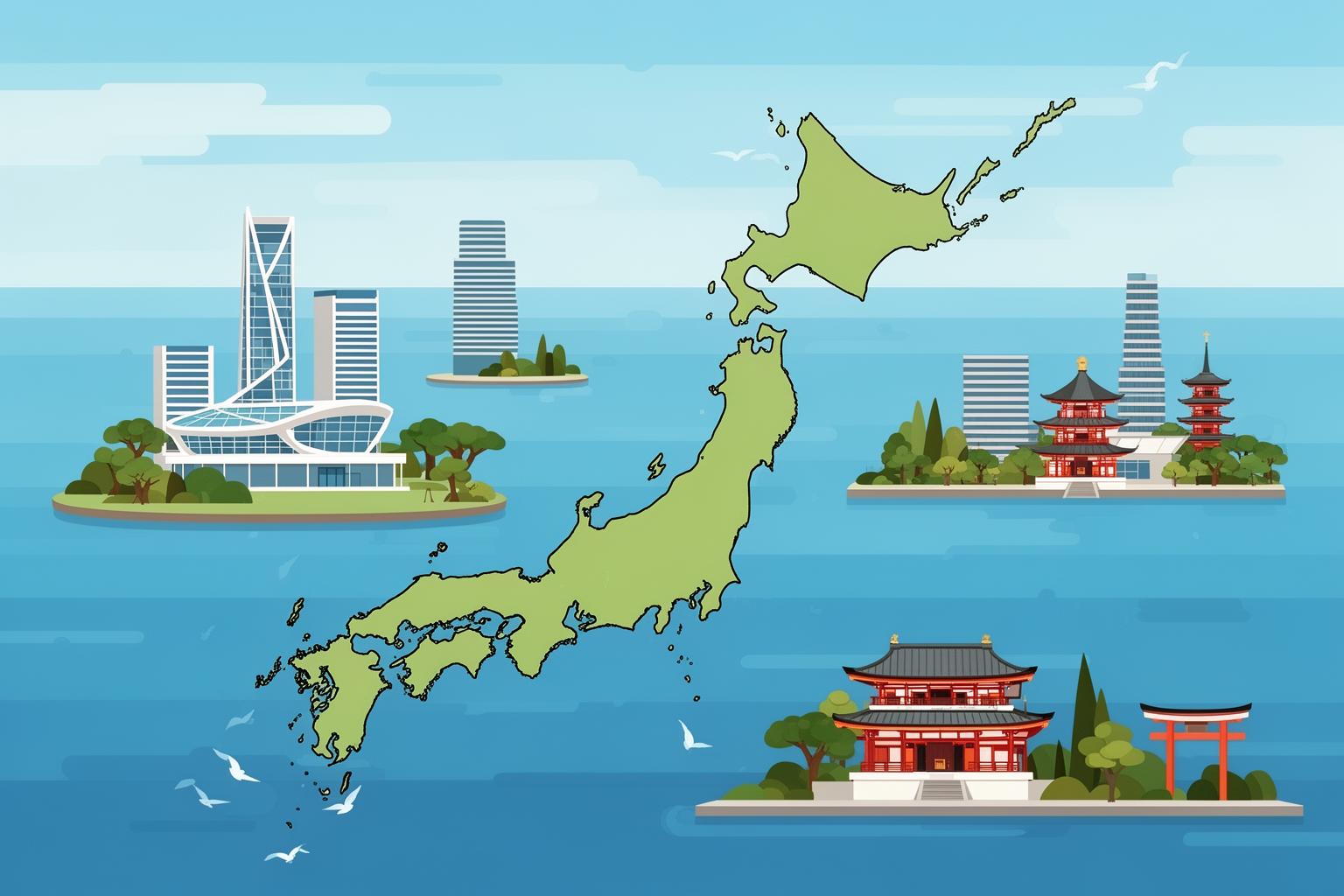
While the island mentality is easy to spot in the quiet realm of traditional arts, it thrives just as powerfully in the vibrant, noisy, and seemingly chaotic world of modern Japanese subcultures. The principle remains the same; only the subject matter has shifted. The insular, intensely focused quest for perfection has been applied to anime, manga, video games, fashion, and music, forming cultural “islands” that are often as impenetrable to outsiders as a tea ceremony.
The most notable example is otaku culture. Once a somewhat negative term for a hobbyist with obsessive interests, it now signifies a vast and influential cultural phenomenon. An otaku’s dedication to a specific anime series, manga character, or voice actor can be astonishingly deep. This is no casual fandom; it is a precise, scholarly pursuit. They analyze plotlines, dissect character designs, and produce vast amounts of derivative works, from fan comics (dōjinshi) to intricate costumes (cosplay). Events like the twice-yearly Comiket in Tokyo exemplify this. It is a huge marketplace where hundreds of thousands of creators and fans gather to buy and sell self-published works grounded in a shared, encyclopedic knowledge of niche media. The creativity is impressive, but it exists within a largely self-contained ecosystem. The art is created for and evaluated by the community’s standards. Outside opinions are almost entirely irrelevant.
This is shimaguni konjo in the digital era. These subcultures act as micro-islands. They develop their own distinct aesthetic languages, tropes, and inside jokes. To an outsider, a conversation between two devoted fans might sound like a foreign language. This insularity enables an extraordinary level of detail and complexity to flourish. A genre like mecha (giant robots) has its own sub-genres, historical design lineages, and revered creators who are legends within the community but largely unknown beyond it. The same holds true for numerous other niches: idol fandom with its intricate rituals of support; the Visual Kei music scene, marked by specific and evolving codes of androgynous glamour; or the cult of street fashion in Harajuku, where styles evolve and fuse within a bubble of hyper-local trends.
These scenes are not created with a global audience in mind. They arise from a culture comfortable with turning inward, finding a small cultural plot and nurturing it with an intensity bordering on obsession. The result is a cultural landscape that is not broad and shallow, but rather a collection of deep, narrow wells of remarkable creativity.
Breaking the Frame: When the Island Looks Outward
Certainly, Japan has never been a completely closed-off entity. The island has always had openings, and what it has both sent out and received has frequently influenced the world. The story of shimaguni konjo in art is not merely about isolation; it reflects a highly selective and transformative interaction with the outside world.
Perhaps the most renowned instance of this was the Japonisme movement that swept through Europe in the late 19th century. When Japan reopened its ports after centuries of isolation, a surge of its art and design objects reached the West. For European artists like Monet, Degas, and Van Gogh, Japanese ukiyo-e woodblock prints were a revelation. This art form featured an entirely different visual language: flattened perspectives, asymmetrical compositions, bold outlines, and everyday subjects. It was a shock that helped break the conventions of Western academic painting and paved the way for Impressionism and modern art. This cultural export was largely accidental; Japanese artists creating these prints for a domestic audience had no idea their work would one day be displayed in Parisian salons. The island’s art, developed in its own context, proved to have universal appeal.
In the post-war period, Japanese artists began to engage more deliberately with the outside world. Movements such as the Gutai group in the 1950s and Mono-ha in the late 1960s engaged directly with global art trends like Abstract Expressionism and Arte Povera. Yet their response was distinctly Japanese. Gutai artists emphasized the visceral connection among body, material, and action, while Mono-ha examined the philosophical relationship between natural and artificial objects. They used an international artistic language, but with a uniquely Japanese inflection, infused with ideas of ephemerality, materiality, and existence rooted in Zen Buddhism and Shintoism.
More recently, contemporary artists like Takashi Murakami and Yayoi Kusama have become global icons by skillfully translating the island’s sensibility for an international audience. Murakami’s Superflat theory explicitly links the flattened style of traditional Japanese painting to the visual language of post-war anime and manga. He transformed the inward, obsessive world of otaku culture—a product of shimaguni konjo—into high art on the global stage. Kusama’s work, with its compulsive repetition of dots and patterns, is a deeply personal reflection of her own psychology, yet it also echoes the Japanese cultural penchant for focused, all-consuming detail. These artists serve as bridges, standing with one foot on the island and the other in the wider world, demonstrating that art born of insularity can speak a universal language.
The Price and the Prize of Insularity
Like any potent cultural force, shimaguni konjo is a double-edged sword. Its strengths and weaknesses are two facets of the same reality. The reward is undeniable: a culture of mastery that yields art of stunning refinement and profound depth. This steadfast dedication enables a swordsmith to fold steel thousands of times to craft a flawless blade or an animator to spend a week perfecting a few seconds of fluid motion. Such inward focus preserves tradition and nurtures a respect for process that much of the fast-paced, disposable modern world has lost. It creates rich, intricate artistic ecosystems that value deep knowledge and lifelong commitment.
However, there is a cost. The same insularity that nurtures perfection can also cause stagnation and resistance to new ideas. It may form an echo chamber where outside critique is dismissed and where deviation from established forms is discouraged. These deep, narrow wells of creativity can sometimes seem exclusionary, with specialized languages and unwritten rules intimidating the uninitiated. The Japanese art world can occasionally feel detached from the global conversation, functioning on its own rhythms and hierarchies, which can hinder its artists’ ability to gain international recognition without a Western advocate.
In the end, the island mentality is neither inherently good nor bad; it is simply the central tension driving much of Japanese culture and art. It represents a constant negotiation between the comfort of the familiar and the attraction of the unfamiliar, between perfecting tradition and welcoming innovation. As a photographer here, I encounter this duality daily. I see it in the ancient moss garden, a perfectly curated microcosm of nature, and in the vibrant, chaotic alleyways of Shinjuku’s Golden Gai, a small, self-contained world of bars with its own strict etiquette. The island is not a cage; it is a crucible. It exerts a unique pressure that forges art of remarkable purity and intensity. It is the quiet, persistent force that urges the artist: look deeper, work harder, and perfect the world you have right here.