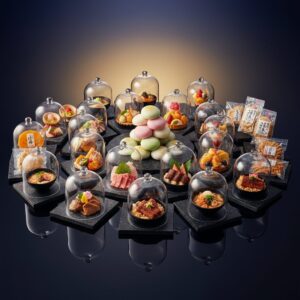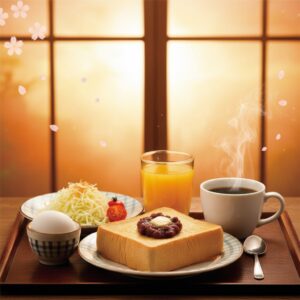
Walk down almost any commercial street in Japan, from a bustling Tokyo shotengai to a quiet lane in a regional city, and you will eventually encounter them. Sitting silently behind glass, arranged in pristine displays, is a feast for the eyes. A bowl of ramen, its broth gleaming with an impossible sheen, noodles suspended mid-air by a floating pair of chopsticks. A glistening slice of tuna sushi, the texture of the fish so perfectly rendered you can almost feel its coolness. A plate of spaghetti Napolitan, each strand coated in a glossy ketchup-based sauce, frozen in a perfect, inviting twirl. This is the world of shokuhin sanpuru, or Japanese food samples, a universe of culinary replicas so convincing they can make your stomach rumble from the other side of a window.
For a first-time visitor, the sight is often a source of delightful confusion. Are they real? Is it some kind of bizarre, permanent buffet? The immediate assumption is that they’re just a quirky form of marketing, a three-dimensional menu for those who can’t read Japanese. And while they certainly serve that purpose, to leave it there is to miss the point entirely. These plastic and vinyl creations are not just props; they are a deeply ingrained part of Japan’s food culture, a testament to a national obsession with detail, presentation, and the unspoken promise of a good meal. They are the result of a century-old craft, honed by artisans whose skill rivals that of the chefs they imitate. This isn’t just about showing you what’s on the menu. It’s about communicating an ideal, an aesthetic, and a feeling—the feeling of oishisou, that wonderful sensation of something looking utterly, mouthwateringly delicious. To understand these plastic feasts is to understand a fundamental aspect of the Japanese approach to dining, where the ritual begins long before you ever take a bite.
This meticulous attention to presentation extends beyond the display case, deeply influencing the dining experience itself, as seen in the quiet precision of Japan’s solo ramen rituals.
The Birth of an Illusion: From Wax to Vinyl Chloride

The story of shokuhin sanpuru, like many contemporary Japanese innovations, is one of cultural exchange and inventive adaptation. Its origins trace back to the early Showa era in the late 1920s, a period marked by rapid modernization and Western influence. As Western dishes such as omelets, curries, and fried cutlets began appearing on menus in major department store dining halls, restaurateurs encountered a challenge. Many Japanese customers had no clear idea what these foreign foods were supposed to look like, and written descriptions alone were insufficient.
The most commonly accepted origin story credits a man named Takizo Iwasaki. Inspired by wax anatomical models used in medical education, Iwasaki, a craftsman from Gifu Prefecture, reportedly had a moment of inspiration while observing patterns created by dripping candle wax. In 1932, he produced his first masterpiece: an impressively realistic omelet, complete with a splash of ketchup. It was so lifelike that his wife allegedly couldn’t distinguish it from the real dish. He went on to establish a company, Iwasaki Mokei Seizo (now Iwasaki Co., Ltd.), giving rise to a new industry.
Early food samples were crafted entirely from paraffin wax. Artisans made molds and carefully poured colored wax in layers to replicate the various elements of a dish. Although innovative, wax had its limitations. It was fragile, prone to cracking, and its colors would fade when exposed to sunlight or display case lighting. A hot summer day could transform a perfect plate of curry into a melted, unfortunate mess. The craft was pioneering, but its material was impermanent.
The true turning point arrived after World War II. The American occupation brought new materials and technologies, which the food sample industry eagerly embraced. The major breakthrough was the adoption of plastics, particularly polyvinyl chloride (PVC). This new material revolutionized the craft. It was far more durable, resistant to heat and light, and capable of reproducing stunning detail. The shift from wax to plastic elevated shokuhin sanpuru from a clever novelty to an art form. Artisans could now produce replicas that were not only realistic but also durable enough to maintain their flawless, appetizing appearance for years.
The Anatomy of a Perfect Replica: The Craftsman’s Process
Creating a food sample is a process that merges craft, science, and art. It is a meticulous, multi-step endeavor requiring a deep understanding of food itself—its textures, colors, and how it reacts to cooking. The aim is not merely to replicate, but to capture the essence of a dish at its most enticing moment.
The Mold and the Pour
It all starts with the actual dish. A restaurant commissions a sample by providing the artisan with a perfectly prepared meal. The artisan’s first task is deconstruction, carefully dismantling the dish piece by piece—the pork slice, bamboo shoot, fish cake, noodles. Each component is then used to create a mold. The food item is placed in a container and covered with liquid silicone. Once it hardens, the silicone forms an exact negative impression, capturing every pore on an orange slice, every ridge on fried chicken, or the delicate veins of a shiso leaf.
This mold serves as the base for the replica. Liquid vinyl chloride, mixed with pigments for the base color, is poured into the mold and heated until solid. When removed, the result is a pale, lifeless but perfectly detailed version of the original food. It has shape, but lacks soul. The next phase is where true artistry begins.
The Art of the Brush: Painting Life into Plastic
Painting transforms a blank plastic form into a mouthwatering delicacy. This is done almost entirely by hand, by craftsmen who are hyper-realistic painters working on a three-dimensional canvas. They use airbrushes for broad gradients—such as the golden-brown crust of tonkatsu—and fine-tipped brushes for intricate details.
They excel in illusion. To mimic translucent marbling of high-grade beef, they apply layers of semi-transparent paint. To replicate the glossy sheen of oil on stir-fry, a clear coating is added. Subtle char marks on grilled eel are airbrushed on, and tiny sesame seeds are painted individually. The faint blush on raw fish, the slight browning on a fried egg’s edge, the condensation on a cold beer glass—no detail is too minute. Artisans often keep the real food beside them to constantly compare and ensure colors and textures match life perfectly.
The Final Assembly: Creating the Perfect Moment
After each element is cooked, cooled, molded, and painted, the final step is assembling them into a complete dish. Here, artistry outweighs mere replication. The goal is to depict the food at its most vibrant and appetizing state.
This often includes creating a sense of movement. The iconic floating chopsticks holding dripping ramen noodles are a prime example. This effect is achieved by attaching noodles to the chopsticks and bowl with clear acrylic supports, capturing a frozen moment of delicious anticipation. Tempura might be sliced to reveal its perfectly cooked interior. Butter on pancakes is given a slight, realistic melt. A bowl of katsudon is arranged to highlight the crispy pork cutlet, soft egg, and bright green onions. Every element is thoughtfully placed to compose a balanced and inviting scene. The final product is more than a dish model; it is a carefully crafted sculpture designed to evoke an immediate, visceral response from onlookers.
More Than Just a Menu: The Cultural Function of Shokuhin Sanpuru
Although food samples began as a practical answer to a communication challenge, they have developed into a profound cultural element within the Japanese dining experience. They physically embody several fundamental Japanese values, ranging from hospitality to an appreciation for visual beauty.
The Promise of `Oishisou`
The main purpose of a food sample is to evoke the sensation of oishisou (美味しそう), meaning “looks delicious.” In Japanese cuisine, the visual presentation of food is regarded as equally important as its flavor. A meal should delight the eyes before it ever reaches the palate. Shokuhin sanpuru represent the ultimate expression of this ideal. They are crafted to be the perfect version of the dish, capturing it at its peak freshness and flavor. The sample displayed in the window is a promise. It communicates to the customer, “This is the deliciousness that awaits you.” It establishes a clear expectation of quality and care, fostering a sense of trust between the restaurant and diner even before entering.
A Universal Language
In a country historically quite homogeneous, shokuhin sanpuru offered a simple way to introduce and normalize unfamiliar foods. Today, they fulfill a similar role for the millions of foreign tourists visiting Japan annually. For travelers who cannot read Japanese, a restaurant window display is a blessing. It eliminates the anxiety and guesswork involved in ordering from an unfamiliar menu. You can simply point to the shining plate of gyoza or the perfectly assembled parfait and know exactly what you will receive. This silent, effective form of communication transcends language barriers. This visual agreement—what you see is exactly what you get—is a powerful tool for reassurance and hospitality.
The Psychology of Choice
Beyond merely showcasing what’s offered, the displays play an important role in the psychology of decision-making. Japanese culture often values efficiency and the avoidance of uncertainty. Standing outside a restaurant, potential customers can immediately see portion sizes, ingredients, and prices all at once. This simplifies the decision, making the dining experience smoother and more predictable. It is a subtle form of omotenashi, or Japanese hospitality. The restaurant anticipates the customer’s needs and questions by providing all essential information upfront to ensure a seamless and enjoyable experience. The samples eliminate the risk of disappointment, assuring customers that their choice will be satisfying.
The Modern Evolution: From Restaurant Windows to Global Art
The world of shokuhin sanpuru continues to develop. While these food samples remain a common sight outside restaurants nationwide, the craft has found new vitality and audiences in the 21st century.
The Workshop Experience
At the heart of the food sample world is Kappabashi Kitchen Town in Tokyo, a bustling district filled with restaurant supply shops. Several long-established shokuhin sanpuru companies have their workshops and retail outlets here, selling not only to restaurants but also directly to the public. Many of these workshops now offer hands-on experiences for both tourists and locals. For a modest fee, you can try making your own tempura shrimp or a cup of shaved ice from wax and plastic under the guidance of a master artisan. These opportunities have transformed an industrial behind-the-scenes craft into a popular tourist attraction, giving people a fresh appreciation for the skill involved.
Sanpuru as Souvenirs and Art Objects
The charm of these hyper-realistic replicas has also led to a booming market for food sample-themed souvenirs. You can find everything from sushi keychains and bacon-and-egg phone cases to magnets shaped like tiny bowls of ramen. These items have become sought-after gifts, allowing people to take home a small, inedible piece of Japan’s culinary culture.
Additionally, the boundary between craft and art is increasingly blurred. Some contemporary Japanese artists have embraced shokuhin sanpuru techniques to create thought-provoking sculptures and installations. They leverage the startling realism of the medium to challenge expectations and comment on consumer culture, transforming a commercial tool into a form of artistic expression. These pieces are now exhibited in galleries and museums, solidifying food sample creation as a recognized art form.
Beyond Japan’s Borders
The distinctiveness and effectiveness of shokuhin sanpuru have attracted global attention. Japanese sample-making companies now export their products worldwide, especially to other parts of Asia where visual menus are popular. The craft itself is also gaining international enthusiasts, with artisans and hobbyists abroad striving to replicate the techniques. What started as a uniquely Japanese answer to a local need has grown into a globally acknowledged symbol of the country’s meticulous craftsmanship.
The Enduring Allure of the Inedible

Shokuhin sanpuru are much more than mere plastic food replicas. They are a subtle yet omnipresent element of the Japanese landscape, a craft honed through generations, and a cultural symbol that reveals much about the nation’s connection to food. They embody kodawari, the unwavering commitment to excellence in one’s craft. They reflect the aesthetic belief that food should be visually appealing. Moreover, they serve as a form of silent hospitality, extending a universal invitation to the Japanese dining experience.
So, the next time you find yourself gazing into a restaurant window in Japan, captivated by a bowl of plastic noodles that appears more appetizing than any meal you’ve ever tasted, pause to admire the craftsmanship. You’re not merely looking at a menu. You are witnessing a masterpiece of illusion, a tangible piece of cultural heritage, and the enduring promise of an exceptional meal.