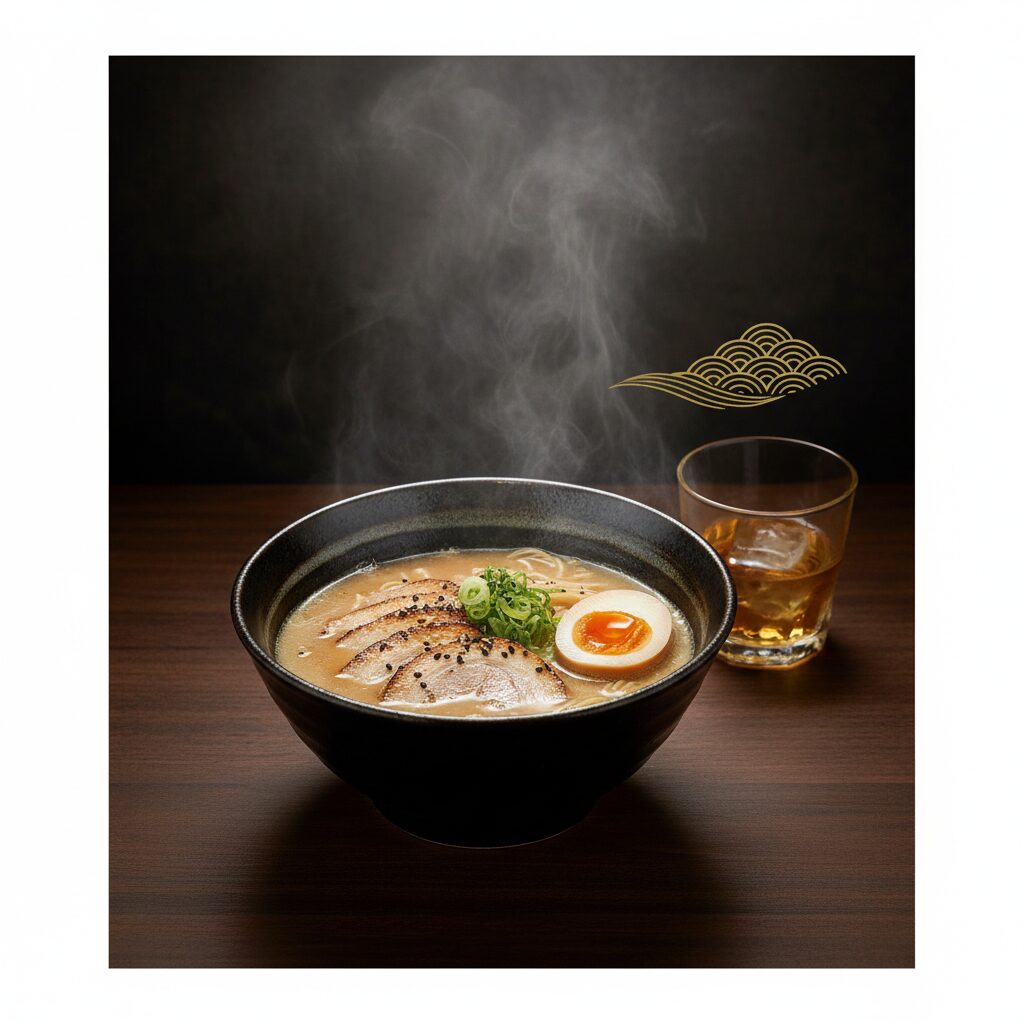
It’s a scene many travelers from the West find quietly unsettling. A bustling ramen shop, steam clouding the windows, the air thick with the scent of pork broth and toasted sesame. But inside, instead of boisterous groups, you see a row of single diners lining the counter, each person absorbed in their own world, their focus directed entirely into the bowl before them. There’s no awkward fumbling with a phone, no feigned busyness to ward off perceived judgment. There is only a quiet, deliberate, and seemingly complete contentment. In many parts of the world, eating alone in public is treated as a minor tragedy, a sign of social failure or loneliness. It’s something to be endured, not enjoyed. But in Japan, it’s something else entirely. It’s an art form, a cultural institution, and a deeply ingrained social norm known as hitorimeshi (一人飯), or “one-person meal.”
To understand hitorimeshi is to understand a fundamental aspect of the Japanese mindset. This isn’t about a nation of introverts or a breakdown of community. Far from it. This is about a society that has cultivated a profound respect for personal time, individual experience, and the sanctity of a well-made meal. Hitorimeshi is the active, conscious choice to dedicate a moment solely to the pleasure of eating, free from the obligations and distractions of social performance. It’s a testament to a culture that has designed its cities, its restaurants, and its social etiquette to not only accommodate the solo individual but to elevate their experience. For the curious traveler, looking past the tourist-brochure clichés, the world of solo dining offers one of the most honest and insightful windows into the real, everyday rhythm of Japan. It’s a practice that reveals how a society balances public and private life, community and individuality, noise and silence.
This respect for individual culinary focus extends even to the humble, yet deeply ritualistic, world of Japan’s instant noodle obsession.
The Cultural Roots: Why Solo Dining Thrives in Japan

To understand why hitorimeshi feels so natural in Japan, you first need to let go of the Western stigma around doing things alone. The cultural mindset is simply different. The solo diner isn’t seen as pitiable; rather, they are often viewed as a model of urban sophistication and self-reliance. This acceptance is deeply embedded in Japanese society, rooted in practical realities, social philosophies, and a profound respect for craftsmanship.
Beyond Loneliness: The Rise of the ‘Ohitorisama’
At the heart of hitorimeshi lies a broader, empowering idea: ohitorisama (お一人様). The suffix ‘-sama’ is an honorific, elevating ‘hitori’ (one person) to mean something like “the esteemed solo individual.” This is more than just a linguistic nuance; it represents a cultural shift that frames solitude as positive and aspirational. An ohitorisama is someone who confidently and happily does activities solo—be it watching a movie, going to karaoke, traveling, or most commonly, enjoying a meal. They are independent rather than isolated; self-assured rather than lonely.
This positive perspective is key. In the West, people might ask, “Who are you going with?” but in Japan, the question often shifts focus. It’s about the experience itself: Do you want to see this exhibit? Try that new restaurant? The “who” becomes secondary. If coordinating with friends is difficult or you simply want a personal moment, you go alone. This mindset alleviates the social pressure that elsewhere might keep people from going out solo. Ohitorisama culture is celebrated in magazines, TV dramas, and advertisements, reflecting a society where single-person households are increasingly common and independence is highly valued.
The Logic of Urban Life and Personal Space
Practicality plays a large role in why hitorimeshi is so widespread. In a megacity like Tokyo, daily life is a complex logistical challenge. Millions of people juggle long commutes and demanding work hours that rarely sync up with friends or partners. Waiting to arrange a group meal can mean missing the chance to eat or settling for a quick, unsatisfying snack from a convenience store. Hitorimeshi offers an elegant solution—it’s efficient, straightforward, and respects everyone’s time.
There’s also a deeper psychological aspect connected to personal space. Japanese cities are extremely dense; you’re never far from others—on trains, sidewalks, or in offices. This constant low-level social pressure fosters a strong need for psychological refuge, a personal “bubble” even in public. Eating alone grants that pause—a socially accepted moment to withdraw from the crowd and turn inward. It allows you to recharge, protected by an unspoken social understanding that ensures privacy. This relates to meiwaku o kakenai (迷惑をかけない), or “not causing trouble for others.” Often, it can feel more considerate to dine alone than to pressure a friend to fit your schedule or dietary needs.
A Legacy of Individual Craftsmanship
Perhaps the deepest cultural foundation of hitorimeshi is Japan’s admiration for the master craftsman, the shokunin (職人). Whether a sushi chef, ramen master, or tempura artisan, the creator is revered for lifelong dedication to perfecting their craft. The ideal dining experience here is a direct connection to that mastery. Socializing can feel like a distraction—a filter between you and the chef’s work.
Sitting at the counter, you are not just a customer but an audience. Dining alone lets you fully absorb the performance—the swift, precise knife skills of the sushi chef, the practiced flick of a tempura chef’s wrist, the rhythmic slurp in a ramen shop. The meal becomes a dialogue between you and the food, not between you and dining companions. Your undivided attention honors the shokunin’s skill. This elevates eating from a purely social act to an aesthetic, sensory experience, making the solo diner not an anomaly but the most focused and appreciative patron in the room.
The Architecture of Solitude: Designing for the Solo Diner
Japan’s acceptance of solo dining goes beyond a mere attitude; it is physically integrated into the environment. Restaurants are not only accepting of solo customers but are often explicitly designed to accommodate them, creating spaces that are comfortable, efficient, and even luxurious for individuals. The architecture itself communicates that eating alone is a normal and respected activity.
The Counter Seat: A Front-Row View of Culinary Performance
In the West, sitting at the bar or counter is often viewed as a consolation prize for those without a dining companion. In Japan, however, the counter seat is frequently the most prized spot in the restaurant. It forms the heart of the establishment, providing an intimate and engaging experience that private tables cannot match. This is especially true in places specializing in particular crafts, such as sushi, ramen, or tempura.
Sitting at the counter places you in the direct orbit of the chef. You get a front-row view of the craftsmanship. You see the raw ingredients, observe their transformation, and the finished dish is often placed before you by the person who made it, moments after its preparation. This proximity creates a unique connection. Although extended conversations are rare, a quiet and respectful dynamic develops. You can watch, learn, and appreciate the remarkable skill involved. The counter is designed for this focused interaction. Its narrow depth fosters intimacy, while the linear layout ensures each diner has their own defined personal space. It’s a cleverly designed system that encourages a communal yet individual appreciation.
The ‘Flavor Concentration Booth’: Ichiran Ramen’s Bold Innovation
No conversation about hitorimeshi is complete without mentioning Ichiran Ramen. This popular ramen chain pushed the concept of solo dining to its logical, and for some, radical extreme. They created what they call the “Flavor Concentration Booth.” Diners sit in individual stalls, separated by tall wooden partitions on each side. In front of you is a small window covered by a bamboo screen.
The process exemplifies streamlined, non-verbal communication. You fill out a form to customize every aspect of your ramen—the broth’s richness, the amount of garlic, the noodle firmness. You press a button, and a staff member’s hands appear through the window to collect your order. Minutes later, the screen lifts, a steaming bowl of ramen is placed before you, and the screen lowers again. You are left completely alone with your meal. All possible social distractions have been systematically removed. The company explicitly states that the goal is to allow you to focus fully on the taste of the ramen.
To an outsider, this might appear dystopian, like a human feedlot. But that interpretation misses the cultural context entirely. Ichiran’s system stems from the utmost respect for the food and the diner’s experience. It eliminates the pressure to engage socially, the self-consciousness of eating alone, and any other sensory distractions, creating a pure and uninterrupted dialogue between you and the bowl. It is hitorimeshi perfected as a science.
Subtle Design Details for Comfort
Beyond counters and booths, numerous subtle design elements in Japanese eateries make dining alone effortless. Small, single-person tables are typical and not tucked away in inconvenient corners. Baskets or boxes are often placed under chairs or counters to store belongings securely and keep them out of the way. Hooks for coats and bags are commonly provided. Many venues offer power outlets for charging devices, recognizing that a phone can serve as a quiet companion.
This thoughtful approach extends to the business models themselves. The emergence of hitori yakiniku (solo grilled meat) and hitori nabe (solo hot pot) restaurants highlights the market strength of the ohitorisama. These establishments provide smaller, individual grills and induction burners, enabling solo diners to enjoy meals traditionally reserved for groups. This ongoing innovation demonstrates that hitorimeshi is not a stagnant tradition but a vibrant and evolving aspect of Japan’s food culture.
The Rituals and Etiquette of Hitorimeshi
Like many facets of life in Japan, hitorimeshi is guided by a set of unwritten rules and rituals. It creates a subtle social harmony that enables a room full of strangers to share the space in peaceful solitude. Understanding this etiquette is essential to fully appreciating the experience and engaging in it respectfully as a traveler.
The Silent Agreement: Reading the Air (‘Kuuki wo Yomu’)
The most crucial skill in any Japanese social context is kuuki wo yomu (空気を読む), which literally means “reading the air.” It refers to the ability to sense unspoken social cues and the atmosphere of a situation, then respond appropriately. In the setting of hitorimeshi, this involves recognizing that you are part of a shared quiet. Although the room may not be completely silent—the sounds of chopsticks clinking, noodles being slurped, and the chef’s subtle instructions persist—it remains free from social distractions.
This implies you avoid loud phone calls, refrain from striking up unsolicited long conversations with nearby diners, don’t listen to music without headphones, and respect personal space and boundaries. This behavior is not about being cold or unfriendly; it represents honoring a silent contract with everyone present. By mutually committing to minimize social disturbances, a comfortable and focused environment is established for all. The outcome is a distinctive sense of community: individuals quietly engaged in the same solitary activity, together.
The Art of Mindful Observation and Appreciation
Freed from the pressure to converse, the solo diner can connect with their meal on a deeper sensory level. Hitorimeshi is fundamentally a mindful practice. You become aware of details you might otherwise overlook: the precise arrangement of pickles—moritsuke (盛り付け)—the texture of handmade soba noodles, the complex layers of flavors in the broth that you can savor with closed eyes.
This intensified observation is a form of active engagement. Your silent focus shows respect for the meal and its creator. The ritual begins with a quiet greeting upon arrival and concludes when you set down your chopsticks and say a sincere gochisousama deshita (ごちそうさまでした)—a phrase expressing gratitude for the meal, acknowledging everyone involved, from the farmer to the chef. This small closing gesture is an essential part of the experience, signifying that although you ate alone, you were part of a shared system of effort and appreciation.
Guidelines for Travelers: What to Do (and What Not to Do)
For visitors aiming to experience genuine hitorimeshi, the guidelines are straightforward and intuitive once you grasp the mindset behind them. First, release any self-consciousness; no one is judging you—in fact, hardly anyone is paying you attention. Embrace the freedom that comes with this anonymity.
When selecting a seat, be considerate of the space. If dining alone during a busy lunch hour, opt for the counter instead of occupying a four-person table. This is common courtesy and good manners. Respect the chef’s workspace and concentration. Unless the chef initiates conversation, keep your interactions brief and polite—a simple nod or a quiet “oishii” (delicious) suffices. Above all, mind your phone etiquette. Quietly scrolling is generally acceptable, but talking on the phone violates the unspoken contract. By following these simple practices, you move beyond being a tourist and become a respectful participant in the daily rhythm of Japanese life.
Hitorimeshi in the Modern Age: Beyond Convenience
While hitorimeshi has long-standing roots, it is not a fixed tradition. In the 21st century, it has continued to transform, becoming less about simple convenience and more a conscious lifestyle choice—a symbol of personal freedom and a powerful means of self-care in a fast-paced world. This transformation is evident in business, media, and the shifting demographics of those who choose to eat alone.
A Statement of Independence and Self-Care
Increasingly, hitorimeshi is embraced as a form of self-care. It signifies the freedom to eat exactly what you want, when you want, without compromise or negotiation. Craving to splurge on high-end sushi? You can, without having to justify the cost to anyone else. Want a greasy bowl of ramen at 10 PM? There’s no one to talk you out of it. This act of treating yourself on your own terms is a powerful assertion of independence, especially for women, who have traditionally faced more societal pressure to dine in groups.
This trend is supported by significant social and economic shifts. Japan, like many developed countries, has an increasing number of single-person households. People are marrying later, or not at all, shaping lives that are not defined by traditional family structures. For this group, hitorimeshi is not just an occasional activity but a daily reality, and businesses have responded with a wide range of high-quality options that go well beyond fast food.
The Influence of Media: From ‘Solitary Gourmet’ to YouTube
Popular media has played a major role in solidifying hitorimeshi’s image as a cool and desirable activity. The most influential example is the long-running manga and television series Kodoku no Gurume, or “Solitary Gourmet.” Its premise is simple: each episode follows a salesman, Goro Inogashira, as he travels for work, gets hungry, and finds a local, unpretentious restaurant to eat alone. The audience shares his rich inner monologue as he enthusiastically describes every detail of the food.
The show’s brilliance lies in validating and romanticizing the solo dining experience. Goro is not lonely; he is a free agent on a culinary journey. He finds pure, unfiltered joy in the simple act of eating a good meal by himself. The series became a cultural phenomenon, inspiring many Japanese people to seek their own “Solitary Gourmet” experiences and showing that a meal’s worth is found in the food itself, not in company. This spirit continues today in YouTube and social media, where solo food vloggers and mukbang artists draw huge audiences by focusing solely on the sensory experience of eating, further normalizing and celebrating the art of dining alone.
Ultimately, hitorimeshi is far more than a meal for one. It is a cultural practice that gracefully balances the tension between individual and collective life in one of the world’s most densely populated countries. It embodies a deep respect for craftsmanship, an appreciation for mindfulness, and a modern interpretation of independence. For travelers, embracing hitorimeshi is an opportunity to do more than just eat; it is an invitation to slow down, observe, and connect with the subtle, profound rhythms of Japanese culture on a deeply personal level. In its quiet way, it offers one of the most authentic experiences possible.