Yo, let’s talk about a feeling. You duck into a basement bar in a quiet Tokyo neighborhood like Ogikubo or Jimbocho to escape the summer heat. It’s dark. It smells like old wood, whiskey, and drip coffee. But before any of that registers, you feel it in your chest. The sound. It’s not just music playing; it’s a physical presence. It’s a John Coltrane sax solo so clear, so rich and warm, you feel like you could reach out and touch the bell of his horn. You look around. There are a few salarymen quietly nursing highballs, a student reading a book, and a bartender who moves with the slow, deliberate grace of a priest. And dominating the entire space, like a shrine at the heart of a temple, is the stereo system. It’s a beast. Towering horn speakers that look like they belong in a 1940s movie palace, and a rack of amplifiers glowing with the soft, alien light of vacuum tubes. You’re not in a bar that happens to have good music. You’ve stumbled into a temple of sound. And you’re left with one, massive question: Why? Why this insane level of dedication to audio in a random coffee shop or a tiny eight-seater bar? The answer is a one-word vibe check that explains so much about modern Japan: kodawari. It’s a word that doesn’t really have a clean English translation. It’s more than ‘craftsmanship’ or ‘attention to detail.’ It’s a personal, borderline-obsessive, deeply spiritual commitment to perfecting one’s chosen craft, no matter how niche. It’s the relentless pursuit of an ideal, and in this world, the ideal is sonic perfection. This isn’t just about having a killer playlist; it’s about engineering an entire atmosphere, a kuuki (air, or vibe), where the music is the main character. It’s a deep dive into a subculture that’s a full-on rebellion against the age of convenience, and honestly? It’s a whole mood.
This kodawari for sonic perfection is a key reason behind the enduring appeal and global vinyl boom of 80s Japanese City Pop.
The Kodawari Mindset: More Than Just a Hobby
To truly understand what’s happening in these audio temples, you need to rewire your brain. This isn’t about status in the way a luxury car or a designer watch might be. It’s an internal journey, a personal quest. The people running these places aren’t trying to show off. They’re on a mission from God, and God resides in the grooves of a first-pressing Blue Note jazz record. This mindset prioritizes the soul of the craft above all else—profit, efficiency, even accessibility. It’s the spirit of the shokunin, the master artisan, applied to turntables and tubes.
It’s Not About the Flex, It’s About the Quest
Consider this: in the West, high-end audio often feels like a conspicuous display of wealth. It’s about owning the biggest, most expensive gear to show off. In Japan, the atmosphere is entirely different. The owner of a legendary jazz kissa might operate a system worth hundreds of thousands of dollars, but the emphasis isn’t on the price tag. It’s on the outcome. It’s the belief that this particular combination of vintage speakers, a hand-built tube amp, and a finely tuned turntable is the one true path to recreating the sound of a specific moment in time. It’s a form of sonic archaeology. They aren’t just playing a recording; they’re striving to resurrect the spirit of the original performance. This is a philosophical pursuit, not a financial one. The satisfaction comes from the quiet, internal knowledge that you’re one step closer to perfection. It’s a journey without end. There’s always a new capacitor to try, a different cable to test, a subtle shift in speaker placement. The system is a living entity, a bonsai tree continually pruned and shaped in pursuit of an unattainable ideal. It’s a deeply personal expression, a lifetime’s work distilled into sound waves. That dedication is palpable when you walk in. It’s not for Instagram, it’s not for clout. It’s for the handful of people in the room, sharing a moment of pure, unfiltered sound. It’s a subtle flex, but the flex is about devotion, not dollars.
The Gospel of Inconvenience
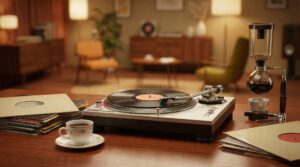
We live in a world designed for convenience. We summon food, cars, and content with a tap on a glass screen. Our music is an infinite, weightless stream from the cloud, compressed and convenient, ready to be blasted through tiny Bluetooth speakers. The Japanese audiophile scene is a radical, almost monastic rejection of this entire paradigm. It’s a deliberate choice for inconvenience, a belief that effort is part of the experience. Consider the process. The master doesn’t just tap a screen. He walks to a library of thousands of vinyl records, selects an album with the care of a scholar choosing a rare manuscript. He inspects the vinyl for dust, gives it a ritualistic cleaning with a velvet brush and special fluid. He carefully places it on the platter, cues the tonearm, and with the precision of a surgeon, lowers the diamond-tipped stylus into the groove. The whole room holds its breath for the soft crackle and pop before the music blooms into existence. Every step is a ceremony. This ritual demands presence. It elevates listening from a passive background activity to an active, focused engagement. It’s the polar opposite of having a Spotify playlist on while doing chores. This is the main event. This embrace of ‘inefficiency’ is a powerful cultural statement in a society otherwise obsessed with hyper-efficiency and optimization. It creates a sacred space where the goal isn’t to save time, but to spend it meaningfully, to get lost in the process and honor the music as it deserves.
The Anatomy of a Japanese Audiophile Haven
These spaces—whether called jazz kissa, meikyoku kissa (classical music cafes), or simply record bars—are more than just rooms equipped with excellent stereos. They are comprehensive environments meticulously crafted so that every detail serves the sound. From the equipment itself to the very walls, everything combines into a single vast instrument designed for immersive listening. Entering one feels like stepping inside a giant, perfectly tuned speaker cabinet.
The Gear: Altars to Audio Deities
Let’s begin with the hardware, as it’s impossible to overlook. These are not mere devices; they are works of art. You’ll find massive, stunning horn speakers from the mid-20th century, often from revered American brands like JBL, Altec Lansing, or Western Electric—brands that are almost holy relics of audio’s golden age in Japan. These speakers are considered historical artifacts, believed to carry a distinct ‘voice’ or ‘soul’ absent in modern gear. Then there are the amplifiers—the system’s heart—where Japanese kodawari is truly evident. Glowing racks filled with vacuum tube, or shinkuu-kan, amplifiers by legendary Japanese makers such as Shindo, Kondo, or Luxman adorn the space. These aren’t mass-produced devices; often hand-wired point-to-point by a single master craftsman. The philosophy: vacuum tubes deliver a warmer, richer, and more emotionally resonant sound than solid-state transistors. This is not a debate over technicalities, but one of aesthetics and spirit. The turntables are equally meticulous—heavy-plinthed giants from brands like Micro Seiki or bespoke pieces designed to eliminate vibration. Every component, down to the esoteric, hand-braided speaker cables and tiny, jewel-like phono cartridges, is selected with obsessive precision. This is a curated lifetime collection, an altar dedicated to the gods of audio.
The Space: The Womb of Sound
Owning top-tier gear is only part of the equation. In the realm of Japanese audiophiles, the room itself is a vital element of the system. The space’s acoustics are engineered with the same obsessive detail as the electronics. This goes far beyond hanging a few posters; it involves serious acoustic architecture. Many of these venues are located in basements for a reason: the surrounding earth provides natural soundproofing from city noise. Walls are often thick, solid concrete, creating a silent, black canvas upon which music can be painted. Inside, custom-built acoustic panels are strategically mounted on the walls and ceiling to absorb stray reflections or diffuse sound, preventing echoes and ensuring a crystal-clear sonic image. Listening chairs are not placed haphazardly; they are situated precisely at the ‘sweet spot’—the geometric point where sound from the left and right speakers blends perfectly. Even the lighting contributes to the ambiance—always dim, usually with just a few spotlights on the gear, minimizing visual distractions and directing all your focus to what you hear. The aim is to create an ideal listening environment—almost a sensory deprivation chamber for everything except sound. It is a womb for music, a protected sanctuary designed to facilitate the deepest connection with the performance.
The Master: The Sonic Sommelier
At the heart of this world is the owner—the ‘Master’. This person is far more than a bartender or shopkeeper; they are the curator, the guide, and the high priest of the ritual. They often possess encyclopedic knowledge of their chosen genre, whether bebop jazz, baroque classical, or ’70s rock. Don’t expect bubbly or chatty service. The Master is usually a figure of quiet, intense concentration. Their movements are deliberate and precise as they operate the system. They select the music, and here’s a key point: requests aren’t accepted. The playlist is the Master’s sermon. Albums are often played in their entirety, as the artist intended, with the dramatic flow and silent pauses between tracks intact. This is where the well-known ‘no talking’ or ‘quiet conversation only’ rule originates. To Westerners, it may feel intimidating or even rude, but it is essential to understand it from their perspective. It isn’t about being unfriendly; it’s about preserving collective respect for the experience. The music is the main event, and talking over it is like chatting loudly during a film or a church service—it breaks the spell. The Master guards that spell, ensuring everyone in the room shares a communal, meditative act of deep listening. They are the sonic sommelier, serving not a glass of wine, but a flawless, pure measure of sound.
The Cultural Roots: Why Here? Why This Obsession?

This entire phenomenon can seem quite unusual. Why did this highly dedicated, ritualistic listening culture take such strong root specifically in Japan? It’s no coincidence. It results from a unique convergence of traditional Japanese aesthetics, modern subcultures, and the social dynamics of urban life. It represents a contemporary expression of very old ideas. To understand it, you need to look beyond the speakers and into the cultural DNA.
‘Kata’: The Ritual is the Reality
In many traditional Japanese arts—from the tea ceremony (sadō) and flower arranging (ikebana) to martial arts (budō)—there is a central concept called kata. Kata means ‘form’ or ‘pattern.’ It consists of a series of prescribed, precise movements and procedures that one must master. To an outsider, it may appear rigid and repetitive. But the philosophy behind it is profound. The idea is that by perfecting the external form, you cultivate inner substance. The ritual isn’t just a means to an end; the ritual is the experience. The tea ceremony isn’t simply about making a tasty cup of matcha. The meticulous, step-by-step process is a form of moving meditation designed to foster harmony, respect, and tranquility. Now, consider the audiophile master cleaning a record and lowering the stylus. It’s pure kata. The ritual of handling physical media, warming up the amplifiers, and sitting in the sweet spot is not merely a fussy prelude to the music. It’s a discipline that tunes your mind and body, preparing you to receive the sound with heightened awareness and appreciation. The form creates the feeling. It’s a modern tea ceremony where the brew is a pristine audio signal.
The Otaku Gene: From Niche to Art Form
Let’s discuss the word otaku. In the West, it’s often translated as ‘nerd’ or ‘geek,’ but that doesn’t quite capture its essence. At its core, otaku culture is about a passionate, all-consuming deep dive into a specific, often niche, subject. It involves acquiring an encyclopedic, almost academic level of knowledge about something you love, whether it’s anime, idol groups, military history, or in this case, audio equipment. Japanese society, despite its emphasis on group harmony, shows remarkable tolerance and even respect for these deep-dive specializations. The audiophile is a kind of otaku. They obsess over minutiae that 99.9% of people would never notice. They debate the sonic characteristics of different brands of capacitors from the 1960s. They track down a particular German pressing of a Beatles album because it is known to have superior mastering. This isn’t simply a quirky hobby; it is recognized as a legitimate path of inquiry, a form of self-cultivation. This cultural acceptance of obsession is the fertile ground where kodawari flourishes. It grants people permission to go all-in, dedicating their lives to the pursuit of perfection in their chosen field, no matter how esoteric it may seem to outsiders.
The Sanctuary: Finding Stillness in the Chaos
There is also a vital social dimension to all of this. Japanese cities, especially Tokyo, are incredible, vibrant places, yet they are also dense, crowded, and often relentlessly stimulating. The social and professional spheres operate under immense pressure, emphasizing group responsibility and long working hours. In this context, the audiophile den fulfills a crucial role: it is a sanctuary. It acts as a third space, neither home nor work, where one can escape the pressures of the outside world. The strict rules, the subdued lighting, the focus on a single, all-encompassing sensory experience—this combination creates a recipe for urban meditation. It enables you to disconnect from daily anxieties and reconnect with yourself through music. The ‘no talking’ rule, seen in this light, becomes an act of collective care. It safeguards the sanctity of the space for everyone. It is a place where you can be alone, together. You share an intensely personal experience with a handful of strangers, united by silent understanding and a shared reverence for sound. It is a refuge of stillness and order carved out from the heart of urban chaos.
So, What’s the ‘Vibe’ Really About?
We’ve explored the equipment, the mindset, and the cultural foundations. But ultimately, it all comes down to that feeling— that ‘vibe.’ It’s an atmosphere so palpable you can almost feel it on your skin. It’s more than just the sum of its components. It’s a deliberately crafted reality shaped by sound, embodying a fundamentally different way of connecting with music and the spaces where we listen.
The Music Takes Center Stage
The most important shift in mindset is this: in a Japanese audiophile bar or kissa, the music is not mere background entertainment. It is the primary reason the establishment exists. In a typical Western cafe, music serves as wallpaper—something that fills the silence and creates a generic ‘chill’ ambiance conducive to conversation and work. Here, that dynamic is reversed. The coffee, the whiskey, the cozy seats—they all exist to serve the music. They play a supporting role. The main star is the sound emanating from the speakers. The ‘vibe’ is one of shared, focused reverence. You aren’t simply a customer in a transaction; you are part of a congregation in a secular church. The silence between tracks is charged with anticipation. The silent, collective nod when a stunning solo arises becomes a form of communication. This shift in perspective transforms listening from a solitary, passive activity into a communal, sacred ritual.
An Analog Embrace in a Digital Era
At its core, the vibe is about feeling. The audio from these vintage, tube-driven systems is often described as ‘warm,’ ‘rich,’ ‘three-dimensional,’ and ‘non-fatiguing.’ It possesses both a physical presence and emotional depth often missing in the thin, compressed, hyper-detailed world of digital sound. You don’t just hear the notes; you sense the texture of the upright bass, the resonance of the drumhead, the breath flowing through the singer’s lungs. It’s a fully immersive, whole-body experience. It’s an analog embrace. In an age dominated by screens and digital streams—ephemeral, intangible, and detached—this experience is boldly, defiantly real. It stands as proof of the power of the tangible. It declares that certain things are worth the effort, the cost, and the inconvenience. The ‘vibe’ of a Japanese audiophile sanctuary quietly and confidently affirms that in the quest for beauty, there are no shortcuts. It’s a sound so authentic and so pure, it feels like coming home.