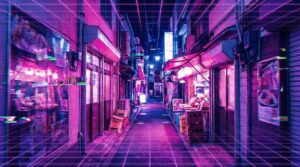
Yo, what’s up world? Ryo Kimura here. Let’s get real for a sec. You’ve probably scrolled past a million videos of Tokyo. You’ve seen the Shibuya Scramble, that human river flooding the streets, a total sensory overload. You’ve seen the neon-drenched canyons of Shinjuku, looking like something straight out of a sci-fi flick. That’s the Tokyo that gets plastered everywhere, the high-tech, hyper-efficient metropolis that runs on a level of precision that’s almost terrifying. It’s clean, it’s fast, it’s the future, right? It’s the brand.
But what if I told you there’s a pocket of Tokyo that completely ghosts that script? A place just a five-minute train ride from Shibuya that feels like it’s operating in a different dimension, on a different timeline. Welcome to Shimokitazawa, or ‘Shimokita’ as the real ones call it. When you step off the train here, the first thing that hits you isn’t the scale, it’s the lack of it. There are no skyscrapers piercing the clouds. No six-lane roads. Instead, you’re immediately swallowed by a labyrinth of narrow, winding streets, a tangled web of overhead power lines that look like a messy sketch against the sky, and the low, constant hum of something… creative. You hear the faint sound of a guitar riff bleeding from a basement, smell the rich aroma of third-wave coffee brewing in a tiny shopfront, and see fashion that looks less like it came off a runway and more like it was pieced together from different decades as a badge of honor.
This ain’t the high-tech, perfectly polished Japan from your feed. It feels gloriously messy, lived-in, a little bit dusty, and aggressively indie all at once. It’s a place where time seems to bend, where a Showa-era kissaten slinging melon sodas sits comfortably next to a punk rock record store, which is across from a high-concept art gallery. The vibe is less about orderly progression and more about a chaotic, beautiful collision of cultures and eras. It begs the question that so many visitors and even Tokyoites ask themselves: why is this place like this? How, in the middle of one of the most developed cities on the planet, did this neighborhood become the undisputed capital of Tokyo’s counter-culture, a sanctuary for the misfits, artists, and dreamers? It’s not an accident. It’s a story of failed city planning, cheap rent, and a rebellious spirit that refused to be paved over. Let’s dive deep and decode the glorious mess that is Shimokitazawa.
If you’re intrigued by Tokyo’s unique urban spaces, you might also enjoy exploring Shibuya’s Miyashita Park to see another unconventional take on city life.
The Blueprint of Chaos: Why Shimokita Looks Like a Maze
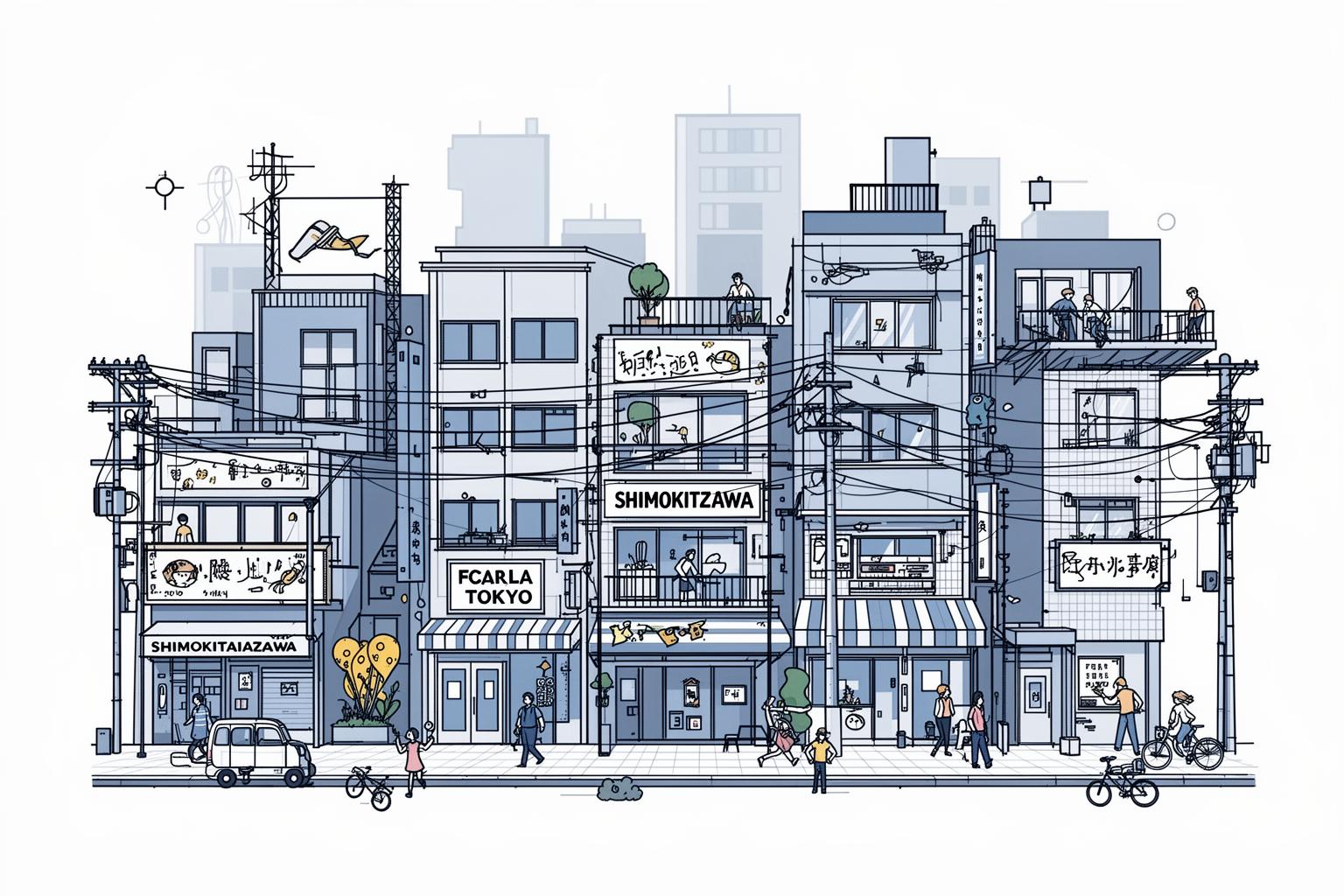
To understand why Shimokita feels the way it does, you need to examine its foundation—the streets themselves. Unlike much of central Tokyo, which was either carefully planned or completely flattened during World War II and rebuilt on a grid, Shimokitazawa’s layout is pure, unfiltered chaos. And that chaos is its secret ingredient. It wasn’t meant to become a trendy hotspot; in fact, its current appeal stems directly from being overlooked and, in many ways, a failure of modern urban development.
A Post-War Relic
Before Tokyo expanded to engulf everything around it, this area was simply farmland, part of the rural outskirts of Setagaya. The “roads” were little more than dirt paths winding through rice paddies and vegetable fields, shaped by the land’s natural contours. They were built for people on foot or pushing carts, not for cars. When the Odakyu and Keio Inokashira train lines were established in the 1920s and 30s, a station was placed here, and a small town gradually took shape. But it grew naturally, with houses and shops emerging along those same old farm lanes.
Then came the war. While major commercial and industrial hubs like Shinjuku, Shibuya, and Ginza were destroyed by firebombing raids, Shimokitazawa largely escaped damage. This is crucial. The destruction elsewhere triggered massive post-war rebuilding projects, offering a chance to start fresh with wider roads, bigger buildings, and a more “modern” cityscape. Shimokita never received that reset. It retained its pre-war, agricultural footprint. After the war, its closeness to the rapidly growing Shibuya, combined with its relative intactness, made it an ideal location for black markets, or `yami-ichi`. These were spontaneous, unregulated markets where people traded scarce goods. This established the core DNA of Shimokita: a place of informal, independent trade, operating outside the confines of mainstream economic systems. The spirit of those markets, with people carving out small spaces to pursue their own ventures, is the direct ancestor of the thousands of tiny, independent shops you see today.
The Streets That Said “No” to Big Business
The real story, the reason Shimokita remains Shimokita, is about the roads. For decades, city planners in Setagaya Ward attempted to “fix” the neighborhood. They drafted ambitious plans to tear down the winding alleys and replace them with a grid of wide streets designed for cars and modern development. But they failed. Every single time. The obstacles were legal complexity and local opposition. The land plots were minuscule and owned by a bewildering number of different individuals. Getting unanimous agreement to sell was a bureaucratic nightmare. The community, fiercely independent, had little desire to see their human-scale neighborhood transformed into another generic suburb.
This “failure” of urban planning turned out to be a blessing in disguise. The narrow streets, impassable to large trucks, formed a natural barrier against big corporations. Major fashion chains like Uniqlo or H&M, or huge electronics retailers like Bic Camera, couldn’t just move in here. Their business models depend on large floor spaces, easy truck access for deliveries, and prominent locations on major roads. Shimokita lacked all of that. Instead, it offered countless tiny, affordable storefronts along pedestrian-only alleys. This physical limitation fostered an economic ecosystem where only small, independent businesses could flourish. The labyrinthine layout wasn’t a defect to be fixed; it became a fortress preserving the neighborhood’s unique character. It demanded a different kind of experience—one based on walking, getting lost, and unexpected discovery. You don’t drive to Shimokita; you dive into it. And by doing so, you engage in a culture born from the very streets beneath your feet.
The Soul of the Counter-Culture: More Than Just Second-Hand Clothes
So, you have this physically isolated, economically distinct pocket in Tokyo—a place with cheap rent because big money couldn’t penetrate it. Who does that draw in? It attracts those with more creativity than cash. Beginning in the 1960s and booming in the ’70s and ’80s, Shimokitazawa became a magnet for Japan’s youthquake—the students, artists, writers, musicians, and actors seeking an affordable place to live and create freely, far from the strict expectations of mainstream Japanese society.
From Farmland to Freedom Land
The 1970s in Japan was a period of immense cultural energy and social change. University students were protesting, artists experimenting, and a vibrant counterculture was emerging. These young people needed a physical space to gather, live, and perform. Shimokita, with its low-rise wooden apartments (`mokuzo apato`) and affordable rents, became that sanctuary. It was close enough to the hustle of Shinjuku and Shibuya but worlds apart in atmosphere and cost. At first, it was a practical choice—a cheap place to live—but it rapidly grew into a cultural hub. A community of like-minded individuals began to form, creating a self-sustaining ecosystem of creativity. If you were in a band, your neighbor was probably a stage actor, and the person who served your coffee was a budding filmmaker. This concentration of artistic energy created a strong gravitational pull, cementing Shimokita’s reputation as the heart of Tokyo’s youth culture.
The Holy Trinity: Music, Theater, and Fashion
This creative surge manifested in three central pillars that continue to define Shimokita’s identity today. These elements are interconnected, each fueling the others, weaving a vibrant cultural tapestry.
First, there is theater—not the grand, Kabuki-za style or the polished musicals of commercial districts. Shimokita became the epicenter of `Angura` theater—literally “underground” theater—a movement of small, experimental, and often politically charged performances. The legendary Honda Gekijo, which opened in 1982, became its most famous stage, but the true spirit of Shimokita theater lives in the dozens of tiny, black-box venues known as `hako` (boxes), usually seating just 30 or 40 people. This fostered an intimate and raw performance culture, valuing creative freedom over commercial success. Walking around Shimokita today, you’ll still see posters for a dizzying array of tiny productions, a testament to this enduring legacy.
Second, music. Alongside the theater scene, Shimokita turned into a haven for live music—not large arenas but `raibu hausu` (live houses)—small, often underground venues where the boundary between band and audience nearly disappears. Legendary spots like Shelter, Garage, and Three became breeding grounds for generations of Japanese indie rock, punk, and alternative bands. For countless musicians, playing a gig in Shimokita was—and remains—a rite of passage. The neighborhood’s air is thick with the history of bands who started out in these cramped basements before hitting it big, and the promise of the next great band playing to a handful of people tonight.
It’s Not ‘Vintage,’ It’s a Statement
Lastly, and perhaps most visibly, there’s fashion. Shimokitazawa is synonymous with `furugi`, or second-hand clothing. But to truly understand Shimokita, you must realize this goes beyond thrift shopping. The vintage clothing scene here is a vital part of the neighborhood’s philosophy. It developed as a powerful form of self-expression—a rebellion against the rigid conformity of Japanese society, exemplified by the ubiquitous dark suits of the `salaryman`. It was also a practical way for cash-strapped creatives to build a unique wardrobe.
Over the years, this has evolved into a highly sophisticated, curated culture. A Shimokita vintage store is not just a random assortment of old clothes. Each shop has a distinct identity and specialty. One might focus exclusively on 1960s American military surplus; another might specialize in brightly colored 1980s European sportswear; a third could be a treasure trove of perfectly preserved 1990s designer pieces. Shop owners are obsessive curators, often traveling worldwide to carefully source their items. For shoppers here, assembling an outfit is an art—a blend of historical knowledge, personal style, and the thrill of the hunt. It’s a rejection of fast fashion and mass-produced trends in favor of items with history, character, and story. This ethos perfectly embodies Shimokita itself: valuing the old, the unique, and the authentic over the new, the shiny, and the mass-marketed.
The ‘Shimokita Vibe’ Decoded: Community Over Commerce
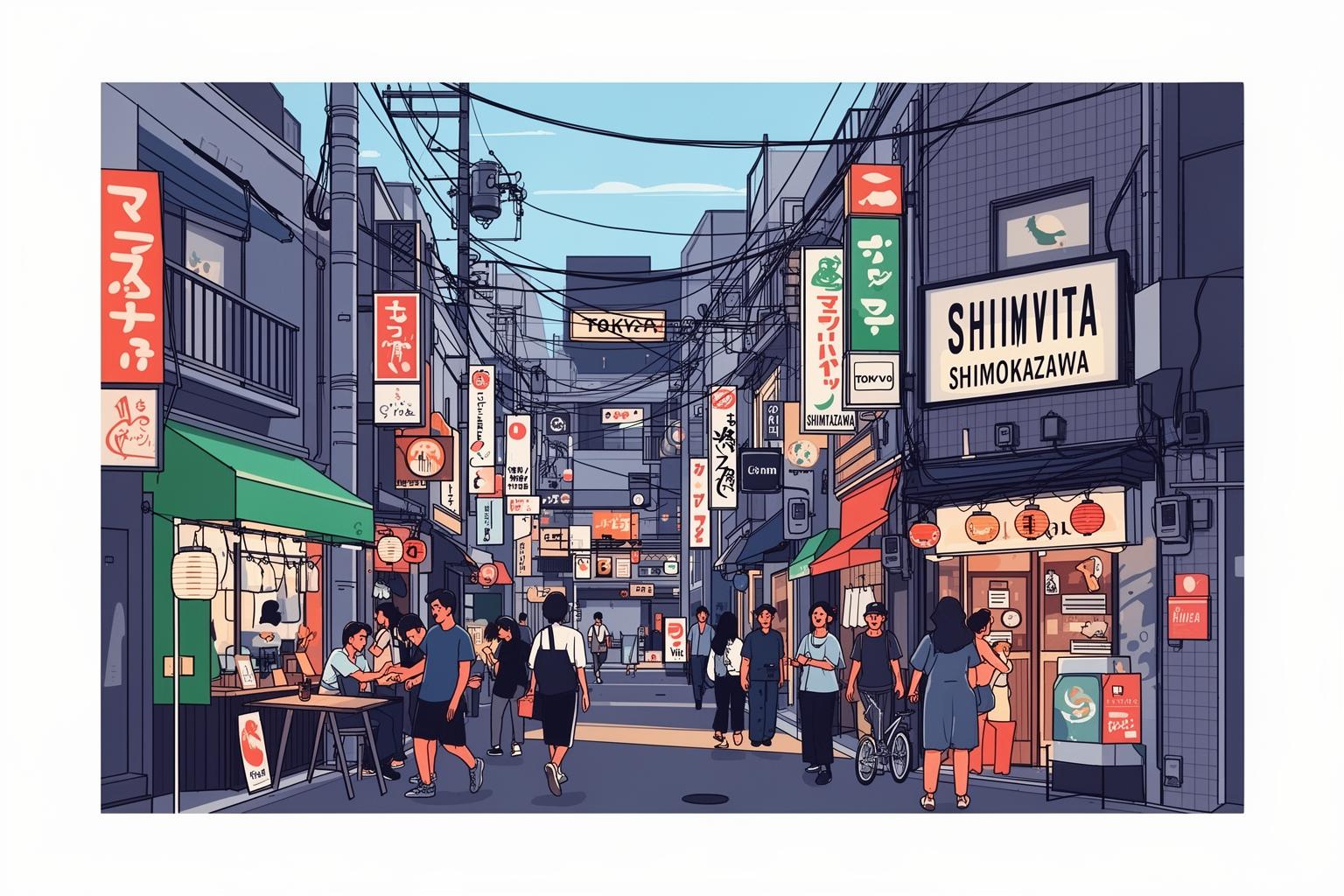
So, we have the history and the cultural pillars, but that alone doesn’t fully capture the essence—the intangible ‘vibe’ of the place. Why does simply hanging out in Shimokita feel so fundamentally different from anywhere else in Tokyo? It boils down to a culture that values community and experience over efficiency and commerce.
The Art of ‘Hanging Out’
Most Tokyo neighborhoods are designed with a purpose. You go to Ginza to shop at department stores. You go to Marunouchi to work in offices. You go to Shibuya to meet friends at a specific landmark before heading to a predetermined destination. These areas prioritize efficiency, moving people seamlessly from Point A to Point B. Shimokitazawa, however, is the complete opposite. Its maze-like layout actively discourages efficiency. There’s no “main street” to dominate, no singular place defining the neighborhood. The whole point of being in Shimokita is to get lost. The activity lies in aimless wandering—drifting through narrow alleys with no particular goal, only to stumble upon a hidden coffee stand, a tiny independent bookstore, or a gallery converted from a garage. This encourages a slower, more mindful way to experience the city. The pleasure isn’t in arriving; it’s in the process of discovery. This culture of ‘just chilling’ (`burabura suru`) is woven into the neighborhood’s physical form. It’s a space made for loitering, sitting on park benches, spending hours in a cafe with a book. It’s an environment that grants you the freedom of having no plans.
Where Your Barista is Also in a Band
This laid-back, creative vibe is intensified by the people who inhabit it. Shimokita exists on a human scale. The shops are small, the restaurants intimate, the theaters modest. As a result, you’re constantly engaging with the owners, creators, and artists themselves. The person making your latte isn’t a corporate employee in uniform; they’re likely a musician trying to pay rent, a designer selling their own creations on the side, or an actor rehearsing for a play at night. There’s a blurring of boundaries between work, art, and life that’s rare in Japan’s traditionally segmented work culture.
This fosters a strong sense of a shared ecosystem. When you buy a vintage shirt or a cup of coffee, you’re not just completing a transaction—you’re directly supporting an individual’s creative endeavors. You’re contributing to the very culture that makes the neighborhood unique. This builds a profound sense of community and mutual support. People aren’t in Shimokita just for a job; they stay because they’re part of a scene, a tribe. This authenticity is the neighborhood’s lifeblood. It’s a community built on shared passions, not merely shared geography. And that feeling is impossible to replicate, no matter how much money is poured into a new development.
The New Wave vs. The Old Guard: Gentrification Hits Tokyo’s Indie Heart
For decades, Shimokitazawa’s chaotic charm was safeguarded by its inconvenient layout and the noisy, ground-level Odakyu Line tracks that literally cut the neighborhood in half, causing frustratingly long waits at railway crossings. But that protection has now disappeared. In a massive, multi-decade engineering effort, the tracks were relocated deep underground. Suddenly, a large, valuable strip of land running through the heart of Shimokita—the `senrogai`, or ‘former track area’—became available for development. This was the moment every Shimokita purist had feared. Developers arrived, bringing with them the inevitable wave of gentrification.
Reload, Mikan, and the Clean-Up Crew
The transformation of the old track lands has been swift and dramatic, highlighting a stark contrast between the old Shimokita and the new. Right next to the station, facilities like Mikan Shimokita have emerged—a clean, orderly complex built beneath the elevated Inokashira Line tracks, hosting trendy chain restaurants, co-working spaces, and a sleek Tsutaya bookstore. It is convenient, well-lit, and completely devoid of the chaotic energy found in the `shotengai` (traditional shopping arcades) just a few steps away.
Further along the old tracks lies Reload, a subtler effort to preserve Shimokita’s spirit. This low-rise complex of stark-white buildings houses a curated mix of independent, high-concept shops—a boutique curry restaurant, a specialty coffee roaster, and a vintage eyewear store. The architecture is designed to encourage wandering between shops, echoing the discovery experience of the old alleyways. It is visually appealing, highly Instagrammable, and meticulously planned—an architectural simulation of the organic chaos it replaced.
These new developments, alongside others like Tefu Lounge, represent a fresh vision for Shimokita: cleaner, more accessible, better organized, and more commercially viable. Undeniably, they have injected new life and investment into the area, addressing the longstanding issue of the community being split by the tracks.
Is the “Real” Shimokita Disappearing?
This leads to the existential question looming over the neighborhood today: Is Shimokitazawa losing its soul? The debate is fierce in local bars, online forums, and the minds of those who cherished the area’s pre-gentrification grit. Both sides of the argument have valid points.
Supporters of the new developments emphasize evolution and accessibility. The old Shimokita could be intimidating, grimy, and hard to navigate. The new spaces are clean, safe, and welcoming to families and tourists, attracting fresh audiences and economic vitality. Some businesses housed within are genuinely independent and cool. Proponents argue that cities must evolve or fade away, and this is simply Shimokita’s next chapter.
Conversely, critics present a powerful, deeply felt counterpoint. They view these developments as sanitization, a “Disneyfication” of a truly raw, authentic culture. The uniform architecture, though stylish, lacks the messy, layered history embodied by the old buildings. Higher rents inevitably raise the barriers for the next generation of struggling artists and broke musicians who were the lifeblood of the old Shimokita. They fear the neighborhood is being transformed from a living, breathing community into a trendy lifestyle backdrop—a cool stage set for consumption rather than a messy studio for creation.
The Spirit Endures… For Now
So, what’s the verdict? The reality is, Shimokitazawa exists in a fascinating state of tension. It is two neighborhoods coexisting in the same space. One can stroll along the clean, curated paths of Reload, then, by taking a single turn, find themselves in a dark, narrow alleyway unchanged since 1985, leading to a basement live house with peeling paint on the walls. The old guard and the new wave live side by side. The polished, commercialized version of “indie” culture sits right next to the real, gritty scene.
The soul of Shimokitazawa hasn’t been entirely extinguished. It has been pushed into the smaller cracks—the backstreets, upper floors, and basements. The spirit of rebellion and creativity remains, now perhaps with a new adversary to unite against: the threat of becoming too polished for its own good. Shimokita’s story is no longer just about its past; it is about the ongoing struggle for its future. And that very conflict, the visible friction between the authentic and the curated, is what makes it one of Tokyo’s most compelling and culturally significant neighborhoods to explore today.