What’s good? Hiroshi Tanaka here. So you’ve seen it, right? The shot. The iconic railway crossing, the old-school green train trundling past, a blue, sparkling ocean in the background, and maybe some high school kid with a book bag staring out at the sea, looking like the main character of, well, everything. That’s Shonan. Or, at least, that’s the Shonan that’s been beamed into your brain through a million anime OPs, City Pop album covers, and Instagram posts. It’s the vibe of an endless summer, a sun-drenched escape just a stone’s throw from the concrete chaos of Tokyo. It’s Japan’s very own California dream, bottled and sold as a two-hour train ride. But here’s the real question, the one that probably brought you here: Is any of it legit? When you step off that train, do you actually land in a Tatsuro Yamashita song, or is it just another crowded beach with a really good PR team? The deal is, Shonan isn’t just a place. It’s an idea, a massive cultural mood board where Japan has projected its fantasies of freedom, youth, and a different way of life for, like, almost a century. It’s where the high-pressure salaryman life hits the brakes and stares at the horizon. It’s a carefully constructed aesthetic, a blend of borrowed American cool and a deep-seated Japanese yearning for a moment of perfect, breezy nostalgia. This isn’t a guide on where to get the best shave ice. Nah, we’re going deeper. We’re gonna unpack the whole myth. We’ll look at why this specific stretch of coast became the backdrop for the nation’s daydreams, how music and animation turned it into a pilgrimage site for fictional memories, and what you actually find when you get there, beyond the filters and the hype. We’re separating the vibe from the reality, to get to the truth of Japan’s most iconic shore. It’s a whole mood, for real.
To truly embody this coastal aesthetic, consider how scoring the perfect retro van could complete your own Shonan adventure.
The “Aitai” Feeling: What Shonan Represents in the Japanese Psyche
To truly understand Shonan, you first have to understand Tokyo. Imagine the morning crush on the Yamanote Line, so packed you can’t even reach your phone. The endless gray buildings, the unspoken rules of behavior on the street, in the office, everywhere. Tokyo is a city driven by precision, politeness, and an overwhelming sense of collective responsibility. It’s impressive and efficient, but it can wear you down. The Japanese psyche is shaped by the tension between the group (tatemae, the public face) and the individual (honne, the true feelings). Tokyo is the ultimate stage for tatemae. Shonan, by contrast, is where you go to reconnect with your honne. It embodies a primal urge to just… breathe out. This feeling has a name, somewhat—it’s tied to the word aitai, meaning “I want to meet you,” but often used in songs and media to express a deeper, more abstract longing for a person, place, or feeling. Shonan is the physical expression of that aitai feeling for freedom.
The Tokyo Escape Fantasy
This escape fantasy isn’t new. For decades, Shonan has served as the pressure-release valve for the Kanto region. Why? Because proximity matters. It’s far enough to feel like a trip, yet close enough to do on a whim. You could be working at your desk in Shinjuku at 3 PM and watching the sunset over Enoshima by 5 PM if you wanted. That accessibility is key. It makes the fantasy tangible. It’s not some distant dream of a vacation in Hawaii; it’s a real, doable escape plan you can keep in your back pocket when the city overwhelms you. This idea ties into a fringe yet influential concept in Japanese work culture: datsusara. It literally means “escaping the salaryman life.” While most people don’t follow through, the dream of quitting the corporate grind, moving by the sea, and opening a small café or surf shop is a powerful national fantasy. Shonan is the capital of that fantasy. You see it everywhere—the beacheside bars run by guys who clearly once wore suits, the art galleries, the yoga studios. These are symbols of a different path, a life measured by tides rather than train timetables. For the millions who can’t or won’t make that leap, a weekend trip to Shonan is the next best thing. It’s a temporary immersion in the dream, a chance to play the role of the person who escaped. You rent a board even if you can’t stand on it, sip a beer on the beach at 2 PM, wear clothes you’d never wear in Shibuya. You’re performing a version of freedom, and for 48 hours, that act feels real enough to recharge you for another month in the urban grind.
A Borrowed Dream: The American West Coast Influence
The vibe Shonan projects wasn’t born in Japan. It was imported, remixed, and perfected. After World War II, American culture swept over Japan like a tidal wave, hitting the Miura and Shonan peninsulas first and hardest. The massive U.S. naval base at Yokosuka, right next door, was ground zero. It served as a direct pipeline of American music, fashion, food, and, most importantly, attitude. GIs cruising in big American cars, listening to rock and roll on the radio—this was a vision of a carefree, rebellious, impossibly cool world to a generation of Japanese kids growing up in a rigid, recovering society. This is where the roots of the Shonan aesthetic were planted. It began with the Taiyo-zoku or “Sun Tribe” in the mid-1950s, a youth subculture of wealthy kids who imitated this rebellious, sun-and-sin lifestyle in Shonan, famously captured in a scandalous novel by Shintaro Ishihara. They were controversial, but they cemented the link between Shonan, youth, and breaking from tradition. Then surf culture arrived. The Beach Boys, Gidget, the whole California package. Japanese youth encountered this lifestyle through magazines and movies and wanted a piece of it. Shonan had the waves—not great ones, but waves nonetheless—and it became the birthplace of Japanese surfing. Early pioneers adapted the style, shaping their own boards and founding clubs. They weren’t just copying; they were translating. They took the raw materials of American beach culture and filtered them through a Japanese lens, adding craftsmanship, community, and a certain coastal melancholy. The iconic blue and white sign for Route 134, the main coastal highway, became a symbol of this adopted dream—Japan’s Pacific Coast Highway. Driving that road with the window down and the right music playing was the closest you could get to a California dream without leaving the country.
The City Pop Soundtrack: Crafting the Shonan Vibe
If Shonan were a movie, then City Pop would be its unmistakable soundtrack. This genre, which thrived during Japan’s bubble economy in the late ’70s and ’80s, is inherently tied to the Shonan aesthetic. They are inseparable. The music—a polished, sophisticated blend of soft rock, funk, and jazz—embodied aspiration. It was the sound of economic prosperity, reflecting a Japan no longer merely catching up with the West but forging its own distinctive modern cool. A major element of that image was leisure. City Pop was crafted for a lifestyle most people didn’t actually live but deeply desired: lounging beside a shimmering pool, cruising in a convertible with the top down at midnight, or, naturally, driving along a coastal highway on a flawless summer afternoon. Shonan was the default backdrop for that final daydream.
Music for a Fantasy Drive
Listen to the icons of the genre. Tatsuro Yamashita’s album For You even features a track titled “Loveland, Island.” Toshiki Kadomatsu’s After 5 Clash perfectly captures the mood of leaving the office and heading for the coast. Anri’s “Last Summer Whisper” evokes pure sunset-beach nostalgia. These artists, and many others, weren’t just composing songs; they were crafting worlds. Their lyrics overflowed with images of summer, the sea, dolphins, cocktails, and the bittersweet feeling of fleeting romance under the sun. They were selling a dream package, and Shonan coast was the box it came in. The music was designed for the car stereo. The crisp production, rolling basslines, and breezy saxophone solos all sound best when you’re in motion, watching sunlight dance on the water. Route 134 is sacred ground for this experience. Even now, people drive the stretch from Zushi to Kugenuma Beach with a City Pop playlist blaring. It’s a ritual. But there’s an important subtlety often lost in the West’s rediscovery of the genre. This isn’t just lighthearted music. Beneath that easy optimism lies a uniquely Japanese melancholy, a sense of mono no aware—a gentle sadness for the fleeting nature of things. The perfect summer day is beautiful precisely because it must end. The romance is sweet because it’s temporary. City Pop expresses not only the joy of fantasy but also the quiet ache of knowing it’s just a fantasy. That’s why it resonates so deeply. It’s the sound of yearning for something just out of reach, the very core of the Shonan escape.
Eizin Suzuki’s Hyper-Real Americana
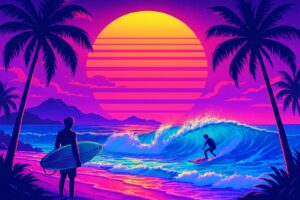
You can’t discuss the City Pop aesthetic without mentioning Eizin Suzuki. If Yamashita and his contemporaries created the soundtrack, Suzuki was the artist behind the album covers and posters. His work is the visual language of the era, inseparably connected to Shonan. His style is distinctive: clean lines, vibrant pastels, and an idealized vision of American-style leisure. He painted classic cars, seaside diners, palm trees, and endless blue skies. His scenes often feature faceless figures, inviting viewers to imagine themselves within the frame. Interestingly, his paintings weren’t realistic portrayals of Shonan but exaggerated, borrowed fantasies. He took the Californian dream and cranked the saturation to eleven. He depicted a Shonan that was cleaner, brighter, and more American than reality. Then something curious happened: reality began to imitate art. People who saw Suzuki’s images on album covers and in magazines traveled to Shonan in search of that world. In response, Shonan businesses adapted to meet those expectations. Cafés styled themselves like American diners. Surf shops adopted pastel palettes. Palm trees were planted in greater numbers. The fantasy—crafted visually by Suzuki and sonically by City Pop—began to reshape the actual landscape. It’s a fascinating cycle where an idealized image of a place becomes so powerful that the place itself starts to mirror that image. Today, visiting Shonan means walking through a landscape that is, in part, a physical realization of an ’80s pop-art dream. You see the real place filtered through the lens of the fantasy it helped to create.
Anime’s Endless Summer: From Slam Dunk to Rascal Does Not Dream of Bunny Girl Senpai
If City Pop and Eizin Suzuki created the foundational myth of Shonan in the 80s, anime took that myth and propelled it into a global phenomenon during the 90s and beyond. The area, with its unique combination of scenic beauty, iconic transportation, and nostalgic atmosphere, proved to be the ideal backdrop for stories about youth, romance, and the challenges of growing up. It became the go-to setting for life stories needing a backdrop of sparkling sea and wistful train rides. Through anime, millions around the world who had never heard of Kanagawa Prefecture developed a profound, nostalgic connection to its landscapes. They have imagined riding the Enoden line countless times long before ever visiting Japan.
The Kamakurakokomae Crossing: A Pilgrimage Site for a Fictional Memory
No better example exists of this phenomenon than the railway crossing near Kamakurakokomae Station. To non-anime fans, it’s just a crossing—pleasant, but nothing special. For fans of the iconic basketball manga and anime Slam Dunk, it is Mecca. It’s the setting of one of the most memorable opening sequences in anime history: a simple, poignant shot of the protagonist, Hanamichi Sakuragi, watching the Enoden train pass, revealing his love interest Haruko on the opposite side, with the brilliant blue of Sagami Bay behind them. That brief moment captures so much—unrequited love, the promise of youth, the beauty of an ordinary day—and has transformed this unremarkable piece of public infrastructure into a major tourist attraction. On any given day, crowds from across Asia and increasingly from around the world gather, waiting for the green train to pass so they can snap the exact same shot. This exemplifies seichi junrei, or “sacred site pilgrimage,” where fans visit real-life locations featured in their favorite anime. What’s remarkable about the Slam Dunk crossing is that visitors aren’t merely going to a place; they’re trying to recapture a feeling, chasing a manufactured memory. The power of that scene isn’t about basketball—it’s about a universal idea deeply rooted in Japanese culture: seishun. Often translated as “youth,” seishun is more precise—it refers to the “blue spring” of life, a period marked by intense emotions, friendships, struggles, and fleeting beauty, typically centered around high school. The crossing scene embodies peak seishun. The train symbolizes time’s relentless forward motion, while the characters and the endless ocean capture a perfect, timeless moment. By visiting the crossing, fans make a pilgrimage to the heart of that nostalgic ideal.
Beyond the Hype: The “Real” Shonan Life in Anime
While Slam Dunk put Shonan on the global stage, many other anime explore the area with greater nuance and depth, revealing a side less about iconic imagery and more about the texture of everyday life. Shows like Rascal Does Not Dream of Bunny Girl Senpai utilize the entire Shonan region, from Fujisawa to Enoshima, treating it almost as a character itself. The protagonists’ struggles with bizarre, supernatural events are grounded in the mundane realities of commuting on the Enoden, studying at the Fujisawa library, and relaxing on Kugenuma Beach. The setting is more than a pretty backdrop; its specific locations are integral to the story. Similarly, Tsuritama, a charmingly quirky series about fishing and aliens, unfolds entirely on Enoshima Island. It lovingly portrays the island’s narrow streets, numerous cats, fishing docks, and distinctive community feel—capturing the essence of a place that is both a major tourist spot and a small, tight-knit town. Even darker series like Elfen Lied use Kamakura’s beaches and temples to provide a stark, ironic contrast to their brutal and tragic narratives. Together, these and other anime create a composite portrait of Shonan, showing it as multifaceted: the grand historical sites of Kamakura, the bustling tourist energy of Enoshima, the quiet residential streets of Fujisawa, and the expansive beaches that link them all. The Enoden train line serves as the narrative thread weaving these elements into a cohesive whole. Watching these shows, one gains a sense of the area’s rhythm of life—the way each distinct town flows seamlessly into the next, crafting a world that feels both magical and authentically lived-in.
The Reality Check: What is Shonan Actually Like?
Alright, so we’ve thoroughly explored the myth, the music, and the media. We’ve encountered the hyper-real fantasy of City Pop and the nostalgic allure of anime. But now, let’s get to the ground truth. What do you actually encounter when you step off the train at Kamakura or Fujisawa and head towards the coast? The first thing you’ll likely notice, especially on a summer weekend, is the crowds. Many of them. The dream of a peaceful, reflective stroll along the beach often remains just that—a dream. The reality is that Shonan is one of the most popular day-trip spots for the 30 million people living in the greater Tokyo area. Its beaches can be awash with colorful umbrellas, the narrow roads clogged with traffic, and lines for popular restaurants stretching down the block. This is the reality of the “accessible escape”: you’re escaping, but so are hundreds of thousands of others.
It’s Not Always Sunny
Let’s also consider the water. The image is of a sparkling, azure sea. The reality is… the Pacific Ocean near a major city. The sand is volcanic and greyish, not white and powdery. The water quality is fine for swimming, but it’s not the crystal-clear turquoise of Okinawa or the Caribbean. It’s often murky green or grey. And the weather can be unpredictable. The classic Shonan image is a crisp, sunny day with Mt. Fuji visible in the distance. That does happen, especially in winter. But Japan’s summers are notoriously hot and oppressively humid, often wrapped in a white-grey haze that obscures Fuji. The rainy season in June can bring weeks of drizzle. The reality is that the postcard-perfect day captured by Eizin Suzuki is the exception, not the norm. Expecting it sets you up for disappointment. The traffic on Route 134, the iconic City Pop highway, serves as another dose of reality. On weekends, it can become a parking lot. The fantasy of cruising down the coast in a convertible often turns into a slow, frustrating crawl. This isn’t criticism—just a necessary recalibration of expectations. The fantasy is a highlight reel; the reality includes traffic jams, crowds, and overcast days, much like anywhere else.
A Patchwork of Towns, Not a Monolith
The biggest misconception is viewing “Shonan” as one single place with a unified vibe. It isn’t. It’s a patchwork quilt of distinct towns, each with its own character, history, and social scene. Grasping this is essential to understanding the real Shonan.
Kamakura: The Old Capital Meets New Cool
Kamakura is the historical core of the region. It was the seat of Japan’s first shogunate and is rich in history. There’s the Great Buddha (Daibutsu), Hasedera Temple, Tsurugaoka Hachimangu Shrine… it’s a world-class historical destination. Yet it’s also a beach town, creating a unique fusion. You’ll see surfers carrying boards strolling past ancient Zen temples. The main shopping street, Komachi-dori, offers a chaotic mix of traditional rice cracker shops, trendy organic cafes, and souvenir stalls. Kamakura feels more established and refined, with a touch of “old money” mixed with a modern, health-conscious, slightly bohemian beach culture. It’s where history and surf lifestyles blend in a sometimes strange but always fascinating balance.
Enoshima: The Tourist Powerhouse
If Kamakura represents refinement, Enoshima is the energetic, sometimes chaotic, commercial heart. It’s an island (connected by a bridge) devoted to tourism. You have Enoshima Shrine climbing the hill, the Iwaya Caves at the back, the Sea Candle lighthouse with panoramic views, and an aquarium on the mainland. It’s packed with restaurants serving the local specialty shirasu (whitebait), souvenir shops, and street food stalls. It’s also famous for its large population of stray cats, who are local celebrities. Enoshima’s vibe is pure energy—loud, crowded, a little kitschy, and a lot of fun. This is the Shonan designed for a big day out, for families and couples seeking entertainment. It’s less about quiet reflection and more about sensory stimulation.
Chigasaki & Kugenuma: The Surf-Life Core
Moving west from Enoshima, the vibe shifts. The historical sites and major tourist draws fade away, giving way to the residential heart of Japanese surf culture. Kugenuma Beach is among the most famous surf spots, surrounded by surf shops, schools, and relaxed beachside cafes. Chigasaki, further along, is the hometown of the legendary band Southern All Stars, whose music arguably captures the everyday Shonan spirit more authentically than the slick fantasies of City Pop. This area feels more genuine and laid-back. People here don’t just visit the beach lifestyle—they live it. The streets are wider, houses have racks for surfboards, and the pace of life slows. This is where you’ll find the real datsusara crowd—the people who have made the escape from Tokyo a permanent way of life.
Zushi & Hayama: The Exclusive Enclave
To the east of Kamakura lie Zushi and Hayama. This is the upscale, high-end side of Shonan. Here, it’s less about surfing and more about sailing. Hayama, in particular, is known for its marinas, exclusive beach clubs, and luxury villas nestled in the hills. The Japanese Imperial Family has a seaside villa here, which speaks volumes about its status. The atmosphere is quiet, private, and affluent. The beaches tend to be calmer and less crowded. This isn’t the rebellious, youthful Shonan of the Sun Tribe or the laid-back surf culture of Chigasaki. It’s established, sophisticated coastal living. It adds another dimension to the Shonan dream: for some, it’s not just an escape but an aspiration, a symbol of truly having “made it.”
So, Why the Obsession? Decoding the Shonan Dream
After all this—the fantasy, the reality, the crowds, the hype—one question remains: why does Shonan hold such a strong hold on the Japanese imagination? It’s more than just a pleasant beach near a major city. The fascination is rooted in something far deeper within the culture, a concept both universally understood and uniquely Japanese. It reflects a collective longing for a perfect, irretrievable moment in time. The magic of Shonan isn’t found in the sand or the surf; it lies in its role as an ideal stage for this national nostalgia.
The Power of “Seishun” (Youthful Blue)
We mentioned it before, but now let’s really focus on seishun—that “blue spring” of life. In Western cultures, youth is often about rebellion and self-discovery. In Japan, seishun is more of a shared experience, typically shaped by the structured environment of school. It’s about intense friendships in sports clubs, studying together for exams, the bittersweet ache of a first crush, and the collective participation in school festivals. It’s a beautiful, dramatic, and most importantly, limited period. Once you graduate and enter the workforce, it’s gone forever. This makes it a powerful source of nostalgia and romanticization in Japanese culture. Shonan has become the quintessential backdrop for seishun. Consider the essential elements: a school uniform, a train ride, a coastline, a sunset. Shonan offers all of these in abundance. The Enoden line is essentially a school bus for several local high schools. The image of students in uniforms gazing out the train window at the sea is not fantasy; it’s an everyday reality. But through the lens of anime and music, this ordinary scene transforms into something mythical. It becomes a symbol of that entire phase of life. The beach serves as a space of freedom, away from teachers’ and parents’ watchful eyes, where youthful dramas unfold. The sunset acts as the natural closing credits, a daily reminder of the fleeting yet beautiful nature of time. Shonan acts as a national vault for these emotions. People go there not only to escape Tokyo but to escape the passage of time itself, to feel, if only briefly, as if they’re back in that blue spring of their youth, even if their own adolescence bore no resemblance to a Slam Dunk opening.
An Achievable Fantasy
So, is the Shonan vibe authentic? The answer is both yes and no. The hyper-saturated, Americanized fantasy of Eizin Suzuki’s paintings and the polished, aspirational world of City Pop? Not really. That world never truly existed; it was a dreamscape crafted during the Bubble Era’s prosperity. The dramatic, emotionally charged universe of anime? Again, not exactly. Life is unlikely to unfold with such perfect framing and emotional intensity. But the core emotion these portrayals aim to capture? That is entirely real. The urge to break free from pressure. The deep, nostalgic ache for the simplicity and intensity of youth. The yearning to feel a cool breeze and see an expansive horizon. The desire for a life that feels a bit freer. This feeling runs deeply through Japanese society. Shonan’s ultimate brilliance is in its accessibility. It’s not an impossible dream. It’s a fantasy with a train ticket price. You can stand at that crossing, ride that train, watch that sunset. You can step into the scene and, for an afternoon, become the main character. You’re not merely visiting a place; you’re engaging in a decades-old cultural ritual. You’re consuming a feeling. In a world demanding conformity and hard work, a place offering a temporary, affordable, and beautiful escape is more than just a travel spot. It’s a psychological necessity. That is Shonan’s true vibe. It’s not in the perfect wave or flawless view. It’s in the collective sigh of relief from a city desperate for a place to dream.