
Walk into any well-curated design shop or a dusty antique market in Japan, and you’ll eventually meet their gaze. A simple, limbless wooden doll. It has a cylindrical body and an oversized, perfectly round head. Its face is a masterpiece of minimalism: a few deft brushstrokes for eyes, a hint of a nose, perhaps a tiny, unsmiling mouth. This is a kokeshi doll. On the surface, it’s a charming piece of folk art, a tangible connection to the rustic craftsmanship of Japan’s northern regions. You might pick one up, feel the smooth, cool wood in your palm, and admire its simple elegance.
But then, you might pause. There’s something else there, isn’t there? An intensity in that simple painted stare. A stillness that feels less like inanimate material and more like a held breath. Put it on a shelf, and it doesn’t just sit there; it watches. Suddenly, the charm is tinged with an unnerving quality. It’s a feeling many people, Japanese and foreign alike, share. A quiet consensus that these dolls, for all their simplicity, feel… alive. And perhaps, a little haunted.
This feeling isn’t just a modern projection fueled by horror movies, though they certainly play their part. It’s a vibe that taps into a much deeper, older stratum of Japanese culture. It’s a whisper that connects these simple wooden figures to the very soul of the forest they came from, to the ancient belief in tree spirits known as kodama. And it’s a feeling amplified by a dark, persistent folklore that ties the dolls to the ghosts of lost children. Are they just toys? Or are they vessels? This is the central question that gives the kokeshi its power. To understand their uniquely haunted vibe, we need to look past the painted face and into the heart of the wood itself.
This haunting quality, a ghost in the simple wooden form, resonates with other fading echoes of Japan’s subcultures, like the rebellious spirit of the bosozoku.
A Deceptively Simple Form

Before we explore the spectral, let’s first anchor ourselves in the physical. A traditional kokeshi doll originates from the Tōhoku region, the rugged, snow-laden northern part of Japan’s main island. For centuries, this area has been renowned for its rich forests and healing hot springs, or onsen. It was in these onsen towns—such as Naruko, Tōgatta, and Hijiori—that the dolls first emerged during the late Edo Period, sometime in the 19th century.
Woodworkers called kijiya, who typically crafted bowls and trays, began turning leftover scraps of wood on their lathes to create simple toys for local farmers’ children. When tourists started flocking to the onsen for their restorative waters, these dolls became an ideal souvenir: small, lightweight, and infused with the region’s rustic spirit. They were, and still are, made from local woods, most commonly the creamy white Mizuki tree (dogwood), which is seasoned for months or even years before carving.
What truly defines a kokeshi is its shape, determined by the lathe. There are no elaborate carvings of arms or legs. The beauty lies in the purity of the turned form. An artisan mounts a block of wood on the lathe and, using a set of specialized tools, shaves and shapes it into the iconic head and body in one smooth operation. The head is then painted with a distinctive face, and the body adorned with simple floral or linear motifs, often in red, black, and occasionally green or yellow. A thin layer of wax is applied as a finish, giving the doll a soft, warm sheen that invites touch.
Each onsen town developed its own unique style—a kind of local dialect expressed through the dolls. Naruko kokeshi have heads that squeak when turned, a trait said to imitate a baby’s cry. Tōgatta dolls often feature a red chrysanthemum atop the head. Yajirō kokeshi have heads carved with concentric painted rings, giving them the appearance of wearing a beret. This regional identity and the hand-crafted nature are vital. No two dolls are exactly alike. Each one is a direct creation of a particular place and a specific pair of hands. This intimate bond between maker, material, and form forms the first layer of its soul.
The Whispers Begin: Kokeshi and Lost Children
This is the point where the story darkens, stepping into the realm of folklore that clings to the dolls like a shadow. For decades, a persistent and unsettling theory has circulated regarding the true origin of kokeshi. This theory proposes that they were not just toys, but something far more tragic: memorial effigies for children who did not survive.
This belief is closely connected to the doll’s name. The word “kokeshi” is written in hiragana (こけし), a phonetic script, leaving its kanji characters open to interpretation. One reading breaks the word into ko (子), meaning “child,” and keshi (消し), from the verb kesu, meaning “to erase” or “to extinguish.” A “child erased.” Another interpretation sees ko as child and shi (子) again, symbolizing a stillborn baby or a child who died shortly after birth. Viewed this way, the doll shifts from a charming toy to a heartrending monument to a life that never was.
This theory is often associated with the grim practice of mabiki (間引き), a term literally meaning “thinning out seedlings.” It was a euphemism for infanticide, a desperate measure employed by impoverished farming families in Tōhoku during the frequent famines of the Edo period. When a family could not sustain another mouth, a newborn might be “sent back.” According to this dark folklore, a family would commission a kokeshi doll to represent the soul of the lost child, allowing them to grieve privately and give the spirit a place to reside.
It is a powerful and profoundly sorrowful story that has deeply influenced modern perceptions of the dolls as vessels for restless spirits. But is it true? Most academic historians and contemporary kokeshi artisans firmly reject this interpretation. They argue that the “erased child” etymology is a grim piece of modern mythmaking, likely emerging in the mid-20th century. Instead, they offer more credible origins, suggesting the name comes from regional dialectal variations of words for “wooden” (ki or ko) and “dolls” (deko, hoko). The squeaking head of the Naruko doll, they claim, was simply a clever gimmick rather than a depiction of a baby’s cry.
Yet the story persists. It resists being disproved by historical facts because it resonates with a deeper emotional truth. It taps into the doll’s inherent melancholy—the plain, unsmiling face, the limbless body—and provides a narrative. Whether historically accurate or not, the legend has become part of the kokeshi’s mystique. It has imbued the wood with an aura of sorrow and loss, making it impossible for many to look at one without imagining the tiny ghost that might be watching them in return.
From the Forest to the Shelf: The Spirit in the Wood

To truly grasp why a simple wooden doll might be regarded as a spiritual vessel, we need to step back from the specific folklore surrounding the kokeshi and consider the broader Japanese connection with the natural world. This connection is fundamentally influenced by Shinto, Japan’s indigenous religion, which is less about rigid doctrines and more about a way of life rooted in an animistic worldview.
At the heart of Shinto is the belief in kami—gods, deities, or spirits that inhabit all things. There are kami of the sun and moon, of rivers and mountains, of thunderstorms and rice paddies. Crucially, there are kami dwelling in trees. An ancient, twisted camphor tree or a towering cedar is not merely a plant; it is a home to a powerful spirit, often marked with a shimenawa, a sacred rope, signifying its holy status. This brings us to the kodama (木霊), which means “tree spirit.”
Kodama are neither exactly ghosts nor gods. They are the soul or essence of the tree itself. They are often depicted as faint, glowing figures, famously envisioned in Studio Ghibli’s Princess Mononoke as small, white beings with rattling heads. Cutting down a tree that housed a kodama was believed to bring a curse. It was thought that the spirit’s energy persisted in the wood long after the tree was felled. The sound of a tree falling in a forest when no one is nearby, or an echo responding from the mountains? That is the voice of a kodama.
Now, consider the kokeshi doll. It is carved from the wood of the Mizuki tree, a species with strong spiritual associations, often used in Shinto rituals. From a Shinto viewpoint, the wood is not a lifeless, inert material. It is a substance that was once alive and still holds the resonant energy of the forest, the echo of the kodama that inhabited it. When the artisan turns the wood on the lathe, they are not creating something from nothing; rather, they are reshaping a pre-existing life force.
This is why the doll’s simplicity holds such power. The absence of detailed facial features makes it a blank canvas. It expresses no fixed emotion. It simply exists. This openness allows it to become a conduit for that spiritual energy. The unblinking gaze evokes the deep, ancient watchfulness of the forest. The doll serves as a bridge, a tiny envoy from the realm of tree spirits to the human world of the home. It is not necessarily haunted by a human ghost; instead, it is inhabited by a far older, wilder, more elemental spirit. It carries the whispers of the woods.
The Unblinking Gaze: Kokeshi in Modern Horror
If the blend of tragic folklore and Shinto animism sparked the kokeshi’s haunted reputation, then modern media—particularly Japanese horror—has been the match that ignited it. The “creepy doll” is a common horror trope worldwide, from Chucky to Annabelle, but the kokeshi offers a distinctively unsettling variation that J-horror has skillfully utilized.
In Western horror, the fear of creepy dolls usually stems from their actions—they move, speak, or attack. The terror arises from their unnatural animation. In contrast, Japanese horror often evokes fear through a doll’s unnatural stillness. A kokeshi doll placed subtly in the background doesn’t need to act to be frightening; its mere presence creates a deep sense of unease. Its simple, unchanging face becomes a source of dread. When you look away and then glance back, has it shifted? Changed ever so slightly in the shadows? This horror is psychological, feeding on paranoia and the fear of what’s unseen.
A clear example is the 2000 horror film Kokeshi, which heavily relies on the doll-as-vessel-for-vengeful-spirit trope. More commonly, however, kokeshi dolls appear as potent atmospheric elements. In video games like the Fatal Frame series, centered on exorcising ghosts with a special camera, traditional Japanese dolls—including kokeshi—fill the environment, their silent judgment following the player. They serve as a visual shorthand for an ancient, lingering curse.
Why are they so effective? It comes down to their form. Their limbless, torso-like bodies appear helpless and passive, creating a chilling contrast with the potential for supernatural malice. The oversized head, reminiscent of infancy, evokes a primal protective instinct, which is then subverted by the doll’s cold, expressionless gaze. They are silent witnesses, embodying a tradition and past that modern characters have forgotten or disrespected—and now, that past has come back to claim them. The dolls don’t need to brandish knives; their stare is weapon enough.
The Collector’s Passion: Embracing the Ambiguity
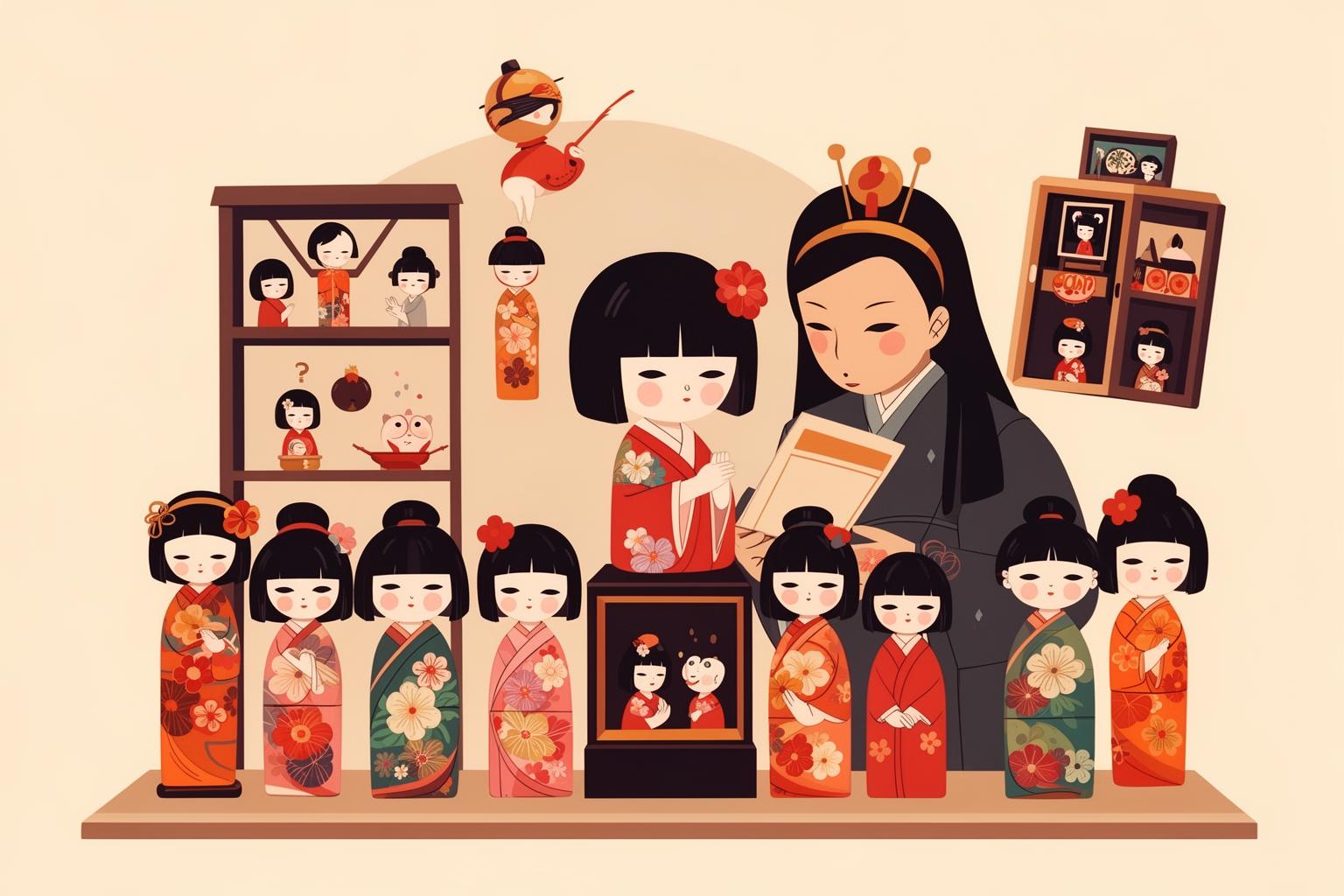
Despite—or perhaps because of—the complex web of unsettling associations, kokeshi dolls have never been more popular. A vibrant community of collectors exists in Japan and worldwide, and it’s not merely a niche interest for fans of the macabre. Kokeshi dolls are recognized as a genuine and beautiful art form.
The world of kokeshi is generally split into two main categories. There are the dentō-kokeshi (traditional kokeshi), which follow the 11 or 12 classic styles handed down through generations in the Tōhoku onsen towns. These are valued for their heritage and authenticity. Then there are the sōsaku-kokeshi (creative kokeshi), which emerged after World War II. These dolls break with tradition, allowing artisans to experiment with various shapes, colors, and themes. They may feature more expressive faces, intricate bodies, or even be carved to resemble characters or animals.
For collectors, the attraction is multifaceted. It involves appreciating the artisan’s skill, the subtle stylistic differences between regions, and the natural beauty of the wood itself. It means owning a piece of genuine Japanese folk art, a link to a rural lifestyle quickly fading away. Yet, the ambiguity and darker tales undeniably add to the fascination. A collector doesn’t just possess a wooden figure; they hold a story—the history of the Tōhoku craftsmen, the disputed but poignant legend of the lost children, and a profound spiritual connection to the forest.
The eerie aura should not be feared or dismissed; it is what imparts depth and character to the doll. It distinguishes a kokeshi from a mass-produced plastic toy. Displaying a row of kokeshi on your shelf invites a silent, watchful audience into your home—a quiet recognition of the layers of meaning—historical, spiritual, and emotional—that a simple, handmade object can embody.
Living with Kokeshi
When living in Japan, kokeshi dolls are seen everywhere. They aren’t limited to antique stores or tourist spots. Their designs appear on stationery, fabrics, and business logos. Elegant, artistic kokeshi dolls are displayed on shelves in minimalist, architect-designed homes. They have smoothly evolved from humble folk toys into refined design objects.
Yet, the eerie feeling they evoke never fully fades. You can appreciate a kokeshi for its simple lines and wabi-sabi beauty, but catch a glimpse of one at twilight, and old whispers resurface. You recall tales of them shedding real tears, of their hair growing, or their heads turning on their own to watch you leave the room.
The haunted presence of a kokeshi doll is complex and multifaceted. It’s a blend of cultural echoes resonating in harmony. It reflects the kodama, the spirit of the tree embodied in human form. It carries the lingering sorrow of folk stories about lost children, true or not. It embodies the unnerving stillness magnified by countless horror films. And it bears the dedicated intent of the artisan who carved it, whose spirit, in a sense, is infused into the finished piece.
A kokeshi doll doesn’t feel alive because it’s haunted in the Western sense. It feels alive because, in Japanese culture, it never ceased to be. The wood was once living, the spirit within it remains alive, and the stories breathed into it grant it a different kind of life. It stands silently on the shelf, a wooden mystery, watching us with eyes that hold the quiet depths of the forest and the faint, sorrowful echoes of human memory.