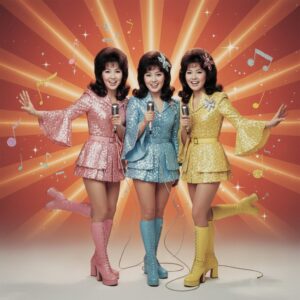
You see it everywhere. The massive, synchronized armies of AKB48, the digital perfection of a virtual YouTuber like Hatsune Miku, the entire global phenomenon of K-Pop trainees polished to an impossible sheen. It’s a world of hyper-produced, fan-centric pop culture that feels distinctly modern, a product of the internet age. But what if I told you the entire blueprint for this world was drafted half a century ago, in an era of landlines, boxy televisions, and economic miracles?
Before you can understand the J-Pop of today, you have to understand the singers of yesterday. Specifically, you need to understand the idols of the Showa Era (1926-1989). These weren’t just pop stars in the Western sense—they were something entirely different. They were meticulously crafted cultural products, living embodiments of a national mood, and the original architects of the aesthetic we now globally recognize as “kawaii.” They were the beta test for the parasocial relationships that now define online fandom, and their careers laid the tracks for the idol-industrial complex that runs East Asian entertainment. To look at a Showa idol is to see the origin story of modern Japanese pop culture in a frilly dress and a perfectly feathered haircut.
This isn’t just a story about music. It’s a story about a nation rebuilding itself and deciding what it wanted to dream about. It’s about the creation of a powerful business model that turned youthful charm into a multi-billion yen industry. And it’s about how a generation of teenage girls, singing about first loves and sunny days, accidentally defined a visual and emotional language that would conquer the world. Forget what you think you know about pop music. We’re going back to the source code.
The transformation of Japan’s pop culture not only set the stage for modern idols but also fostered diverse fan-driven niches, as seen in the world of adult gachapon collectors, where innovative passion and playful artistry intersect.
A Nation in Search of a New Song
To understand why the idol phenomenon took such deep root, you need to sense the environment from which it emerged. Japan in the 1960s and early 70s was a country undergoing a remarkable transformation. The literal and psychological remnants of World War II were still fresh, yet the nation was surging ahead on the back of an economic boom that seemed almost miraculous. Cities were being rebuilt, bullet trains were connecting distant places, and for the first time in a generation, ordinary families had disposable income. At the heart of the modern Japanese living room stood the television—a glowing altar around which families gathered nightly.
This new era of peace and prosperity created a cultural void. The stern, militaristic values of the past had vanished, but what was meant to take their place? American culture, from rock and roll to Hollywood films, poured in, offering one possible answer. Still, Japan was also seeking something uniquely its own—a new kind of Japanese dream that was optimistic, forward-looking, and, above all, safe.
The French Connection and the Japanese Adaptation
The earliest roots of the idol concept were not entirely native. Japan’s entertainment industry, skilled at adopting and refining foreign ideas, looked westward. They observed the teenybopper phenomena around stars like Elvis, but his raw, rebellious energy seemed too aggressive. Then they turned to Europe, especially France, and its “yé-yé” singers—young, fashionable girls performing light, catchy pop songs. This felt closer to the mark.
However, the Japanese model introduced a vital, transformative element: accessibility. Western pop stars were often seen as untouchable icons of cool, endowed with talent that appeared innate and nearly superhuman. Japan’s entertainment executives took a different approach. What if the star wasn’t an enigmatic genius, but the cute girl from the neighboring town? What if her charm lay not in perfection, but in her imperfections? This shift—from unattainable talent to relatable aspiration—ignited the idol phenomenon. They weren’t promoting a rock god; they were selling a dream you could root for.
The Golden Age and Its Holy Trinity
The idol system truly took shape in the 1970s, a period now known as the hana no san-nin musume or “the golden trio” era. Although many idols rose and fell, three girls who debuted in the early 70s established the archetypes and set the standard for decades: Yamaguchi Momoe, Sakurada Junko, and Mori Masako.
Yamaguchi Momoe: The Melancholy Queen
Yamaguchi Momoe was, and still is, an anomaly. She was an idol, yet she transcended the typical label. While her contemporaries sang cheerful songs about innocent romance, Momoe, even as a teenager, delivered performances marked by remarkable emotional depth and maturity. Her voice was lower, her gaze more intense, and her lyrics hinted at experiences far beyond her years. She embodied a quality called kage, or shadow—a sense of melancholy and mystery that made her irresistibly captivating. She wasn’t merely cute; she was compelling. She represented a more complex, soulful depiction of Japanese femininity.
Her legend, however, was solidified not only by her career but also by its dramatic conclusion. In 1980, at the absolute peak of her fame, 21-year-old Momoe announced her retirement. She was marrying her frequent co-star, Miura Tomokazu, and planned to leave public life entirely to become a wife and mother. And she meant it. She gave a final, tearful concert at the Budokan, placed the microphone on the stage, and walked away forever. She has never returned. This choice, unimaginable for a Western star, transformed her from a top idol into a national myth—the ultimate symbol of a traditional female ideal, choosing family and private life over fame and fortune.
Sakurada Junko and Mori Masako: The Two Sides of Cute
If Momoe was the soul, her two contemporaries embodied the more conventional aspects of idol culture. Sakurada Junko was the perfect example of the energetic, girl-next-door idol. With a constant, radiant smile and a slightly goofy charm, she was pure sunshine. She was the girl you wanted to root for, the one whose posters you’d hang on your wall to brighten your room.
Mori Masako, by contrast, was the clean-cut, talented honor student. Her image was that of the dependable, well-mannered daughter. She was an excellent singer with a clear, steady voice, often performing more traditional kayōkyoku songs. Together, the trio formed an ideal triangle: the enigmatic artist (Momoe), the bubbly cheerleader (Junko), and the respectable role model (Masako). The industry realized it could design and market different facets of the same core product, appealing to every segment of the public’s imagination.
The Idol Factory: A System for Manufacturing Dreams
The success of these early stars was no accident. It stemmed from a highly refined and ruthlessly efficient system for discovering, producing, and marketing talent. The idol was treated as a product, and Japanese entertainment agencies were masters of this assembly line.
Star Tanjō!: The Public Audition
The process began with a television show. Star Tanjō! (“A Star is Born!”), which aired from 1971 to 1983, was the undisputed kingmaker of its time. It was a weekly televised talent competition where aspiring singers from across Japan could try their luck. Representatives from numerous talent agencies and record labels sat in the audience, raising placards bearing their company’s name if interested in signing a contestant.
This format was brilliant for two reasons. First, it provided a seemingly endless stream of fresh faces for the industry. Second, and more importantly, it allowed the public to be part of the creation story. Viewers watched a nervous girl from a small town pour her heart into her performance and witnessed the moment the placards went up. They felt a sense of discovery and ownership from the very start. The idol’s journey became their journey.
The Paradox: Unattainable yet Relatable
Once signed, the idol’s image was carefully crafted around a central paradox: she had to appear as a celestial figure on television, yet at the same time feel like someone familiar. Her songs, written by professional songwriters, rarely deviated from a narrow range of themes: the excitement of a first crush, the melancholy of a rainy day, the stress of exams, the dreams of a schoolgirl. These were universal, relatable emotions.
This fostered what is now known as a parasocial relationship—a one-sided intimacy where fans feel a genuine connection to the celebrity. The idol wasn’t a distant rock star singing abstract ideas; she was singing about your life, or at least an idealized version of it. This connection formed the foundation of fan devotion.
The Power of Imperfection
A crucial aspect of this relatability was the concept of shinwasei, or kinship. Unlike Western artists, who are expected to be polished professionals from the start, idols were often celebrated for their imperfections. A slightly off-key note or a clumsy dance move wasn’t a failure; it was a sign of effort, of a young girl giving her all (isshōkenmei ganbaru). This visible struggle made fans feel protective. They weren’t merely passive spectators; they were rooting for her growth. Watching her improve over time felt like a shared victory.
The Business of Purity
This entire fantasy was upheld by a set of ironclad, unwritten rules. The most important was the implicit ban on romance. An idol belonged to her fans. Her image was one of pure innocence, and any hint of a real-life boyfriend would shatter that illusion. A dating scandal was a cardinal sin, often leading to a forced public apology, a temporary suspension, or even the end of a career.
This wasn’t simply about morality; it was about business. The idol sold a fantasy—the idea that she was available, not necessarily romantically to every fan, but that her heart was an open space reserved for her audience’s devotion. The agencies managing them exercised absolute control, scripting public appearances, managing schedules, and fiercely protecting their private lives to maintain the integrity of the product.
The Congregation: Forging a New Fan Culture
The idol industry did more than just produce stars; it created a new type of consumer: the dedicated, organized, and highly engaged fan. This was not the passive audience typical of traditional movie stars. Instead, it was a participatory subculture with its own rituals, language, and social framework.
From Fan Mail to Fan Clubs
In its early days, fandom expressed itself through conventional means: purchasing records, cutting out pictures from teen magazines such as Myojo and Heibon, and inundating television studios with fan mail. However, as the industry became more sophisticated, the methods for capitalizing on this devotion evolved as well. Official fan clubs appeared, providing members with exclusive newsletters, priority concert ticket access, and special merchandise.
The Rise of the Ōendan
The most prominent and intriguing feature of this new fan culture was the rise of the ōendan, or cheering squads. These were highly organized, mostly male fan groups devoted to supporting their chosen idol. At concerts and television appearances, they would assemble in uniform—often wearing custom-made happi coats bearing the idol’s name—and lead the crowd in intricate cheers.
This marked the origin of the wotagei (or otagei) chants still popular today. Fans developed a precise choreography of calls and responses, perfectly synchronized with the idol’s songs. The best-known chant was the “L-O-V-E, Lovely [Idol’s Name]!” cheer that became a scene staple. This was active participation in its purest form. Fans weren’t merely watching the performance; they were an integral part of it. Their organized enthusiasm became a crucial element of the idol’s show, creating a feedback loop of admiration that electrified the venue. This intense, ritualized devotion would eventually evolve into the modern “wota” culture associated with groups like AKB48.
The 80s Wave: Codifying the Kawaii Aesthetic
If the 70s created the idol machine, the 1980s pushed it into overdrive. This era was the true “Golden Age,” marked by a booming economy and idols dominating the airwaves. And one name stood above all others: Matsuda Seiko.
Matsuda Seiko and the Art of “Burikko”
Matsuda Seiko, who debuted in 1980, was a phenomenon. She was more than just an idol; she was an institution. More than anyone before her, Seiko defined what it meant to be “kawaii.” She perfected the burikko persona—a girl who deliberately and skillfully performs cuteness. This was evident in her high-pitched, coquettish speech, wide-eyed expressions of surprise, and her signature pout.
While some critics saw it as calculated, the public was completely captivated. Seiko expertly managed her own image, radiating an aura of eternal, sunny optimism. Her songs were impeccably produced pop anthems that became the decade’s soundtrack. She set trends in every sense of the word.
The “Seiko-chan Cut” and Visual Language
Seiko’s impact was most visible in fashion and style. When she debuted a feathered, permed hairstyle, it quickly became known as the “Seiko-chan cut,” prompting countless teenage girls across Japan to flock to salons to copy it. It was more than just a haircut; it symbolized belonging to the vibrant, prosperous youth culture of the 80s.
Through idols like Seiko, a comprehensive visual language of kawaii was established. Fashion embraced frilly dresses, pastel colors, ribbons, and lace. Poses became standardized: a slight head tilt, the peace sign held near the face, and a subtly pigeon-toed stance conveying girlish vulnerability. Even the singing style, often characterized by a high-pitched, slightly nasal tone, became part of the package. This was not merely a collection of trends; it was a carefully crafted aesthetic system aimed at maximizing appeal, with Showa idols as its chief ambassadors.
The Pressure Behind the Smile
Despite the bright lights and cheerful songs, the world of the Showa idol had a significant dark side. The pressure on these young women—mostly teenagers pulled from obscurity—was immense and unrelenting.
The Cost of a Flawless Image
Idols lived in a fishbowl, with their lives tightly controlled by their agencies and grueling schedules of singing lessons, dance rehearsals, TV shoots, radio appearances, and magazine interviews. They had almost no private life. The constant demand to always be “on”—cheerful, polite, and perfect—was emotionally and physically draining. A single misstep, such as a candid photo with a boy or an offhand comment, could spark a major scandal and threaten the career they had worked so hard to build.
This pressure led to tragic outcomes. The most infamous case was Okada Yukiko, a beloved idol who took her own life in 1986 at 18 by jumping from the roof of her talent agency. Her death shocked the nation and revealed the harsh mental health toll the industry imposed on its brightest stars.
A Built-in Expiration Date
Moreover, an idol’s career was understood to be temporary. The system emphasized youth and freshness. By their early twenties, many idols were considered past their prime. They were expected to “graduate” from the idol world, often transitioning into acting or TV hosting, or more commonly, retiring entirely to marry. The industry was a relentless cycle, always searching for the next 15-year-old to captivate the public’s attention. For most, stardom was not a lifelong career but a brilliant, beautiful, and brief moment in the spotlight.
The Echo in the Modern Machine
The Showa Era concluded in 1989, but the system its idols established did not. Rather, it evolved, adapted, and continues to serve as the fundamental foundation of Japanese pop culture and beyond.
From Onyanko Club to AKB48
The direct connection to today’s idol groups is unmistakable. In the late 1980s, producer Akimoto Yasushi launched Onyanko Club, a large group of amateur high school girls with their own daily TV show. They were neither polished singers nor dancers, which was exactly their charm. Their appeal lay in their rawness and relatability. This group introduced ideas such as a rotating lineup and a “graduation” system. Decades later, the same producer, Akimoto Yasushi, refined this exact formula with AKB48, whose concept of “idols you can meet” directly descends from the Showa-era focus on accessibility.
The Global Legacy: J-Pop, K-Pop, and Beyond
The essence of the Showa idol system is now global. The carefully managed image, the emphasis on group harmony rather than individual rebellion, the rigorous training periods, and the cultivation of dedicated fanbases through merchandise and events—all these are cornerstones of the modern J-Pop industry. However, the influence extends further. The South Korean K-Pop industry, with its intense trainee system resembling a hyper-competitive boarding school for aspiring stars, represents a more intensified and globalized evolution of the Japanese agency model. The concept of crafting a pop star from the ground up, controlling their image, and forging a strong fan connection was pioneered and perfected in Japan decades ago.
In the end, the legacy of Showa idols transcends nostalgic pop songs. They were a cultural force that helped redefine a nation during a time of optimism. They forged a new kind of celebrity, built on a delicate balance between fantasy and relatability. Most importantly, they transformed the emerging concept of “kawaii” into a powerful, marketable, and enduring aesthetic that has become one of Japan’s most significant cultural exports. Whenever you see a character with oversized eyes, a pop group dressed in matching pastel outfits, or fans chanting in perfect unison, you are witnessing an echo of a song first sung in Showa Japan.