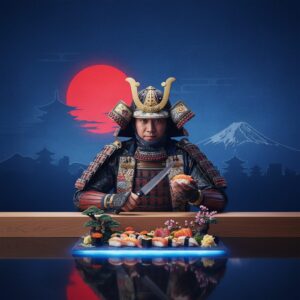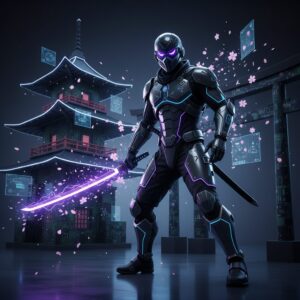
You’ve probably seen him. Maybe on a game cover or in an anime. He has impossibly spiky hair, armor that looks more like a high-fashion runway piece than something you’d wear into battle, and he’s wielding a sword that’s on fire, or crackling with lightning, or maybe it’s the size of a small car. He screams his attack names, poses dramatically after defeating a thousand enemies single-handedly, and carries the swagger of a stadium rock god. This is the modern pop culture image of the Sengoku samurai. And if you’ve ever stood in front of a museum display, looking at a piece of actual, historical samurai armor—lacquered, functional, and deeply serious—you might have asked yourself a very reasonable question: how in the world did we get from that to this?
The answer isn’t simply ‘creative license.’ It’s a fascinating cultural evolution, a story of how Japan’s most violent and chaotic historical period became the ultimate playground for modern entertainment. The transformation of stoic, feudal warlords into high-octane, super-powered icons is a direct result of the video game industry, which took the raw material of history and remixed it with the aesthetics of anime, the energy of rock music, and the pure, unadulterated power fantasy that only interactive media can provide. This isn’t about forgetting history; it’s about making it feel legendary. It’s a subculture built for an audience that wants its historical figures to be more than names in a textbook. They want them to be heroes, villains, and above all, incredibly cool. This is the story of why that niche exists, who it’s for, and how it completely redefined the image of the samurai for a global generation.
This modern reinvention of the samurai spirit echoes the vibrant energy of Japan’s urban nightlife, where even the art of bar hopping in Japan turns an ordinary evening into a legendary performance.
The Historical Canvas: Men of Ambition, Not Anime
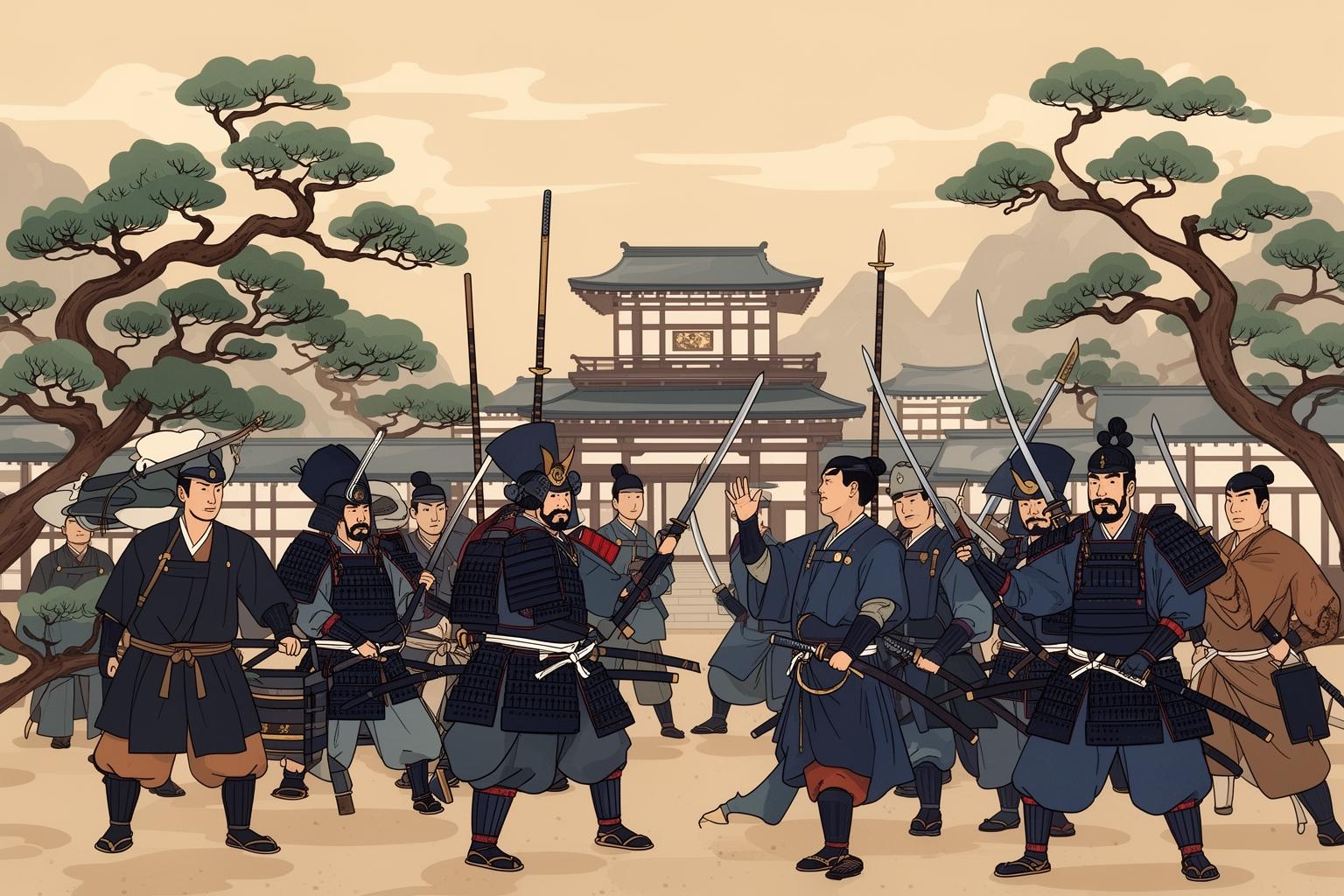
Before we delve into the world of lightning katanas and six-bladed fighting styles, it’s important to ground ourselves in the historical reality of the era these games are inspired by. The Sengoku Jidai, or “Warring States Period,” was a brutal, chaotic, and politically intricate time in Japanese history, lasting approximately from the mid-15th to early 17th century. The central shogunate authority had collapsed, and Japan fragmented into numerous provinces controlled by ambitious daimyō (feudal lords), all competing for power and the ultimate goal: unifying the nation under their own flag.
This was not a period of chivalrous duels beneath cherry blossoms. It was an age of betrayal, shrewd strategy, and relentless warfare. The men who rose to prominence were not flashy anime heroes; they were brilliant, ruthless, and pragmatic leaders. Understanding who they truly were is crucial to appreciating the boldness of their video game reinterpretations.
The Demon King: Oda Nobunaga
Few figures are as central to the Sengoku story as Oda Nobunaga. Historically, he was the first of the “Three Great Unifiers.” A brilliant yet ruthless innovator, he transformed Japanese warfare by widely adopting firearms and devising brutally effective tactics. He was both a patron of the arts and a skilled administrator, but also infamous for his absolute intolerance of betrayal and for burning enemy temples, slaughtering thousands. His well-known nickname, “The Demon King of the Sixth Heaven,” was not crafted for a video game boss; it was a title he is said to have given himself in a letter to a rival—a chilling testament to his terrifying ambition. The real Nobunaga was a complex figure marked by visionary progress and brutal cruelty.
The One-Eyed Dragon: Date Masamune
Further north, a younger and ambitious daimyō was making his mark: Date Masamune. Known as the “One-Eyed Dragon of Ōshū,” he lost an eye to smallpox in childhood and allegedly plucked it out himself. Renowned for his military skill, political savvy, and distinct sense of style, his signature black armor and crescent-moon helmet became iconic. A shrewd and ambitious leader, he even planned an invasion of Korea and considered an alliance with Christian powers to overthrow the shogunate. Masamune was both stylish and aggressive—a man who cultivated a powerful personal brand long before branding was a concept.
The Crimson Demon of War: Sanada Yukimura
On the opposing side stood figures like Sanada Yukimura. Not a great unifier, but a warrior celebrated for loyalty and stunning battlefield heroics, especially during the Sengoku period’s final years. Fighting for the Toyotomi clan against the eventual victor Tokugawa Ieyasu, Yukimura led legendary charges during the Siege of Osaka. Donning his iconic red armor, which earned him the nickname “The Crimson Demon of War,” his ferocity reportedly breached Tokugawa defenses many times, coming close to claiming Ieyasu’s head. Ultimately killed in battle, his story became one of tragic, steadfast heroism—the perfect archetype of a valiant warrior fighting for a noble but doomed cause.
These were real men, shaped by their strategies, political intrigue, and brutal, bloody battles. They were the raw material. The next step is to see how popular culture began to smooth their rough historical edges and reshape them into entertainment.
The Spark of Transformation: From Kabuki to Koei
The transformation of historical figures into popular entertainers did not start with video games. Long before the first pixelated samurai appeared on screens, traditional arts such as Kabuki theater and ukiyo-e woodblock prints were already at work. These art forms distilled complex histories into dramatic tales of heroism, betrayal, and tragedy. Warlords were given distinct personalities, catchphrases, and visual motifs, becoming archetypes. Oda Nobunaga was portrayed as the fearsome tyrant, Sanada Yukimura as the tragic loyalist. This tradition of dramatizing history is deeply embedded in Japanese culture.
With the arrival of the 1980s and the rise of video games, a company named Koei (now Koei Tecmo) recognized the potential of this rich historical tapestry. Their first major success in this vein was Nobunaga’s Ambition, a grand strategy game released in 1983. In it, players assumed the role of a daimyō, managing resources, commanding armies, and engaging in diplomacy to unify Japan. It was cerebral, complex, and immensely popular. For the first time, a generation of players wasn’t just reading about these figures; they were interacting with them, stepping into their shoes, and reshaping history. The game made the Sengoku period’s intricate web of alliances and rivalries accessible and engaging.
However, strategy games naturally keep players at a distance, functioning as commanders moving units on a map. The real revolution came when Koei shifted the perspective from a god’s-eye view down to the battlefield itself.
The Musou Formula: One Versus a Thousand
In 2000, Koei released Dynasty Warriors, based on China’s Three Kingdoms era. The game introduced a new genre, later known as Musou in Japan. The core concept was a radical power fantasy: you controlled a single legendary warrior against entire armies. With simple button combinations, you could cut through hundreds, even thousands, of generic enemy soldiers. It focused less on strategy and more on the visceral thrill of being an unstoppable force.
In 2004, Koei adapted this formula to Japan’s own history with Samurai Warriors (Sengoku Musou). This marked a turning point for the Sengoku warlords. Playing as Sanada Yukimura, you weren’t just reading about his famous charge at the Siege of Osaka; you were living it. You were the one cutting down legions of Tokugawa soldiers, unleashing spectacular special attacks, and feeling like a true legend. The game took historical foundations and amplified the heroism to a superhuman level. Character designs were more stylized than in Nobunaga’s Ambition, featuring brighter colors and more dynamic armor, yet they remained recognizably grounded in history. Samurai Warriors opened the door, proving there was a huge appetite for experiencing history not as a lesson, but as an action spectacle.
The Birth of the ‘Sengoku Rockstar’: Capcom’s Sengoku Basara
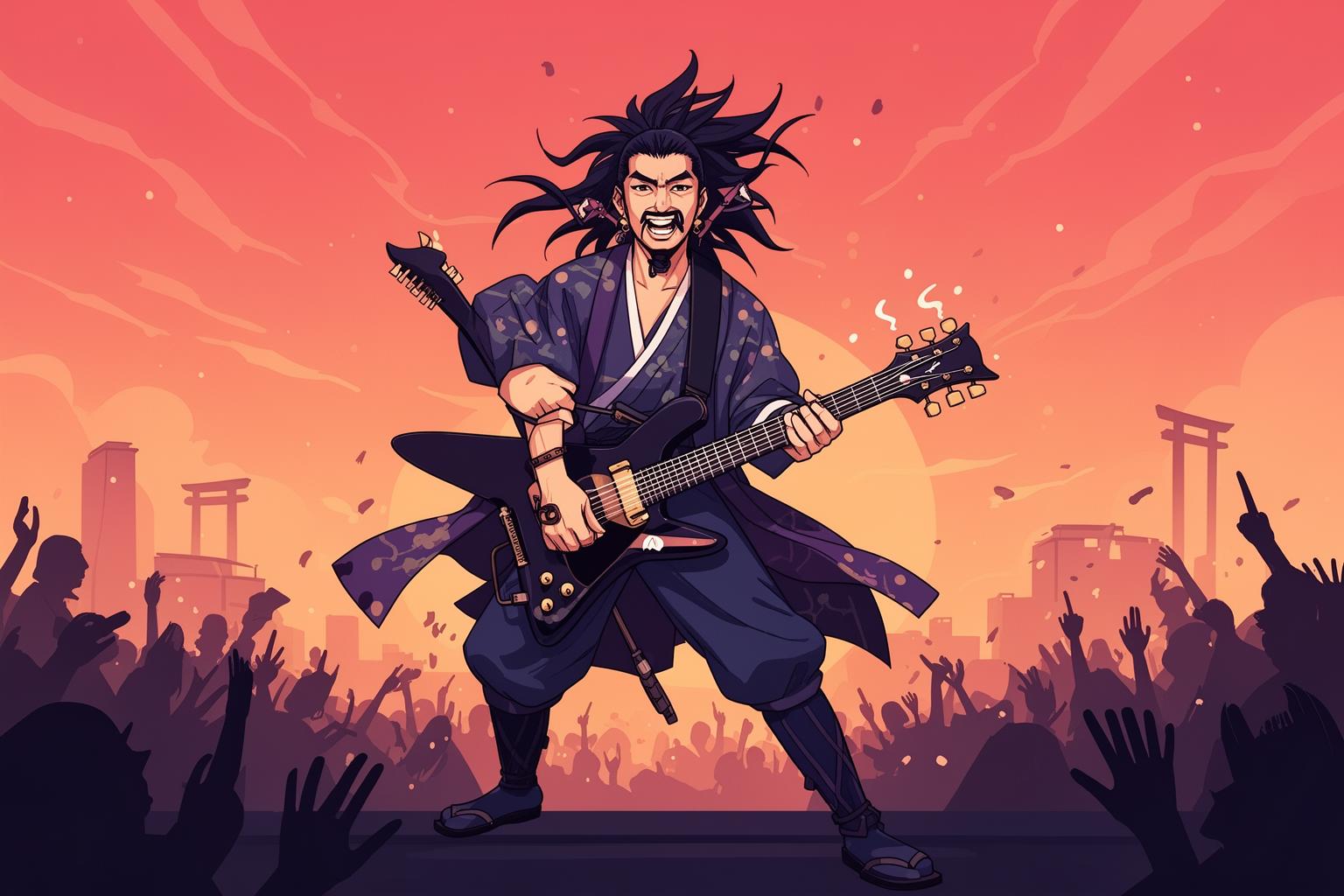
If Samurai Warriors merely opened the door, then Capcom’s Sengoku Basara, first launched in 2005, kicked it off its hinges, set it ablaze, and performed a guitar solo over the flames. Capcom, known for their flamboyant, arcade-style approach with titles like Street Fighter and Devil May Cry, viewed the Sengoku period not as a historical era to be respected but as a stage to be electrified.
The design philosophy behind Sengoku Basara was straightforward: take the core historical essence of a warlord and turn every dial up to eleven, then break the dials off entirely. Historical accuracy played a distant secondary role to pure, unfiltered “cool.” The outcome was a lineup of characters so wildly exaggerated they instantly became icons.
Let’s examine how Basara reimagined these historical figures:
Date Masamune was no longer just the stylish “One-Eyed Dragon.” He became a swaggering, motorcycle gang leader archetype, speaking a mix of Japanese and Engrish and shouting phrases like “OK, let’s party!” before battle. His signature crescent-moon helmet remained, but now he wielded six katanas simultaneously, three in each hand, akin to a Japanese Wolverine. Even his horse was customized to resemble a motorcycle, complete with handlebars and exhaust pipes. He embodied rebellious cool.
Sanada Yukimura’s loyalty and fiery spirit were turned into a literal burning passion. Portrayed as a hot-blooded, constantly yelling shonen anime hero, his devotion to Takeda Shingen is expressed through screaming and fist-pumping dialogues. He fights not with one spear but two massive ones, spinning them like propellers to fly short distances. He is pure, untamed heroic energy.
Oda Nobunaga discarded any historical nuance to become the literal Demon King. Often wielding a sawed-off shotgun alongside his sword, he is enveloped in dark energy, speaks in a menacing baritone, and rules by fear. He is less a historical unifier and more a final boss straight out of a fantasy RPG.
And it didn’t stop there. Honda Tadakatsu, historically one of Tokugawa Ieyasu’s fiercest generals, was reimagined as a silent, towering jet-powered robot. Mōri Motonari, a cunning strategist, became an effete, narcissistic manipulator who fights with a massive ring blade. The game distilled the essence of each character—Masamune’s style, Yukimura’s passion, Nobunaga’s terror—into modern pop culture archetypes. This was a deliberate, brilliant choice, making these figures instantly recognizable and appealing to an audience raised on anime and rock music.
The Tools of Transformation: Visuals, Voice, and Verve
The magic that turned historical daimyō into video game rock stars relied on a few core elements, executed with masterful precision.
Character Design
The foremost element was the visual redesign. The creators drew heavily from contemporary anime and manga styles. Armor became sleeker, more angular, and embellished with visually striking yet utterly impractical details. Color palettes exploded; Sanada’s crimson turned into a burning scarlet, while Masamune’s dark armor was highlighted with electric blue. Hairstyles became spiky, flowing, and gravity-defying. The goal was to craft a strong, instantly recognizable silhouette for each character, prioritizing personality over realism.
Weaponry
Next came the weapons. Simple katanas or yari (spears) were no longer sufficient. Weapons became extensions of the characters’ exaggerated personas. Maeda Keiji, a historical eccentric and rogue, brandishes a ridiculously oversized nodachi. Chōsokabe Motochika, a daimyō from a maritime region, fights wielding a giant anchor. These weapons were not merely tools of war; they were visual statements reinforcing the larger-than-life nature of their wielders and enhancing spectacular gameplay.
Voice Acting (Seiyuu)
In Japan, voice actors, or seiyuu, are celebrities with devoted fanbases. The casting for games like Sengoku Basara and Samurai Warriors played a crucial role in their success. Renowned charismatic actors were selected to breathe life into these historical figures. Kazuya Nakai’s deep, swaggering portrayal of Date Masamune and Sōichirō Hoshi’s passionate, screaming performance as Sanada Yukimura became as iconic as the characters’ visual designs. The dramatic, often shouted line delivery defined the personalities for millions of fans and spawned countless memes.
Music
The final element was the soundtrack. Gone were the somber, traditional tunes typical of historical dramas. The battlefields of Sengoku Basara and Samurai Warriors throb with J-rock, heavy metal, and high-energy techno. The music conveys the essence of the experience: this isn’t a history lecture. It’s an action movie, a rock concert, and a power trip all rolled into one.
The Cultural Impact: Why This Resonates
So why did this radical reimagining of history become such a huge cultural phenomenon? Who exactly is this subculture aimed at? The answer reveals much about modern Japan’s connection to its own past.
One of the most notable outcomes was the rise of the rekijo (歴史女子), or “history girls.” These games, with their emphasis on dramatic narratives and casts of attractive, stylish male characters (ikemen), made history highly appealing to a young female audience. Suddenly, the Sengoku period was no longer just a dry topic from school; it transformed into an exciting world filled with characters they could support, create fan art of, and follow across multiple game installments. This group became a powerful force, boosting sales of games, merchandise, and even increasing tourism.
This brings us to another important point: these games serve as an entry point to history. For many, the threshold for studying feudal Japanese history is steep. The names are complicated, the politics dense. A game like Sengoku Basara reduces that barrier to zero. A player might be drawn in by Date Masamune’s six katanas and broken English, but soon their curiosity grows. Who was this man really? What’s the story behind his eyepatch? This curiosity often leads them to museums, historical sites, and real history books. The games create a feedback loop, converting entertainment into authentic historical interest.
Local governments and historical sites quickly saw this potential. In cities like Sendai (Date Masamune’s historical domain) or Ueda (home of the Sanada clan), official merchandise and tourist posters featuring the video game versions of their local heroes are common. Events at Osaka Castle honoring the Sanada clan often use imagery from Samurai Warriors. These hyper-stylized characters have become unofficial cultural ambassadors, driving tourism and revitalizing local economies by connecting a new generation with their regional heritage.
Ultimately, the genre’s success boils down to the power of archetypes. By stripping away complex political and social contexts, the games distill these multifaceted men into strong, universal tropes: The Ambitious Tyrant, The Loyal Hero, The Stylish Rebel, The Wise Elder. These are fundamental stories that resonate across cultures. Video game creators simply gave these classic archetypes a fresh, modern, and electrifying makeover.
This bold, anachronistic reimagining of the Sengoku period is far from a desecration of history. Instead, it’s a tribute to the lasting power of these stories and the figures who lived them. It represents a uniquely Japanese blend of deep reverence for the past with fearless, playful creativity inspired by the country’s modern pop culture. The samurai of the video game world may not be historically precise, but they are a vibrant continuation of a long-standing storytelling tradition. They carry the spirit of these legendary figures forward, ensuring that the names Nobunaga, Masamune, and Yukimura are not only remembered but celebrated—with all the intensity, excitement, and thunderous energy of a rock star’s final encore.