There’s a particular kind of magic that happens in the dusty, cramped aisles of a Tokyo record store. It’s a quiet alchemy. You’re flipping through a stack of vinyl, the soft, rhythmic thump-thump-thump of cardboard sleeves the only sound in the reverent silence. Then you see it. A cover that speaks to you—maybe it’s the high-fashion aesthetics of the late 1970s, or the neon-drenched optimism of the 80s. You don’t recognize the artist, but the feeling is there. You pull it from the rack, place it on the listening deck, and drop the needle. A slick bassline slides out of the speakers, followed by shimmering keyboards and a voice that sounds like a sunset drive through a city that exists only in memory. You’ve just found it. You’ve struck gold. You’ve found a piece of Wamono.
So, what is this treasure I’m talking about? The term Wamono (和物) literally translates to “Japanese things,” but in the world of music collectors, it’s the holy grail. It’s the catch-all name for a universe of Japanese-made music, primarily from the 70s and 80s, that has been rediscovered and coveted by DJs and listeners around the globe. While the term often gets flattened into “city pop”—thanks to a few viral YouTube sensations—the reality is a sprawling, incredibly deep well of jazz fusion, sophisticated funk, sultry soul, breezy AOR (Adult-Oriented Rock), and even experimental disco. This was the soundtrack to Japan’s economic miracle, music crafted with astronomical budgets and virtuosic musicianship, only to be largely forgotten for decades. Now, the world is catching on, and the hunt for original pressings is on.
And if you’re going to hunt, there is only one place to go: Shimokitazawa. This neighborhood in western Tokyo is the undisputed heartland of Japanese counter-culture. Forget the sterile electronics stores of Akihabara or the high-fashion gloss of Ginza. Shimokitazawa, or “Shimokita” as it’s known, is a chaotic, charming labyrinth of narrow pedestrian streets packed with vintage clothing stores, tiny independent theaters, smoky coffee shops, and, most importantly, a density of world-class record stores that is frankly astonishing. This is where the cool kids have always gone to cultivate their tastes, far from the mainstream glare. To dig for Wamono here isn’t just a shopping trip; it’s a cultural pilgrimage. It’s an immersion into the very vibe that gave birth to this music in the first place. This is your guide to that pilgrimage—not just where to go, but how to understand the sound, the scene, and the subtle art of the dig.
What Exactly is Wamono? The Sound Behind the Hype
Before entering your first Shimokita record store, it’s helpful to grasp the sonic landscape you’re about to explore. The term ‘Wamono’ is wonderfully broad, which is both its charm and its challenge. For many outside Japan, the entry point was the unexpected revival of Mariya Takeuchi’s 1984 track “Plastic Love,” which became a strange and beautiful phenomenon driven by the YouTube algorithm. Its catchy groove and bittersweet vibe opened the floodgates, but it’s only the tip of a vast, deeply funky iceberg.
Beyond City Pop
City Pop is the most familiar face of Wamono. It represents urban sophistication, evoking cocktails on a skyscraper balcony at dusk. It’s defined by lush production, tight arrangements, and a fusion of Western influences such as soul, R&B, and soft rock. Artists like Tatsuro Yamashita, Mariya Takeuchi’s husband and a giant of the genre, crafted albums that remain impressively polished even today. Yet, focusing solely on City Pop means missing the bigger picture.
Dig deeper, and you’ll encounter Japanese jazz, or ‘wa-jazz’. During this era, Japanese musicians weren’t merely copying their American idols; they were pushing boundaries. Artists like Terumasa Hino and Sadao Watanabe merged hard bop with traditional Japanese scales and funk grooves, creating something entirely unique. Then there’s the rich, soulful funk of singers like Minako Yoshida or the psychedelic, genre-defying explorations of Haruomi Hosono and his band Tin Pan Alley. This music was intricate, ambitious, and made for an adult audience with refined tastes. It was meant for high-end stereo systems, not teenage bedrooms.
The Bubble Era Soundscape
This music’s impossibly luxurious sound stems from the fact that it once truly was. Much of the classic Wamono canon was produced during Japan’s 1980s “Bubble Economy.” Money was abundant, optimism soared, and the recording industry reflected this prosperity. Record labels had vast budgets, enabling them to hire the best session musicians—‘cats’ who could play anything—and book countless hours in cutting-edge studios. The result is a sonic richness and clarity that’s unmatched. The bass is deep, the drums are crisp, and the layers of synthesizers, horns, and strings are perfectly balanced.
This music became the soundtrack of a modernizing Japan, linked to the rise of car culture, the Walkman, and a life of urban leisure. It was aspirational. Ironically, this also led to its fall from favor. When the economic bubble burst in the early 90s, the optimism soured. This slick, costly sound suddenly felt dated and out of touch. For years, these records ended up in bargain bins, dismissed as cheesy relics of a past era. It took a new generation of listeners, detached from the original context and discovering the music on its own terms online, to appreciate it as the treasure it truly is.
The Shimokitazawa Vibe: More Than Just Record Shops
To genuinely grasp the culture of crate-digging in Japan, you need to appreciate the physical and social context of Shimokitazawa. The neighborhood itself is as integral to the experience as the records you discover. It’s a place that has consistently resisted the hyper-modern, high-rise development that has transformed much of Tokyo. Its charm comes from its human scale and fiercely independent spirit.
A Village of Vintage
Strolling through Shimokita feels like wandering through a village within the megacity. The streets are too narrow for most cars, fostering a relaxed, pedestrian-friendly vibe. Around every corner, you’ll find a tiny shop, a hidden bar, or a steep staircase leading to a second-floor café. The prevailing aesthetic is vintage. This is the heart of furugi, or second-hand clothing. Shops specialize in everything from American workwear to 60s European fashion.
This ecosystem is essential to the vinyl scene. The person carefully hunting for a perfectly worn pair of 1970s jeans is often the same one searching for an obscure Japanese funk record from that decade. There’s a shared appreciation for items with history, analog quality, and a personal style that can’t be purchased in a department store. The record stores don’t feel like isolated businesses; they seem like vital parts of a broader cultural fabric. They are nodes in a network of taste that also includes independent cinemas, small art galleries, and numerous live houses where new generations of musicians refine their craft.
The Anatomy of a Shimokita Record Store
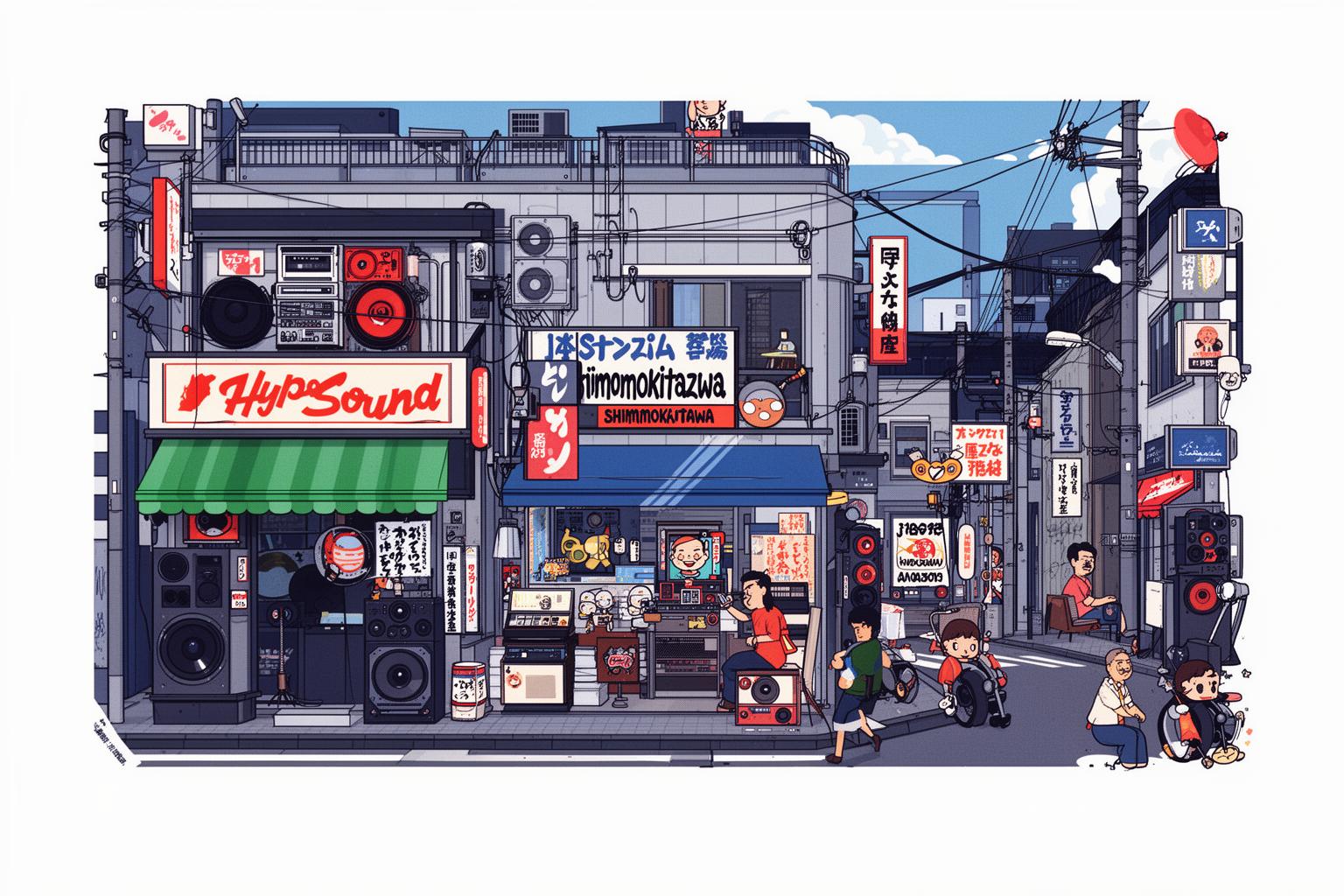
Brace yourself: a Shimokitazawa record store is rarely a spacious, brightly lit retail space. More often, it’s a beautifully cluttered cave of wonders. Space is limited in Tokyo, and these shops utilize every square centimeter. Records are stacked from floor to ceiling, spilling out of their bins, and piling up on countertops and in hallways. Maneuvering through the narrow aisles with a tote bag requires a certain spatial awareness.
This density contributes to the charm. It signals a seriousness of purpose. These aren’t curated lifestyle boutiques; they are archives, run by people who breathe and live music. The organization can vary from meticulously alphabetized and genre-sorted to completely chaotic. In some shops, you’ll find pristine, plastic-sleeved treasures. In others, you might have to dig through dusty, unpriced boxes in a corner to locate what you want. This is the essence of the “dig.” It’s an active, physical search, not a passive scroll through a website. The store owners are often legendary figures themselves. They might be quiet, almost intimidatingly so, but their knowledge is encyclopedic. Their curation is their voice. They are the guardians of the groove.
The Crate-Digger’s Code: How to Hunt in Japan
Digging for records in Japan follows a slightly different set of social customs compared to many Western countries. It’s a focused and respectful activity, and being aware of the local etiquette will make the experience smoother and more enjoyable. This is not merely about purchasing items; it involves engaging with a culture that deeply values physical media.
The Art of the Flip
The experience inside the store is a quiet ritual. You select a section of records, find a small spot on the floor or a countertop to call your own, and begin flipping through them. The mood is often one of intense but shared focus. Most serious shops have one or two listening stations—turntables with headphones where you can preview potential buys. There may be a line, so be patient and avoid monopolizing the station. Limit yourself to a few tracks per record before deciding.
One key point to remember is how you handle the records. Japanese collectors are renowned for being meticulous about the condition of their vinyl. It’s common to come across 40-year-old records that look as if they were pressed yesterday. This respect for the medium is contagious. Handle the records by their edges, gently slide the vinyl out of the inner sleeve, and place it on the turntable with care. When finished, return everything exactly as you found it. This unspoken reverence for the material is crucial.
Reading the Room (and the Obi Strip)
As you browse, you’ll quickly spot a unique feature of Japanese LPs: the obi. This is a paper strip or sash wrapped around the left side of the album cover. Originally a marketing tool, it provided information about the album—track listings, price, promotional text—in Japanese for the local market. Today, the obi is highly prized by collectors. A record with its original obi intact is far more valuable and desirable than one without. It signifies a complete, well-preserved copy.
Beyond the obi, note the legendary quality of Japanese pressings themselves. In the 70s and 80s, Japanese manufacturers often used higher-grade, virgin vinyl, resulting in quieter, cleaner sound with less surface noise. This superior audio quality is a major reason DJs and audiophiles seek out these pressings. Learning to recognize labels of leading Japanese record companies from that era—such as Nippon Columbia, Toshiba EMI, or Victor—can be very helpful.
To Talk or Not to Talk?
If you’re used to the friendly, chatty atmosphere of a neighborhood record store in London or Los Angeles, the quietness of a Tokyo shop may feel striking. Small talk is not the norm. The store owner might greet you with a soft “irasshaimase” (welcome) upon entry, but that’s often the extent of the interaction unless you ask a specific question. This is not rudeness; it reflects a culture that values concentration and respects personal space.
Haggling is definitely not practiced. Prices are fixed and deemed fair based on the record’s condition and rarity. The owner’s expertise is reflected in their pricing and curation, not in sales tactics. The best way to show appreciation is to handle the records with respect, make your choices, and pay quietly. A simple “arigatou gozaimasu” (thank you very much) as you leave is sufficient. The connection is made through a shared love of music, rather than small talk.
Key Digging Spots: A Curated Tour
Listing every record store in Shimokitazawa would be pointless—they open, close, and relocate with dizzying speed. Instead, it’s more helpful to consider the shops by type. Here are a few essential stops that showcase the different aspects of the Shimokita digging experience.
The Institution: Disk Union
Disk Union is a chain, but it operates unlike any other. It’s the foundation of Japan’s second-hand music scene. Each location is highly specialized, and the Shimokitazawa branch is a must-visit first stop. It’s spacious, well-lit, and meticulously organized, making it an ideal introduction for newcomers. The Wamono section is clearly labeled and extensive, offering a superb overview of the genre. Prices are reasonable, and the record conditions are consistently graded. While the rarest, most obscure private-press records might not be here, you’ll find a rich, satisfying selection of classics. It’s the perfect place to start building a collection.
The Specialist’s Den: Flash Disc Ranch
For a completely different experience, visit Flash Disc Ranch. This place is legendary. Walking in feels like entering a private, obsessive collection that has morphed into a shop. It’s an overwhelming, floor-to-ceiling vault of vinyl, with a strong emphasis on rock, psych, and folk from the ’60s and ’70s. Discovering the Japanese gems here takes some effort—you’ll need to get down on your hands and knees and really search. The owner is a true expert. The store is cramped and dusty, offering one of the most thrilling and authentic digging experiences possible. This is where you go for deep cuts—unheard tracks that may change your life.
The New Wave: General Record Store & Others
Responding to the renewed interest in vinyl, several other shops provide a more modern, curated experience. General Record Store, for example, offers a carefully chosen selection that often highlights City Pop and other popular Wamono subgenres. The atmosphere is more relaxed, and the staff tend to be younger and more familiar with international visitors. These stores are ideal for finding well-known classics in excellent condition. They understand the current market well and usually have a display section dedicated to the most sought-after titles, saving you some searching if you’re short on time but have a generous budget.
Why Here, Why Now? The Global Resonance of a Local Sound
Standing in a store in Shimokitazawa, holding a 40-year-old Japanese soul-funk record, you might wonder: why has this music, so deeply connected to a particular time and place, suddenly attracted such a passionate global following? The explanation lies in a captivating blend of technology, psychology, and the timeless charm of great music.
The YouTube Algorithm and the Rediscovery
The story of the Wamono revival cannot be told without the internet. For decades, this music was a local secret, known only to a small group of dedicated collectors outside Japan. Then, digital platforms began to reveal it. DJs and producers sampling these records left a trail of breadcrumbs. But the true catalyst was the enigmatic workings of YouTube’s recommendation algorithm. It began suggesting tracks like “Plastic Love” to millions who weren’t actively searching for them, sparking an immediate, worldwide cult following. This was a rediscovery on an enormous scale, completely bypassing traditional music industry gatekeepers.
Nostalgia for a Future That Never Was
There is a deeper, more emotional reason behind its appeal. The sound of Wamono, particularly City Pop, evokes a very distinct feeling. It represents an imagined nostalgia for an era of sleek, analog technology and limitless urban possibility. It’s a vision of late-20th-century Japan—a clean, safe, and prosperous cityscape viewed through a soft-focus lens. For listeners who never experienced that time, it offers an escape to a past that seems more optimistic and refined than our turbulent present. It serves as the soundtrack to a future that never quite arrived, making it endlessly captivating.
The Collector’s Quest
Ultimately, searching for these records in a place like Shimokitazawa is a way to make that fantasy feel real. In an era dominated by fleeting digital streams, holding a beautifully crafted LP is a powerful experience. It’s a tangible link to the artists, designers, and engineers who brought it to life. You’re not merely consuming content; you’re preserving a piece of cultural history. Every record you discover carries its own story—of where it has been, who owned it, and how it survived. The act of digging through thousands of sleeves, hoping to find that one perfect groove, is the true reward. You leave Shimokitazawa with more than just a bag of records; you leave with a piece of a lost and beautiful world.