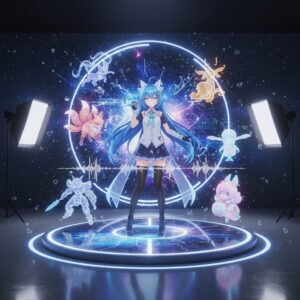
You’ve probably seen the image, even if you couldn’t place it. A stadium pulsing with thousands of glow sticks, a roaring crowd, and on stage, a band is playing full-tilt. But the singer, the focus of all this adoration, isn’t there. Not really. In her place is a shimmering, holographic girl with impossibly long teal pigtails, singing her heart out. This is Hatsune Miku, and the scene isn’t from a science fiction movie. It’s a real concert, one of many she’s sold out across the globe. The obvious question is: how did a piece of software, a disembodied voice with a cartoon avatar, become one of the 21st century’s most fascinating and legitimate pop icons? It’s a question that gets at the heart of Japan’s modern subcultures, its relationship with technology, and its unique vision of celebrity.
To understand Miku is to understand that she is not a character from an anime, nor is she an advanced AI making creative decisions. She began life in 2007 as a product: a voice synthesizer built on Yamaha’s Vocaloid 2 engine by a small Sapporo-based company called Crypton Future Media. They sampled the voice of a human actress, Saki Fujita, and turned it into a digital instrument. The idea was simple: give amateur musicians a high-quality female vocal they could use in their own compositions without hiring a real singer. The anime-style character on the box was just clever marketing—a face for the voice. But what happened next, nobody could have predicted. That character, that empty vessel, was filled with the creative energy of a million fans, sparking a grassroots revolution that redefined music production, fandom, and the very nature of a pop star. This isn’t just a story about a virtual singer; it’s the story of how a subculture built its own idol from the ground up, on a uniquely Japanese digital stage.
Miku’s unparalleled ascent in the digital realm resonates with the vibrant energy found in Japan’s stamp rallies, where traditional enthusiasm meets modern innovation.
The Voice Without a Body

Before becoming a phenomenon, Miku first had to be a product—and that product was a smart evolution of existing technology. Yamaha’s Vocaloid software had existed since 2004, but it was a niche tool aimed at professional musicians. While functional, it lacked personality. Early English and Japanese voicebanks, codenamed Leon, Lola, and Meiko, were marketed solely as software. They had no official avatars, no backstory, and no inherent appeal beyond their utility.
Crypton Future Media recognized an opportunity. They understood a key aspect of the Japanese market: character is king. A product, especially one targeting a creative and otaku-oriented audience, sells better when it has a face, a name, and a trace of personality. Preparing to launch their next Japanese voicebank, they didn’t just promote software; they promoted a person. They commissioned artist Kei Garou to design a character for the voice. The brief was futuristic and tech-inspired, resulting in the iconic look we recognize today: teal pigtails tied with digital ribbons, a sleeveless, school-uniform-style top featuring a synthesizer interface motif, thigh-high boots, and the official character number “01” on her arm, marking her as the first in the “Character Vocal Series.”
They named her Hatsune Miku (初音ミク). The name itself was a declaration: Hatsu (初, first), Ne (音, sound), and Miku (ミク, future)—the “First Sound from the Future.” It was brilliant branding. Her official profile was minimal yet evocative: she’s 16 years old, 158 cm tall, and weighs 42 kg. That was all. Crypton intentionally left her personality a blank canvas—not an oversight but a stroke of genius. They provided the vessel—a high-quality voice and an appealing avatar—and then stepped back, leaving the vital work of defining who Miku was to the users.
When the software launched on August 31, 2007, it became an immediate and unprecedented success. It sold rapidly, to Crypton’s surprise. Amateur and semi-professional musicians, who had previously been confined to creating instrumental tracks or using their own often-imperfect vocals, now had access to a tireless, pitch-perfect virtual singer. She was an enabler, unlocking a new realm of creative potential. But the true explosion didn’t happen in private studios—it happened publicly, on a chaotic, vibrant, and uniquely Japanese corner of the internet.
The Platform Becomes the Star: Nico Nico Douga and the Creative Explosion
To grasp Miku’s rapid ascent, it is essential to understand the role of Nico Nico Douga. Launched in 2006, Nico Nico Douga (NND) was Japan’s version of YouTube, but with a key distinction. It wasn’t merely a video hosting platform; it offered a communal viewing experience. Its hallmark feature is the `danmaku` (弾幕, meaning “bullet curtain”), where user comments stream across the video in real-time, layered on top of the footage. Watching a popular video on NND is far from passive. It’s like sitting in a theater filled with a lively, witty, and highly responsive audience. You witness jokes, praise, and memes from other viewers appear exactly when they are typed, creating a shared, living archive of the community’s reactions.
This environment was the ideal breeding ground for a phenomenon like Hatsune Miku. By late 2007, NND was already a bustling center for otaku subcultures, brimming with anime parodies, video game music remixes, and other user-generated content. When Miku emerged, the community embraced her almost immediately.
It began simply. A user uploaded a video of a leek-twirling Miku avatar singing a cover of the Finnish folk song “Ievan Polkka.” It was quirky, catchy, and quickly went viral on the site. This video laid down an early and crucial part of Miku lore: her connection with leeks. More importantly, it showcased her potential for meme-ability. Before long, creators—who added the suffix “-P” (for Producer) to their usernames—started uploading original songs.
A Symphony of Amateurs
This is where the true magic started. A music producer, let’s call him Baker-P, would compose a song and use the Miku software for the vocals. Since he wasn’t a visual artist, he might include just a single, static illustration of Miku in the video. The song would be uploaded to NND. Immediately, `danmaku` comments would flood the screen: “This is amazing!” “The lyrics are so relatable!” “Someone should make a better picture for this!”
And someone would respond. An aspiring illustrator, inspired by the song, would create their own interpretation of Miku as depicted in the lyrics and upload it to an image-sharing site like Pixiv. Another fan might then take that illustration—or a series of them—and produce a more polished music video. Someone else might choreograph a dance routine for the song and upload a video of their performance. Others might sing their own cover (`utattemita`) or play an instrumental version on the piano (`hiitemita`).
This became a self-sustaining creative cycle. Each new piece of content branched out from the original song, all interconnected through tags and links on NND. Miku’s identity wasn’t shaped top-down by Crypton; it was pieced together bit by bit by thousands of individual creators. One producer’s song might depict her as a heartbroken girl, another as a rock-and-roll goddess, a third as a surreal, nonsensical comedian. All of these portrayals were valid. Miku wasn’t a single character; she functioned as a platform, an open-source persona. Her personality was the sum of every song, illustration, and animation ever created of her. Songs that became massive hits on NND, like Ryo (Supercell)’s “Melt” or “World is Mine,” weren’t merely popular tracks; they became foundational texts in the Miku canon, shaping her personality for millions of fans—all without any direct official influence from her corporate owners.
The Cultural Soil: Why Japan?

The explosion of user-generated content was astonishing, but it prompts a deeper question: why did it happen so intensely in Japan? A virtual pop star could have theoretically emerged anywhere. The fact that it occurred in Japan, and in this particular way, is no coincidence. It stems from several deeply rooted cultural currents.
The Idol Industrial Complex
Japan has a longstanding and deeply embedded idol culture. Idols are more than just singers; they are carefully crafted personalities marketed on an image of purity, accessibility, and relentless positivity. Groups like AKB48, with their “idols you can meet” concept, built empires on fans who invest emotionally and financially in the careers of these young women. However, the idol industry is founded on a fragile fantasy. Human idols are imperfect—they age, tire, make mistakes, and sometimes get embroiled in scandals that destroy their carefully maintained image. Fans live with the constant risk that their idealized vision will be shattered by reality.
Hatsune Miku is the perfect idol. She embodies the ultimate realization of the idol concept, liberated from the constraints of a human body. She remains perpetually 16, never falls ill, never utters the wrong thing, and will never be caught on a tabloid date. She is a flawless, scandal-proof vessel for fan projection. She can perform thousands of songs expressing countless emotions, yet her core identity stays pure and untarnished. For a fandom conditioned to seek an idealized, untouchable kind of celebrity, Miku was the natural conclusion. She offered all the emotional attachment of a human idol without any risk of disappointment.
Character over Celebrity
Beyond idols, Japanese popular culture displays a profound fluency in and affection for fictional characters, or `kyara`. From Hello Kitty to the mascots representing every prefecture and corporation (`yuru-kyara`), characters are an integral part of everyday life. People are accustomed to forming emotional connections with well-designed, non-human entities. These characters offer a stable, reliable source of comfort and identity that fickle human celebrities often cannot provide.
Miku represents the ultimate `kyara`. She embodies what cultural critic Hiroki Azuma calls a “database” structure. She has a set of core design elements (the pigtails, the color scheme, the voice) that are instantly recognizable. However, her personality, stories, and emotions are not fixed; they are derived from the vast database of user-generated songs and art. Fans don’t have to love every Miku song—they can pick and choose the Miku that resonates with them: the melancholic Miku of one producer, the defiant rock Miku of another. This enables a deeply personalized form of fandom. You aren’t just a fan of Miku; you’re a fan of your Miku, constructed from your favorite songs and creators. This modular, customizable personality makes her far more adaptable and enduring than any single, top-down narrative ever could be.
The Rise of the “Prosumer”
Finally, Miku’s success is inseparable from the ethos of otaku culture itself. Otaku are not passive consumers. For decades, this subculture has been characterized by active participation. Events like Comiket, the world’s largest fan convention, revolve around the creation and sale of `doujinshi`—fan-made comics, novels, and art that reinterpret or expand upon existing commercial properties. This is a culture of “prosumers,” individuals who both consume and produce media.
Hatsune Miku was the perfect tool for this already existing creative impulse. She essentially transformed music production into a form of `doujinshi`. She provided a shared universe and a central character, inviting everyone to write their own stories for her. The barrier to entry was relatively low—you didn’t need a recording studio or a record deal, just a computer, the Vocaloid software, and an idea. This democratized music creation and gave a voice—quite literally—to a generation of bedroom producers who might otherwise have remained unheard. Miku didn’t just create songs; she created creators. Many of Japan’s most successful musicians today, like Kenshi Yonezu and the group Yoasobi, began as Vocaloid producers on Nico Nico Douga.
From Digital Ghost to Global Phenomenon
For the first several years, Hatsune Miku existed solely as an online phenomenon, a huge star within the confines of NND and its associated subcultures. However, the overwhelming quantity and quality of creative output eventually compelled the mainstream world to take notice. The digital apparition was on the verge of becoming physical.
The Live Concert Paradox
The concept of a Hatsune Miku “live” concert seems inherently contradictory. How can a software program perform live? The answer was both technologically impressive and conceptually ingenious. Using an advanced rear-projection screen that is mostly transparent (often a DILAD screen or similar technology), a 3D model of Miku is projected onto the stage. To the audience, it looks like a life-sized, three-dimensional hologram is singing and dancing, accompanied by a band of very real, highly skilled human musicians.
The first concert of this kind, held in 2009, was a landmark event. It demonstrated that the emotional bond fans had formed with Miku online was strong enough to fill a physical venue. Experiencing a Miku concert is surreal. The crowd is a sea of green glow sticks, one for each fan, moving in perfect harmony. They sing along to songs not crafted by corporate executives, but by their peers, fellow fans who started in their bedrooms. The concert isn’t about convincing people that Miku is a real girl on stage. It’s a celebration of the community itself. It’s a pilgrimage, a ritual where the collective digital creation becomes tangible for a few hours. The applause is not just for the hologram; it’s for the thousands of producers, artists, and animators who brought her to life.
Corporate Co-option and Artistic Integrity
As her popularity increased, corporations took notice. Miku appeared in commercials for Toyota and Google Chrome. Sega created a highly successful series of rhythm games (Project DIVA) based on her songs. She transformed into a legitimate commercial entity, far removed from her niche internet beginnings. This could have marked the end of the grassroots magic—a classic tale of a subculture being sanitized and commodified by the mainstream.
But it didn’t, largely due to the foresight of Crypton Future Media. Early on, they established a non-commercial license called the Piapro Character License (PCL). This essentially granted creators broad permission to use Miku’s image and name in their own non-profit fan works without fear of copyright infringement. This simple measure protected the fertile ground of the `doujin` scene. It showed the community that Crypton recognized Miku’s value came from them. For commercial ventures, Crypton serves as a gatekeeper, ensuring her image is used appropriately, but they have always respected the fan-driven ecosystem that made her a star. This balance between corporate oversight and grassroots freedom is a key reason for her enduring relevance.
Miku’s Legacy: The Post-Human Pop Star

Hatsune Miku is no longer just a novelty. She has performed alongside symphony orchestras, opened for Lady Gaga, and become an established figure in contemporary art. Her influence is indisputable. She demonstrated that a pop star can be decentralized, crowdsourced, and open-source. Her identity, shaped by a million voices, is more resilient and multifaceted than any single human celebrity could ever achieve.
Perhaps her greatest legacy is paving the way for today’s media landscape. The entire VTuber phenomenon—virtual YouTubers who use animated avatars to stream and perform—is a direct offshoot of the Miku model. Companies like Hololive and Nijisanji have cultivated enormous global audiences using the same core idea: a charismatic avatar as a medium for performance. The difference is that VTubers have one human operator behind the scenes, whereas Miku is operated by everyone. She is the original VTuber, the ghost in the machine that revealed what was possible.
Ultimately, asking whether Hatsune Miku is “real” misses the point. She is not a fake singer pretending to be human. She is a new kind of instrument, a collaborative canvas, a cultural platform. She embodies a fundamental shift in the source of art—not arising from a solitary genius, but from the networked creativity of a community. She is the sound of the future, as her name always suggested—a future where anyone can compose a song for the world’s biggest pop star. All it takes is an idea.