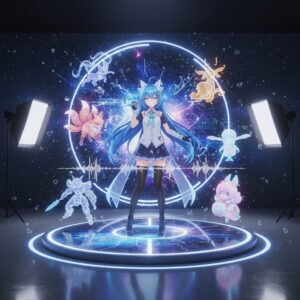
Picture a sold-out stadium, thousands of fans roaring, waving glow sticks in perfect, synchronized rhythm. On stage, bathed in holographic light, the star sings and dances. She’s a pop idol in every sense of the word. Except she isn’t real. She’s a high-fidelity anime character, a digital avatar controlled in real-time by a human performer hidden from view. This isn’t a scene from a sci-fi movie; it’s a Tuesday night in the world of Virtual YouTubers, or VTubers. What started as a niche experiment in a corner of the Japanese internet has exploded into a multi-billion dollar industry and, arguably, one of Japan’s most significant cultural exports of the last decade. The question is, how? How did watching cartoon characters play video games and chat with an audience become a global phenomenon? The answer is a fascinating blend of technology, deep-seated cultural norms, and a clever reimagining of what it means to be a star in the 21st century. It’s a story about the freedom of anonymity, the power of community, and the surprising humanity found behind a digital mask.
The explosive rise of VTubers, driven by innovative digital expression and deep-rooted cultural influences, mirrors the transformative pulse found in Japan’s nostalgic arcade spaces, as seen in the subtle social dynamics of arcade culture.
The Genesis of a Digital Being

Kizuna AI: The Self-Proclaimed ‘World’s First’
To understand the VTuber phenomenon, you have to begin with the one who broke new ground. In late 2016, a YouTube channel emerged featuring a lively, energetic anime girl with a pink bow named Kizuna AI. Her debut video was a self-introduction, but instead of a creator unveiling their new avatar, she presented herself as a sentient, super-intelligent AI. The concept was ingenious. She wasn’t simply a person using an avatar; she was the avatar. This framing captivated viewers. Her content blended typical YouTuber elements—video game streams, Q&A sessions, trending challenges—but all through this distinctive persona.
Kizuna AI wasn’t technically the first to use a virtual avatar for content, but she was the one who codified the format and gave it a name. By calling herself a “Virtual YouTuber,” she coined the term that would come to define an entire industry. Her videos, professionally produced with polished editing and scripted comedy, set a new standard. She felt like an anime character who had suddenly come to life and started a YouTube channel. This novelty was huge, and her subscriber count soared, demonstrating a vast, untapped audience for this new form of entertainment. She became the digital pioneer—the proof of concept that launched countless digital ventures.
The First Wave: From Pioneer to Pantheon
Kizuna AI’s success did not go unnoticed. Shortly after her debut, a wave of similar virtual personalities appeared. This initial group, including figures like Kaguya Luna, Mirai Akari, Dennou Shojo Siro, and Nekomiya Hinata, would later be affectionately known as the Shitennō, or “Four Heavenly Kings,” a term borrowed from Buddhism and commonly used in Japanese pop culture to denote a top-tier group of four. Alongside Kizuna AI, they formed the first pantheon of virtual stars.
This period was marked by experimentation. Creators were still exploring the medium. Most content was pre-recorded and heavily edited, much like Kizuna AI’s. The emphasis was on short, easily digestible videos, comedy skits, and music covers. Though the technology was still evolving, the core appeal was already clear: the seamless blend of an engaging character with a captivating personality. The term “VTuber” quickly lost its original meaning of a literal “virtual AI” and became a catch-all for any content creator using a digital avatar. The foundation had been laid, but the true surge was yet to come, driven by a shift from polished videos to the chaotic, unpredictable, and deeply engaging world of live streaming.
The Corporate Machine: Building the Idol Factory
The Rise of the Agencies: Hololive and Nijisanji
The initial VTuber boom was mostly made up of independent creators or those supported by small tech startups. The next stage, however, was marked by the emergence of two major corporations that professionalized and expanded the industry: Cover Corporation’s Hololive Production and ANYCOLOR Inc.’s Nijisanji. These companies didn’t just manage talent; they crafted entire universes.
They functioned like a blend of a tech startup and a traditional Japanese talent agency. They conducted rigorous auditions, seeking not only skilled voice actors but also charismatic entertainers with unique talents—whether in gaming, singing, art, or simply possessing a magnetic personality. Once selected, talents were given professionally designed 2D or 3D avatars, the necessary technology to operate them, and the marketing power of a prominent brand. This agency model lowered the barrier to entry; aspiring creators no longer needed to be tech experts and exceptional artists—they just had to be entertaining.
Nijisanji, one of the earliest major forces, emphasized a large and diverse roster, pioneering the use of more accessible 2D models with Live2D software. This approach enabled them to debut a massive number of talents, fostering a dynamic environment where interactions and collaborations between “Livers” (their term for streamers) became a key attraction. Hololive, by contrast, embraced the idol concept more deeply. Their talents were organized into distinct “generations,” much like J-pop groups, focusing on music, concerts, and cultivating a polished, aspirational brand that strongly appealed to idol and anime fandoms.
The Live Stream Revolution
This agency-driven era also coincided with the industry’s major shift from pre-recorded videos to live streaming, which changed everything. Early VTuber content was often scripted and controlled, while live streams were raw, interactive, and unpredictable. A three-hour stream of a VTuber struggling to defeat a tough video game boss wasn’t just about the game; it was about sharing the experience. Viewers could engage directly with the performer via live chat, and the performer could respond instantly. This feedback loop fostered a powerful sense of intimacy and community.
Monetization tools like YouTube’s Super Chats, allowing fans to pay to highlight messages, became central to the culture. It was a direct, tangible way for fans to support their favorite creators and, for a moment, gain their direct attention. This interactive model transformed passive viewers into active participants. The content was no longer merely a performance to watch; it became a shared space where fans and performers built relationships over hundreds, even thousands, of hours of live interaction. This transformation is arguably the single most vital factor behind the VTuber industry’s explosive growth.
The Person in the Machine: Naka no Hito
Behind every avatar is a real person, known in Japanese as the naka no hito (中の人), or “the person inside.” This is the fundamental, unspoken truth of the VTuber world. Although fans and companies maintain the illusion that the character is real, everyone recognizes that a human performer is controlling the avatar. This creates a compelling dynamic.
The appeal comes from the delicate balance between the character’s lore and the performer’s personality. The avatar is the medium, but the human’s wit, emotions, and talent bring the character to life. A clumsy, airheaded character might be portrayed by an exceptionally skilled gamer. A cool, stoic warrior might have a surprisingly silly and gentle disposition. These charming contradictions are where fans find the “humanity” within the virtual persona.
The avatar acts as a shield, offering the performer anonymity and shielding them from the harsh scrutiny typically directed at the physical appearance of traditional celebrities. At the same time, it serves as a performance tool, an instrument through which their personality shines uniquely. The success of a VTuber is the perfect fusion of a captivating character design and the irreplaceable soul of the person inside.
The Cultural Soil: Why This Could Only Start in Japan

The History of Avatars and Anonymity
The concept of engaging online through an avatar is not new, but in Japan, it is deeply embedded in the internet culture. For decades, large online communities such as 2channel (now 5channel) thrived on anonymity. Users were recognized not by their real names or faces but by usernames and the content of their posts. This created a culture where the value of one’s ideas or the wit in their comments mattered more than their real-world identity.
This cultural ease with separating one’s online persona from their physical self is a vital part of the story. It connects to broader social ideas like honne (本音), meaning one’s true thoughts and feelings, and tatemae (建前), the public facade maintained for social harmony. For many, the anonymity an avatar offers gives a safe space to express their honne without fear of social consequences in face-to-face interactions. A VTuber avatar represents the ultimate tatemae, a public mask that, paradoxically, allows performers to be more authentically themselves than they might be otherwise.
Anime as a Universal Language
The rise of VTubers is inseparable from the global influence of anime. The visual style—large expressive eyes, dynamic hair, and stylized designs—is instantly recognizable and adored by millions worldwide. VTubers didn’t have to create a new visual language; they simply harnessed one that was already a powerful global cultural phenomenon.
This gave them a significant edge. An anime-style avatar is immediately attractive to a massive pre-existing global subculture. People unfamiliar with VTubers might still click on a thumbnail drawn to the character’s design. This aesthetic carries with it established expectations and cultural shorthand, enabling viewers to quickly understand character archetypes—the energetic genki girl, the cool older sister, the mischievous gremlin. It provided an effortless entry point for a global audience already inclined to love characters who seem to step right out of their favorite anime.
Digitally Perfected Idol Culture
The VTuber model also draws heavily from Japan’s long-standing idol industry. Traditional idol groups like AKB48 or those managed by Johnny & Associates are founded on more than music alone. They depend on the parasocial relationship between idol and fan. Fans don’t just purchase albums; they buy merchandise, attend handshake events, and vote in “elections” determining a member’s popularity. They feel personally invested in the idol’s journey and success.
VTubers take this model and elevate it digitally. The live stream chat replaces the handshake event. Super Chats serve as the modern popularity poll. Supporting a VTuber from debut and watching their growth reflects the experience of backing a rising idol. However, the virtual nature of VTubers addresses some of the inherent “problems” of the traditional idol world. A virtual idol never ages and is less prone to real-world scandals that might damage their image. They can perform feats impossible for humans, like instantly changing outfits or possessing magical powers within their lore. In many respects, they are the idealized, perfected evolution of the idol concept, liberated from the constraints of the physical world.
The Leap to Global Phenomenon
The Pandemic as a Catalyst
Although VTubers were already steadily gaining popularity, the global COVID-19 pandemic in 2020 acted as a powerful accelerator. With lockdowns in place worldwide, people found themselves isolated, bored, and seeking connection and entertainment. Live streaming, in general, experienced a massive surge, and VTubers were ideally positioned to attract this new, captive audience.
Their streams offered not only consistent entertainment but, more importantly, a sense of community. Watching a VTuber play games for hours became a comforting daily routine for many. The live chat function transformed into a virtual living room where people from across the globe could come together and share experiences. In a period marked by deep social isolation, VTubers provided a vibrant, welcoming, and endlessly engaging digital space to inhabit.
Fan Translators: The Unsung Heroes
The initial global expansion of VTubers was driven not by corporate marketing but by a dedicated grassroots fandom. Since most content was in Japanese, international fans took it upon themselves to translate and subtitle short, funny, or impressive clips from lengthy streams. These “clippers” played a crucial role, acting as cultural intermediaries who curated the best moments and made them accessible to non-Japanese-speaking audiences.
A viewer in North America or Europe might not watch a four-hour Japanese stream but would eagerly watch a two-minute clip of a cute anime girl hilariously failing at a game or delivering an unexpectedly powerful vocal performance. These clips went viral, serving as a gateway that brought millions of new fans into the “VTuber hole.” This fan-led movement revealed the significant international demand, encouraging agencies like Hololive and Nijisanji to launch official English-speaking branches.
Hololive English and the Tsunami of Success
The launch of Hololive English in late 2020 marked a turning point. It definitively showed that the VTuber phenomenon was not merely a Japanese cultural curiosity but a universally appealing form of entertainment. The first generation, particularly shark-themed Gawr Gura, saw unprecedented growth. Within months, Gura became the most subscribed VTuber worldwide, surpassing even Kizuna AI. The success of Hololive EN and later Nijisanji EN established a solid global presence for the industry. While the format remained the same, presenting it in English removed the last barrier to entry for a vast segment of the global audience. VTubing was no longer just a Japanese export to be observed from a distance; it had become a global culture anyone could take part in.
The Enduring Appeal: Finding Humanity in the Virtual

So, who is this meant for? Why do millions of people consistently tune in to watch digital avatars? The answer lies in the fact that VTubers satisfy a deeply human desire for connection, storytelling, and community through a digital-native medium. Their appeal is multi-faceted. For some, it’s about the entertainment value. These are skilled singers, expert gamers, and hilarious comedians who just happen to perform using avatars.
For others, it’s about the sense of community. Fanbases are highly active, producing art, memes, music, and organizing projects to support their favorite creators. Being a VTuber fan is an engaged, creative, and social pastime. For many more, it’s about the unique parasocial relationship. Following a VTuber is like watching a long-running TV series, but with a main character who can interact with you directly. You become emotionally invested in their stories, ambitions, friendships with other VTubers, and personal growth over years of streaming.
The freedom of the avatar is another crucial element, benefiting both the audience and the performer. It offers a form of escapism, a respite from the stresses of the physical world. For creators, it removes biases and judgments tied to physical appearance, allowing their talent and personality to be the focus. It democratizes entertainment by opening doors for people who don’t fit the traditional celebrity mold to reach large audiences.
Ultimately, the magic of VTubers lies in the fascinating paradox at their heart. They are both fictional characters and real people simultaneously. They are manufactured idols and genuine entertainers. This fusion of the artificial and the authentic creates a new kind of performance, ideally suited for our increasingly digital world. VTubers are not just a passing fad; they offer a glimpse into the future of entertainment, where the boundaries between the real and virtual continue to blur, fostering new spaces for creativity, community, and connection.