What’s up, fellow adventurers! Li Wei here, and today we’re ditching the neon-drenched streets of Tokyo and the serene temple gardens of Kyoto for something way more raw, way more real. We’re talking about a journey to the literal edge of Japan, a place where the land meets the sea in the most dramatic breakup scene ever recorded in stone. I’m talking about the Oki Islands, a remote archipelago floating in the Sea of Japan, a place so geologically and culturally unique it’s been designated a UNESCO Global Geopark. And our mission, should we choose to accept it, is to get down to sea level and experience its crown jewel, the Kuniga Coast on Nishinoshima Island, from the most intimate vantage point possible: a sea kayak. Forget just looking at the scenery; we’re about to become part of it. This isn’t just a trip; it’s a deep dive into the planet’s diary, written in towering cliffs, secret sea caves, and water so clear it feels like you’re flying. The vibe here is pure, untamed nature. It’s the Earth flexing its creative muscles, and trust me, it’s a spectacle you won’t forget. It’s where the stories of volcanoes, ancient myths, and resilient islanders converge, creating a travel experience that’s absolutely next-level. So, strap in, get your paddle ready, and let’s explore this masterpiece together. It’s time to get epic.
For another deep dive into Japan’s UNESCO-recognized heritage, explore the silver mining history of Iwami Ginzan.
The Oki Islands Vibe: Stepping into Another Japan
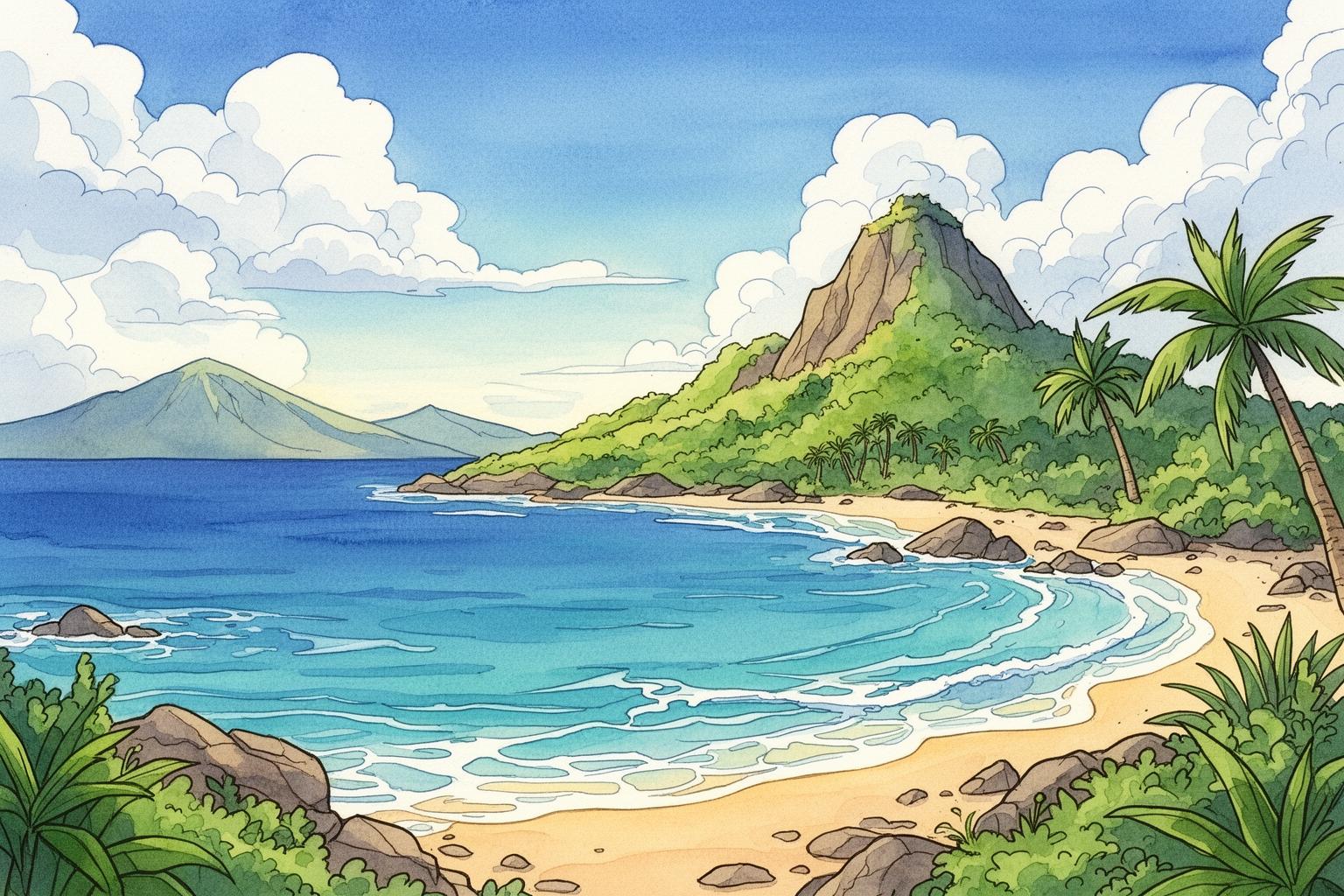
Before you even dip a paddle into the water, you need to grasp the entire atmosphere of the Oki Islands. This place operates on an entirely different wavelength. Arriving here—whether on the slow, meditative ferry crossing the Sea of Japan or the small propeller plane that hops over from the mainland—feels like stepping through a portal. The frantic, hyper-efficient energy of urban Japan dissolves into the sea mist, replaced by something slower, deeper, and profoundly connected to nature’s rhythms. Nishinoshima, one of the four main inhabited islands and home to the Kuniga Coast, perfectly embodies this sensation. There are no 24/7 convenience stores, no train stations with their familiar jingles, and the loudest sounds you’ll likely hear are the cry of a black-tailed gull or the lowing of a cow. This is no exaggeration; on Nishinoshima, cows and horses roam freely across vast green pastures covering the island’s volcanic slopes. They are the true locals, grazing casually right up to the edge of terrifyingly high cliffs, completely unbothered.
The ambiance is one of profound tranquility and rugged self-reliance. The small fishing villages scattered along the coastline seem as if they’ve stood for centuries, with weathered wooden houses clustered around sheltered harbors. You witness fishing boats heading out at dawn and returning with their catch, a daily rhythm that has sustained life here for generations. There is a palpable sense of community, with a genuine warmth from the islanders that is inviting and sincere. Life here is simpler, but not in a regressive way—it’s deliberate. It’s about prioritizing connection—to one another and to the powerful natural world surrounding them. From an East Asian viewpoint, it evokes the ancient Daoist ideal of living harmoniously with the ‘Tao,’ the natural flow of the universe. Here, that philosophy is not just an abstract notion; it is a reality lived day to day. This isolation has also fostered a unique culture. Oki is known for things found nowhere else, such as its distinctive style of Kagura sacred dance and a ritualistic form of bull sumo called ‘Ushitsuki,’ which is more a ceremonial display of strength than a violent contest. This cultural uniqueness directly results from its separation, allowing traditions to develop in their own beautiful, peculiar ways. So, when you come to kayak the Kuniga Coast, you are not merely visiting a natural wonder; you are immersing yourself in a microcosm of Japan that has charted its own path—a world shaped by volcano and sea.
Earth’s Architecture: Decoding the Kuniga Coast
Alright, let’s dive into the geology because, frankly, it’s the star of this whole story. The Kuniga Coast isn’t just a collection of beautiful rocks; it’s a layered chapter of Earth’s history, a dramatic tale of fire and water. The Oki Islands themselves are the remains of massive volcanic activity from millions of years ago, linked closely to the formation of the Sea of Japan. What we witness today is the outcome of those ancient volcanoes being continuously shaped by the fierce waves and harsh weather of the sea. The result is a coastline that feels like an open-air museum of geological wonders, with a sea kayak as your exclusive all-access pass.
Matengai: The Sky-Scraping Cliff
The main attraction, the highlight, is the Matengai Cliff. Its name literally means “Sky-Scraping Cliff,” and that’s no exaggeration. Towering a sheer 257 meters (about 843 feet) straight from the turbulent sea, it’s one of Japan’s highest sea cliffs. To truly appreciate its grandeur, you need to experience it from two viewpoints. First, hike or drive to the top. Standing on the grassy plateau, with those famous cows and horses grazing peacefully just feet from the dizzying drop, you feel like you’re on top of the world. The view is breathtaking, a sweeping panorama of deep blue sea extending to an endless horizon. But the true magic reveals itself from your kayak. From sea level, looking up, Matengai is colossal. It’s a monolithic wall of dark, layered rock, almost blotting out the sky. You feel completely tiny, a mere speck in this vast and powerful world. The cliff face is a tapestry of textures—rough, jagged sections, streaks of green from resilient vegetation, and dark shadows hinting at secret depths. It’s humbling and awe-inspiring, a visceral reminder of nature’s immense power.
Tsutenkyo Arch: The Bridge to Heaven
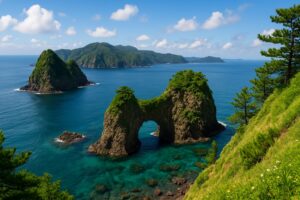
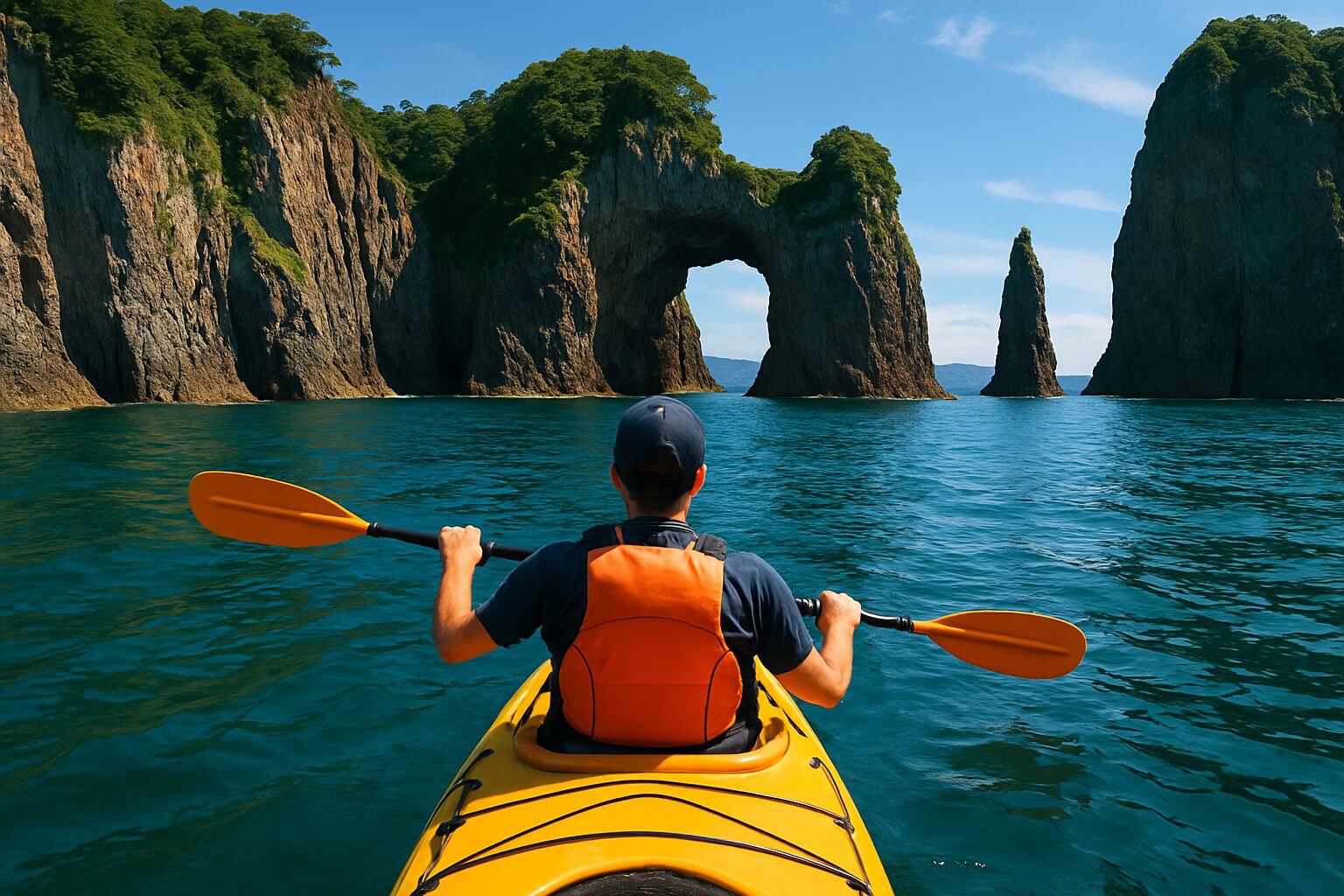
As you paddle along the base of these towering cliffs, you’ll come across Tsutenkyo Arch. Its name means “Bridge to Heaven,” and it’s easy to see why. This is nature’s answer to the grand arches of human architecture. A huge slab of rock has been patiently hollowed out by persistent wave action, forming a perfect, soaring archway that you can paddle right through. The experience is surreal. As you glide beneath the arch, the world seems to shift. The acoustics change, and the sound of your paddle echoes in the enclosed space. Light filters through, turning the water beneath you into an impossible shade of emerald or turquoise. For a moment, you’re inside the rock itself, passing from one world into another. You can clearly see the layers of volcanic rock up close, tracing lines of ancient lava flows. It’s a geological gateway, a tribute to the patient, persistent artistry of water and wind. It’s one of those moments that makes you pause, lay down your paddle, lean back, and simply soak in the sheer wonder.
Akao no Kabekake: The Wall of Red Fire
Further along the coast, the color palette shifts dramatically. You’ll encounter Akao no Kabekake, the “Red Wall.” This stretch of cliff is a stunning spectacle of vibrant color. The cliffs here are made of oxidized scoria and volcanic breccia, meaning the iron in the rock has rusted over millions of years, painting the entire cliff face with brilliant shades of red, orange, and ochre. It looks like a massive abstract painting or as if the volcano’s fiery core still glows within the rock. The intensity of color changes with the light. In the soft morning glow, it’s a warm, earthy red. But during the golden hour before sunset, it blazes with a fiery intensity that seems almost unreal. From your kayak, you can approach close enough to see the texture—the crumbly surface of the red rock contrasting with the dark, solid basalt around it. It’s a visual feast and a powerful reminder of the chemical and elemental forces that shaped this landscape. You’re not merely seeing a red cliff; you’re witnessing the story of oxidation, of fire meeting air and water over millions of years.
The Kayak Chronicles: A Journey Along the Coastline
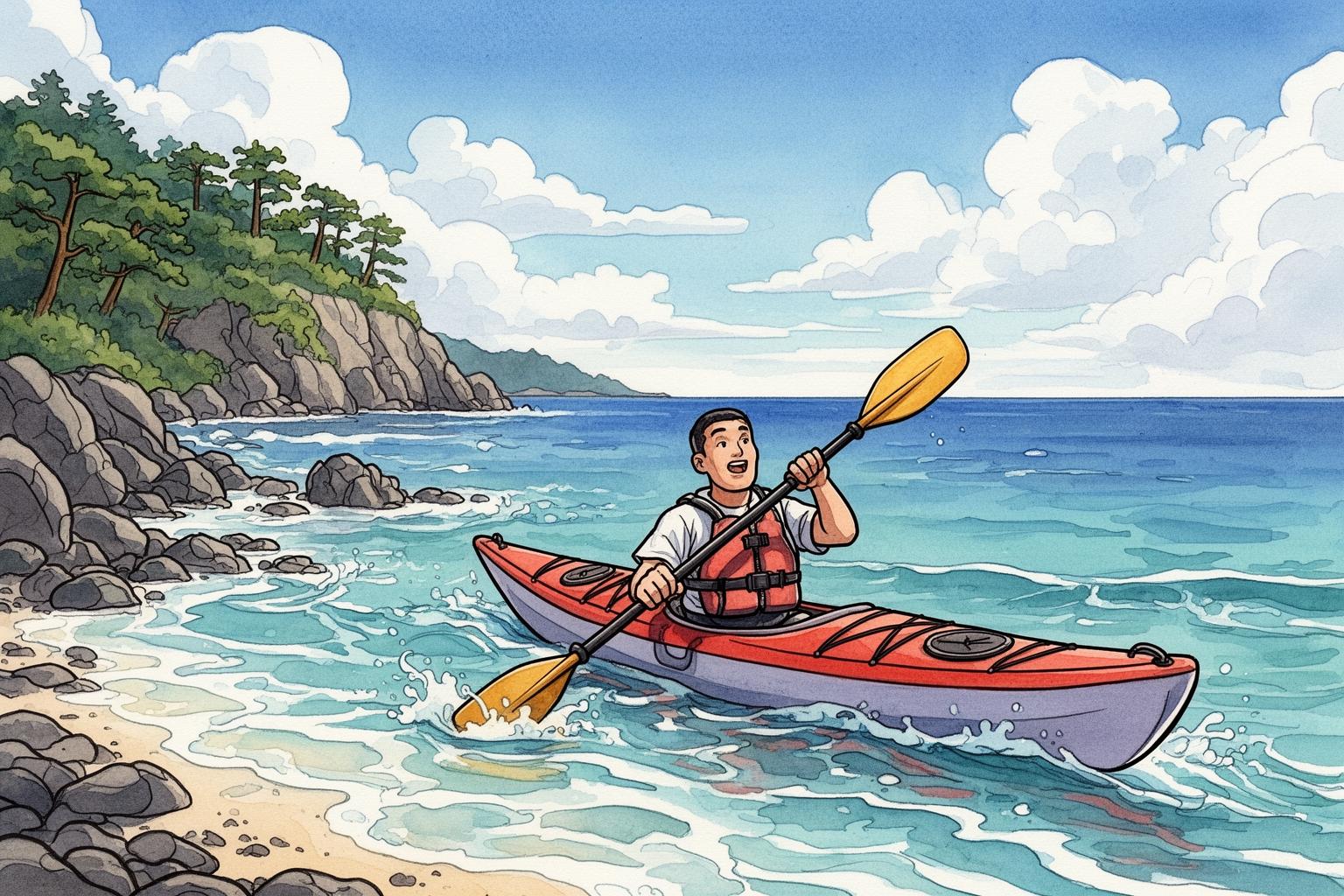
This is where the true adventure begins. Entering a sea kayak here is more than just a leisure activity; it’s the key that reveals the Kuniga Coast’s most intimate secrets. Paddling along this shoreline engages your entire body and senses, immersing you in a world unreachable by any other means.
Gearing Up and Setting Off
Your journey begins at a tranquil bay, where your guide will brief you. Safety is crucial, as the Sea of Japan can be unpredictable. You’ll be equipped with a life vest, a spray skirt to keep you dry, and a paddle. The kayaks are stable and surprisingly simple to maneuver, even for first-timers. The initial paddle strokes feel significant. As you push away from the shore, you leave solid ground behind. The water is often astonishingly clear, revealing the rocky seabed and darting schools of small fish. A moment of pure bliss arrives as you find your rhythm, the gentle plop-swoosh of your paddle turning into a meditative mantra. Gliding out of the sheltered bay, the vastness of the Kuniga Coast suddenly becomes apparent. The cliffs, impressive from afar, now tower over you like ancient giants. The adventure has officially begun.
Into the Dragon’s Lair: Discovering Sea Caves
One of the ultimate highlights of kayaking here is exploring the numerous sea caves at the base of the cliffs. These aren’t mere indentations in the rock; some are vast, cathedral-like caverns you can paddle deeply into. Stepping from the bright, open sea into the cool cave darkness is magical. Your eyes adjust, and you see it: the water inside glows. Sunlight filtering through the entrance and refracting from the seabed illuminates the water with an ethereal aquamarine light, resembling a secret enchanted grotto. The acoustics are stunning; every drip from the cave ceiling and soft splash of your paddle echoes and amplifies, creating a subterranean symphony. You can touch the cold, damp walls, feeling rock untouched by direct sunlight for centuries. It’s thrilling, slightly eerie, and utterly unforgettable. Each cave has its own character—some narrow passages, others wide chambers—but all feel like gateways to a hidden realm.
Wildlife on the Water
As you paddle, stay alert. The Kuniga Coast teems with wildlife. Above, black-tailed gulls and cormorants nest on precarious ledges, their calls bouncing off the cliffs. You might even spot a majestic osprey circling overhead, hunting for its next meal. Beneath you, the water resembles an aquarium. On calm days, you can watch fish navigating the underwater landscape. Occasionally, you’ll paddle over thick kelp beds, their long fronds swaying like a submerged forest. While larger marine mammals are rare, the abundance of birds and fish makes you feel like a guest in a vibrant ecosystem. This is no sterile environment; it’s a living, breathing coastline where daily dramas quietly unfold before your eyes.
The Paddler’s Zen
There’s a deeply satisfying rhythm to a long paddle. After an hour or two, your body settles into its motion: paddle, glide, paddle, glide. Your mind clears of its usual clutter, focusing solely on movement, scenery, and the feel of the sea beneath you. You become acutely aware of subtle environmental shifts—the wind picking up as you round a headland, the water’s temperature changing, the ocean swell gently lifting and lowering your kayak in a hypnotic dance. It’s active meditation. Your body works, but your mind is at peace, fully present in the magnificent moment. This connection to the elements, this sensation of propelling yourself through such a monumental landscape, embodies the very essence of sea kayaking.
Beyond the Paddle: Soaking in Nishinoshima
Your adventure on Nishinoshima doesn’t have to end when you pull your kayak onto shore. The island has so much more to offer, and exploring it on land provides a perfect complement to your marine journey, giving you a fuller experience of this remarkable place.
The View from Above: Hiking the Kuniga Coast
Remember Matengai Cliff? You’ve admired it from below; now it’s time to see it from the top. A stunning trail follows the clifftop, starting at the peak of Matengai and winding down to the bay where Tsutenkyo Arch stands. This hike is essential. Along the way, you’ll share the path with the island’s famous free-roaming horses and cows, which are incredibly calm, adding a surreal, pastoral charm to the dramatic landscape. The panoramic views are awe-inspiring, offering a bird’s-eye perspective of the coastline you just paddled. Looking down, you can spot sea caves and arches, gaining a new appreciation for your journey. The mix of rolling green pastures, peacefully grazing animals, and the sheer, heart-stopping drop to the ocean creates a unique and unforgettable contrast. It’s wild and gentle at the same time.
Local Legends and Flavors
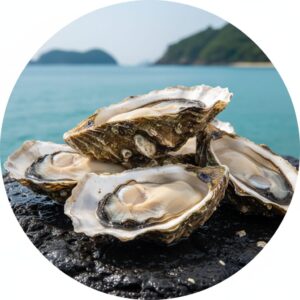
To connect with the island’s spirit, visit Yurahime Shrine. This beautiful Shinto shrine is dedicated to the goddess Yurahime-no-mikoto and is famous for a local legend about squid. According to the tale, every year a vast school of squid would come to the bay before the shrine as an offering. Even now, these waters are renowned for their squid, and the shrine remains a spiritual and cultural focal point of the island. It’s a tranquil, atmospheric place that links you to the islanders’ deep-rooted beliefs. After a day of adventure, you’ll likely be hungry, and Nishinoshima won’t disappoint. The local cuisine centers on fresh seafood. Visit a local restaurant or stay at a minshuku (a family-run inn) to savor the sea’s bounty. You must try fresh squid sashimi, grilled turban shells (sazae), and local rock oysters. Many places also serve Oki Soba, a distinctive style of soba noodles. Enjoying a meal made from ingredients harvested just hours earlier from the surrounding sea is the perfect way to end a day of exploration. It’s a true taste of the island’s soul.
The Practical Playbook: Planning Your Oki Adventure
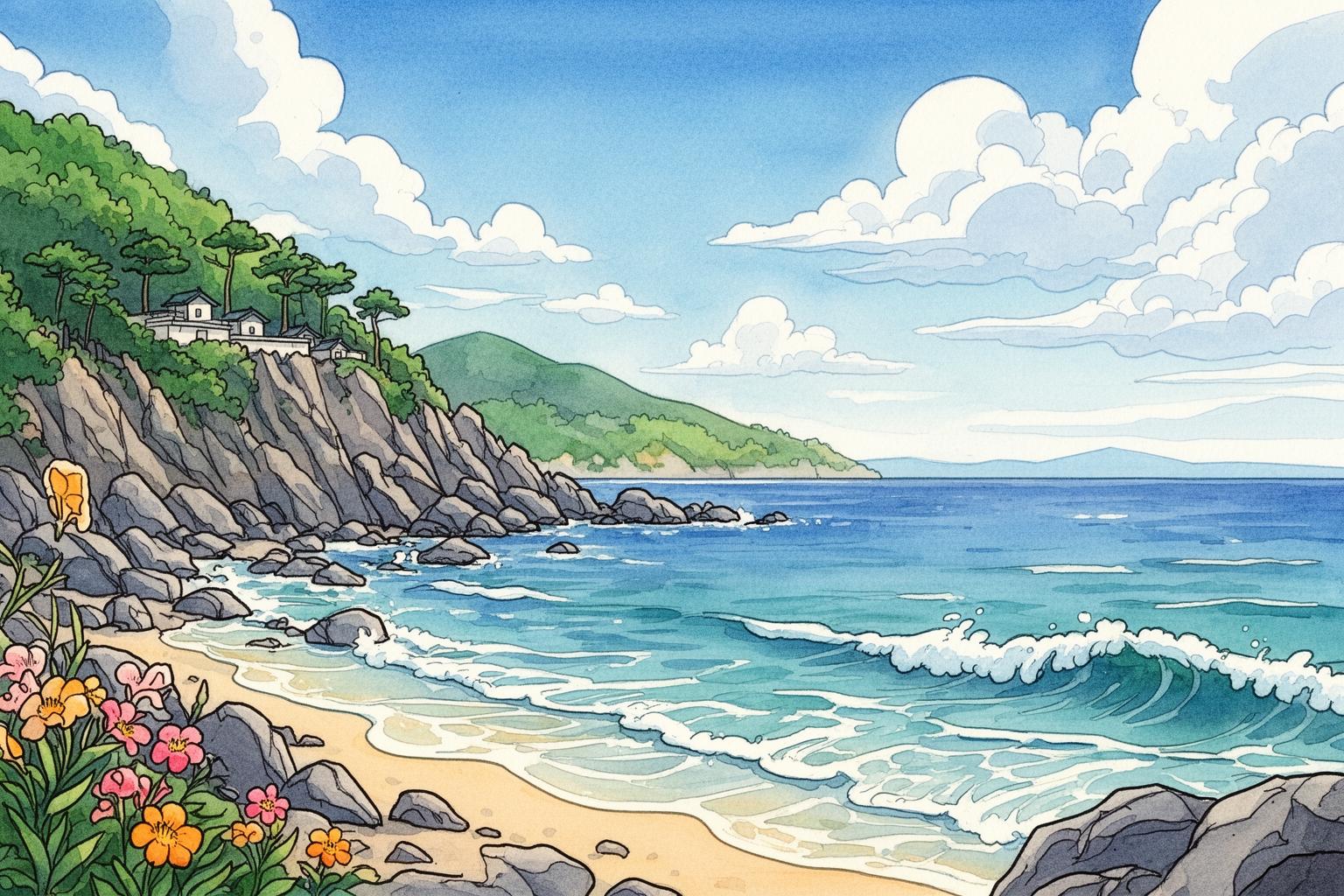
Reaching the Oki Islands takes a bit more preparation than visiting a major city, but that’s part of what makes it special. The journey itself plays a key role in the overall experience. Here’s the crucial information you need to get there.
Traveling to the Islands
There are two main ways to reach the Oki Islands: by sea or air. The most popular choice is by ferry. Spacious, comfortable ferries depart from two mainland ports: Shichirui in Shimane Prefecture and Sakaiminato in Tottori Prefecture. You can opt for a slower, larger ferry, which offers a relaxing, scenic ride lasting several hours, or a faster hydrofoil that much reduces travel time. Taking the ferry lets you watch the mainland recede and the islands come into view, building anticipation. Alternatively, you can fly into Oki Airport on Dogo, the largest island. From there, an inter-island ferry is required to reach Nishinoshima. While this is the quickest route, it lacks the classic charm of a sea voyage.
Getting Around the Islands
Once on Nishinoshima, transportation options are limited. Renting a car is by far your best choice, giving you the freedom to explore winding coastal roads, hidden shrines, and scenic viewpoints at your own pace. Car rentals are available near the port, but booking well ahead—especially in peak summer—is essential due to limited availability. For shorter trips or a more active option, hiring an e-bike is also excellent.
Best Time to Visit
The ideal season for sea kayaking along the Kuniga Coast is from late spring through early autumn (May to October). During this period, the seas are generally calm and the weather pleasant. Summer (July and August) is peak season with warm water perfect for swimming but also the busiest and hardest to find accommodation. Personally, I recommend the shoulder seasons: September and October offer warm weather, fewer tourists, and beautiful, gentle light. Spring (May and June) is also stunning, with hillsides carpeted in wildflowers.
Reserving Your Kayak Tour
Unless you are a seasoned sea kayaker with your own equipment, joining a guided tour is highly advisable. For safety and expert local knowledge, guides who know the coastline intimately—including safe routes, sea caves, and weather patterns—are invaluable. Tours must be booked in advance, especially in summer. Several operators on Nishinoshima provide tours of different durations. Check for English-speaking guides if you don’t speak Japanese. A typical tour runs about three hours, which is enough time to explore a good portion of the coast without overexerting yourself.
What to Bring for Kayaking
Pack wisely for your day on the water. Wear quick-drying clothing (synthetics are better than cotton), and don’t forget a hat, sunglasses, and high-SPF sunscreen since the sun reflecting off the water is strong. Water shoes or old sneakers that can get wet are ideal for launching and landing. Bring a waterproof bag for your phone or camera. If you have a waterproof camera like a GoPro, it’s the perfect occasion to use it. Your tour operator will supply essential gear—kayak, paddle, life vest, and usually a waterproof jacket if needed—but it’s wise to have your personal items ready.
An Echo in Your Soul
A trip to the Kuniga Coast is more than merely a box to tick on a travel list. It’s an experience that lingers, a reminder of the Earth’s force that echoes long after you return to the mainland. Paddling beneath those ancient cliffs, you sense a deep connection to something vast and eternal. It’s a journey that cuts through the distractions of modern life, replacing them with the steady, powerful rhythm of paddle and sea. You leave with more than just photographs; you depart with a renewed sense of wonder, a deeper appreciation for the wild, untamed corners of our planet, and a story imprinted not only in your memory but in your very soul. So, if you seek an adventure that is both physically exhilarating and spiritually refreshing, look no further. The cliffs of Kuniga are calling.