Yo, what’s up? Hiroshi Tanaka here, your local guide to the stuff in Japan that leaves you scratching your head. So, you’ve seen the neon lights, the temples, the wild fashion on TikTok. You might’ve even visited and had a blast. But then you get invited to a nomikai—a company drinking party—and suddenly, you’re in a whole new world with rules you can’t see. You reach for a big bottle of Kirin to pour yourself a glass and the whole table goes dead silent. Your boss gives you a look. Your colleagues are frozen, hands halfway to their own glasses. It’s awkward. Big time. You just committed a major party foul, but you have no idea why. The vibe is officially off. So what’s the deal? Why is pouring a simple drink in Japan loaded with more drama and hidden meaning than a season finale of a prestige TV show? It’s because you didn’t just try to pour a drink. You accidentally screamed, “I’m a lone wolf who doesn’t respect anyone here,” in a silent language you didn’t know you were speaking. This isn’t just about getting lit with your coworkers. This is a deeply ingrained cultural ritual, a performance where every gesture, every pour, and every sip is part of a script that reinforces hierarchy, builds bonds, and checks everyone’s social aptitude. It’s a whole vibe, a complex dance of power and respect that has been going on for centuries. Low-key, it’s one of the most important aspects of corporate life to understand if you really want to get what makes Japan tick. Forget your travel guide clichés; we’re about to spill the real tea on the silent, strategic art of pouring sake. It’s a trip, for real. Let’s get into it and decode the whole situation so next time, you’re the one navigating the nomikai like a pro. These rituals are most alive in the bustling back alleys and izakayas of major cities, places where deals are informally struck and teams truly bond, all over the simple act of pouring a drink for one another. Think of places like Shinjuku’s legendary Omoide Yokocho, a labyrinth of tiny yakitori joints and bars where this social dance is performed every single night.
To truly master this social dance, you should also understand the evolution of the modern izakaya scene where these rituals play out.
The “WTF” Moment: Why You Never, Ever Pour Your Own Drink
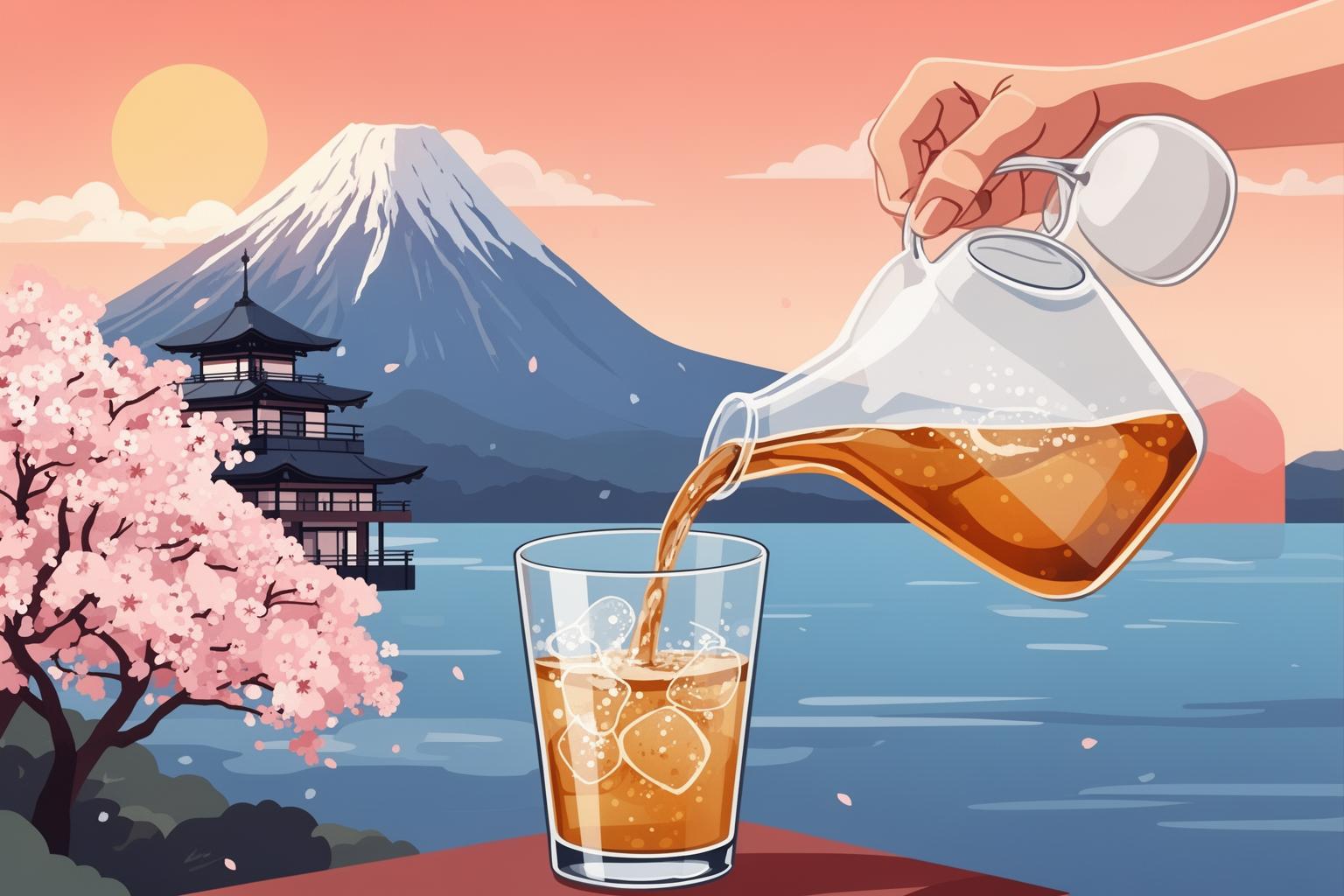
Alright, let’s unpack that moment of pure panic. You’re thirsty, and there’s a bottle of Asahi right in front of you. Logic says to pour yourself a drink. But in Japan, especially in formal or corporate settings, that logic will completely fail. Pouring your own drink is so taboo it has its own term, and grasping this is the essential first step to unlocking the nomikai code. It’s not an exaggeration to say this single action can shape how the entire group perceives you. It reflects a fundamental misunderstanding of the social contract you silently agreed to when you sat at that table. This isn’t merely about quenching your thirst; it’s about fulfilling your role within the collective. Your personal needs come second to the needs and rituals of the group. The gathering is not just individuals drinking, but a unified whole, and every action should reinforce that unity. Pouring your own drink breaks that unity immediately, serving as a visual and symbolic statement that you are distancing yourself from the group—one of the most uncomfortable things you can do in a society centered on the collective. Think of it less like a casual hangout and more like a carefully orchestrated stage performance. Everyone has a role, and your first role is to demonstrate that you understand the fundamental rule: you are here to serve others before serving yourself.
The Cardinal Sin: Tejaku (手酌)
The term you need to remember is tejaku, which literally means “hand-pouring for oneself.” In the West, this might be seen as self-sufficiency, but at a Japanese nomikai, it’s a social bombshell. When you perform tejaku, you silently send out a range of negative signals. First, you imply that no one else at the table is attentive enough to notice your empty glass, subtly shaming everyone for neglecting their social responsibility. It’s a passive-aggressive act that puts everyone on edge. More importantly, you signal deep loneliness or, worse, arrogant self-isolation. The message conveyed is, “I don’t need any of you; I can manage on my own.” This goes totally against the nomikai’s purpose, which is to build interdependence and mutual support. The empty glass acts as a prompt, an invitation for social interaction. By filling it yourself, you cut off that opportunity for connection before it starts. It’s like someone asking, “How are you?” and you just walking away—an outright rejection of the social game. Traditionally, tejaku was linked with solitary, lonely old men drinking by themselves. You essentially mark yourself as a social outcast, unable to engage in the mutual give-and-take of human connection. It’s a big loss and creates a very awkward atmosphere for everyone else trying to preserve harmony.
The Flip Side: Oshaku (お酌) as Social Glue
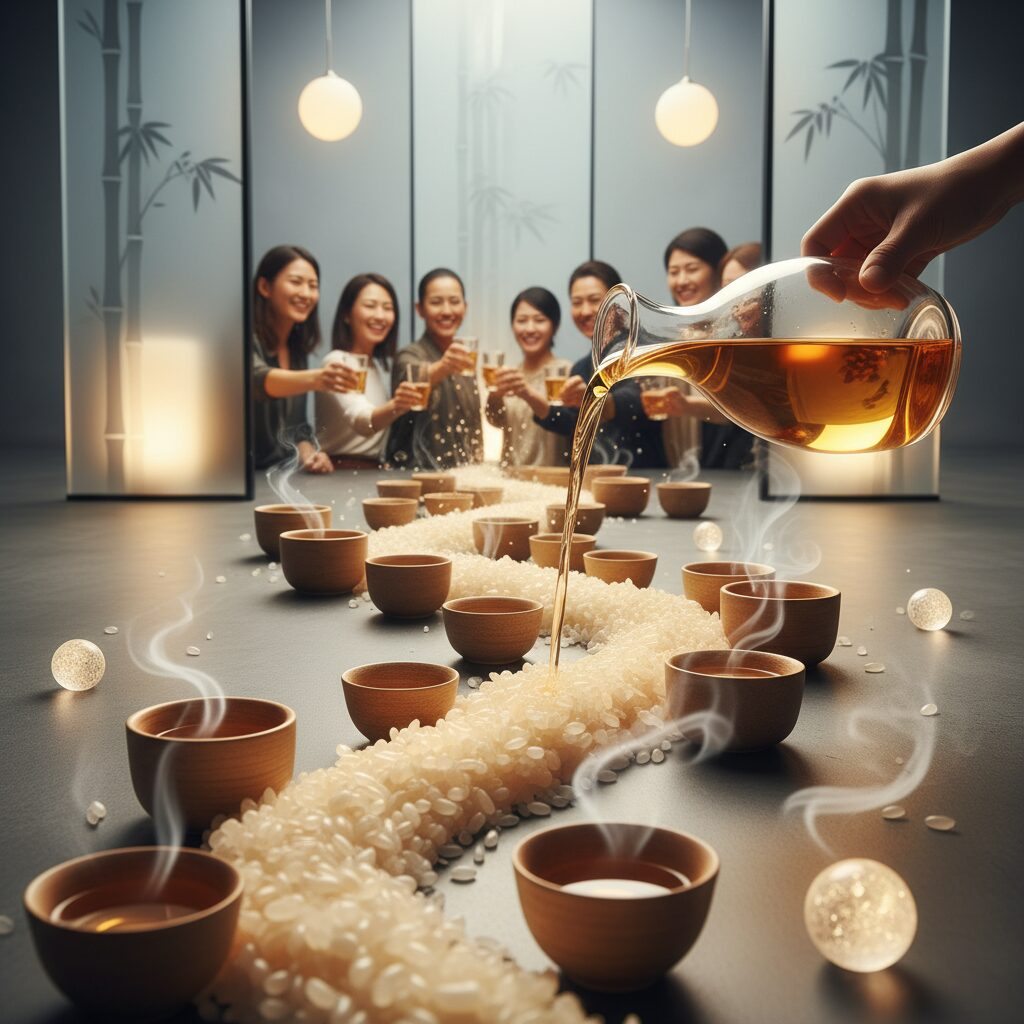
So if you can’t pour your own drink, what should you do? You engage in oshaku, the opposite and complement to tejaku. Oshaku is the act of pouring drinks for others. It’s the heart of the nomikai, the currency of social exchange. It’s the mechanism that transforms coworkers sitting together into a united team. Oshaku isn’t simply about refilling glasses; it’s a versatile social tool, an excuse. An excuse to approach your boss you might otherwise feel too shy to talk to. An excuse to connect with someone from another department. An excuse to show respect to senior colleagues. By picking up the bottle and moving to refill someone’s empty glass, you initiate an interaction. You offer a gesture of care and respect. You actively contribute to a positive social atmosphere. The person receiving the drink is socially obligated to respond, thank you, and engage in brief conversation. It’s an elegant, built-in icebreaker embedded in the drinking ritual itself, ensuring no one is left out and conversations flow continuously across the table. It embodies the Japanese concept of kikubari, the art of attentiveness to others’ needs. The night becomes a continuous cycle of oshaku, with people moving around, pouring drinks, chatting, and strengthening bonds. It’s the social glue that holds the occasion together, transforming a simple dinner into a rich, meaningful ritual of team building.
Decoding the Pour: A Masterclass in Social Hierarchy
Alright, so you grasp the basic idea: pour for others, not for yourself. Got it. But there’s much more to it than that. Who you pour for, when you pour for them, and even how you hold the bottle all carry significant meaning. This is where Japan’s famously hierarchical society—often called tate-shakai (縦社会) or “vertical society”—really shines through. The movement of sake and beer around the table serves as a vivid, living representation of the group’s power dynamics. Your place within the company—your age, rank, and seniority—dictates every action you take. For an outsider, this can feel rigid and stressful, but for those raised in this system, it’s as natural as breathing. It’s a non-verbal way to reaffirm everyone’s position in the social hierarchy, ensuring smooth, frictionless interactions. Each pour reinforces the structure, and every properly received pour signals your acceptance of that order. It’s a performance of social harmony, where the details matter immensely. Doing it right means more than just being polite; it shows you grasp and respect the very foundation of the social world you’ve entered. This is how you can genuinely impress your Japanese colleagues by demonstrating that you’ve done your research and sincerely aim to connect with their culture.
The Upstream/Downstream Flow: Who Pours for Whom?
The golden rule is clear and absolute: respect flows upward. This means junior members pour for their seniors. The kohai (junior) serves the senpai (senior). Regular employees pour for section chiefs (kacho), section chiefs pour for department heads (bucho), and everyone pours for the president (shacho). Age matters, too—young attendees pour for older ones. This is the fundamental direction of the oshaku current. As a junior person, your main job at the start of the nomikai is to be a keen observer. You constantly scan the table, watching for empty or nearly empty glasses among your superiors. Your responsibility is to keep their glasses full at all times. This is a sign of respect, attentiveness, and acknowledgment of their higher status. It’s not demeaning; it’s fulfilling your role properly. Think of it as training in social awareness. In contrast, when a senior pours for a junior, it is a meaningful gesture—a sign of favor, recognition, and a way of saying, “I appreciate your hard work.” This reversal is a powerful bonding moment, which we’ll discuss later. But the default flow always moves upward. So, if you’re an intern sitting next to the CEO, your top priority is to ensure the CEO’s glass never runs low. Doing this well proves you’re a team player who understands the rules.
The Art of the Pour: It’s All in the Details
Now we delve into the small gestures that distinguish beginners from experts. Simply grabbing a bottle and pouring sake into a cup won’t cut it. The how is just as crucial as the who and when. These nuances form a physical language of respect, and mastering them reflects a high level of cultural fluency. They convey deference and sincerity without a single word.
The Two-Handed Rule
This is non-negotiable. When pouring for a superior, you must hold the bottle or carafe (tokkuri for sake) with both hands. The proper way is to hold the bottle’s body with your right hand while your left hand gently supports the bottom. This posture inherently shows respect. Pouring one-handed appears casual, lazy, or even arrogant, implying a lack of regard for the person served. The two-handed hold lowers your own status and raises that of the recipient. It’s a subtle but powerful bodily signal saying, “I serve you with full attention and respect.” The same rule applies when you receive a pour: hold your glass (o-choko for sake or a regular glass for beer) with two hands, your right hand grasping the glass and your left cupped beneath it. This demonstrates humility and gratitude. Simply leaving your glass on the table to be filled is a major power move, usually reserved for high-status individuals and can come across as rude. Raising your glass and receiving with two hands means you engage actively and graciously in the ritual.
Label Up, Bubbles Right
Believe it or not, even the bottle itself follows etiquette. When pouring from a beer or sake bottle, the label should face up. This lets the recipient see the brand being served and signals transparency and consideration—showing you’re proud of what you offer. This small detail reflects a keen social awareness. With beer, there is an additional technique: aim for a perfect foam head with about a 70:30 beer-to-foam ratio. Start pouring slowly, tip the bottle to pour faster, then slow down at the end to create a creamy head. This isn’t just for looks; it is thought to lock in flavor and aroma. A poorly poured, foamless beer marks an amateur. Mastering this pour shows skill and respect for the person you serve.
The Counter-Pour: When the Boss Pours Back
This is the moment every junior employee anticipates. Known as henpai (返杯), or the “return pour,” it happens after you have diligently poured for your seniors throughout the evening. When the boss picks up a bottle and comes to pour for you, it’s a significant moment. A superior pouring for a subordinate reverses the hierarchy temporarily and signifies deep appreciation and recognition. It’s the boss’s way of saying, “Thank you for your effort and attentiveness tonight. I see you, and I value you.” This gesture fosters immense loyalty and goodwill. Your response is crucial: show sincere gratitude and mild surprise. The proper reply is to immediately lift your glass with both hands and say something like, “Kyoshuku desu” (I’m honored/unworthy). Accept the pour graciously, take at least one sip promptly, then set the glass down. It’s polite to finish that glass relatively quickly. Refusing a henpai is unthinkable—it would be seen as rejecting your boss’s goodwill and a serious social faux pas. This reciprocal pour is the culmination of the night’s rituals. It rewards your earlier service and softens the strict hierarchy into a more communal and bonded atmosphere, strengthening mutual obligation and respect that carry back into the workplace.
Reading the Room: The Unspoken Rules of the Nomikai Vibe
Beyond the mechanics of pouring, the nomikai serves as an exercise in advanced social awareness. Your ability to read the room, anticipate needs, and grasp subtle cues is continuously challenged. This embodies the essence of kuuki wo yomu (空気を読む), literally “reading the air.” It means understanding the context and unspoken feelings within a group and responding appropriately. At a nomikai, the atmosphere is dense with social signals, and your performance is judged not by what you say but by how well you perceive the flow of the evening. It’s about more than just keeping glasses filled; it’s about fostering overall harmony and ensuring everyone feels comfortable and included. This is where true social ninjas excel—they navigate the complex web of relationships effortlessly, making everyone feel acknowledged and respected without it seeming like a task. For foreigners, this can be the hardest part to master, as many cues are culturally specific and extremely subtle. Yet even a basic understanding can help avoid major missteps and demonstrate your effort to align with the group’s rhythm.
The Empty Glass is a Signal Flare
We’ve mentioned this before, but it’s worth emphasizing. In a Western setting, an empty glass is simply an empty glass, and it’s up to the individual to refill it if desired. At a Japanese nomikai, however, an empty glass—especially that of a superior—is a social emergency. It’s a glaring, flashing red light, a signal flare shouting, “A junior member is neglecting their duty!” Allowing your boss’s glass to remain empty for more than a moment is a significant mistake. It suggests inattentiveness, self-absorption, and a lack of kikubari—the valued Japanese trait of anticipating others’ needs. A good kohai maintains a “360-degree view” of the table, keeping track of all superiors’ drink levels simultaneously. The moment a glass falls below one-third full, they mentally prepare to act. This vigilance isn’t about promoting heavy drinking but about service and attentiveness. Even if the boss declines another drink, the offer must be made. The kohai approaches with the bottle, asking, “O-tsugi shimashou ka?” (Shall I pour the next one for you?). This steady attentiveness is a performance of respect, demonstrating you prioritize your superiors’ comfort and needs over your own party enjoyment. It encapsulates the ideal employer-employee dynamic within a traditional Japanese company.
“Beer or Sake?” – Navigating Drink Choices
The evening follows a particular rhythm, often beginning with beer. In Japan, a well-known phrase is “Toriaezu, biru!,” roughly meaning “For now, beer!” This is the classic opening line at nearly every nomikai. The first round usually involves large bottles of beer shared among the table. This is intentional. Starting everyone off with the same drink creates an immediate sense of unity and equality, even amidst hierarchy. It’s a way of saying, “Tonight, we’re all in this together.” After the initial round, the selections become more varied, with participants ordering drinks like sake, shochu, or highballs. This shift is another test of your attentiveness. You must keep track of your superiors’ drink choices. If the bucho switches from beer to warm sake, you need to notice. The next time you offer a drink, you should bring the sake tokkuri instead of the beer bottle. Remembering someone’s drink preference is a subtle yet powerful way to show you are paying close attention to them as an individual. It expresses personalized respect, going beyond the basic task of refilling glasses. This reflects a higher level of social intelligence and care, qualities highly valued in Japanese corporate culture. These small attentions accumulate throughout the evening, gradually building your social capital within the group.
Declining a Drink: The Art of Saying No (Without Saying No)
This is a particularly delicate situation. In a culture that values group harmony and avoids direct refusal, how do you decline a drink, especially when it’s offered by a superior? A blunt “No, thank you” (Iie, kekko desu) can seem abrupt and risk offending the offerer. You aren’t just turning down a drink—you might be rejecting their goodwill and camaraderie. Therefore, a softer, more indirect approach is necessary. One common tactic is placing your hand over the top of your glass as the bottle approaches—a clear non-verbal cue. This should be paired with a polite and slightly apologetic phrase like “Sumimasen, sukoshi yasumasete kudasai” (Excuse me, please let me rest a bit) or “Mo juubun itadakimashita, arigatou gozaimasu” (I’ve had enough, thank you very much). The key is to express appreciation for the offer while gently deferring. Present it as a personal limitation rather than a rejection of their kindness. Another method is taking the smallest sip while leaving the glass relatively full; a full glass signals no need for a refill. Due to stricter awareness around aru-hara (alcohol harassment) in recent years, people are generally more understanding. However, social pressure can remain strong, so handling it delicately is essential. The goal is to preserve the harmony of the moment while setting a personal boundary.
Beyond the Office: Is This Vibe Everywhere?
So, you’ve mastered the corporate nomikai. But does this intense level of drinking etiquette apply to every social setting in Japan? Will you have to follow these rules when hanging out casually with friends on a Saturday night? The short answer is: no, not really. The longer answer is more nuanced. The strictness of these customs depends heavily on the context, especially the relationships between those involved. The Japanese concept of uchi-soto (内外), meaning “inside/outside,” is key here. This cultural idea means you behave differently with people in your “inside” group (like family and close friends) compared to those in your “outside” group (such as colleagues, superiors, and strangers). Company nomikai are a classic soto scenario, where formal rules and hierarchies dominate. A casual drink with close friends is an uchi setting, where you can relax and be yourself. Understanding this code-switching is essential to navigating Japanese social life without seeming either overly formal or inappropriately casual.
Friends vs. Colleagues: The Code-Switch
When drinking with close friends, the atmosphere is far more relaxed. The strict rules of oshaku largely disappear. While it remains common and appreciated to pour drinks for one another, it’s done out of friendship and camaraderie, not obligation. The rigid hierarchical flow vanishes. You might pour for your friend, and they’ll pour for you in return—a reciprocal, easygoing exchange. Most importantly, tejaku (pouring your own drink) is generally acceptable. If the beer bottle is nearby and your glass is empty, you can pour without anyone noticing. The elaborate performative attentiveness is replaced by genuine, laid-back interaction. This drastic shift can surprise foreigners. For example, a Japanese colleague who is extremely formal and deferential at a work party may be loud, casual, and freely pouring their own drinks when out with university friends. This isn’t hypocrisy; it’s a sophisticated display of social intelligence—adapting behavior perfectly to the context. For Japanese people, this code-switching is second nature. They seamlessly transition between the formal soto environment and the informal uchi world. Many visitors’ mistake is applying one set of rules to every situation, causing awkwardness.
Generational Shifts: Is Gen Z Cancelling Oshaku?
It’s also important to recognize that this culture is not static. Japan is evolving, and younger generations have a very different take on the nomikai tradition. For many millennials and Gen Zers, the traditional nomikai culture feels burdensome. They often see it as unpaid overtime, a compulsory performance of loyalty that intrudes on personal time. The pressure to drink, strict hierarchies, and the constant need for kikubari are viewed as outdated relics. There is a growing backlash against what’s sometimes called “nomi-nication” (a blend of nomu – to drink, and communication), the idea that drinking together is essential for business relationships. Younger employees tend to prefer a clear boundary between work and personal life. Additionally, increased awareness of power harassment and alcohol harassment (aru-hara) has made companies more cautious. Forcing subordinates to drink is now a fireable offense in many places. The rise of remote work due to the pandemic has also disrupted the tradition, making large group drinking sessions less common. In modern startups and tech firms with flatter hierarchies, these old rituals are much less frequent. However, it would be wrong to assume the culture is dead. In traditional large corporations, government offices, and rural areas, these customs remain very much alive. The reality is a spectrum. The old ways are fading, but slowly, and in many parts of Japanese society, the silent language of pouring sake continues to be spoken fluently.
So, What’s the Real Takeaway for a Visitor?
After all this, you might feel that this social landscape is impossibly complex. And frankly, it kind of is. But don’t be discouraged. As a non-Japanese, you’re not expected to master these intricate rules. There’s a concept known as the “gaijin card,” an unofficial social pass that allows foreigners some flexibility with cultural etiquette. People understand you didn’t grow up with these norms, so they’re generally more forgiving of your mistakes than they would be of a Japanese person’s. Still, the goal isn’t just to earn a pass—it’s to connect. Making a visible effort to understand and engage in these rituals, even imperfectly, will earn you tremendous respect and goodwill. It shows you’re not merely a tourist or a temporary guest, but someone sincerely trying to appreciate and respect the culture on its own terms. It’s about moving beyond observation to genuine participation in the group’s social fabric.
Your “Gaijin Card” is Real, But Effort Matters Most
No one expects you to perfect the 70:30 beer-to-foam ratio on your first try, nor will you be excluded if you forget to use two hands once. Your “gaijin card” offers some buffer. But relying on it misses the point. The real savvy move is to demonstrate that you’re trying. The effort itself is what resonates deeply with people. So, what simple, high-impact actions can you take? First, whenever anyone—literally anyone—pours you a drink, lift your glass. Hold it with one hand, or better yet, both. This is the single most important rule to remember. Second, watch the glasses of those around you. If you see one is empty, pick up a nearby bottle (with two hands!) and offer to pour. It doesn’t have to be the CEO; pouring for a colleague next to you is a great gesture. They’ll likely be pleasantly surprised. You can say a simple “Douzo” (Here you are). This small act of oshaku instantly sets you apart from other visitors. It shows humility, respect, and a willingness to engage. Your colleagues will notice and greatly appreciate it. You’re no longer just a foreigner—you’re someone actively trying to join the team. That effort is far more valuable than flawless execution.
It’s Not About the Alcohol, It’s About the “Wa” (和)
Above all, it’s essential to realize these rituals aren’t really about the alcohol. Sake, beer, and shochu are merely props in a larger social performance. The true purpose of the nomikai and its detailed oshaku rules is to reinforce wa (和), the idea of group harmony. Wa is arguably the core value of Japanese society, emphasizing that the group’s well-being and smooth function outweigh the desires or needs of any individual. The act of pouring drinks for one another is a tangible expression of this principle. It’s a continuous, cyclical ritual of service, deference, gratitude, and reciprocity that strengthens social bonds and maintains hierarchical balance. When you pour for your boss, you acknowledge the hierarchy. When your boss pours for you, they reaffirm their care as a group member. Keeping everyone’s glass full ensures conversation and camaraderie flow uninterrupted. Every action works to reduce friction and enhance unity. It’s a shared experience where everyone fulfills their role to support the group’s harmony. So, when you’re at a nomikai, feeling lost amid the rules, remember this: you’re taking part in a ceremony meant to build and sustain human connection. The drink in your hand is just the medium. The real work happens through the silent language of the pour, which speaks of respect, belonging, and the intricate, beautiful dance of Japanese group harmony.