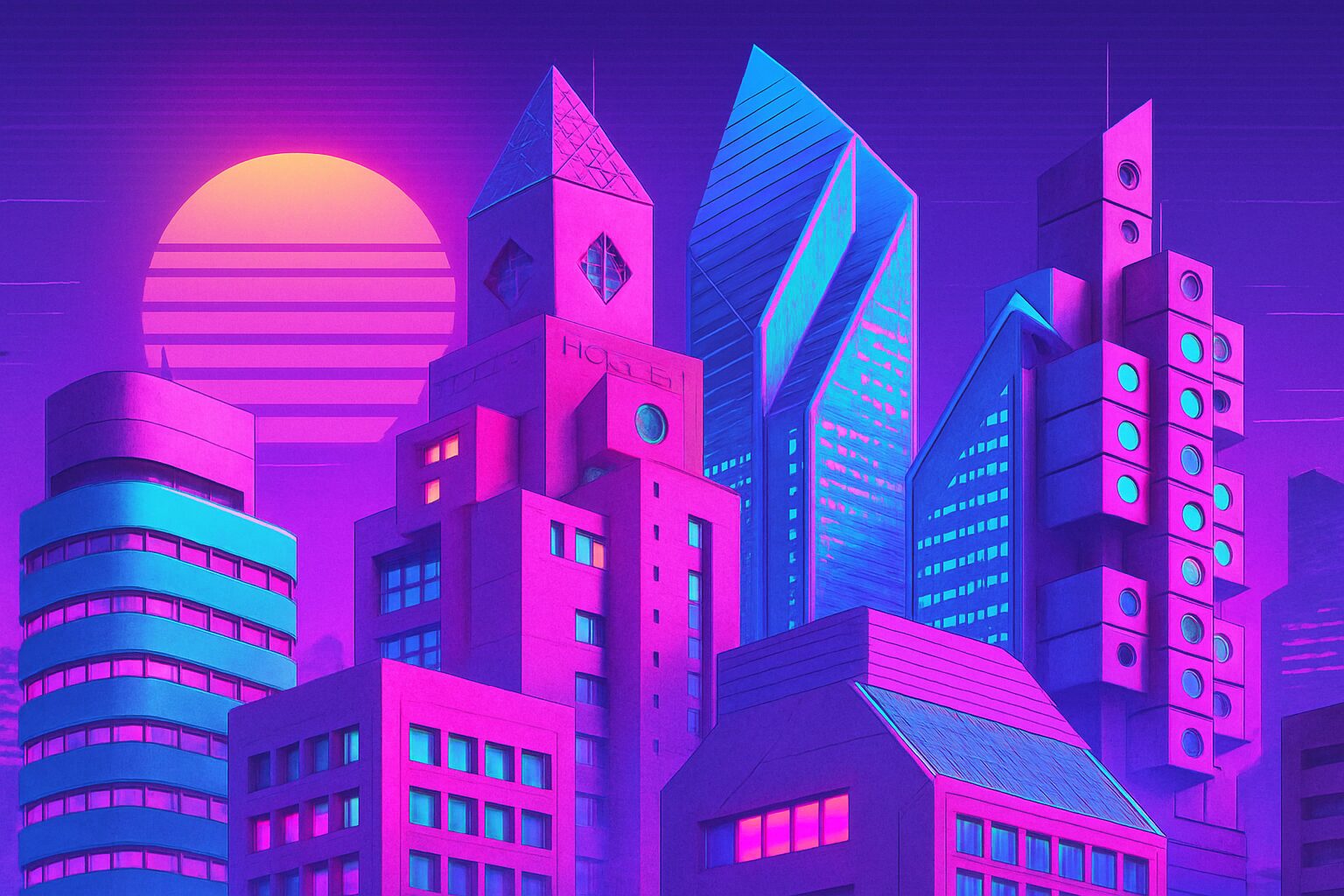
Hey besties! Sofia here, coming at you live from the city of endless vibes, Tokyo. So, picture this: you think you know Tokyo. You’ve got the serene temples, the neon-drenched streets of Shinjuku, the chic boutiques of Omotesando all mapped out. But what if I told you there’s a whole other dimension to this city, a collection of urban islands floating in Tokyo Bay that are basically a living, breathing museum of the most extra, most epic architectural era ever? I’m talking about the 1980s, babes. We’re going on a deep dive into the wild world of Japanese Postmodern architecture, a style born from the legendary Bubble Economy when everything was bigger, bolder, and way more fun. Forget tropical escapes; these are islands of concrete, steel, and pure imagination, and honestly, they are a whole mood. We’re about to explore Odaiba and Tennozu Isle, two man-made marvels that serve as ground zero for this retro-futuristic aesthetic. It’s a trip back in time to an era of unbridled optimism and creative chaos, all set against the stunning backdrop of the Tokyo skyline. So grab your chunkiest sneakers and your most colorful jacket, because we’re about to explore a side of Tokyo that’s totally off the beaten path and absolutely iconic. It’s time to understand the soul of the city through its most audacious creations.
If you’re loving this deep dive into the 80s aesthetic, you’ll definitely want to explore the perfect soundtrack for the era by chasing Japan’s 80s City Pop sunset.
The Vibe Check: What is Japanese Postmodernism Anyway?
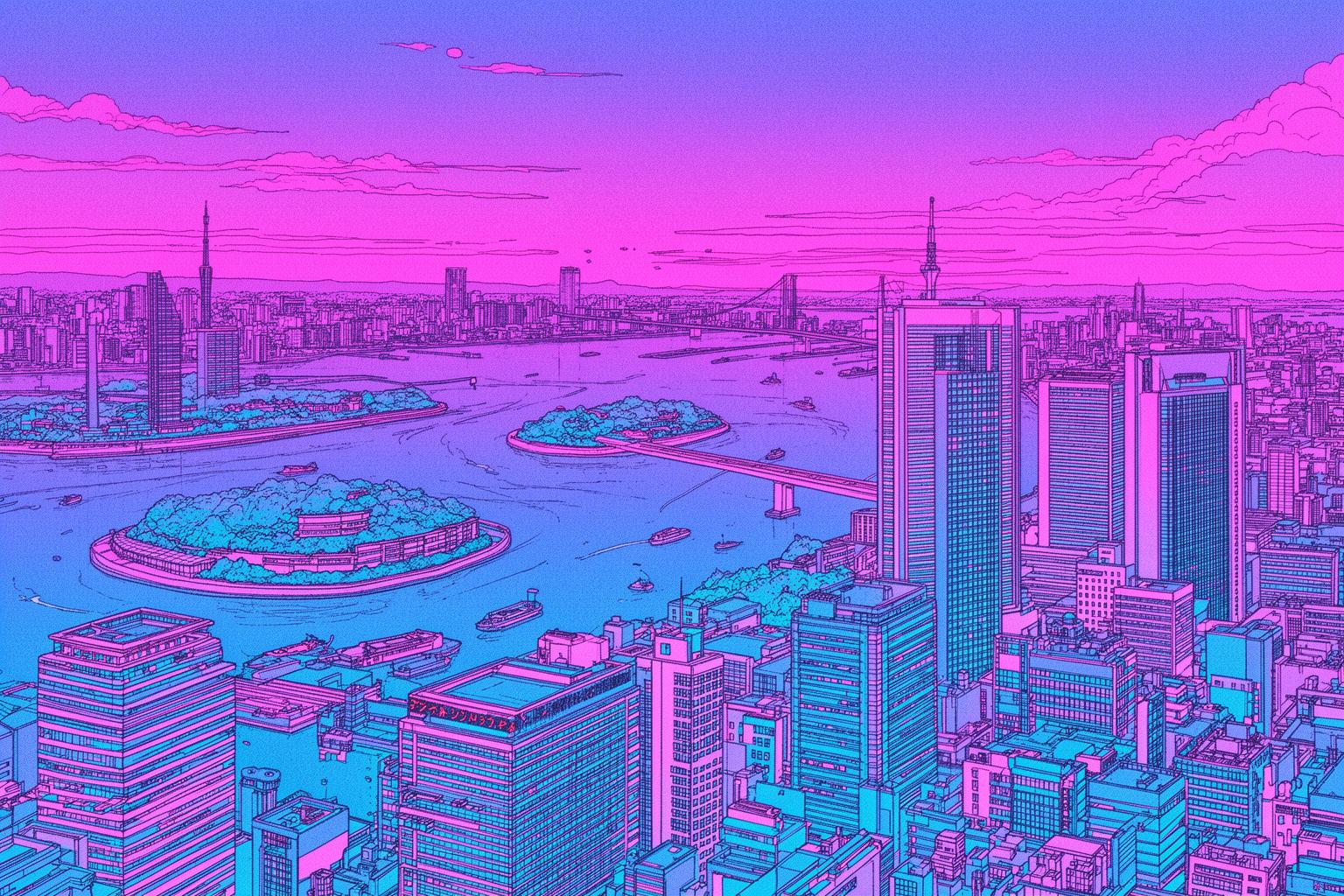
Before we teleport onto these islands, let’s quickly check the vibe of what we’re actually searching for. What is Postmodern architecture, and why did Japan become its ultimate playground in the 80s? Think of it this way: for a long time, architecture was dominated by Modernism. It was super serious, with clean lines, minimalism, and the motto “form follows function.” It was cool and efficient but a bit… beige. Then the 80s arrived. Postmodernism crashed the scene, asking, “What if buildings could have fun? What if they could tell jokes, reference history, and sport clashing colors?” It rebelled against Modernism’s strict rules, becoming playful, eclectic, and sometimes delightfully weird.
Now, add Japan’s Bubble Economy into the equation. From the mid-80s to the early 90s, the country experienced an unprecedented economic boom. Money was flowing, confidence was high, and there was a sense of endless possibility. This energy needed an outlet, and much of it poured into architecture. Clients demanded not just buildings but landmarks, bold statements. Architects received enormous budgets and creative freedom to experiment. The outcome? Buildings that were more than structures—they were spectacular urban sculptures. They combined historical motifs with futuristic technology, flaunted vibrant colors and luxurious materials unapologetically, and shattered every rule. You’ll find buildings shaped like robots, others with giant spheres suspended in midair, classical columns standing beside gleaming metal grids. It was a period of pure, unfiltered architectural expression, with the Tokyo Bay islands serving as a canvas for these incredible experiments. The aesthetic exudes confidence, a touch of chaos, and a wealth of personality. It’s not just about looking cool; it’s about embodying the bold spirit of an era that dared to dream in technicolor.
Odaiba: The Epicenter of Retro-Futurism
Our first destination is the undisputed queen of Tokyo’s urban islands: Odaiba. This vast stretch of reclaimed land is essentially a theme park filled with 80s and 90s futuristic visions. The journey there is part of the fun. You simply must take the Yurikamome line, an automated train that glides along an elevated track from Shimbashi. As you curve up and over the iconic Rainbow Bridge, with the Tokyo skyline shrinking behind you and the peculiar shapes of Odaiba growing larger ahead, it feels like you’re being transported to another world. The sea breeze rushes through your hair, the views are absolutely breathtaking, and the sense of arrival is pure cinematic magic. The entire island resembles a set from a sci-fi film shot in 1989, and I’m all for it. It’s a place of expansive skies, sprawling parks, and architecture that is completely, gloriously extravagant. The vibe is one of constant holiday; it’s where Tokyo comes to play, with the buildings themselves serving as the main attractions in this futuristic playground.
The Journey is Half the Adventure: The Rainbow Bridge & Yurikamome Line
You can’t talk about Odaiba without raving about the journey. The Yurikamome isn’t just public transportation; it’s the opening scene of your Odaiba adventure. As the train departs Shimbashi station, it winds through the dense cluster of Shiodome’s skyscrapers before its grand ascent onto the Rainbow Bridge. Pro tip: try to secure a seat at the very front of the train. Because it’s automated and has no driver, you get an unobstructed, panoramic view that feels like piloting a spaceship. The train performs a dramatic 270-degree loop to gain elevation, offering breathtaking, ever-shifting views of the city and bay. You catch glimpses of Hamarikyu Gardens, Tokyo Tower, and the endless urban sprawl laid out like a glittering map. Then, you’re on the bridge itself, suspended between sky and sea. The double-decker bridge features the expressway on top and the Yurikamome line along with a public walkway underneath. Completed in 1993, the structure is a prime example of the era’s grand-scale engineering feats. It’s not just a bridge; it’s a monument. Crossing over to the island, the architectural landscape shifts dramatically: the city’s rigid grid yields to Odaiba’s playful, unconventional forms. The entire ride builds anticipation for the visual feast ahead, with every smooth, futuristic curve of the track.
The Icon: Fuji TV Building by Kenzo Tange
And then you see it — the unmistakable symbol, the leading figure of Odaiba’s skyline: the Fuji Television headquarters. This building is far more than just a structure; it’s a statement, a legend. Designed by master architect Kenzo Tange and completed in 1997, it stands as one of the most recognizable and daring examples of late 20th-century Japanese architecture. Tange, a titan of the earlier Modernist movement, truly unleashed his creativity here, crafting something that is pure structural poetry. The building consists of two main towers connected by a series of enclosed walkways, or “sky corridors,” creating a massive, hollow grid. It’s designed to resemble a gateway to a futuristic city. The centerpiece—and the jaw-dropping highlight—is the enormous titanium-clad sphere, weighing an astonishing 1,350 tons, which appears to float effortlessly within the building’s skeletal frame. This sphere, called “Hachitama,” houses an observation deck you can actually enter. Standing beneath this monumental structure is a humbling experience. The scale is immense. The metallic latticework casts intricate patterns of light and shadow, making it a photographer’s dream from every angle. It’s a machine for living, a city within a building, perfectly embodying 80s and 90s obsessions with mega-structures and technological brilliance. It’s bold, optimistic, and a bit wild. It captures everything I adore about that era. Climbing the long escalators through its core and gazing out from the Hachitama observatory, with panoramic views of Tokyo, provides a quintessential Odaiba moment. You can feel Tange’s vision of a future city come alive all around you.
More Odaiba Treasures: A Postmodern Playground
While the Fuji TV building may be the star, Odaiba is full of other architectural gems. Just a short walk away, you’ll find Tokyo Big Sight, officially known as the Tokyo International Exhibition Center, which you simply cannot miss. Its conference tower is composed of four gigantic, inverted pyramids clad in glass and titanium, precariously balanced on massive supports. It looks like a crystalline mothership that’s just landed. Designed by the firm AXS Satow, it’s another tribute to the era’s love for dramatic, monumental geometry. The spectacle is mind-blowing. Walking beneath these colossal forms feels surreal, and their ever-changing reflections capture the sky in mesmerizing ways. Nearby is the Telecom Center, a striking building featuring a massive square arch through its center, earning it the nickname of the Japanese “Arc de Triomphe.” Its twin towers are joined at the top by a skybridge, and it boasts an observatory offering some of the best—and least crowded—views of the city, especially at sunset. The design is clean yet powerful, a perfect blend of classical form and high-tech execution. Even Odaiba’s urban planning reflects postmodern values. Wide promenades, waterfront parks like Daiba Park and Shiokaze Park, and the deliberate placement of architectural giants create a curated landscape that feels more like a utopian world’s fair than an ordinary city district. It’s a place for strolling, marveling, and experiencing human ingenuity at its finest.
Tennozu Isle: The Chic, Arty Sister Island

If Odaiba is the loud, futuristic theme park, Tennozu Isle is its chic, sophisticated older sister. This island, also reclaimed land, exudes a completely different vibe. It’s less about flashy spectacle and more about curated cool. Here, the industrial grit of old Tokyo warehouses blends seamlessly with the polished world of contemporary art and design. Arriving via the Tokyo Monorail or the Rinkai line feels like stepping into one of the city’s best-kept secrets. The atmosphere is calmer and more intimate. Instead of sprawling parks, there are charming canals and boardwalks. Instead of giant robots, you find world-class art galleries and achingly stylish design stores. It offers the perfect counterpoint to Odaiba’s high-energy futurism, showcasing another facet of the Bubble Era’s legacy: transforming functional industrial spaces into cultural hotspots.
Warehouse Chic: From Industrial Port to Art Hub
The story of Tennozu Isle is a masterclass in urban regeneration. In the 80s and 90s, this area was mainly a landscape of warehouses and distribution centers—a functional but forgotten corner of the port. However, as Tokyo’s creative scene flourished, visionaries recognized the potential in these vast empty spaces. The high ceilings, raw concrete walls, and waterfront location made them ideal canvases for art. The transformation began with companies like Warehouse Terrada, which initially offered high-quality storage for art and wine before expanding into cultural venues. They repurposed entire warehouses, preserving their industrial frameworks while inserting sleek, modern galleries, museums, and creative spaces inside. This blend of old and new, raw and refined, defines Tennozu’s aesthetic. Walking around, you can sense this history. You might pass a nondescript corrugated steel facade, then discover through an open door a pristine, white-walled gallery showcasing cutting-edge art. This element of discovery makes Tennozu so thrilling. It feels less like a tourist spot and more like a creative community you’ve been lucky to stumble upon.
The Must-Sees of Tennozu
Tennozu is packed with cultural treasures, but a few places are absolute must-visits. First is the Archi-Depot Museum. For anyone even remotely interested in the trip’s theme, this place is heaven. It’s the only museum in Japan dedicated to architectural models. You enter a soaring, dramatically lit warehouse filled with shelves of intricate, beautifully crafted models by Japan’s most renowned architects. Here, you can see miniature versions of iconic buildings, tracing the evolution of architectural ideas. It offers a chance to get up close and personal with the creative process, viewing the blueprints of genius in three dimensions. The experience is both inspiring and visually stunning. Just around the corner is Pigment Tokyo, less a store and more a sanctuary of color. Designed by the legendary architect Kengo Kuma, it resembles a futuristic apothecary. One entire wall displays thousands of glass vials filled with pigments in every imaginable hue, arranged in a flawless gradient. It’s an art installation in its own right and arguably one of the most photogenic interiors in Tokyo. Then there’s the Terrada Art Complex, the heart of the island’s gallery scene. This vast warehouse houses several independent contemporary art galleries. You can spend hours wandering its cavernous halls, discovering new artists and soaking in creative energy. The contrast of world-class art against the raw industrial backdrop is simply chef’s kiss.
Waterside Wanderings: The Boardwalk and Beyond
Beyond the art, one of the greatest delights of Tennozu Isle is simply being by the water. A lovely boardwalk lines the canal, offering a peaceful retreat from the city’s bustle. This is where the island’s social life comes alive. The crown jewel is T.Y. Harbor Brewery, a restaurant and craft brewery set in a converted warehouse. It boasts a large terrace right on the water, making it ideal for a leisurely afternoon lunch or evening drink, with views of passing boats and the Shinagawa skyline. The vibe is effortlessly cool and cosmopolitan. Strolling along the boardwalk, you’ll find chic cafes, bakeries, and cozy seating areas where you can simply sit and watch the world go by. The island is also peppered with striking street art and public sculptures, turning every walk into a mini art tour. Unlike Odaiba’s monumental scale, Tennozu’s charm lies in these smaller, intimate moments—the feel of the sea breeze, the sound of water lapping against canal walls, and the excitement of discovering a hidden gallery or the perfect little coffee shop. It offers a more relaxed, personal take on the urban island experience.
The Deeper Dive: Decoding the 80s Architectural Language
To fully grasp what makes these islands truly special, we need to delve a little deeper into the minds of the architects who crafted them. The 1980s in Japan were not merely a construction boom; they represented a philosophical revolution in architecture. The austere mantra of Modernism, “form follows function,” was discarded. The new, unwritten rule became something akin to “form follows fiction” or “form follows feeling.” Architects turned into storytellers, and buildings became their narratives, expressed through steel, glass, and concrete. They embedded messages, symbols, and inside jokes into their facades, creating a rich, layered experience for those who knew how to “read” them. This approach, heavily influenced by semiotics and Western postmodern theory, took on a distinctively Japanese character, blending ancient aesthetic concepts with cutting-edge technology and a playful irreverence. It was an era of radical experimentation, where the aim was not just to provide shelter but to evoke emotion, surprise, and delight.
The Architects Who Dared to Dream
Kenzo Tange serves as a compelling example. He was a cornerstone of the Japanese Modernist movement, renowned for his powerful, Brutalist-inspired government buildings and the iconic Yoyogi National Gymnasium for the 1964 Olympics. His transition toward Postmodernism, marked by projects like the Tokyo Metropolitan Government Building in Shinjuku and the Fuji TV Building, was significant. It symbolized a shift in the architectural zeitgeist. With the Fuji TV building, he wasn’t simply designing an office; he was creating a media fortress, a futuristic icon recognizable on TV screens worldwide. His use of a mega-structure grid and the suspended sphere became a potent symbol of communication and technology. Yet, other architects were even more radical. Shin Takamatsu, for instance, gained fame for his highly mechanized, almost robotic-looking buildings in Kyoto, such as Kirin Plaza Osaka. His work, dense with metallic details, resembled complex machinery and directly reflected Japan’s rise as a technological superpower. Then there is Itsuko Hasegawa, one of the few prominent female architects of the time. Her work, including the Shonandai Cultural Center Fujisawa, offered a softer, more whimsical interpretation of Postmodernism. She incorporated celestial motifs, clusters of spheres, and varied materials to craft a kind of architectural landscape or “second nature,” focusing on creating fun and engaging community spaces. Although not all of their major works are located on these specific islands, their influence was widespread. They participated in a nationwide conversation that pushed the boundaries of what buildings could be, with Odaiba and Tennozu becoming prime showcases for these new ideas.
The Philosophy Behind the Funhouse
So, what were these architects truly trying to convey? A central idea of Postmodernism was rejecting the universal, one-size-fits-all solutions of Modernism. Instead, it embraced complexity, contradiction, and context. Architects began to draw from history—not in a solemn or reverent manner—but by plucking a classical column here, a Gothic arch there, and combining them with industrial materials and pop-culture references. It was a stylistic collage, acknowledging that cities are messy, layered places full of history and memory. This explains the wild mix of shapes and styles. A building might have a perfectly symmetrical facade that suddenly erupts into an asymmetrical explosion of forms. This fragmentation was intentional, reflecting the fractured nature of modern life. Another key aspect was symbolism. Buildings were designed to communicate. The Fuji TV building’s sphere is not just an intriguing shape; it is a globe symbolizing global communication. The Telecom Center’s arch is not merely a hole in a building; it’s a gate, a monumental entrance to the information age. This focus on meaning and narrative made architecture more accessible and, frankly, more enjoyable for the public. It ceased to be a cold, abstract art form and became a vibrant, engaging part of the urban experience. The Bubble Economy provided the perfect fuel for this creative fire, enabling the use of costly materials and complex construction techniques that brought these architectural dreams to life.
Your Ultimate 80s Aesthetic Itinerary

Feeling hyped? Great. Here’s how you can harness all that energy for two perfect days of Postmodern exploration. This is your plan to soak up every retro-futuristic vibe and capture the best shots for the ‘gram. Get ready to time travel.
Day 1: Odaiba’s Sci-Fi Saga
Your first day focuses on embracing the grand scale and spectacular oddities of Odaiba. Start your morning by heading to Shimbashi Station and catching the Yurikamome line around 10 AM. Don’t forget to grab a front-row seat! The ride over the Rainbow Bridge is the perfect cinematic opening. Get off at Daiba station. Your first task: the Fuji TV Building. Spend an hour or two wandering around its base, admiring the incredible structure from every angle. Then, head up to the Hachitama spherical observatory for stunning panoramic views. After soaking up the high-tech architecture, take a stroll along the waterfront promenade toward the Decks Tokyo Beach shopping mall. The wooden boardwalk offers a fun contrast to the metal and glass surroundings. Enjoy a casual lunch at one of the restaurants with a view of the Rainbow Bridge. In the afternoon, continue your architectural tour by walking to Tokyo Big Sight. The 20-minute walk is perfect for appreciating the island’s spaciousness. Spend time marveling at the inverted pyramids. From there, spot the Telecom Center in the distance. If you’re up for it, walk over; otherwise, a short ride on the Yurikamome works too. Head up to its observatory for sunset. Watching the sun set behind the Tokyo skyline and the city lights flicker on is pure magic. For dinner, return to Aqua City Odaiba. There are plenty of options, many with terraces overlooking the illuminated Rainbow Bridge and the miniature Statue of Liberty. It’s a slightly surreal, unforgettable way to end your day.
Day 2: Tennozu’s Artsy Escape
Today, we trade sci-fi for sophistication. Begin your day at Tennozu Isle Station, aiming to arrive around 11 AM when many galleries open. Your first stop is the Archi-Depot Museum. Spend at least an hour and a half there; it’s fascinating to get lost in the world of miniature buildings. Once inspired, immerse yourself in color at Pigment Tokyo. Even if you’re not an artist, the sheer variety of colors is a visual treat. Expect your camera roll to be filled with shots of pigment vials. For lunch, don’t miss T.Y. Harbor Brewery, the social hub of the island. Try to snag a table on the waterside terrace. The food is excellent, the craft beer even better, and the atmosphere top-notch. In the afternoon, it’s gallery-hopping time. Explore the Terrada Art Complex and its diverse galleries. The contemporary, often challenging art offers a sharp intellectual contrast to the previous day’s visual feast. After your art fix, take a leisurely walk along the canal boardwalks. Discover small public art pieces, find a bench, and simply soak in the peaceful, creative vibe. For dinner, you can either indulge in a more upscale meal at one of Tennozu’s waterfront restaurants or head back into the city, your mind buzzing with all the art and design you’ve absorbed.
Pro Tips for the Gram
These spots are an aesthetic treasure trove. To capture the best shots, timing and framing are key. In Odaiba, the Fuji TV Building looks stunning from a low angle, emphasizing its massive scale. The golden hour just before sunset casts a warm glow on its metallic facade. The promenade facing the Rainbow Bridge is perfect for classic night shots of the illuminated bridge and skyline. At Tennozu Isle, focus on details. Highlight textures—the rough concrete of the warehouses against the sleek glass of a gallery entrance. The interior of Pigment Tokyo is a must-shoot; use shallow depth of field to make the colorful vials pop. At T.Y. Harbor, capture the vibe with a photo of your drink framed by the canal. For your style, channel the ‘80s! Think bold color-blocking, geometric patterns, or a sleek futuristic monochrome look. You’re part of the aesthetic, so enjoy it!
Practical Slay: How to Navigate Like a Pro
Exploring Tokyo’s urban islands becomes easy once you know the main routes. A bit of planning will ensure your journey goes smoothly, allowing you to focus on what truly matters—immersing yourself in the atmosphere and capturing the best photo opportunities.
Access & Transport
Getting to Odaiba is straightforward and part of the enjoyment. The most scenic option is the Yurikamome Line from Shimbashi Station (connecting to the JR Yamanote and Ginza subway lines). Alternatively, you can use the Rinkai Line from major stations like Shinjuku, Shibuya, or Ikebukuro, which takes you directly to Tokyo Teleport Station in central Odaiba. For a unique approach, consider the Tokyo Water Bus! Running from Asakusa and Hinode Pier, it offers a wonderful cruise experience with stunning water views. To reach Tennozu Isle, the primary choices are the Tokyo Monorail from Hamamatsucho Station (a key JR Yamanote Line stop) or the Rinkai Line to Tennozu Isle Station. Traveling between Odaiba and Tennozu Isle isn’t a simple walk. The quickest way is the Rinkai Line, which connects Tokyo Teleport Station (Odaiba) to Tennozu Isle Station in just one stop, making for an easy and convenient transfer.
When to Go & What to Expect
Like much of Tokyo, the best periods to visit are spring (March-May) and autumn (October-November), when the weather is mild and ideal for strolling. Summers can be hot and humid, while winters are often cold, especially with bay winds. Odaiba is a popular entertainment and shopping spot, so it tends to get crowded on weekends and public holidays. For a more relaxed visit, try to come on a weekday. Tennozu Isle is generally much quieter, although its restaurants can be busy during lunch and dinner hours. One essential tip for both islands: wear comfortable shoes. Both places are extensive and designed for exploration on foot. You’ll be walking quite a bit, so pick footwear that’s both stylish and practical. Also, while termed “islands,” these are fully urbanized areas with plenty of convenience stores, cafes, and restaurants, so there’s no need to carry much. Just bring your camera, a portable charger, and a spirit of adventure.
Beyond the Buildings: The Lingering Legacy of the Bubble Era

Exploring these islands is more than just an architectural tour; it’s a journey into a unique and fascinating moment in Japanese history. The Bubble Era was a period marked by immense cultural and economic confidence, a spirit that is physically embodied in the concrete and steel of these buildings. They stand as monuments to a future envisioned in the 1980s—a future filled with technological wonders, limitless growth, and playful experimentation. Naturally, the bubble eventually burst in the early ’90s, ushering in a lengthy phase of economic stagnation known as the “Lost Decade.” Because of this, some critics see these extravagant structures as symbols of hubris and excess. Yet that is precisely what makes them so captivating. They are not merely architectural specimens; they are historical artifacts. They capture the peak of a nation’s optimism just before a significant turning point. The legacy of this era is undeniable. It nurtured a generation of architects unafraid to take risks, pushing the boundaries of engineering and design. This spirit of bold innovation did not vanish with the bubble; it merely transformed. It laid the foundation for the incredibly diverse and dynamic architectural scene we find in Tokyo today, where architects like Kengo Kuma and SANAA continue to produce groundbreaking work. These 1980s dreamscapes by the bay form a crucial chapter in Tokyo’s ongoing story of relentless reinvention. They remind us that cities are more than just collections of buildings; they are repositories of dreams, ambitions, and occasional bursts of glorious, unapologetic madness.
So, there you have it: a journey into the core of Tokyo’s postmodern dream. These urban islands offer a completely different lens through which to experience the city. They reveal a Tokyo that is playful, ambitious, and delightfully unconventional. It’s a side of the city that invites you to look up, question what a building can be, and find beauty in the boldest human creations. It’s a reminder that sometimes the most intriguing stories aren’t found in ancient temples or quiet gardens but in the audacious, futuristic visions daring to reach for the sky. So next time you’re in Tokyo, take a day or two to leave the mainland behind. Ride the futuristic train across the Rainbow Bridge, get lost in a museum of architectural models, and enjoy a drink by the water as the city lights up. Live your 1980s Tokyo dream. You won’t regret it. ¡Hasta luego!