Yo, what’s up, world. Let’s talk about a different side of Japan. Forget the neon glow of Shibuya for a sec, put the serene temples of Kyoto on pause. We’re going deeper, into the concrete heart of the suburbs, into a vibe that’s pure liminal space, a mood that hits different after the sun goes down. I’m talking about the Showa-era danchi. These aren’t just apartment blocks; they’re monuments to a dream, sprawling concrete cities within cities, sleeping giants that hold the collective memory of Japan’s post-war boom. By day, they can seem mundane, just rows and rows of aging buildings. But at night? That’s when they transform. The silence gets loud, the shadows play tricks, and you feel like you’ve slipped into a forgotten timeline. It’s an uncanny valley of architecture, a place so familiar it becomes strange, a low-key haunting that’s less about ghosts and more about the echoes of millions of lives lived within these walls. This is a journey into the soul of suburban Japan, a search for the aesthetic of absence and the beauty in the quiet, overwhelming presence of the past. If you know, you know. And if you don’t, you’re about to find out. It’s a whole mood, an experience that’ll stick with you long after you’ve caught the last train back to the city’s bright lights.
To fully immerse yourself in this nostalgic Showa-era atmosphere, consider taking a time-slip drive to a classic roadside ramen stall.
The Birth of the Concrete Utopia
To truly capture the danchi vibe, you need to rewind the clock and imagine Japan in the 1950s. The war was over, and the nation was in full-on rebuilding mode. Cities like Tokyo and Osaka were bursting with people seeking jobs, but there was no housing for them. The housing shortage was severe. The solution? A vision straight from a modernist playbook, inspired by European architects such as Le Corbusier. The Japan Housing Corporation (JHC) was established in 1955, marking the beginning of the danchi era. This was not merely about constructing cheap apartments; it was a genuine social revolution. The danchi represented the dream of a new, modern, Western-style life, built in concrete and offered to the masses.
Consider what life was like before: traditional Japanese homes were often small, wooden structures with shared facilities. Danchi, however, was the future. They provided families with their own private space, including a kitchen, a flush toilet, and sometimes even a bath. The typical danchi floor plan was the “nDK” model—’n’ indicating the number of bedrooms, ‘D’ for dining area, and ‘K’ for kitchen. A 2DK was the ideal middle-class aspiration. For the first time, families had a space to eat together, separate from where they slept. This marked a profound lifestyle change. The kitchen, especially, was revolutionary. Designed for efficiency with features like a stainless steel sink—nicknamed the “shining sink”—it became a major selling point. The danchi set the stage for the modern nuclear family. It was here that the post-war “Three Sacred Treasures” lived: the television, the refrigerator, and the washing machine. Owning these items was a status symbol, proof of success. Danchi was more than housing; it was an identity. It signified progress, prosperity, and the promise of a brighter, more convenient future. These complexes were designed as self-sufficient communities, complete with shops, clinics, post offices, and schools. Their playgrounds featured futuristic concrete sculptures for children to climb on. It was a fully planned environment, a utopia crafted to nurture the new generation of Japanese citizens. Demand was overwhelming. People entered lotteries with impossibly low odds just for a chance to move in. Securing a danchi apartment was like hitting the jackpot. It was the height of cool, the ultimate symbol of a modern, successful life.
The Architectural Aesthetic: Order and Overwhelm
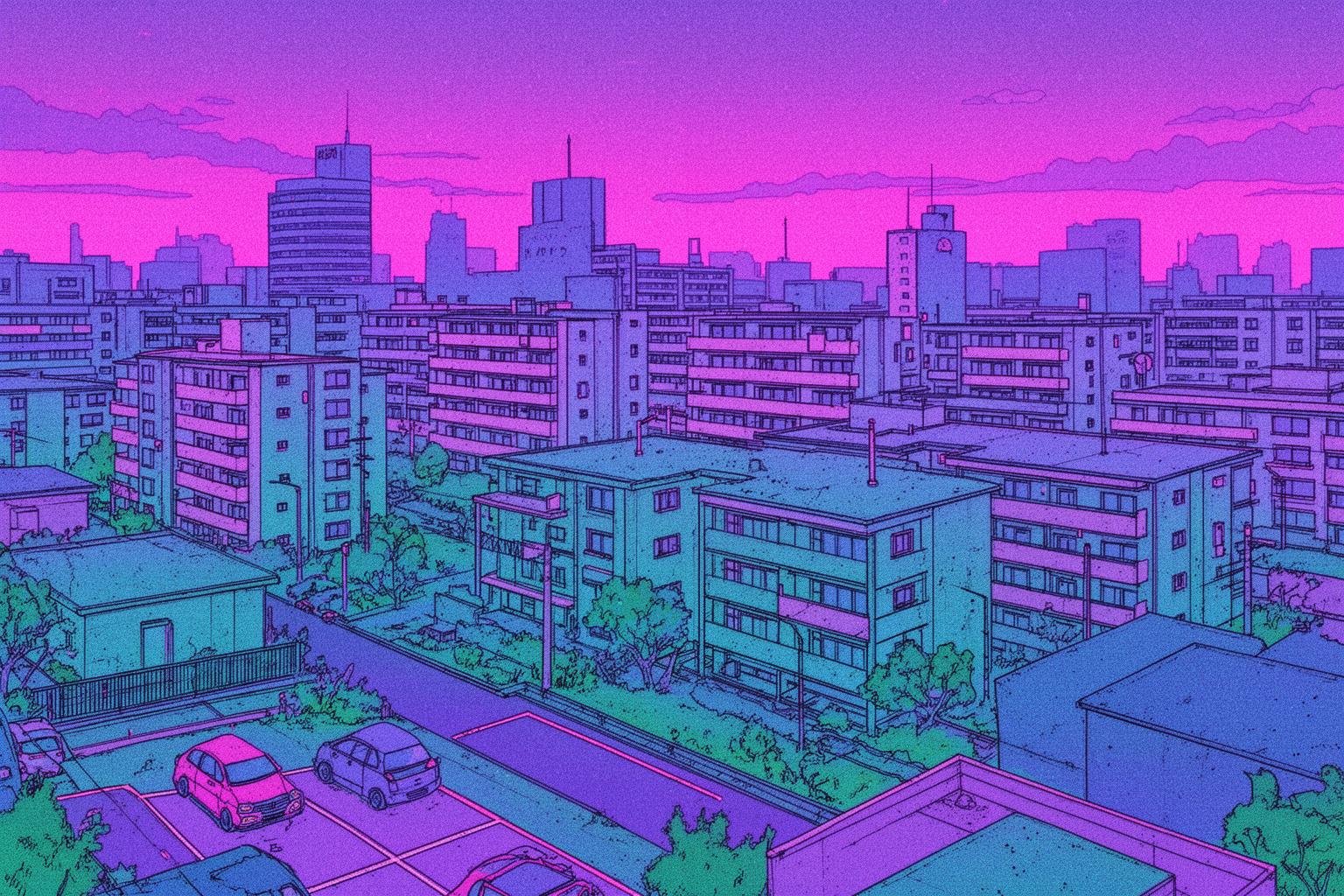
Stepping into a danchi complex for the first time, the initial impression is its sheer scale—and the repetition. It embodies an aesthetic of pure, unfiltered geometry. Row after row of identical buildings extend as far as the eye can see. The lines are crisp, the shapes straightforward, and the material almost always raw, unforgiving concrete. This is Brutalism’s domesticated cousin. From a photographer’s viewpoint, it’s a paradise of lines and patterns. Stairwells form dizzying spirals of shadow and light, while the long open-air corridors stretch into endless vanishing points. The grid of windows on a massive apartment block resembles a circuit board, each light a flickering sign of life within the machine.
Yet this uniformity also generates an uncanny valley effect. It’s housing on an industrial scale—so perfectly ordered it feels… unnatural. The human element appears almost as an afterthought, an organic variable in a concrete equation. Every door is painted the same color, every balcony features identical railings. This was intentional, of course: standardization was essential for building quickly and cheaply. But the result is a landscape that can be deeply disorienting. At night, this sensation intensifies significantly. Sodium lamps cast a sickly orange glow over the concrete, flattening its texture and turning the entire complex into a monochrome world. The few lit windows become focal points, small glowing squares of humanity within a vast dark grid. You begin to notice subtle breaks in the pattern—a plant on a balcony, a brightly colored towel hanging to dry, the unique silhouette of a person seen through frosted glass. These small signs of life become powerfully poignant against the overwhelming uniformity.
The buildings themselves tell a story. Early danchi were usually four or five-story walk-ups, arranged around green courtyards to encourage community. Later, as land grew scarce and ambitions increased, they soared upwards into towering high-rises connected by bridges and walkways. Complexes like Takashimadaira in Tokyo are so immense they have their own internal bus routes. Walking through one of these giants feels like navigating a city designed by algorithm. The building numbers can confuse, the pathways are labyrinthine. It’s easy to get lost, and the feeling of being a small, insignificant figure within a massive, impersonal structure contributes greatly to the eerie allure. It’s the sublime, but suburban. Standing in the center of it all, listening to the wind whipping through the concrete canyons, offers a quiet, humbling experience.
When the Dream Faded: The Vibe Shift
So what happened? The danchi was the dream, right? Well, dreams fade. By the 1980s, at the peak of Japan’s bubble economy, the danchi began to lose its appeal. They were aging. The once-modern features now seemed outdated. The rooms felt small and cramped compared to the new, private condominiums—the “mansions,” as they are called in Japan—that were springing up everywhere. The newer generation desired more space, greater luxury, and more individuality. The danchi, with its uniform, communal identity, started to feel like a relic from a past era. The very aspects that made it revolutionary—the concrete construction, the compact design—were now viewed as its biggest shortcomings. Concrete ages poorly, staining and cracking. The lack of insulation left them cold in winter and hot in summer. Many lacked elevators, making life difficult for residents who were now growing old within them.
As younger families moved out, the danchi population aged significantly. The playgrounds became silent. The once-bustling shopping arcades saw stores close one after another. The communities that once thrived at the heart of these complexes grew fragmented. The danchi gained a reputation as a place for the elderly, single-person households, and those unable to afford other housing. This is the source of the melancholy, the nostalgic ache you feel when you walk through a danchi today. It’s not abandoned—people still live here, life continues—but it’s haunted by the shadow of its own past. You can sense the faded optimism in the air. You see it in the peeling paint on a playground slide, the overgrown community garden, the darkened windows of vacant apartments. It’s a living museum of a social experiment that was once wildly successful and then, quietly, left behind by the unstoppable march of progress. This shift is what makes the danchi a liminal space. It’s caught between its past as a symbol of the future and its present as a quiet refuge for the aging. It’s neither dead nor fully alive. It exists in a state of suspended animation, a time capsule of the Showa era. At night, this feeling can be almost overwhelming. The silence isn’t peaceful; it’s heavy. It’s filled with the unsaid, the forgotten, the stories of the people who built their lives here when this was the center of the universe. It’s a deeply human silence, and listening to it is the true reason to come here.
A Night Walk Through the Concrete Forest
Let’s embark on a journey. It’s 10 PM on a Tuesday, and you step off the train at a station you’ve never heard of, nestled deep in the suburbs of Tokyo. The air here is cooler. The city’s frantic energy has given way to a quiet, suburban hum. Moving away from the station’s small bubble of light, a few blocks later, you see them—looming—an imposing wall of concrete dotted with tiny, flickering lights stretching into the night sky. The danchi.
Your initial steps into the complex are cautious. The scale is overwhelming. The buildings aren’t just tall; they’re broad, massive slabs of concrete that blot out the stars. You’ve entered a man-made canyon. The only illumination comes from evenly spaced street lamps, casting long, distorted shadows that dance and shift as you move. What strikes you first is the silence—not an absence of sound, but an altered soundscape. You hear leaves rustling in manicured hedges, the distant rumble of a passing train, the hum of a fluorescent light in a covered walkway. Then come the muted human sounds: a faint TV theme from a fourth-floor window, the sharp clang of a metal door closing somewhere down a long corridor, a brief argument snippet, a baby’s cry quickly hushed. Thousands of people surround you, yet you feel utterly alone—an anonymous observer, a ghost drifting through their world.
You find your way to one of the central courtyards, centered around the playground. Here, the eerie atmosphere intensifies. By day, it’s a children’s haven; by night, a surrealist stage. A single rusted swing sways gently in the breeze, its creak the only sound for a prolonged moment. The concrete panda slide, its paint chipped and faded, seems to gaze at you with empty, hollow eyes. Objects meant for joy and laughter become deeply melancholic under the dim orange light—artifacts of a childhood long gone, monuments to the danchi’s own lost youth. You almost hear phantom echoes of children playing, a ghostly soundtrack layered over the present silence.
Next, head toward one of the main buildings and look up at the access corridors—a hallmark of danchi architecture. At night, these long, open-air hallways stretch into what feels like infinity, ribbons of light and shadow. Each doorway is a dark rectangle—a potential entrance to another life, another story. Some bear personal touches—a small plant, a child’s bike, an umbrella stand—small acts of defiance against the overwhelming uniformity. As you watch, a silhouette appears at the corridor’s far end—a resident returning home late from work. You watch them walk the entire length, their footsteps a steady, rhythmic tap-tap-tap echoing in the stillness. They unlock their door, step inside, and the door clicks shut. The corridor falls silent again. The brief moment of human connection is gone. It’s an oddly intimate yet completely detached experience. You glimpse fragments of life but remain apart.
The windows say everything. Each lit window is a tiny, self-contained universe. In one, the cool blue-white flicker of a television illuminates a room you can’t fully see. In another, warm yellow light hints at a family dinner table. A single bare bulb in a window speaks of solitude. You find yourself weaving stories for these anonymous lights. This quiet observation is deeply meditative. You’re not spying—you’re bearing witness to the simple, profound act of living, repeated thousands of times all around. From a photographic perspective, this is the perfect shot: the building’s grid, the interplay of dark unlit windows and warm glowing ones. It visually captures community and isolation in one frame, telling the entire story of the danchi without a single word.
Danchi Destinations: A Few Case Studies
While the overall danchi atmosphere is universal, certain complexes possess their own distinct character and history. Exploring various ones uncovers the subtle differences within this architectural style.
Takashimadaira Danchi, Tokyo
This is the giant of them all. A true titan in the danchi world, located in Itabashi Ward. Constructed in the early 1970s, it functions like a sprawling city, with more than 10,000 units. Its scale is nearly unfathomable until you find yourself in the heart of it. The towering heights and extended lengths of the buildings generate powerful wind tunnels. Takashimadaira is notorious, or perhaps famed, for its overwhelming size, which has sadly been associated with feelings of isolation and carries a somewhat dark history. This contributes an authentic sense of unease to its nighttime atmosphere. Walking here feels like navigating a futuristic, dystopian city from a vintage sci-fi movie. The elevated walkways and massive, block-like structures embody pure retro-futurism. The dense population, combined with the anonymity of the architecture, creates an intense and unforgettable experience. It represents the danchi aesthetic distilled to its most potent and intimidating form.
Senri New Town, Osaka
If Takashimadaira is a brute, Senri is the thinker. Situated in the Osaka suburbs, it was Japan’s first major “new town” project, launched in 1962. It is a carefully planned community, designed from scratch to offer an ideal living environment. The layout is more diverse than many other complexes, featuring a blend of high-rise and low-rise buildings, integrated with parks, ponds, and winding pathways. Exploring Senri feels less like being in a concrete jungle and more like strolling through a vast, modernist park that people reside in. The original planners’ vision remains tangible. However, Senri is also among the oldest new towns, and the aging of its population and infrastructure is quite apparent. The contrast between the optimistic, utopian design and the quiet, slow-paced reality today is especially striking. It is a place for reflecting on the lifespan of grand ideas.
Tokiwadaira Danchi, Chiba
This complex brings a completely different vibe. Located in Matsudo, Chiba, Tokiwadaira is renowned for its sakura, or cherry blossoms. In spring, the main roads running through the complex transform into stunning tunnels of pink and white flowers. The sight of the delicate, transient blossoms set against the stark gray lines of the concrete buildings is surreal. It serves as a visual metaphor for the danchi experience itself: discovering beauty and life within an environment that can feel sterile and harsh. A nighttime walk here during sakura season is pure enchantment. The blossoms are softly illuminated from below by street lamps, creating a glowing, ethereal canopy. This softens the entire complex, making it feel more like a dreamscape than a housing development. It demonstrates how nature and time can interact with these structures to create something new and unexpectedly beautiful.
The Danchi in the Cultural Imagination
The power of the danchi aesthetic isn’t only experienced by urban explorers and photographers; it is deeply ingrained in Japanese cultural consciousness, often appearing in movies, anime, and manga as a powerful symbol.
In horror films like Hideo Nakata’s Dark Water, the danchi serves as a setting of dread and isolation. Its aging infrastructure, water stains on the ceiling, long empty corridors, and oppressive anonymity create the perfect backdrop for a ghost story. The film skillfully uses the ordinary environment of the danchi to evoke a sense of creeping terror, tapping into fears about urban loneliness and decaying social structures. It transforms the mundane into something monstrous.
By contrast, anime such as Danchi Tomoo offers a nostalgic, heartwarming portrayal of danchi life. This comedy series celebrates the close-knit community and the quirky adventures of a young boy growing up in a danchi complex. It recalls a time when these places were filled with children, neighbors all knew each other, and courtyards buzzed with social life. It’s a fond look back at the danchi’s golden era, a sweet and humorous depiction of a bygone utopia.
There are also more artistic and surreal takes, like in the anime Tekkonkinkreet. While not set entirely in a danchi, the film’s chaotic, sprawling urban landscapes draw heavily from the aesthetic of aging Showa-era buildings. It captures these spaces as complex, layered ecosystems full of hidden corners, decay, and vibrant life. Similarly, manga artist Inio Asano’s works often unfold in quiet, melancholic suburbs, with the danchi serving as a silent witness to the characters’ anxieties and existential struggles. Here, the danchi is more than a setting; it becomes a character embodying the weight of the past, the constraints of social expectations, and the search for meaning within uniformity. Its recurring presence across diverse media reveals just how profoundly it has shaped the visual and emotional language of modern Japan.
A Guide for the Respectful Explorer

If you feel drawn to go and experience this vibe firsthand, that’s fantastic. But it’s crucial to do it the right way. This isn’t a tourist spot or an abandoned place; it’s home to thousands of people. The number one rule is respect. Your cool, atmospheric adventure is their everyday life. So, here are a few important points to keep in mind.
Be a Ghost
The aim is to observe without intruding. Move quietly. Avoid loud phone calls or conversations with friends. Sound echoes oddly through these concrete walls, and you don’t want to disturb the residents. Wear dark clothes to blend in. The whole point is to soak up the atmosphere, which you can’t do if you’re disrupting it. In essence, master the art of being invisible.
Photography with a Conscience
Of course, you’ll want to take photos—the danchi is incredibly photogenic. But be considerate. Never point your camera directly into people’s windows; that’s a serious invasion of privacy and simply not okay. Focus on the architecture, patterns, light and shadow, and the overall mood. Capture the scale and details. If you use a tripod, be quick and discreet. Don’t block pathways or set up in the middle of walkways. You’re a guest in a residential area, so behave accordingly. The best photos capture the essence of the place without compromising the privacy of its residents.
Timing is Everything
The danchi reveals different moods at various times. The “golden hour” before sunset bathes the concrete in warm, beautiful light, highlighting its textures. The “blue hour” after sunset, when the sky turns deep indigo and windows start lighting up, is pure magic. Late night, from 10 PM onwards, is when the silence and eerie atmosphere peak. Weeknights are usually quieter than weekends. Rain drastically changes the vibe too—wet concrete reflects streetlights, creating a moody, cyberpunk look straight out of Blade Runner. Experiment to find the time that resonates most with you.
Getting There and Getting Around
Most large danchi complexes are found in the suburbs and are easily reachable by train from major city centers. A quick Google Maps search for “danchi” (団地) will show clusters scattered across the country. Choose one, locate the nearest station, and just go. Once there, the best way to explore is on foot. Wander freely. Allow yourself to get a bit lost. Follow intriguing pathways, explore different courtyards, and see where you end up. There’s no fixed route—the experience is about discovery and soaking in the unique atmosphere of each place.
More Than Just Concrete
Walking through a Showa-era danchi, it’s easy to notice only decay—the faded paint, empty playgrounds, and aging concrete—and think of it as a sad, forgotten place. But that perspective misses the point. These places are not sorrowful; they are layered with history, memory, and the quiet dignity of lives lived away from the spotlight. They serve as a physical timeline of Japan’s modern story, spanning from the hopeful post-war recovery to the reflective maturity of an aging society. Being in a danchi at night is a form of meditation—about discovering the sublime in the ordinary, appreciating beauty in geometry, silence, and the soft glow of a single illuminated window against the stark concrete. It reminds us that the most powerful stories often lie not in grand monuments but in everyday spaces where ordinary life unfolds. So next time you’re in Japan, take an evening off the city’s pace. Catch a local train to the outskirts, stroll through a concrete forest, and simply listen, watch, and feel. It’s a quiet yet profound experience that will transform how you see Japan—a vibe you won’t soon forget.