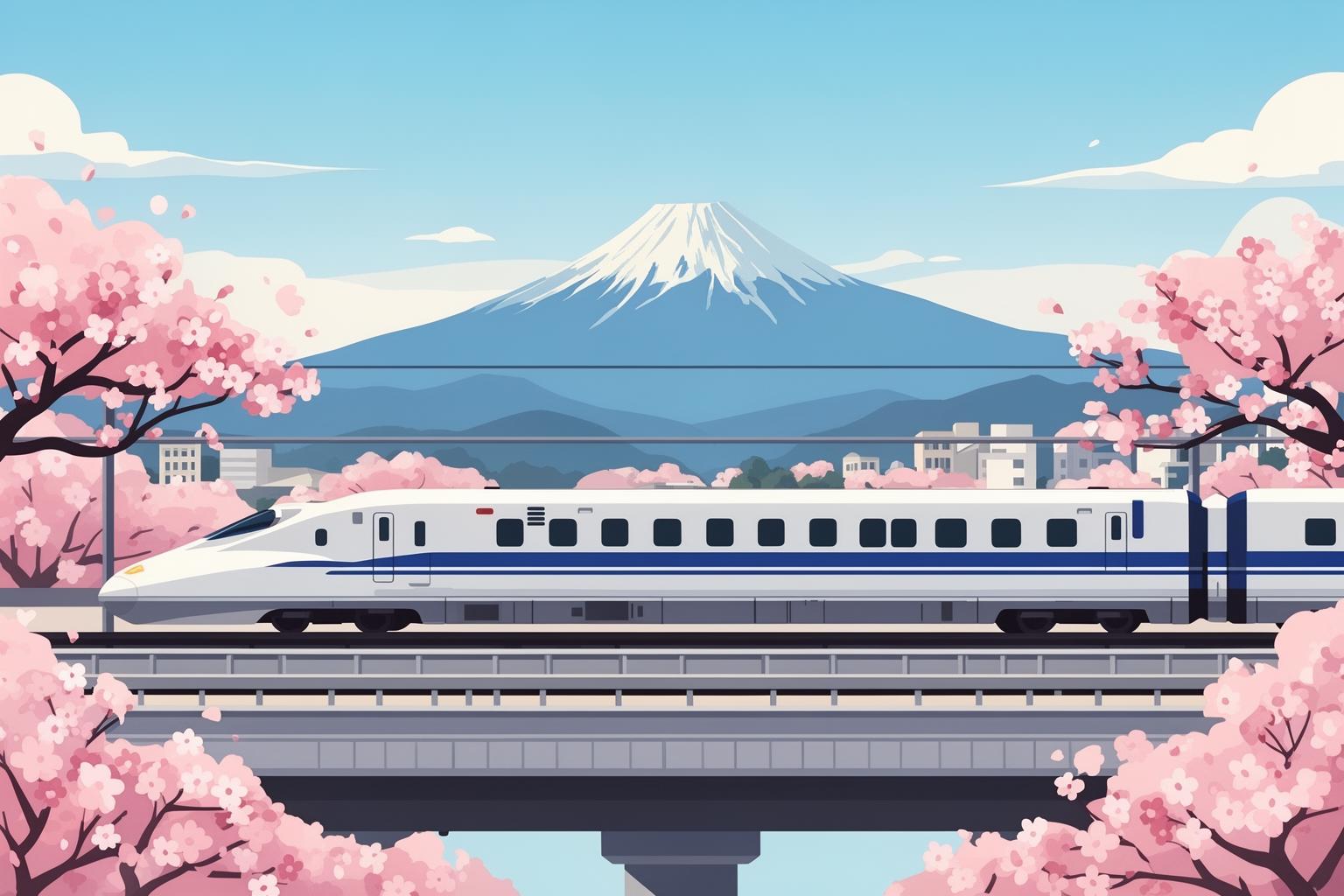
Yo, what’s up? It’s Ayaka. So, let’s get real for a sec. You’ve seen it, right? That impossibly sleek, almost cartoonishly futuristic train gliding past Mount Fuji. It’s in every anime, every travel vlog, every single montage of “Cool Japan.” It’s the Shinkansen, the bullet train. And you might be thinking, “Okay, it’s a fast train. Big deal.” But that’s where you’d be dead wrong. The Shinkansen isn’t just a train. NGL, it’s a whole vibe. It’s a time machine, a piece of art, and a national symbol all rolled into one. It’s the key to understanding Japan’s obsession with a very specific flavor of the future—a kind of retro, pop-futurism that’s still shaping the country’s identity today. You see this train and you feel like you’re in a sci-fi movie, but the movie was made in 1964. It’s this weird, awesome paradox. How did a piece of public transport become the main character in Japan’s story of itself? How did it become a physical manifestation of a dream? To get it, we gotta rewind the clock. We’re not just talking about engineering and timetables. We’re talking about a nation trying to figure out who it was and who it wanted to be, and deciding to build the answer out of steel and electricity, launching it down a track at 210 kilometers per hour. It’s a story about building a future you can ride in. And it all starts at the heart of the capital, a place that is both a beginning and a destination.
This retro-futurism is a key part of the broader Showa retro aesthetic that continues to define cool in Japan today, much like the enduring appeal of a classic Showa-era kissaten.
The Bullet That Blew Up the World’s Expectations
To truly understand the Shinkansen, you need to imagine Japan in the early 1960s. It was far from the neon-lit, high-tech marvel you see on social media today—not even close. This was less than two decades after World War II, when the country lay shattered both physically and mentally. Cities were in ruins, the economy was devastated, and the national mood was, to say the least, quite grim. The older generation recalled a militaristic empire reduced to ashes, while the younger generation was growing up in its shadow, surrounded by scarcity and deep loss. But then, something changed. An almost reckless wave of optimism began to rise. This was the era of the “economic miracle.” Factories roared back to life, and people could finally afford the “Three Sacred Treasures”—not imperial relics but a black-and-white TV, a washing machine, and a refrigerator. It was a period of intense, focused, and almost desperate rebuilding. Japan was fighting to reclaim its place on the world stage and needed a grand debut.
That debut was the 1964 Tokyo Olympics—a monumental event. It marked the first time the Olympics were held in Asia. For Japan, it was everything: a chance to show the world, “We are not a defeated, broken nation. We are peaceful, modern, and technologically advanced.” It was a global rebranding. Everything had to be flawless. New highways sprang up, stadiums were constructed, and Tokyo underwent a massive makeover. But the centerpiece, the ultimate showpiece, was the Tōkaidō Shinkansen. Designed to link Tokyo, the political and cultural core, with Osaka, the commercial hub, the old train trip along the Tōkaidō Main Line was a slow, jarring ordeal. It could take nearly seven hours—an entire workday—to cover over 500 kilometers. This wasn’t just inconvenient; it felt outdated, a relic of a past era. It clashed with the vision of a swift, hyper-efficient Japan emerging anew. The government invested an enormous amount of money, political capital, and national pride into constructing a new kind of railway.
The undertaking was colossal. It required building hundreds of kilometers of new, dedicated tracks without sharp curves, tunneling through mountains, and spanning valleys with massive bridges. Critics abounded. Many called it a colossal waste of money, a vanity project destined to bankrupt the nation. Yet the engineers and planners persevered, driven by a vision. And on October 1, 1964—just ten days before the Olympics’ opening ceremony—the first Shinkansen, the iconic 0 Series, departed Tokyo Station. It completed the trip to Osaka in four hours, a time soon reduced to just over three. For the international media and athletes arriving for the Games, it was a revelation. This was more than a train; it was a statement. Sleek, quiet, and incredibly fast, it was a bullet shot straight into the future. Japan was proudly declaring, in the most dramatic way possible, that it had not only recovered but was now at the forefront. The train’s futuristic design and remarkable performance became the ultimate symbol of the new Japan—peaceful, prosperous, and hurtling forward at astonishing speed.
Designing a Dream, Not Just a Train
So, what made the Shinkansen feel so unique? It wasn’t just the speed. It was the entire aesthetic, the complete experience. It was a masterpiece of what we would now call user-centric design, but at the time, it felt like stepping into a science fiction novel. This is where pop-futurism truly shines. The train was designed to look unlike anything else on Earth.
The 0 Series: A Spaceship on Rails
Consider the design of the original 0 Series train. It’s iconic for a reason. The lead car featured a smooth, rounded, almost cartoonish nose cone, inspired by the aerodynamics of jet aircraft. There were no clunky, exposed mechanics like those on old steam locomotives. Instead, it was all seamless curves and clean lines. The color scheme was a brilliant choice: a crisp white body with a bold blue stripe running along the windows. It appeared clean, optimistic, and strikingly modern. It didn’t look like it belonged in a grimy train yard; it looked like it belonged in a spaceport. This was no coincidence. Designers like Hideo Shima and Reisuke Sone were deliberately aiming to create a visual break from the past. They were crafting a rolling symbol of the future.
This aesthetic perfectly captured the cultural spirit of the ’60s. This was the era of Osamu Tezuka’s Astro Boy (Tetsuwan Atom), a beloved manga and anime about a heroic robot boy in a futuristic world. Children were fascinated with space travel, robots, and futuristic cities. The Shinkansen seemed to have emerged straight from the pages of those manga. It was a tangible piece of that fantasy world. People could see it, touch it, and ride it. This connection cannot be overstated. The Shinkansen was not only a technological marvel; it was a cultural milestone. It validated the dreams and fantasies of a generation, making the imagined future feel real and achievable. The quiet, air-conditioned cabins with their large windows and reclining seats were also revolutionary. It offered a level of comfort and civility previously unimaginable in public transportation. It was a smooth, serene glide, a stark contrast to the noisy, shaky trains of the past. The experience was designed to make you feel transported not just across distance but through time, into a better, more advanced world.
Time-Space Compression and the New Japanese Map
The Shinkansen profoundly transformed the Japanese psyche by fundamentally altering perceptions of time and distance. Before 1964, Tokyo and Osaka felt like two separate worlds. A business trip was a major undertaking, often requiring an overnight stay. Families living in one city might only see relatives in the other once or twice a year. The Shinkansen changed everything. Suddenly, a day trip for business became not only possible but routine. The psychological distance between the country’s two largest metropolitan areas collapsed.
This “time-space compression,” as scholars call it, had a massive impact. It helped forge a stronger sense of a unified national economy and culture. The country literally felt smaller and more interconnected. This sense of connectivity, of a nation seamlessly linked by high technology, became a core element of post-war Japanese identity. It fostered a shared sense of purpose and progress. The Shinkansen wasn’t just a line on a map; it was redrawing Japan’s mental map. It transformed the Tōkaidō corridor into one vast megalopolis. This physical and mental integration formed the infrastructure on which the economic miracle was built. The train’s legendary punctuality—measured in seconds, not minutes—also became a source of immense national pride. It reflected and reinforced a cultural emphasis on precision, reliability, and efficiency. The train wasn’t just punctual; it was a promise fulfilled, again and again, millions of times each year. This reliability became a metaphor for the new Japan itself: a nation you could trust, a finely tuned machine racing toward a bright future.
The Pop Culture Feedback Loop: A Star is Built
Once the Shinkansen began operating, it quickly transcended its role as mere transportation and became a prominent pop culture icon. It gained celebrity status in its own right, serving as a recurring character in the narrative Japan was crafting about itself. This created a dynamic feedback loop: the real train inspired fiction, and that fiction, in turn, reinforced the train’s symbolic significance in the real world.
From the Big Screen to the Toy Box
The Shinkansen’s sleek, photogenic design naturally made it a star. It soon appeared everywhere. In kaiju films like the Godzilla series, the Shinkansen was a favored backdrop. Its destruction by a giant monster served as a powerful visual trope, representing a threat to Japan’s modern progress. Conversely, the hero’s rescue of the Shinkansen symbolized the defense of that very progress. Its most famous leading role was likely in the 1975 thriller Shinkansen Daibakuha (released internationally as The Bullet Train). The plot was pure Hollywood: a bomb planted on a Hikari service would explode if the train’s speed dropped below 80 km/h. It was essentially Speed on rails, 19 years before the movie Speed existed. The film was a major success and cemented the Shinkansen’s image as a high-stakes, high-tech symbol of the nation itself.
Beyond films, it was ubiquitous. It featured in countless TV dramas, commercials, and travel shows. For children, it was the ultimate cool toy. Every kid owned a Plarail (Plastic Rail) set, and the must-have train was always the 0 Series Shinkansen. This cultivated generations of Japanese children with love and fascination for the bullet train. It became more than a machine; it was a friend, a hero, and a part of childhood’s landscape. This constant presence in media and play deeply embedded the Shinkansen within the nation’s cultural DNA. It became a visual shorthand for Japaneseness, instantly recognizable both domestically and abroad. When people saw that white-and-blue train, they saw Japan.
The Power of a Name: Hikari and Kodama
Even the branding was a stroke of pop-futurist brilliance. The two original services weren’t given dull, functional names. Instead, they were called Hikari (ひかり – Light) and Kodama (こだま – Echo). These names are beautiful, poetic, and evocative. Hikari, the faster, limited-stop service, literally means “Light.” It perfectly captured the sensation of futuristic speed. It wasn’t just a fast train; it was a train moving at the speed of light—a name straight out of a space opera. Kodama, the slower service that stopped at every station, means “Echo,” suggesting the ripple effect it would have even in smaller towns along the route. This lyrical, almost spiritual naming elevated the train beyond mere machinery. It sold an experience, a feeling, a dream. It was a masterful branding effort that made the Shinkansen feel like a piece of national mythology from the start. It told passengers they weren’t just buying a ticket; they were boarding a beam of light, embarking on a journey into the future.
A Metaphor for the Miracle Economy
The Shinkansen became the perfect moving metaphor for Japan’s post-war economic miracle. Consider its core attributes. It was incredibly fast, mirroring the rapid pace of economic growth. It was safe and remarkably reliable, reflecting the quality and dependability of Japanese manufacturing that was gaining global acclaim. It was a collective achievement, the result of thousands of people working together with remarkable precision, reflecting the corporate culture of lifetime employment and group harmony seen as the engine of Japan’s success. The train was a constant, visible reminder of what the country could accomplish. As it silently sped past factories and rice paddies, it connected the industrial present with the agricultural past, all while pointing toward a technological future. It symbolized unstoppable momentum. This wasn’t just a government-driven narrative; it was a genuine feeling shared by the people. The Shinkansen was a source of pride because it was proof—proof that Japan had not only recovered but had created something better, faster, and more advanced than anyone else. It was the physical embodiment of the nation’s ambitions.
The Legacy: Is Japan Still on the Fast Track?
Decades have passed since the first bullet train departed from Tokyo Station. The world has transformed, and Japan along with it. The boundless optimism of the 1960s has given way to more nuanced realities. So, what does the Shinkansen represent today? Is it still a symbol of the future, or has it become a monument to a future that never quite materialized?
An Evolving Icon: From 0 to N700S
The Shinkansen itself has never stood still. The original 0 Series was retired from the main Tōkaidō line in 1999, but its spirit endures in a continually evolving fleet of futuristic successors. Each new generation of Shinkansen has made a design statement, reflecting the aesthetics and priorities of its era. The 100 Series, introduced during the bubble economy’s heyday in the 1980s, featured a sharper nose and, notably, double-decker cars with private compartments and a dining car—symbols of a confident and affluent Japan. Then came the 300 Series in the 1990s, the first to reach 270 km/h, with a sleeker, more utilitarian design embodying a shift toward pure efficiency as the bubble burst. The 500 Series, debuting in 1997, remains a fan favorite and perhaps the most sci-fi train ever built. Its incredibly long, needle-like nose and circular fuselage made it resemble a fighter jet or a spaceship more than a train—a pure expression of technological prowess, almost a work of art. Later iterations, like the 700 Series with its distinctive “duck-billed” platypus nose, and the modern N700S (Supreme), have emphasized a balance of speed, efficiency, comfort, and environmental performance. This ongoing evolution demonstrates that the drive to make the Shinkansen a symbol of the “cutting edge” remains very much alive. The train itself serves as a rolling museum of Japan’s shifting vision of the future.
Riding Through the Past’s Future
Here lies the twist and the key to grasping the Shinkansen’s resonance in the 21st century. While the train has continued evolving, the nation has not always advanced at the same pace as the unrestrained optimism it once embodied. The economic miracle gave way to the “Lost Decades” of stagnation starting in the 1990s. The population is now aging and shrinking. The promise of limitless growth and technological supremacy has been tempered by reality. In this light, the Shinkansen acquires a new dimension of meaning. It has become an icon of retro-futurism. Riding it, especially with knowledge of its history, is not merely traveling through space but journeying back to the 1960s’ vision of the 21st century. It is a living, breathing, functioning artifact of a future imagined in the past. This is a major part of its allure, especially for younger generations and international visitors. It evokes the same sensation as listening to 80s City Pop or admiring vaporwave art—a nostalgia for a future that was bright, sleek, and full of promise. The Shinkansen embodies the ultimate vaporwave aesthetic brought to life. It is a clean, efficient, technologically remarkable system that also stirs a powerful nostalgia for a moment of peak Japanese optimism. It recalls a time when the future felt certain, envisioned as a white and blue bullet train speeding off toward the horizon. So, is it still a symbol of the future? Yes, but in a different way. It is no longer just a promise of what lies ahead. It stands as a complex, beautiful emblem of the future Japan dreamed of, the present it created, and the lingering nostalgic glow of that original, radiant vision. It’s not merely a train—it’s Japan’s enduring spirit, still running on time.