Yo, what’s the deal? It’s Yuki Sato, your go-to guide for decoding the matrix that is Japan. So, picture this: you’ve just touched down in Tokyo, hype levels are through the roof. You’ve seen the vlogs, you’ve scrolled the feeds, and you’re on a mission for that one, perfect, soul-altering bowl of ramen. You duck into a tiny alleyway, lured by the steamy aroma of pork broth and the promise of authenticity. You slide open a door and BAM. It hits you. Not a restaurant, but a corridor. A tiny, brightly lit space packed shoulder-to-shoulder with people, all hunched over bowls, slurping with an intensity that’s kinda wild. There are no chairs, just a counter. No friendly host, just a machine with a bazillion buttons. The vibe is less ‘chill dinner spot’ and more ‘mission control during a rocket launch.’ Everyone’s moving with a silent, synchronized purpose, and you’re standing there, a total glitch in the system, wondering, “What did I just walk into? Is this even a restaurant? And why is everyone in such a massive hurry?” You feel the pressure of the line forming behind you, a silent judgment for your hesitation. This, my friend, is the world of `tachigui` ramen—standing ramen. And trust me, it’s not just about eating fast. It’s a full-blown cultural ritual, a masterclass in urban efficiency that tells you more about Japan than a hundred guidebooks ever could. This isn’t just about grabbing a quick bite; it’s about plugging into the very rhythm of the city. It’s a system, a philosophy, and once you get it, you don’t just eat ramen—you experience it. So, let’s spill the tea on why these standing-room-only noodle bars are the real deal and break down the unspoken rules of this high-speed flavor game. It’s time to level up from tourist to insider. No cap.
Once you’ve mastered the standing ramen ritual, you might be ready to dive into another intense noodle experience, like the art of dipping noodles in rich, flavorful broth.
More Than a Meal: The Philosophy of the ‘Quick Bite’
Before even getting to the noodles, you need to understand that `tachigui` isn’t just a modern trend or foodie craze. It’s a legacy system, a slice of living history born from Japan’s rapid post-war economic boom. It represents the architectural and culinary embodiment of a society that chose to buckle down and work hard. This concept serves as a vibe check on the priorities of urban Japan and has done so for decades. It’s not about luxury or leisure; it’s about function, fuel, and a very particular kind of freedom—the freedom to quickly refuel with something genuinely delicious and soul-warming during the ten minutes between a late meeting and the last train home. This system was designed by and for the city’s workers, a tribute to the daily grind and the small moments of satisfaction that make it bearable.
The Genesis of ‘Tachigui’: A Salaryman’s Sanctuary
Let’s rewind to the 1960s and 70s. Japan’s economy was booming. Cities like Tokyo and Osaka were swelling with millions of `salarymen`, the corporate warriors clad in identical dark suits who powered the nation’s growth. These men worked insane hours. Their lives were a relentless loop of commuting, working, overtime, and maybe a few drinks with their boss before the grueling trip home. Leisurely dinners were a luxury few could afford, both in terms of time and money. What they needed was something fast, cheap, filling, and hot—a quick pit stop to recharge before jumping back into the fray. Thus, the `tachigui` scene flourished. Standing soba shops, ramen counters, even sushi bars packed into the nooks and crannies of train stations and business districts. The lack of chairs wasn’t just a space-saving gimmick; it was essential. No chairs means no lingering. It signals the establishment’s purpose from the moment you see it: eat, pay, leave. This created an environment of maximum efficiency—a human conveyor belt of hungry workers. Every detail—the narrow counter, the water pitcher within easy reach, the ticket machine by the door—is a carefully crafted piece of social engineering aimed at one goal: maximizing customer turnover while providing a high-quality meal. It’s a sanctuary, but only a brief one. A short, ten-minute escape into a world where it’s just you, the counter, and the steaming bowl of noodles. For those few moments, the office noise, the boss’s pressure, the crush of the train all fade away into pure, unadulterated consumption.
The Social Contract of the Counter
Here’s where it gets profound. Approaching a `tachigui` counter is like entering into an invisible social contract. You’re not just a customer; you’re a temporary user of a shared public utility. The unwritten rule is to use this utility as efficiently and considerately as possible. The entire system is built on the foundational Japanese concept of `wa` (harmony) and the avoidance of `meiwaku` (causing trouble or inconvenience). This principle sits at the very heart of Japanese society and is played out in hyper-speed at the ramen counter. Lingering after finishing, talking loudly on your phone, or spreading your belongings across the counter aren’t mere annoyances—they breach the collective agreement. You’re effectively stealing time and space from the next person in line, who’s just as tired and hungry as you were. This isn’t about being unfriendly; it’s quite the opposite. It’s an unspoken form of deep consideration for the strangers beside you. The system works because everyone tacitly agrees to follow these rules. It’s a beautiful, silent dance of mutual respect. Everyone knows their role: the chef’s to make incredible ramen at lightning speed; yours to order clearly, eat with purpose, and then make room for the next customer. By honoring this flow, you become part of the shop’s rhythm, contributing to its harmonious function. It’s a unique kind of intimacy, sharing that small, intense space with a dozen strangers, all engaged in the same ritual. No talking, maybe not even making eye contact, but a shared sense of purpose that’s distinctly Japanese. This is why the scene can feel intimidating to outsiders. It’s not hostile—it’s just highly structured, a system that assumes you already know the rules, and when you don’t, it feels like you’re disrupting the flow.
The Ritual of the Ramen Bowl: A Masterclass in Efficiency
Alright, you’ve got the philosophy down. Now let’s get tactical. Navigating a `tachigui` ramen spot is a step-by-step ritual, where every move serves a purpose. It’s a game of efficiency, and if you play it right, you’ll walk away not only with an amazing bowl of noodles but also a nod of respect from the chef. This is the ultimate playbook. From approaching the glowing vending machine to your final, smooth exit, you’re part of a performance. It’s a dance of details that, when done well, is deeply satisfying. It turns a simple meal into something more meaningful—a direct connection to the culture of craftsmanship and care that so much of Japan embodies.
The Vending Machine Gauntlet: Order Before You Enter
Before you even step inside, the first challenge awaits: the `kenbaiki`, or ticket vending machine. This device—a wall of plastic buttons covered with pictures and a flood of Japanese characters—is the gatekeeper, and its concept is pure genius. Think about it: by requiring you to order and pay before claiming a seat, the shop has streamlined its entire process. No need for a cashier, saving precious space and labor. The chef, or `taisho`, doesn’t have to handle cash then touch food. The ordering is standardized, reducing errors and limiting the need for conversation—crucial in a noisy, fast-paced setting. The chef simply receives your ticket and can start cooking immediately. This system separates payment from preparation, optimizing both. For you as a customer, this can be stressful. The line grows behind you. The clock ticks. You’re squinting at tiny photos, wondering if `チャーシュー` means extra pork (it does) or something else. Our advice? Have a plan. Know what you want before you reach the machine. Usually, the buttons in the top left corner are the shop’s standard or most popular items. If you’re lost, stick with those. Insert your cash, press the button for your ramen, any extras like a seasoned egg (`ajitama`), and maybe a side of gyoza or rice. Collect your tickets and change, take a deep breath—you’ve cleared the first hurdle.
Finding Your Spot: The Art of the Shuffle
Tickets in hand, you step inside for the next phase: claiming your spot. The counter is likely full. There are no assigned seats. You need to read the room. Look for a diner finishing their meal—perhaps sipping the last of their broth or tidying their space. Hover nearby, but don’t crowd. This isn’t a contest. When they leave, that’s your cue. Step into the open seat. But don’t just stand there. The next move is key. Place your plastic tickets on the raised part of the counter in front of you. This silent message to the chef means: “I’m here, and this is my order.” Without breaking rhythm, the chef glances over, spots the tickets, and offers a brief acknowledgment—maybe a nod or a sharp “Hai!” You’re now in their mental queue. Next, prepare your area. Hang your bag on the hook below or wedge it between your feet. Keep your jacket on or fold it neatly. Aim for compactness. The counter is sacred—reserved only for your bowl, water, and chopsticks. Nothing else. You’re a self-contained unit, minimizing your footprint and respecting the limited shared space. This shuffle, this subtle spatial negotiation, reflects life in a crowded Japanese city, where coexistence depends on acute awareness and small courtesy from everyone.
The Chef’s Stage: A Performance of Precision
While you wait, enjoy a front-row seat to one of the greatest culinary performances. Behind the counter is the chef’s stage, and they are the star. Watch closely. It’s a display of focused efficiency, honed through thousands of hours of practice. Every movement is deliberate—no wasted energy or hesitation. It’s controlled chaos. One hand dips a wire basket of noodles into boiling water, the other ladles precise amounts of `tare` (flavor base) and broth. Their eyes constantly scan—timing noodles, arranging slices of `chashu` pork, grabbing bean sprouts. They might juggle five, six, or seven bowls in different stages, each customized with various toppings. It’s a stunning show of mental organization and muscle memory. This is the spirit of the `shokunin`, the artisan, in its purest form. Having devoted their life to perfecting ramen-making, they work amid steam, heat, and pressure with serene focus. Your role as a customer is to be a respectful audience—no small talk, no special requests beyond the ticket options. Your quiet appreciation is the best compliment you can offer. You’re not just waiting for a meal; you’re witnessing a master at work. When your bowl arrives, it’s the climax of this performance—placed before you with deliberate care. The transaction is complete. The show ends. Now, it’s your turn to perform.
The Slurp: Demystifying the Noodle Noise
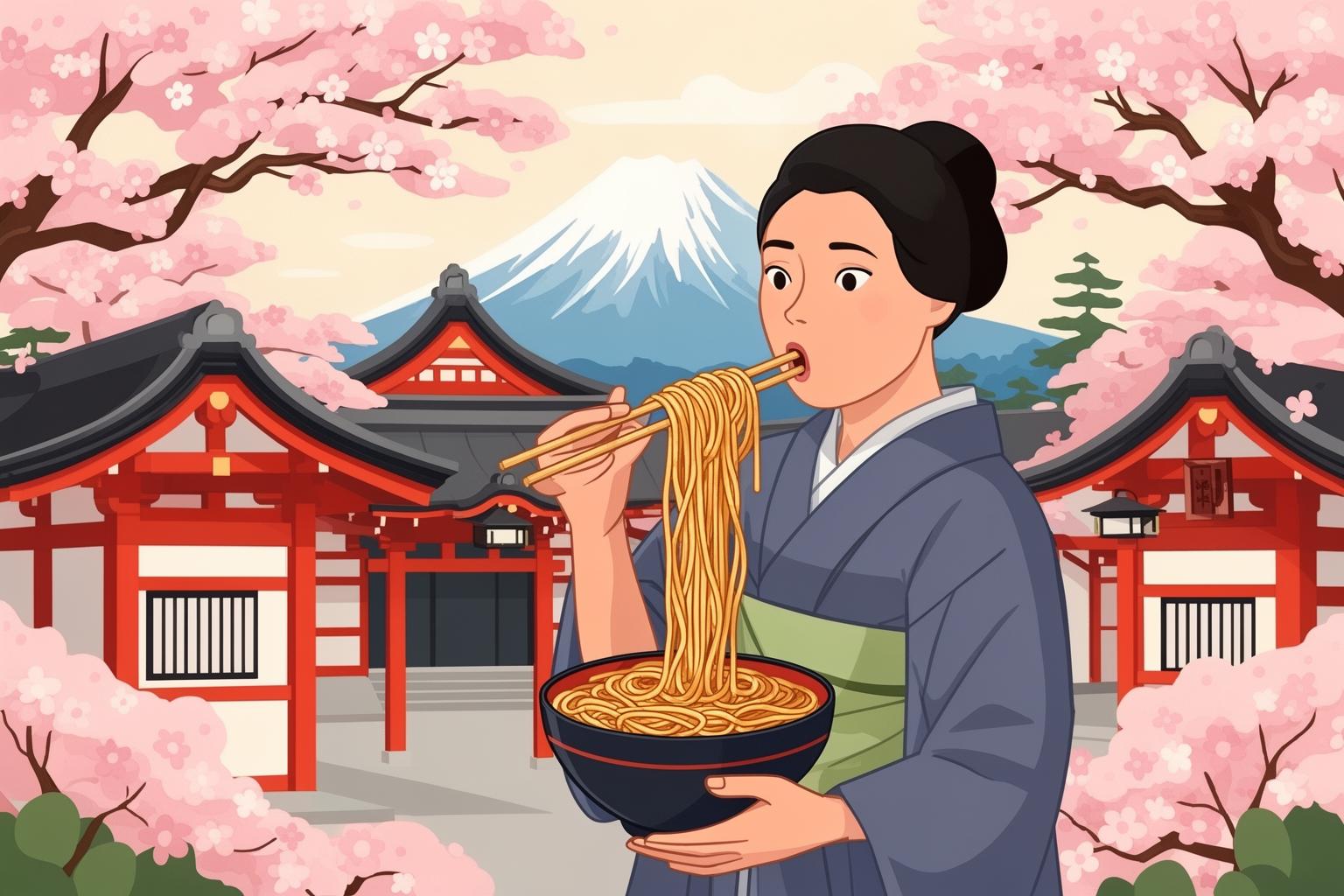
Alright, let’s address the elephant in the room: the noise. To those unfamiliar, the sounds inside a ramen shop can be surprising—a chorus of enthusiastic, unapologetic slurping. In many Western cultures, this might be considered extremely impolite. But here, it’s not only accepted; it’s practically essential. This is likely the biggest cultural gap a visitor will face at the dining table. And the reason behind it isn’t simply “because it’s polite,” a simplistic explanation you might have heard. The true reasons are a fascinating mix of physics, flavor science, and a profound respect for the food itself. Overcoming your slurp-shyness is key to experiencing ramen fully.
It’s Not Rude, It’s Rocket Science (Kind Of)
Let’s be clear: slurping isn’t mainly about showing the chef you enjoy the food, though it can be seen that way. The primary reasons are functional. First and foremost is flavor and aroma. When you slurp noodles, you are drawing them into your mouth along with a rush of air and some broth coating them. This is called aeration. It functions similarly to swirling wine in a glass or letting fine cheese breathe. It releases volatile aromatic compounds in the hot broth and directs them into your nasal passages. Since much of what we taste is actually smell, slurping literally enhances the flavor of the ramen. It’s a technique to boost taste. No exaggeration. Secondly, it cools the noodles. Ramen is served piping hot. The noodles are at their best texture—chewy, firm, or al dente—for only a few minutes. Waiting for them to cool causes them to turn mushy and soggy, a process known as nobiru. Slurping solves this by drawing in cool air alongside the hot noodles, cooling them just enough before they reach your mouth so you don’t burn yourself, allowing you to enjoy them at their ideal temperature and texture. It’s a simple yet clever application of practical physics. So, when you see a counter full of people slurping, they’re not being rude—they’re engaging with their food in the most efficient, flavor-enhancing way possible, eating the ramen exactly as the chef intended.
The Symphony of Sounds: Reading the Room
That said, this doesn’t mean you should make as much noise as possible. There’s an art to it. A good slurp is focused and efficient, not loud and theatrical for its own sake. It’s a “zzzz-zzz” sound, not a sloppy, splattering mess. It forms part of the shop’s ambient soundtrack, the white noise of contentment. Hearing that chorus of slurps signals that the system is working. People are enjoying noodles at their peak, honoring the chef’s craft. It’s a collective, unspoken nod to quality. Of course, it takes practice. As a foreigner, you might initially feel self-conscious, trying to eat quietly with a fork-like twirl of your chopsticks. But that marks you as an outsider and means you’re missing the full experience. The best approach is to just dive in. Pick up a small bundle of noodles with your chopsticks, lift it to your mouth, and inhale. Don’t hesitate. Match the rhythm of those around you. It’s a moment to let go of your own cultural preconceptions and embrace the local logic. The slurp is a sonic testament to the idea that in Japan, the highest respect you can show food is to eat it enthusiastically, right at its moment of perfection. It’s a sound of appreciation—a sign you are fully present and engaged in the act of eating.
The Grand Finale: The Art of the Graceful Exit
You’ve mastered the vending machine, maneuvered the counter, and slurped like a local. The bowl is empty, except for a few lingering drops of broth. But the ritual isn’t finished. How you leave a `tachigui` ramen shop is as important as how you enter. The final act involves closing the circle, resetting the space for the next person, and showing your last respects. This isn’t a place to sit back and digest. Once your meal is done, your role there is complete. It’s time for a graceful exit, a finishing touch that confirms you truly understand the experience.
The Counter Wipe: A Sign of Respect
After your last spoonful of broth, glance at your counter space. You’ve likely splattered a bit of broth here and there. Nearby, you’ll often find a small damp cloth (`fukin`) or paper towels. The final move of a seasoned diner is to grab the cloth and quickly wipe down your area. This isn’t mandatory—the staff will clean it anyway—but this small act of tidiness is a huge sign of respect. It’s a silent `thank you` to the chef and a considerate gesture for the next customer. You leave the space as clean as, or cleaner than, you found it. This small bit of personal responsibility helps the whole system run smoothly. It signals, “I was part of this process, not just a consumer.” In a culture that deeply values cleanliness and regard for others, this subtle gesture speaks volumes. It’s a pro-level move that will earn you an appreciative nod from anyone who notices.
The Swift Departure: No Lingering, No Chat
Once you’ve wiped your space, it’s time to leave. Immediately. Place your empty bowl and cup on the upper counter to make it easier for the staff to clear them. Gather your belongings, stand, and step back to clear the area. As you go, it’s customary to catch the chef’s eye and say a sincere “Gochisousama deshita.” This phrase means more than just “thank you for the meal.” It conveys deep gratitude, acknowledging the effort and life behind the food you just enjoyed. A simple nod also suffices. The key is to be quick. Don’t pull out your phone or start a conversation. Your time is up. Someone else is waiting, ready to begin their own ten-minute ritual. By leaving promptly, you complete your part in the `tachigui` symphony. You’ve played your role and now make way for the next player. It may seem abrupt or impersonal to a visitor, but it embodies the system’s core principle: harmonious efficiency for everyone’s benefit. You came, you saw, you conquered, you left. And the cycle goes on.
So, Is It Worth the Hype? Tachigui Ramen in the Modern Age
After all this discussion about rules, rituals, and silent social contracts, you might be asking yourself, “Is it really that serious? Is it worth the hassle?” The answer is an emphatic and undeniable YES. But it demands a shift in mindset. You need to grasp what `tachigui` ramen truly is—and what it is not. It’s not the place for a first date. It’s not where you go to catch up with an old friend. It’s an experience that values substance over style, speed over comfort, and collective harmony over personal indulgence. And in today’s world, that holds a unique appeal.
The ‘Real’ vs. The ‘Instagrammable’
Let’s be honest. Japan’s culinary landscape is enormous. There are countless ramen shops that are the polar opposite of `tachigui`. Artisanal, third-wave ramen bars with minimalist design, craft beer pairings, and prices to match, where you’re encouraged to linger and savor each bite. These spots are fantastic and definitely have their place. But the `tachigui` experience is something else entirely. It’s a raw, unvarnished glimpse into the heart of urban Japanese life. It’s a throwback, a living relic from another era that has endured because its core values remain timelessly effective. In a world of curated Instagram feeds and staged dining experiences, the `tachigui` shop stands as refreshingly genuine. There’s no pretense. The lighting is often harsh, the decor nonexistent, and the only beauty that counts is in the bowl of ramen itself. It’s not meant to be photographed; it’s meant to be eaten—immediately, before it cools. It challenges modern foodie culture, reminding us that the best food isn’t always found in the most beautiful settings, but in the most functional ones. Choosing a `tachigui` spot is choosing authenticity over aesthetics. It’s a vote for the real thing.
The Takeaway: More Than Just Noodles
In the end, mastering the `tachigui` ramen counter is about far more than just having a meal. It’s a crash course in Japanese culture. In a brief ten-minute interaction, you encounter the values that underpin so much of society. You witness the `shokunin` spirit in the chef’s dedication to their craft. You engage in the principle of `wa` by respecting the shared space and unspoken rules. You appreciate the importance of avoiding `meiwaku` through efficiency and consideration. You observe a system where every element is optimized for the collective good. The vending machine, the absence of chairs, the counter layout, even the act of slurping—it all fits together. It answers the big question: “Why is Japan like this?” Japan is this way because, at its core, it’s a society that values efficiency, craftsmanship, and a profound sense of social responsibility. The `tachigui` ramen shop is not just a place to eat noodles. It’s a living, breathing, interactive museum of Japanese cultural values. So next time you spot one of those tiny, steamy, intimidating counters, don’t pass it by. Take a deep breath, approach the machine, and dive in. It’s a complete vibe. And the reward isn’t just an exceptional bowl of ramen. It’s a small but meaningful moment of genuine cultural insight. You’ll have cracked the code.